History

US Occupation of Nicaragua
The US occupation of Nicaragua refers to the period from 1912 to 1933 when the United States military intervened in Nicaragua to protect American interests and influence the country's political and economic affairs. This intervention led to significant social and political unrest in Nicaragua and was met with resistance from Nicaraguan nationalist forces. The occupation ultimately ended with the withdrawal of US troops in 1933.
Written by Perlego with AI-assistance
Related key terms
1 of 5
5 Key excerpts on "US Occupation of Nicaragua"
 eBook - PDF
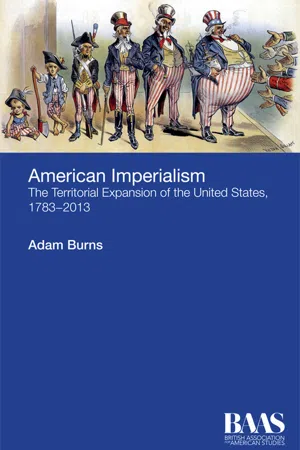
American Imperialism
The Territorial Expansion of the United States, 1783-2013
- Adam Burns(Author)
- 2017(Publication Date)
- Edinburgh University Press(Publisher)
This final US occupation of Cuba lasted through until 1922 , but the interven-tion was just the first of many US occupations following Theodore Roosevelt’s announcement of his corollary to the Monroe Doctrine. Similar US incursions followed in Nicaragua, Haiti and the Domini-can Republic. Like Cuba, all three of these republics had a history of US interest, but it was only in the early twentieth century that the occupation over annexation (1912–73) 139 United States actually occupied them. 10 These lengthy occupations augured a new form of US imperialism that came to dominate the twentieth century and beyond. Nicaragua US interests in Nicaragua can be traced back as far as Thomas Jefferson, who earmarked the territory in 1788 as the ideal place for a trans-isthmian canal. However, it was the nation’s instability following its independence from Spain in 1821 that led to the first ‘real’ US occupation in the 1850 s. This incursion was the result of a filibustering mission headed by an expansionist former newspaper editor from the United States, William Walker. Walker intervened in an internal Nicaraguan political dispute, and then usurped con-trol of the nation for several months. Ultimately, US businessman Cornelius Vanderbilt undermined Walker’s grip on power in order to frustrate leading business rivals who had supported the filibus-terer. This episode constituted Nicaragua’s first ‘dramatic encoun-ter’ with US imperialism. 11 However, 1912 proved to be the truly pivotal year for US-Nicaraguan relations when a short civil war in the Central American state led to the first full-scale US invasion, one that lasted longer than any other US intervention in Central America during the twentieth century. Prior to the renewal of US interventions from 1910 onwards, Mexico had acted as the main external power broker in Nicaragua. eBook - PDF
US-Grenada Relations
Revolution and Intervention in the Backyard
- G. Williams(Author)
- 2007(Publication Date)
- Palgrave Macmillan(Publisher)
Ominously, this was the first time US troops had intervened to restore order and prop up an established government. The troops remained until 1932. By default Washington became the arbiter of Nicaraguan politics and in an effort to establish stability got sucked further into the maelstrom. 17 Loan negotiations had left US bankers owning Nicaragua’s banks, customs, and 51 percent of the railways. 18 During the 20-year occupation Nicaragua was virtually run by Washington and American banks and troops. President Woodrow Wilson’s idealist and moralist convictions were manifested in his policy. He was strongly anti-imperialist and promised “the firm establish- ment of a foreign policy based upon justice and good will rather than upon mere commercial exploitation.” 19 Wilson felt that it was the duty of the United States to spread democracy, that regional unrest originated from problems such as poverty and oppression, and that intervention was counterproductive. Wilson believed that “revolutions would not occur when elections were held, constitutional provisions obeyed, and bad men removed from power.” 20 Military force would be used when necessary but as a civilizing force to guarantee political stability. 21 It is ironic that Wilson would prove to be the most interventionist president yet. In April 1914, US troops occupied the Mexican port of Veracruz after seven US sailors were arrested on shore leave. The United States had substantial busi- ness interests in Mexico, but relations between the two countries had faltered when Victoriano Huerta took control of the Mexican revolution in 1912. Wilson refused to recognize the Huerta regime as it had seized power by force. The Veracruz incident was the excuse Wilson had been waiting for; the occupa- tion helped to bankrupt Mexico’s government and ensured Huerta’s demise.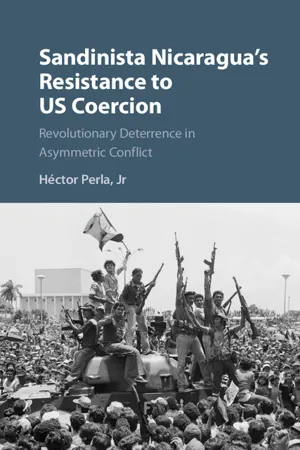 eBook - PDF
Sandinista Nicaragua's Resistance to US Coercion
Revolutionary Deterrence in Asymmetric Conflict
- Héctor Perla, Jr(Authors)
- 2017(Publication Date)
- Cambridge University Press(Publisher)
This event had a profound impact on Sandino. As he would later comment, witness- ing the soldiers kick Zeledon’s dead body made his “blood boil with rage.” 9 From 1912 until 1925, U.S. forces carried out a military occupation of Nicaragua to support a series of Conservative puppet regimes. 10 During that time the Bryan-Chamorro Treaty was signed in 1914 (which was ratified in 1916). The treaty gave the United States the exclusive right, in perpetuity, to build a canal in Nicaragua, a renewable ninety-nine-year lease to the Great and Little Corn Islands in the Caribbean, and a renewable ninety-nine-year option to establish a naval base in the Gulf of Fonseca. For this Nicaragua was paid $3 million, much of which was channeled toward paying the country’s U.S. creditors. In early 1926, only a few months after the withdrawal of U.S. troops the preceding August, the Liberals launched a renewed rebellion. To prevent the Liberal Party from returning to power the Conservatives once again requested U.S. military intervention. But unlike previous invasions, this time U.S. forces 6 Walker. 7 Quoted in Walker, 19. 8 Walker, 18. 9 Walker, 18. 10 John A. Booth, Christine J. Wade, Thomas W. Walker, Understanding Central America: Global Forces, Rebellion, and Change, 4th edn., Boulder, CO: Westview Press, 2006. The Somoza Period 23 arranged a truce and power-sharing scheme between the two parties, which resulted in the holding of elections in 1928 that were won by the Liberals. However, as part of the truce, the United States retained political control over many of the country’s most important institutions, such as the National Railway, the National Bank, and the High Commissioner of Customs that was in charge of Nicaraguan foreign exchange revenue. eBook - PDF
Understanding Central America
Global Forces, Rebellion, and Change
- John A. Booth, Christine J. Wade, Thomas W Walker(Authors)
- 2018(Publication Date)
- Routledge(Publisher)
The displaced peasants had few options except peonage on coffee plantations. When some of them rebelled in the War of the Comuneros of 1881, the elite-run government crushed the uprising by killing thousands. Coffee production that displaced peasant smallholdings accelerated under a modernizing Liberal dictator, José Santos Zelaya (1893–1909). Zelaya also built educational and governmental infrastructure (censuses, archives, a more modern army) and defended the interests of Nicaragua and Central America against a burgeoning imperialist urge in the United States. After the United States decided to build a trans-isthmian canal in Panama, Zelaya sought a ca-nal deal with US rivals Germany and Japan. To protect its canal monopoly, in 1909 the United States encouraged Zelaya’s Conservative opposition to rebel and then landed marines to protect the rebels. In 1909, Zelaya resigned and in 1910 the Liberals relinquished power to the minority Conservative Party. By 1912, however, the Conservatives performed so badly that a combined Liberal-Conservative rebellion occurred. That revolt was put down when US marines physically occupied Nicaragua. Historical Background 99 From most of the period from 1912 to 1933, the United States militarily occupied Nicaragua. US-dominated governments generally followed Wash-ington’s dictates, even when clearly contrary to Nicaraguan interests. The Chamorro-Bryan Treaty of 1916, for example, gave the United States rights to build a canal in Nicaragua. The Americans had no intention of constructing such a canal; they simply wanted to block competition for the US-built water-way just completed in Panama. In 1928, another puppet government under US pressure gave Colombia several important Nicaraguan islands, including San Andrés, to mollify Colombian resentment of the US role in taking Pan-ama from Colombia in 1903. eBook - PDF
Sugar and Power in the Dominican Republic
Eisenhower, Kennedy, and the Trujillos
- Michael R. Hall(Author)
- 2000(Publication Date)
- Praeger(Publisher)
The unstated strategic motive for the US occupation was the desire to protect the southern approaches to the United States and the Panama Canal from German aggression. President Wilson was US Policy, 1900-1957 41 concerned that hostile powers would seize on the Dominican Republic's chronic financial and political instability to the detriment of the US strategic position during World War I. According to Hennquez y Carvajal, "The United States having resolved to declare war on Germany anticipated the declaration by strengthening their position in the Caribbean in order to better guard the approaches to the Panama Canal and to prevent the establishment of submarine bases or the possibility of Germany's finding other aid in this region." 30 US Consul Clement S. Edwards confirmed Henrfquez's contention by asserting, "In view of the tremendous magnitude of the issues at stake in the Great War, the United States may reasonably claim justification for their action." 31 During its military occupation of the Dominican Republic, the United States attempted to bring a number of fundamental changes to the island nation's political, economic, and social life in the hope of creating a stable and cooperative neighbor that would safeguard US strategic and economic interests. Acknowledg- ing that the 1907 Convention was merely a financial instrument whose success was impeded by its inability to forestall, avoid, or remedy violent political disturbances, the US Marines decided to disarm the Dominican citizenry. From a population of 750,000, US military forces confiscated 50,000 firearms and 200,000 rounds of ammunition. 32 The creation of a theoretically apolitical and professionalized National Guard was another attempt to impose order and guarantee democracy. In April 1917, the United States established a constabulary led primarily by US military officers.
Index pages curate the most relevant extracts from our library of academic textbooks. They’ve been created using an in-house natural language model (NLM), each adding context and meaning to key research topics.

