History

Roosevelt Corollary
The Roosevelt Corollary was an addition to the Monroe Doctrine, asserting the right of the United States to intervene in the affairs of Latin American countries to prevent European intervention. It aimed to maintain stability and protect American interests in the region. The corollary significantly expanded the scope of U.S. involvement in Latin America and had a lasting impact on American foreign policy.
Written by Perlego with AI-assistance
Related key terms
1 of 5
11 Key excerpts on "Roosevelt Corollary"
 eBook - PDF
US-Grenada Relations
Revolution and Intervention in the Backyard
- G. Williams(Author)
- 2007(Publication Date)
- Palgrave Macmillan(Publisher)
10 The Roosevelt Corollary has contrastingly been seen as a logical update of the Monroe Doctrine or the transformation of a doctrine “intended for the protec- tion of the states of the New World against intervention from Europe into a doc- trine of intervention by the US.” 11 The Monroe Doctrine now had teeth. As Perez notes, the concept of “intervention as deviation,” with the United States keeping watch from afar and acting when things broke down, was an idea indica- tive of the sphere-of-influence perception of the region. 12 The Corollary was soon tested when the Cuban president Estrada Palma was fraudulently reelected in 1906. The opposition called for US intervention; Washington’s hope that the threat of intervention would ensure stability back- fired, as the opposition had used this threat hoping to change the political bal- ance. When the United States did not intervene, the opposition rebelled. Estrada now called upon US help, claiming he could not guarantee the safety of US nationals and property. 13 When Estrada resigned of his own volition, Roosevelt was forced to establish a provisional government and land 2,000 troops. The army kept peace and order, exercising what Langley terms “moral suzerainty.” 14 The rebels were disarmed and a Rural Guard established. The provisional gov- ernment rewrote electoral law and supervised honest elections. Despite these achievements the United States had to return to Cuba in 1912, 1917, and 1922 to suppress rebellions and protect nationals and property. President William Taft’s policy vision was to “substitute dollars for . . . bullets,” displacing the pound and reducing European claims whilst simultaneously pro- moting the United States’ interests and removing the need for intervention. However, “the success of dollar diplomacy rested on the willingness of private investors . . . to invest in the tropics.” 15 The policy often ended up promoting business interests at the cost of democratic and social development. eBook - PDF
Straight Power Concepts in the Middle East
US Foreign Policy, Israel and World History
- Gregory Harms(Author)
- 2010(Publication Date)
- Pluto Press(Publisher)
41 The second policy exemplifies this realistic, if self-evident, observation. Closer to home, Theodore Roosevelt’s administration (1901–09) was attempting to smooth out economic disagreements between Europe and various Gulf-Caribbean states, and issued what became known as the Roosevelt Corollary (to the Monroe Doctrine). Not only were Britain, Germany, and others reminded of the previ-ously existing Latin American doctrine, but Roosevelt’s 1904 message to the United States’ southern neighbors—“every country washed by the Caribbean Sea”—was both supplemental and rather unambiguous: Chronic wrongdoing, or an impotence which results in a general loosening of the ties of civilized society, may in America, as else-where, ultimately require intervention by some civilized nation, and in the Western Hemisphere the adherence of the United States to the Monroe Doctrine may force the United States, however reluctantly, in flagrant cases of such wrongdoing or impotence, to the exercise of an international police power. 42 Foreign economic intervention frequently disrupted a weaker country’s political stability. But the muscle that the president affixed to Monroe’s message made it clear that orderly compliance was expected, while ferment and revolution would force America’s hand as a “police power.” The Corollary had indeed added much heft to the 1823 original. “Roosevelt justified such intervention as only an exercise of ‘police’ power, but that term actually allowed U.S. presidents to intervene according to any criteria they were imaginative enough to devise,” Walter LaFeber points out in his standard account of US involvement in Central America. “In the end they could talk about ‘civilization,’ and ‘self-determination,’ eBook - ePub
- Phillip J. Cooper(Author)
- 2016(Publication Date)
- Routledge(Publisher)
At the time, the president’s warnings appeared primarily designed for European powers that might be contemplating an intrusion into Latin American affairs. However, President Theodore Roosevelt extended and sharpened the Monroe Doctrine in what has come to be known as the Roosevelt Corollary, so as to claim U.S. authority to intervene in Latin American countries when the U.S. considered it necessary.It is not true that the United States feels any land hunger or entertains any projects as regards the other nations of the Western Hemisphere save such as are for their welfare. All that this country desires is to see the neighboring countries stable, orderly, and prosperous. Any country whose people conduct themselves well can count upon our hearty friendship. If a nation shows that it knows how to act with reasonable efficiency and decency in social and political matters, if it keeps order and pays its obligations, it need fear no interference from the United States. Chronic wrongdoing, or an impotence which results in a general loosening of the ties of civilized society, may in America, as elsewhere, ultimately require intervention by some civilized nation, and in the Western Hemisphere the adherence of the United States to the Monroe Doctrine may force the United States, however reluctantly, in flagrant cases of such wrongdoing or impotence, to the exercise of an international police power. If every country washed by the Caribbean Sea would show the progress in stable and just civilization which with the aid of the Platt Amendment Cuba has shown since our troops left the island, and which so many of the republics in both Americas are constantly and brilliantly showing, all question of interference by this Nation with their affairs would be at an end. Our interests and those of our southern neighbors are in reality identical.… While they thus obey the primary laws of civilized society they may rest assured that they will be treated by us in a spirit of cordial and helpful sympathy. We would interfere with them only in the last resort, and then only if it became evident that their inability or unwillingness to do justice at home and abroad had violated the rights of the United States or had invited foreign aggression to the detriment of the entire body of American nations.… eBook - ePub
US Foreign Policy and Democracy Promotion
From Theodore Roosevelt to Barack Obama
- Michael Cox, Timothy J. Lynch, Nicolas Bouchet, Michael Cox, Timothy J. Lynch, Nicolas Bouchet(Authors)
- 2013(Publication Date)
- Routledge(Publisher)
24 But he was acutely aware that this action on his part had created a moral hazard. If the United States was determined to uphold the Monroe Doctrine, which prohibited European intervention against states in the Americas, did this not provide those nations with every incentive to run up bad debts under cover of a blanket American guarantee of protection against the consequences? In the Venezuelan case, the heat of crisis had allowed the United States to corral the government into arbitration to resolve the original dispute. But what of future such cases?It was the need to resolve this dilemma that gave rise to Roosevelt’s well-known ‘corollary’ to the Monroe Doctrine, which expanded the doctrine into the inter-ventionist’s charter that the term conjures today. The Roosevelt Corollary stated that since the United States was to be expected to defend Latin American states against European intervention in a crisis, it must be entitled to act preventively against any actions on their part that might provoke such a turn of events. This ideological quid pro quo served – from the American perspective, at least – to legitimize interventions on the part of the United States, including if necessary the use of force and the seizure of parts of a state’s financial apparatus, to ensure ‘sound’ management. This was the principle that underwrote what would become a pattern of recurring regional interventionism unfolding under Roosevelt and his successors, including interventions in Cuba, Nicaragua, Haiti and the Dominican Republic.Roosevelt’s conception of ‘civilization’, and his understanding of it as a progressive phenomenon in which some peoples were more advanced than others, played an important part in legitimizing this framework for hemispheric relations. The corollary was based on the idea that more advanced nations had a duty to monitor and educate those less developed. Under conditions where ‘chronic wrongdoing, or … impotence … results in a general loosening of the ties of civilized society’, Roosevelt argued, ‘intervention by some civilized nation’ would be entirely justified, and perhaps morally required. Within the area covered by the Monroe Doctrine this meant the ‘exercise of an international police power’ by the United States, ‘however reluctantly’. He was naturally eager to disavow any ‘land hunger’ on the part of the United States, insisting that any American intervention should be understood as serving the long-term interests of the nations affected. ‘All that this country desires is to see the neighbouring countries stable, orderly, and prosperous’, he professed.25 So long as ‘the reign of law and justice’ held sway within their borders and they obeyed ‘the primary laws of civilized society’, no Latin American state need fear interference.26 eBook - PDF
Guide to U.S. Foreign Policy
A Diplomatic History
- Robert J. McMahon, Thomas W. Zeiler, Robert J. McMahon, Thomas W. Zeiler(Authors)
- 2012(Publication Date)
- CQ Press(Publisher)
. . . Our interests and those of our southern neighbors are in reality identical. . . . While they thus obey the primary laws of civilized society they may rest assured that they will be treated by us in a spirit of cordial and helpful sympathy. We would interfere with them only in the last resort, and then only if it became evident that their inability or unwillingness to do justice at home and abroad had violated the rights of the United States or had invited foreign aggression to the detriment of the entire body of American nations. SOURCE: http://ourdocuments.gov/doc.php?doc = 56&page = transcript. President Theodore Roosevelt became increasingly concerned about European use of force in South America in order to force countries to pay their debts. He wanted to keep European military power out of the region and therefore proposed this extension of the Monroe Doctrine in 1904, which became known as the Roosevelt Corollary. If a nation shows that it knows how to act with reasonable efficiency and decency in social and political matters, if it keeps order and pays its obligations, it need fear no interference from the United States. Chronic wrongdoing, or an impotence which results in a general loosening of the ties of civilized society, may in America, as elsewhere, ultimately require intervention by some civilized nation, and in the Western Hemisphere the adherence of the United States to the Monroe Doctrine may force the SANTO DOMINGO AND THE Roosevelt Corollary When the Dominican Republican had trouble paying its loans, the situation was more complicated, but also more accommodating to Roosevelt’s ideas of how to keep Europe out and Central America in the U.S. sphere. In 1904, German, French, and U.S. business interests wanted assis-tance in having obligations met. The U.S. minister in Santo Domingo, William F. Powell, asked for governmental assis-tance to the American companies, using as rationale the likely involvement of the German government.
- Jerald A Combs(Author)
- 2015(Publication Date)
- Routledge(Publisher)
Roosevelt turned to a very different alternative. He declared that if worse came to worst, the United States itself would intervene in Latin America to see that Latin American nations behaved justly toward their European creditors. U.S. intervention would eliminate any pretext for European intervention. This policy of “preventive intervention” became known as the Roosevelt Corollary to the Monroe Doctrine.The occasion for Roosevelt’s announcement was a crisis in the Dominican Republic. The Dominican Republic was the scene of continuous political and economic chaos. In seventy years, it had had nineteen revolutions and fifty-three presidents. The latest civil war had broken out in 1903, while European creditors were clamoring for payment of their debts and their war vessels sailed Dominican waters. In 1904, the harassed Dominican president asked the United States to intervene by sending arms, guaranteeing Dominican sovereignty, and paying its debts. Roosevelt had no desire for a new territory. He said he would as soon annex the island as “swallow a porcupine wrong-end-to.”He suggested that the United States take over Dominican customs collections, pay off creditors, and turn the remainder of the revenue over to the Dominican government. The suspicious Dominicans accepted out of fear of the Europeans, but the U.S. Senate recoiled after hearing Roosevelt claim that in cases of “chronic wrongdoing, or impotence” among Western Hemisphere nations, the United States “however reluctantly” would have to exercise “an international police power.” Roosevelt seemed ready to extend the Platt Amendment to the whole of the Caribbean and Central America.Roosevelt established the Dominican customs house receivership on his own authority until the balky Senate finally accepted the treaty with the Dominican Republic in 1907. Yet he hoped to keep the intervention limited and to avoid any further ones. He managed to do so until the end of his term; his successors were not so fortunate. eBook - PDF
America's Road to Empire
Foreign Policy from Independence to World War One
- Piero Gleijeses(Author)
- 2021(Publication Date)
- Bloomsbury Academic(Publisher)
The terms were so draconian that the Panamanian junta protested, in vain. The Colombians seethed, impotent. In 1906, the US minister in Bogotá wrote to Secretary of State Root that “you could not realize how strong still was the feeling, amounting almost to intense hatred, among the people of Colombia against the United States.” 32 After midwifing the Panamanian Republic, Roosevelt announced that Washington would no longer allow the Europeans to resort to gunboat diplomacy to recover their debts from Latin American countries, however justified their claims. This meant, he wrote to Root in June 1904, that “sooner or later we must keep order ourselves.” 33 In his December 1904 State of the Union address, Roosevelt asserted that “Chronic wrongdoing . . . may in America, as elsewhere, ultimately require intervention by some civilized nation, and in the Western Hemisphere the adherence of the United States to the Monroe Doctrine may force the United States, however reluctantly, in flagrant cases of such wrongdoing or impotence, to the exercise of an international police power.” 34 The Roosevelt Corollary to the Monroe Doctrine was born. Because the United States would not allow European powers to use force to recover debts from Latin American countries, it would intervene on their behalf. In April 1905, the Dominican government, which owed money to several European countries, agreed to the establishment of the US receivership of the Dominican customs, despite strong domestic opposition. The presence of two US warships in the harbor of Santo Domingo throughout the negotiations had, a US offi cial noted, “a powerful moral effect on the rash and ignorant elements,” that is, on the Dominican masses. 35 The next major step was taken by President Taft. US offi cials accused Nicaragua’s dictator José Santos Zelaya of meddling in the internal affairs of his neighbors, but his eBook - PDF
U.S. Foreign Policy
A Documentary and Reference Guide
- Akis Kalaitzidis, Gregory W. Streich(Authors)
- 2011(Publication Date)
- Greenwood(Publisher)
But in extreme cases action may be justifiable and proper. What form the action shall take must depend upon the circumstances of the case; that is, upon the degree of the atrocity and upon our power to remedy it. The cases in which we could interfere by force of arms as we interfered to put a stop to intolerable con- ditions in Cuba are necessarily very few. Yet it is not to be expected that a people like ours, which in spite of certain very obvious shortcomings, nevertheless as a whole shows by its consistent practice its belief in the principles of civil and religious liberty and of orderly freedom, a people among whom even the worst crime, like the crime of lynching, is never more than sporadic, so that individuals and not classes are molested in their fundamental rights—it is inevi- table that such a nation should desire eagerly to give expression to its horror on an occasion like that of the massacre of the Jews in Kishenef, or when it wit- nesses such systematic and long-extended cruelty and oppression as the cruelty and oppression of which the Armenians have been the victims, and which have won for them the indignant pity of the civilized world. 60 U.S. Foreign Policy Did You Know? The Roosevelt Corollary In 1904 the Dominican Republic was bankrupt, and President Teddy Roosevelt worried that countries such as Germany would intervene to collect their debts. Roosevelt issued his “corollary” when in 1904 he told Congress that “Chronic wrongdoing . . . may in America, as elsewhere, ultimately require intervention by some civilized nation, and in the Western Hemisphere the adherence of the United States to the Monroe Doctrine may force the United States, however reluctantly, in flagrant cases of such wrongdoing or impotence, to the exercise of an international police power.” With that, the United States intervened in the Dominican Republic and took over its customs collections to pay its foreign debts. The Roosevelt Corollary was also used to justify U.S.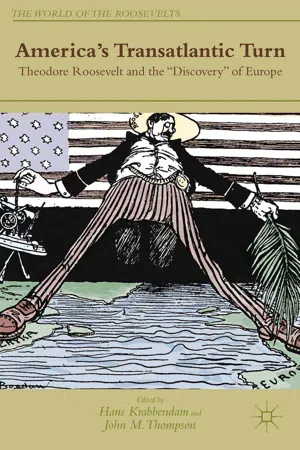 eBook - PDF
America's Transatlantic Turn
Theodore Roosevelt and the "Discovery" of Europe
- H. Krabbendam, J. Thompson, H. Krabbendam, J. Thompson(Authors)
- 2012(Publication Date)
- Palgrave Macmillan(Publisher)
This trait had a profound impact on the thinking of TR and his advisors. Foremost on the list of potentially incendiary issues was the Monroe Doctrine, a fact that was highlighted during the blockade of Venezuela in 1902 by Britain and Germany. Displeasure in the American Venezuela in 1902 by Britain and Germany. Displeasure in the American J o h n M . T h o m p s o n 56 press and Congress over a perceived threat to the Monroe Doctrine (along with his concerns about Germany’s possible imperial ambitions in Latin with his concerns about Germany’s possible imperial ambitions in Latin America and his ideas about the need for “civilized” nations to uplift their America and his ideas about the need for “civilized” nations to uplif t their less advanced neighbors) prompted TR to begin to rethink his understand- ing of President Monroe’s famous axiom and led to his formulation of the Roosevelt Corollar y . 11 But forbidding European interventions in Latin America was one thing; developing capability to enforce such a policy, not to mention the politi- cal support to sustain it, was another. Throughout his tenure as President, Roosevelt complained of the tendency of many in the press, Congress, and broader public to talk tough but refuse to allow him and other policymak- ers to take the steps necessary to backstop such rhetoric, what he called the tendency to “combine the unready hand with the unbridled tongue.” The bruising fight in Congress in 1908 over his calls for an increased rate of naval expansion in order to keep pace with Europe and Japan, in the midst of an upsurge of anti-Japanese rhetoric on the West Coast, was only one more example of this problem, he believed. 12 Ethnic Entanglements Another constraint on Roosevelt’s ability to formulate policy was to be Another constraint on Roosevelt’s ability to formulate policy was to be found in the politics of ethnicity. eBook - PDF
My Fellow Americans
Presidential Addresses That Shaped History
- James C. Humes(Author)
- 1992(Publication Date)
- Praeger(Publisher)
. . His staccato delivery, which clipped off the consonants, became even more pronounced as Roosevelt quickly bore into the heart of the message: Our nation has insisted that because of its primacy in strength among the nations of the Western Hemisphere it has certain duties and responsibilities which oblige it to take a leading part thereon. And then his voice rose in pitch. The Big Stick 105 We hold that our interests in this hemisphere are greater than those of any European power possibly can be, and that our duty to ourselves and to the weaker republics who are our neighbors requires us to see that none of the great military powers from across the seas shall encroach upon the territory of the American republics or acquire control thereover. The audience enthusiastically roared their approval to Roosevelt's broad- ening of the Monroe Doctrine. With the operative words "encroach" and "control," Roosevelt widened the application of the doctrine. N o more did "interference" or "settlement" define the nature of intolerable European involvement. Any military action in the Western Hemisphere that would lead to a takeover or effective dom- inance of a nation's government would justify the United States in invoking the doctrine. This policy, therefore, not only forbids us to acquiesce in such territorial acquisition, but also causes us to object to the acquirement of a control which would in its effect be equal to territorial aggrandizement. Roosevelt paused to let the audience endorse his statement with their hands, then he moved to the proposed Panama Canal project. By impli- cation, he seemed to be suggesting to his audience the dangers to our interests if a European country installed a naval base within sailing reach. eBook - PDF
The Geopolitics of Security in the Americas
Hemispheric Denial from Monroe to Clinton
- Martin Sicker(Author)
- 2001(Publication Date)
- Praeger(Publisher)
xiv. 6. Cited in Abraham F. Lowenthal, ed., Exporting Democracy: The United States and Latin America, Themes and Issues, p. 13. 7. Arthur S. Link, Wilson, vol. 2., p. 387. 8. Franz Rintelen von Kleist, The Dark Invader, p. 175. 9. Ibid., p. 177. 10. Cited in P. Edward Haley, Revolution and Intervention: The Diplomacy of Taft and Wilson with Mexico, 1910–1917, pp. 183–84. 11. Foreign Relations of the United States, 1916, pp. 480–81. 12. Joseph P. Tumulty, Woodrow Wilson As I Know Him, pp. 159–60. 13. The decoded telegram cited here is from Decimal File 862.20212/69 (1910–1929), General Records of the Department of State, Record Group 59, and is quoted from the National Archives and Records Administration’s Web site ttp://www.nara.gov/education/teaching/zimmermann/zimmerma.html. 14. Foreign Relations of the United States, 1917, supplement 1, pp. 238–39. 15. Blasier, Hovering Giant, p. 115. 16. Charles Evans Hughes, “Recent Questions in Negotiations,” pp. 235–36. Page 85 5 The Doctrine of Nonintervention and Collective Security, 1923–1945 The problems of U.S. unilateralism continued to color interAmerican relations in the years that followed World War I. The Latin American response to U.S. policy was dismay, a determination to find a means of curbing what it perceived to be unrestrained use of power, and a simmering anti–U.S. bias that has lingered to this day. The Roosevelt Corollary seemed to imply that the sovereignty of the Latin American states was deficient and that these independent nations were in continual danger of being reduced to U.S. protectorates. The only practical option available to the Latin American states was to seek the development of an interAmerican system that would place constraints on the exercise of its power by the United States. The Fifth InterAmerican Conference, scheduled for 1914, had been postponed because of the war and was subsequently convened in Santiago, Chile, in March 1923.
Index pages curate the most relevant extracts from our library of academic textbooks. They’ve been created using an in-house natural language model (NLM), each adding context and meaning to key research topics.

