History

Monroe Doctrine
The Monroe Doctrine was a U.S. foreign policy introduced in 1823 by President James Monroe. It aimed to prevent European powers from further colonizing or interfering in the Americas. The doctrine asserted that any such interference would be viewed as a threat to U.S. security. It became a key principle in American foreign policy and had a significant impact on the geopolitics of the Western Hemisphere.
Written by Perlego with AI-assistance
Related key terms
1 of 5
12 Key excerpts on "Monroe Doctrine"
 eBook - ePub
Nineteenth Century America in the Society of States
Reluctant Power
- Cornelia Navari, Yannis A. Stivachtis, Cornelia Navari, Yannis A. Stivachtis(Authors)
- 2023(Publication Date)
- Routledge(Publisher)
Deudney, 2019 ). Except on the question of its hemispheric scale, perhaps, it also fails the test of being an international idea of particularly American provenance. Nor, however, does a survey of the doctrine simply provide corroborative evidence for the Realist view of ideas as cudgels, taken up and put down again as needed in the pursuit of power and interests. What it does do is provide us with a useful reminder of the English School’s insight into the complex relations which exist between people, ideas, and actions. The Monroe Doctrine appears at intervals in the history of American foreign relations in a variety of guises—geographical, civilizational, ideological, and geopolitical—promoted by different people and states for different purposes and with different consequences. While it never dominates, however, it never entirely disappears because the Monroe Doctrine and thinking in doctrinal terms are both deeply woven into not how Americans see the world but how they see themselves. This being so, the doctrine is better thought of as an expression of foreign policy and the way it is justified rather than as a contribution to international life and the terms on which it is undertaken.Origins
The Monroe Doctrine,1 although it was not identified as such for another quarter century, received its first articulation in 1823, when President Monroe declared to Congress that the people of1 Sources for the Monroe Doctrine include DeConde, A., (1963). A History of American Foreign Policy. New York, NY, Scribner; Merrill, D. and Patterson, T.G. (Eds.). (2010). Major Problems in American Foreign Relations (7th edition). Boston, MA, Cengage Learning; Perkins, D. (1955). A History of the Monroe Doctrine. New York, NY, Little, Brown; Pratt, J.W. (1967). A History of American Foreign Policy. New York, NY, Routledge; and Sexton, J. (2011). The Monroe Doctrine. New York, NY, Hill and Wang.the American Continents, by the free and independent condition which they have assumed and maintain, are henceforth not to be considered as subjects for future colonization by a European power [and that the United States] should consider any attempt on their part to extend their system to any portions of this hemisphere, as dangerous to our peace and safety.Monroe went on to add that the United States had not interfered with “the existing Colonies or dependencies of any European power” but that any European attempt to oppress or control the destiny of states whose independence the American government had acknowledged could not be viewed “in any other light than as the manifestation of an unfriendly disposition towards the United States” (Sexton, 2011 ). The immediate prompts for his statement were the upheaval in South America caused by the struggles for independence from the Spanish Empire of its colonies there, together with an inquiry by the European great powers in the form of the Holy Alliance between Russia, Prussia, and Austria, regarding America’s position on their possible intervention in support of Spain. The Americans were concerned that Spain’s position in South America might be restored. They were even more concerned, however, that the great powers’ interventions in the concurrent revolutions in Greece and Spain itself would provide models for them becoming directly involved in the Western Hemisphere. There, the Americans argued, there should be no new colonization or re-colonization, no new interventions, and no transfers of territories from one European power to another (DeConde, 1963 eBook - PDF
Borders and Bridges
A History of U.S.-Latin American Relations
- Stewart Brewer(Author)
- 2006(Publication Date)
- Praeger(Publisher)
In the long run, the significance of the Monroe Doctrine cannot be overstated. It became the foundation for U.S.–Latin American diplomatic and military interactions for the rest of the nineteenth century and most of the twentieth century as well. And even though it did not prevent the powers of Western Europe from interfering in the western hemisphere, it did serve as a vehicle for emergent U.S. imperialism because it could be—and indeed was—modified frequently by U.S. leaders according to the needs of the moment. Nevertheless, soon after Monroe’s statement was issued, and the fallout quieted down, the issue and indeed the statement itself were both forgot- ten about for several decades. The document was not called the Monroe Doctrine until the 1840s and 1850s, and not seriously and systematically implemented until after the U.S. Civil War. Even so, this statement in 1823 was the first major step taken by the United States to establish itself as a major hemispheric and world power. THE MAKING OF MANIFEST DESTINY During the early 1800s Americans began to develop a keen sense of their own importance in world affairs. Perhaps this developing sense of con- sequence in the United States further explains why a U.S. president would dare to make such a bold statement as the Monroe Doctrine. Another di- rection that these attitudes took was down the path to what was referred to then and now as Manifest Destiny. 42 Borders and Bridges Prevalent at the time in the United States was the idea that the Amer- ican people were destined to fulfill some future greatness—the notion that racially, religiously, economically, and certainly politically, the United States of America represented the vanguard of a brave new world, and all nations would benefit from interaction with the United States. eBook - PDF
- R. J. Vincent(Author)
- 2015(Publication Date)
- Princeton University Press(Publisher)
Hi. The Function of the Principle of Nonintervention in American Foreign Policy Nonintervention was a doctrine the United States proclaimed for herself, and a policy she followed with afidelitythat varied accord- ing to time, place, and circumstance. This section will point out the part played by the principle of nonintervention as a doctrine which the United States would have others adhere to, as a princi- ple in terms of which the actions of others were criticized and the policy of the United States defended and as a landmark of the domestic debate about foreign policy in the United States. A. GUIDANCE AND COERCION As well as taking the nonintervention principle as one of the standards which informed her own conduct of foreign affairs, the United States wished to encourage others, and especially Euro- peans, to abide by it. This objective could be pursued in three ways. In the first place, other states could be warned off interven- tion in the American hemisphere by the threat, however credi- ble or explicitly stated, of counter-intervention. Second, the rule could be upheld by counterintervention against the power which had ignored the warning. In the third place, the intervention of outside powers could be forestalled by the preventive intervention of the United States. In time, the Monroe Doctrine came to be associated with each of these policies; its original concern was confined to the first of them. Monroe's message of 1823 stated that the interposition of any 273 Wood, pp. 159-167. 130 PRACTICE European power for the purpose of oppressing or controlling the destiny of the newly independent Latin American states would be viewed as a manifestation of an unfriendly disposition toward the United States. There was no direct threat of counterintervention here, and Adams preferred to rely upon his notion of reciprocity. eBook - ePub
America's Backyard
The United States and Latin America from the Monroe Doctrine to the War on Terror
- Grace Livingstone(Author)
- 2013(Publication Date)
- Zed Books(Publisher)
criollo ). The independence leaders were inspired by the Enlightenment, but they found it impossible to build their idealized republics in countries that had virtually no middle class, and instead sported small, quarrelsome oligarchies who feared and loathed the poor and uneducated masses. Post-independence governance fluctuated between bouts of fragile constitutional rule and authoritarianism, and all governments faced regular budget crises because most inhabitants were too poor to tax. These countries were easy prey for a new generation of colonialists. European powers in particular sought markets, raw materials, investment opportunities, land and trade routes.The Monroe Doctrine and Manifest DestinyPresident James Monroe warned the European powers in 1823 that any incursions into the Western Hemisphere would be considered a threat to the peace and safety of the United States itself. Britain, France and Russia, as well as Spain, all were interested in Latin America’s land, labour and raw materials. Britain, at the peak of its imperial might, sought new markets and strategic ports in the region. At the time, President Monroe’s speech was essentially a defensive, isolationist statement, but the Monroe Doctrine, as it became known, was later used as a justification for US intervention in Latin America.The Monroe Doctrine, 1823 ‘American continents, by the free and independent condition which they have assumed and maintain, are henceforth not to be considered as subjects for future colonization by any European powers …We owe it, therefore, to candor and to the amicable relations existing between the United States and those powers to declare that we should consider any attempt on their part to extend their system to any portion of this hemisphere as dangerous to our peace and safety. With the existing colonies or dependences of any European power we have not interfered and shall not interfere.’ eBook - ePub
No Higher Law
American Foreign Policy and the Western Hemisphere since 1776
- Brian Loveman(Author)
- 2010(Publication Date)
- The University of North Carolina Press(Publisher)
For years, the European powers and the Spanish Americans would take little practical notice of Monroe’s claim to an American protectorate over the hemisphere. If Americans gradually came to believe that the Monroe Doctrine established principles or even rights in international law, Europeans thought less of it. As the British and the Americans contested commercial privileges and political influence during the next half century, British diplomatic correspondence repeatedly revealed the low opinion held for America’s unilateralism and the challenges it raised for international law and to European possessions in the region — but also the extent to which the Monroe Doctrine became patriotic pulp for domestic politics in the United States. In private correspondence to Lord Clarendon in 1853 regarding American regional policy and tolerance for filibustering operations in Cuba, England’s chief diplomat in Washington, D.C., wrote:By eternal repetition this so-called doctrine is gradually becoming, in the minds of the Democracy here, one of those habitual maxims which are no longer reasoned upon but felt, and any imagined “violation of the Monroe Doctrine” is now vehemently taken up as a just reason for peremptory demand for satisfaction from any Foreign Power who may have committed it.Now altho’ I know that a great deal of this language is held for home political purposes, each party out-bidding the other in its offer of “Americanism,” still it cannot be denied that a very dangerous effect is produced upon the Masses by such doctrines, and it becomes a very grave question what position Foreign Powers ought to adopt in regard to them. It seems to me quite clear that if carried out to their full effect, we should be forced to resist them somewhere, and the question remains as to the point at which it would be advisable to make a stand.52By the 1840s, an expanded Monroe Doctrine had become a foundation of American foreign policy but also a bipartisan pillar of jingoism in American politics. As a unilateral doctrine aimed at European powers, its meaning, the circumstances when it would be applied, and its reach were strictly matters for U.S. policymakers to decide as they sought for America to command its own fortune and the fortune of the Western Hemisphere.The First American Protectorate and the Central American Isthmus
Dreams, schemes, and failed projects that aimed at constructing a canal across the Central American isthmus dated from Spanish conquest. From the 1780s into the 1830s, European and American visionaries and entrepreneurs periodically resurrected the canal dream.53 American policymakers looked toward Panama, Tehuantepec (Mexico), and Nicaragua with increased interest. With a trans-isthmian route in mind, American presidents and Congress encouraged exploratory expeditions to Central America. Notably, a Senate resolution in 1835 requested that President Andrew Jackson “consider the expediency of entering negotiations” with Central American governments and New Grenada (Colombia), with regard to its northern province (Panama) to secure “forever… the free and equal right of navigating such a canal [across the Central American isthmus] to all such nations, on the payment of such reasonable tolls as may be established, to compensate the capitalists who may engage in such an undertaking and complete the work.”54 eBook - ePub
Latin America and the United States
Addresses by Elihu Root
- Elihu Root, Robert Bacon, James Brown Scott, (Authors)
- 2009(Publication Date)
- Perlego(Publisher)
The international importance achieved by your government and your country had its beginning when President Monroe gave to the world his famous doctrine, so debated, so misunderstood, and perhaps so dangerous, if—as has sometimes been thought—it might be used as a means of illegitimate preponderance at the expense of the sovereignty of other nations. The Monroe Doctrine embodies, nevertheless, and we should not hesitate to say so, the first principle of international law of a great part of this continent, if not the whole. This it means for us Mexicans, ever since the President of the Republic announced it to Congress in his memorable message of April, 1896, received with general acclamation by the national representatives, and later by the whole country. The integrity of the nations of this continent is of vital interest to all, collectively, and not alone to the country immediately affected. Any attack on this integrity should constitute an offense in the eyes of the other nations of America. Accordingly, one of our great thinkers and statesmen has wisely said: "America for Americans means each country for its own people, to the exclusion of all foreign interference, whether this comes from other countries of this continent or whether it comes from any other nation whatsoever. And we in our trying struggles of the past have given ample proof to the whole world of our homage to independence and our hatred of all foreign intervention"—to use President Díaz's own words.From among the various formulas adopted by the interpreters of the Monroe Doctrine, we Latin American nations should gather and keep as a precious pledge, that which Theodore Roosevelt embodied in his famous speech delivered on the occasion of the opening of the Buffalo Exposition. Addressing the republics of the New World, the illustrious statesman, then Vice-President of the United States of America, said: Passage contains an image I believe with all my heart in the Monroe Doctrine. This doctrine is not to be invoked for the aggrandizement of any one of us here on this continent at the expense of any one else on this continent. It should be regarded simply as a great international Pan American policy, vital to the interests of all of us. The United States has and ought to have, and must ever have, only the desire to see her sister commonwealths in the western hemisphere continue to flourish, and the determination that no Old World power shall acquire new territory here on this western continent. We of the two Americas must be left to work out our own salvation along our own lines; and if we are wise we will make it understood as a cardinal feature of our joint foreign policy that, on the one hand, we will not submit to territorial aggrandizement on this continent by any Old World power, and that, on the other hand, among ourselves each nation must scrupulously regard the rights and interests of the others, so that, instead of any one of us committing the criminal folly of trying to rise at the expense of our neighbors, we shall all strive upward in honest and manly brotherhood, shoulder to shoulder.
 eBook - PDF
The Arrow and the Olive Branch
Practical Idealism in U.S. Foreign Policy
- Jack Godwin, John M. Godwin(Authors)
- 2007(Publication Date)
- Praeger(Publisher)
••• In early September 1901, slightly more than a year after the Boxer Rebellion was crushed, McKinley was visiting the Pan-American Exposition in Buffalo, New York. When an alleged anarchist shot and killed McKinley, Vice President Theodore Roosevelt, veteran of the Spanish-American War became president. In Roosevelt’s first annual message in 1901, a few short weeks following his ascension to the presidency, and seventy-eight years since Monroe announced the doctrine bearing his name, Roosevelt asserted the Monroe Doctrine would continue to be the ‘‘cardinal feature’’ of the United States’ foreign policy. Roosevelt went a little further than Monroe intended, however, when he said this should also be the foreign policy of every other nation in the Western Hemisphere. What Roosevelt means by this is every North and South American nation should respect their neighbors’ territorial rights. The nineteenth century political maps of Europe were redrawn with such frequency there was hardly time for the ink to dry, and Roosevelt wanted to safeguard the independence of the smaller Central and South American countries. Roosevelt expanded the Monroe Doctrine to include the basic premise of the open door policy, which would ensure equal access of every American nation to every American market. In principle, Roosevelt’s conception would establish a hemispheric free trade area, not to acquire exclusive rights for U.S.-made goods, but to guarantee ‘‘the commercial independence of the Americas.’’ Meanwhile, the United States negotiated a treaty with Columbia in 1902 to acquire control of a six-mile-wide strip of Columbia’s isthmus, or ‘‘Panama Territory.’’ In consideration, the United States agreed to pay Colombia ten million dollars, plus an annual payment of two hundred fifty thousand dollars for a 100-year lease. Soon afterward, Panama declared its independence from Colombia and sought recognition from the United States. eBook - PDF
Straight Power Concepts in the Middle East
US Foreign Policy, Israel and World History
- Gregory Harms(Author)
- 2010(Publication Date)
- Pluto Press(Publisher)
41 The second policy exemplifies this realistic, if self-evident, observation. Closer to home, Theodore Roosevelt’s administration (1901–09) was attempting to smooth out economic disagreements between Europe and various Gulf-Caribbean states, and issued what became known as the Roosevelt Corollary (to the Monroe Doctrine). Not only were Britain, Germany, and others reminded of the previ-ously existing Latin American doctrine, but Roosevelt’s 1904 message to the United States’ southern neighbors—“every country washed by the Caribbean Sea”—was both supplemental and rather unambiguous: Chronic wrongdoing, or an impotence which results in a general loosening of the ties of civilized society, may in America, as else-where, ultimately require intervention by some civilized nation, and in the Western Hemisphere the adherence of the United States to the Monroe Doctrine may force the United States, however reluctantly, in flagrant cases of such wrongdoing or impotence, to the exercise of an international police power. 42 Foreign economic intervention frequently disrupted a weaker country’s political stability. But the muscle that the president affixed to Monroe’s message made it clear that orderly compliance was expected, while ferment and revolution would force America’s hand as a “police power.” The Corollary had indeed added much heft to the 1823 original. “Roosevelt justified such intervention as only an exercise of ‘police’ power, but that term actually allowed U.S. presidents to intervene according to any criteria they were imaginative enough to devise,” Walter LaFeber points out in his standard account of US involvement in Central America. “In the end they could talk about ‘civilization,’ and ‘self-determination,’ eBook - PDF
Belligerents, Brinkmanship, and the Big Stick
A Historical Encyclopedia of American Diplomatic Concepts
- John M. Dobson(Author)
- 2009(Publication Date)
- ABC-CLIO(Publisher)
We are now concerned, therefore, only with that other practical application of the Monroe Doctrine, the disregard of which by an European power is to be deemed an act of unfriendliness towards the United States. . . . The rule in question has but a single purpose and object. It is that no European power or combination of European powers shall forcibly deprive an American state of the right and power of self-govern- ment and of shaping for itself its own political fortunes and destinies. . . . Is it true, then, that the safety and welfare of the United States are so concerned with the maintenance of the independence of every American state as against any European power as to justify and require the interposition of the United States when- ever that independence is endangered? The question can be candidly answered in but one way. The states of America, South as well as North, by geographical proximity, by natural sympathy, by similarity of governmental constitutions, are friends and allies, commercially and politically, of the United States. To allow the subjugation of any of them by an European power is, of course, to completely reverse that situation and sig- nifies the loss of all the advantages incident to their natural relations to us. . . . Today the United States is practically sovereign on this continent, and its fiat is law upon the subjects to which it confines its interposition. Why? It is not because of the pure friendship or good will felt for it. It is not simply by reason of its high character as a civilized state, nor because wisdom and justice and equity are the invariable char- acteristics of the dealings of the United States. It is because, in addition to all other grounds, its infinite resources combined with its isolated position render it master of the situation and practically invulnerable as against any or all other powers. eBook - PDF
Castlereagh and Adams
England and the United States 1812-1823
- Bradford Perkins(Author)
- 2023(Publication Date)
- University of California Press(Publisher)
20, 1823, FO 5/177. 334 T H E M O N R O E D O C T R I N E antirepublican endeavors everywhere—in Greece, in Spain, in Italy, in Latin America—upset Adams, who successfully urged the President to tone down denunciations of purely European activi- ties, to promise to abstain from European politics, and to concen- trate his fire against outside intervention in the New World. Speaking past Congress to the allies James Monroe wrote: W e owe it . . . to candor, and to the amicable relations existing between the United States and those powers, to declare that we should consider any attempt on their part to extend their system to any portion of this hemisphere as dangerous to our peace and security. . . . With the Governments who have declared their independence and maintained it, . . . we could not view any interposition . . . by any European power, in any other light than as the manifestation of an unfriendly disposition toward the United States. . . . It is impossible that the allied powers should extend their political system to any portion of either continent without endangering our peace and happi- ness; nor can anyone believe that our southern brethren, if left to them- selves, would adopt it of their own accord. It is equally impossible, therefore, that we should behold such interposition, in any form, with indifference. 1 * Thus was phrased the third tenet of Monroe's famous message, the nonintervention doctrine. Secretary Adams, who approved the final version of Monroe's message, altered his draft reply to Tuyll to correspond with it and considered the result a "firm, spirited, and yet conciliatory answer to all the communications lately received from the Russian Gov- ernment, and at the same time an unequivocal answer to the pro- posals made by Mr. Canning to Mr. Rush." Calhoun considered the note far from conciliatory and wanted to eliminate it alto- gether, merely sending the presidential message to Tuyll.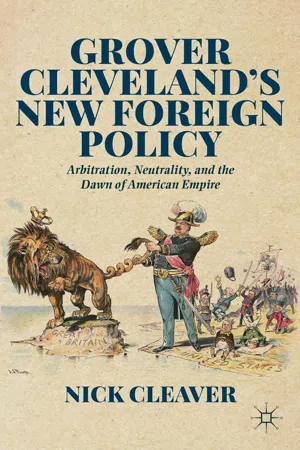 eBook - ePub
Grover Cleveland's New Foreign Policy
Arbitration, Neutrality, and the Dawn of American Empire
- N. Cleaver(Author)
- 2014(Publication Date)
- Palgrave Macmillan(Publisher)
This raises an important contradiction in the Cleveland administration’s foreign policy, a policy that occasionally demonstrated an assertiveness bordering on paternalism in Latin American affairs while simultaneously endeavoring to undermine European imperialism in the region. This complicated balance between the rights and interests of the United States, European powers, and American nations would be a recurring factor in the administration’s dealings with Nicaragua, Venezuela, and Cuba. The late nineteenth century had already seen Central American nations invoke the Monroe Doctrine while appealing to the United States for help in disputes with European powers (as illustrated by Nicaragua itself in 1888). By actively asserting the Monroe Doctrine, Gresham and Cleveland essentially placed the United States in the position of regional hegemon, if a benign and conservative one. Whether this constitutes imperialism is then a matter of definition, since a lack of desire to directly influence the actions of other governments in the Americas did not negate a paternalistic stance toward those governments. However one chooses to define the policy, once again it can clearly be seen as an attempt by Cleveland and Gresham to set out their shared vision of how American power should be applied to defend the traditional U.S. sphere of influence in the western hemisphere. This would be even more starkly demonstrated in relation to Venezuela the next year. Further evidence of Gresham’s determination to defend—and perhaps even reinvigorate—the Monroe Doctrine can be seen in his next exchange with Bayard eBook - PDF
The Geopolitics of Security in the Americas
Hemispheric Denial from Monroe to Clinton
- Martin Sicker(Author)
- 2001(Publication Date)
- Praeger(Publisher)
A nation whose foreign policy aims at acquiring more power than it actually has through expansion of its power beyond its frontiers, whose foreign policy, in other words, seeks a favorable change in power status, pursues a policy of imperialism. A nation whose foreign policy aims to demonstrate the power it has, either for the purpose of maintaining or increasing it, pursues a policy of prestige. 3 It is noteworthy that in this scheme there is no provision for power projection based on nonpolitical factors such as those usually reflected in the often cynical but ostensibly pious justifications offered by statesmen. It seems quite evident that, during the course of its history, the United States has pursued each of these types of foreign policies, occasionally two or more of them at the same time. Thus, it proclaimed the Monroe Doctrine, a clearly status quo policy with respect to Europe, at the same time that it was pursuing a policy of imperialist expansion in North America. However, it is worth bearing in mind, as Morgenthau argued, that territorial expansion does not in itself necessarily imply a foreign policy of imperialism as long as the territory acquired does not fundamentally alter the balance of power between the states concerned. 4 An example of this was the U.S. acquisition of Alaska from Russia in 1867, which did not change the relative power balance between them because of the relative inaccessibility of Alaska to Russia under the prevailing state of communications and transportation in the nineteenth century. Similarly, the acquisition of the Virgin Islands from Denmark in 1917 did not change the status quo between the United States and the Central American states; however, it did significantly improve the U.S. strategic position with regard to the defense of the Panama Canal.
Index pages curate the most relevant extracts from our library of academic textbooks. They’ve been created using an in-house natural language model (NLM), each adding context and meaning to key research topics.

