History

Truman Doctrine
The Truman Doctrine was a foreign policy initiative announced by U.S. President Harry Truman in 1947. It aimed to contain the spread of communism by providing economic and military aid to countries threatened by communist expansion. This doctrine marked a significant shift in U.S. foreign policy, signaling a commitment to actively opposing the spread of communism globally.
Written by Perlego with AI-assistance
Related key terms
1 of 5
10 Key excerpts on "Truman Doctrine"
 eBook - PDF
US Foreign Policy in the Middle East
The Case for Continuity
- Bledar Prifti(Author)
- 2017(Publication Date)
- Palgrave Macmillan(Publisher)
As mentioned previously, these doctrines were selected not only because they have dealt with important geostrategic developments in THE COLD WAR AND THE TRUMANIZATION OF US FOREIGN POLICY... 62 the Middle East but also because they can be used to control other variables that may impact foreign policy. For example, these doctrines control the temporal factor and other factors related to it as each doc- trine was launched at a particular moment in US history. The Truman Doctrine was launched soon after the end of WWII and the use of the atomic bombs against Japan; the Eisenhower Doctrine was launched in response to the demise of Great Britain and France as world leaders; the Nixon Doctrine was a response to the national shock created by the Vietnam War; and so on. But more importantly, these doctrines con- trol the variables at the individual level of analysis, including personality traits and ideology of US presidents, as they were launched by different presidents, among whom were two liberal presidents and three conser- vative ones. The Truman Doctrine provides the starting point and the foundations of US foreign policy toward the Middle East throughout the Cold War. THE Truman Doctrine: CONTAINING THE SOVIET UNION IN THE MIDDLE EAST During WWII, the USA pursued the grand strategy of offshore balancing by utilizing both the buck-passing and balancing strategies to prevent the emergence of Germany as a regional hegemon in Northern Hemisphere and of Japan as a regional hegemon in the Eastern Hemisphere. By doing this, the USA aimed at preventing the encirclement of the Western Hemisphere and its strangulation until demise by the Axis Powers (Spykman 2007 [1942], 194–199, 457). eBook - ePub
- Daniel S. Margolies(Author)
- 2012(Publication Date)
- Wiley-Blackwell(Publisher)
Part V Truman's Foreign Policy Chapter Fifteen Great Britain and American Hegemony Kathleen Britt Rasmussen 1 On March 12, 1947, President Harry S. Truman told a specially convened joint session of Congress that Greece and Turkey needed help. Greece, mired in postwar economic dislocation, was besieged from within by a communist-led insurgency that challenged its “very existence,” while Turkey required a program of economic “modernization necessary for the maintenance of its national integrity.” It was of critical importance that they be stabilized through a massive infusion of economic aid, to the tune of $400 million, which the United States alone could provide. “The free peoples of the world look to us,” Truman declared, “for support in maintaining their freedoms. If we falter in our leadership, we may endanger the peace of the world – and we shall surely endanger the welfare of this Nation.” Thus did Harry Truman announce the seismic shift in U.S. foreign policy known as the Truman Doctrine, a commitment “to support free peoples who are resisting attempted subjugation by armed minorities or by outside pressures,” so as to help them “to work out their own destinies in their own way” (Truman, 1963: 177–80). The Truman Doctrine represented a pivotal moment in American history, signaling both a shift away from efforts to remain aloof from the upheavals of the European continent and the intensification of the Cold War containment of the Soviet Union. It was also indicative of another shift, one that had been in train for some time: the passing of the Pax Britannica into a Pax Americana. Buried deep within the text of Truman's address, amid the ringing calls for support of Greece and Turkey, were a scant few references to the United Kingdom, references that belied the central role that country had played in the coming of the Truman Doctrine eBook - PDF
Guide to U.S. Foreign Policy
A Diplomatic History
- Robert J. McMahon, Thomas W. Zeiler, Robert J. McMahon, Thomas W. Zeiler(Authors)
- 2012(Publication Date)
- CQ Press(Publisher)
Critics laid out other critiques of the Truman Doctrine. It aligned the United States with repressive regimes that only had to claim to be threatened by the Soviet Union to receive aid. It exaggerated the threat of the Soviet Union. Indeed, contrary to what the Truman administration believed, Communist rebels received little sup-port from Joseph Stalin. It paved the way for disastrous interventions such as Viet-nam that were at best peripheral interests. MOVE TOWARD INTERVENTION The Truman Doctrine represented a number of shifts in American foreign policy. In contrast to previous decades (notably the 1920s and 1930s), it represented an American commitment to international affairs whether by economic (Marshall Plan) or military (NATO) means. This active engagement with foreign affairs would have been unimaginable just ten or twenty years before. Secondly, the Truman Doctrine represented a bipartisan (and congressional) approach to foreign policy. Aid to Greece and Turkey would pass in 1947 with the sup-port of Senator Vandenberg and other Republicans. Truman’s other containment poli-cies received bipartisan support, including the Marshall Plan, the Berlin Airlift, and NATO. Third, critics pointed out that the Truman Doctrine frequently aligned the United States with repressive regimes. The Greek government in 1947, for example, was considered by many to be an unsavory regime. Dictatorial regimes could receive support from the United States merely by claiming they were threatened by communism. In the years after the Truman presidency, the United States would support authoritarian regimes in places like Iran and South Vietnam because they were reliably anti-communist and represented American interests. In the end, regardless of how one regards the Truman Doctrine, there can be no doubt that it represented a momentous shift in American foreign policy. eBook - ePub
The President, the State and the Cold War
Comparing the foreign policies of Truman and Reagan
- James Bilsland(Author)
- 2015(Publication Date)
- Routledge(Publisher)
31 This is not to say that Truman's view of the Soviet Union fluctuated back and forth over his time in office. There had been an initial shift from optimism to pessimism, but once Truman was convinced cooperation with the Soviet Union was no longer possible because of its aggressive foreign policy ambitions, this view remained constant for the rest of his presidency and shaped the development the policy of containment. Indeed, this view of a hostile Soviet Union began to pervade all aspects of US foreign policy to the extent that Truman and his advisors began to interpret all hostile foreign policy actions as having their origin in the Kremlin. These ideas will be explored in greater depth later in this chapter, with analysis of the role of Truman in the formulation of the Truman Doctrine.The Truman Doctrine
This section will analyse the role of Truman in formulating the Truman Doctrine. It begins with an overview of the situation facing US foreign policy makers in post-War Europe by focusing on the crisis prompted by events in Greece and Turkey. The reason for doing so is twofold. One, the birth of the Truman Doctrine represents a turning point in the history of US foreign policy, signalling a long-term strategic commitment to Western Europe. Two, it allows us to examine the role played by President Truman in its formulation. It will be shown that the US's decision to intervene was not inevitable, nor was the choice of policy. Instead, the birth of the Truman Doctrine allows us to investigate the importance of presidential worldview in US foreign policy. The key issue to stress is that Truman had choices to make, nothing was preordained. The US could have returned to isolationism, or restricted itself to simply funding Greece and Turkey. Why did Truman decide to enunciate a doctrine that committed the US to potentially long-term intervention outside of the Western Hemisphere for the first time in its history? Did the Truman Doctrine have to be framed in such terms? Answering these questions will allow us to show that presidential decision-making is central to explaining the development of US foreign policy at the outset of the Cold War.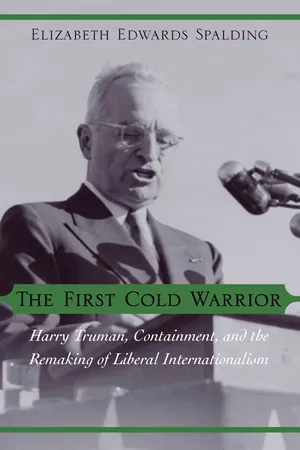 eBook - ePub
The First Cold Warrior
Harry Truman, Containment, and the Remaking of Liberal Internationalism
- Elizabeth Edwards Spalding(Author)
- 2006(Publication Date)
- The University Press of Kentucky(Publisher)
It signified the first formal presidential doctrine since the Monroe Doctrine of 1823 and was judged of comparable magnitude within days of Truman’s March 1947 speech. For his part, the president, departing from those in the State Department who desired a narrow message, intended the speech to be a significant presidential statement. “I am fully aware of the broad implications involved if the United States extends assistance to Greece and Turkey,” Truman explained in the speech, “and I shall discuss these implications with you at this time.” He then succinctly defined the circumstances in Greece and Turkey and the types of actions needed. Although he did not name the Soviet Union as the main adversary—a wise diplomatic move, particularly since Marshall was going to Moscow for another meeting of the Council of Foreign Ministers—he said that totalitarianism was hindering peace and encroaching on other peoples’ territories and lives. Truman saw the essence of the current world conflict as the assault of tyranny on the liberty and independence of free peoples and called for an unprecedented American involvement in foreign affairs in peacetime. For President Truman, these circumstances demanded, and his policy represented, a new dimension in American foreign policy. 25 Truman recognized the newness but, like many at the time, misjudged the ground beneath the grand strategy. He perceived the Truman Doctrine as a break from previous U.S. foreign policy, including the origins of American foreign relations. Indeed, the Truman Doctrine was announced in the face of radically new circumstances in comparison with both the eighteenth and nineteenth centuries. But the president conflated new circumstances and policy with permanent principles. On this point and the connected matter of “isolationism,” he exaggerated the extent to which America was isolationist in its earliest days and during the interwar period eBook - ePub
The Dangerous Doctrine
National Security And U.s. Foreign Policy
- Saul Landau(Author)
- 2019(Publication Date)
- Routledge(Publisher)
The American Century embodied the unstated implication that the United States would become the arbiter of political and economic systems in the rest of the world. Unlike most previous empires, the United States had no worthy rivals. Indeed, its leaders presumed that they could decide the world's fate. The problem was to figure out a way simultaneously to control U.S. society without appearing to make apparent alterations in its political and social forms.The men who made global decisions based their world vision on a concept of U.S. national security that Dean Acheson succinctly summarized in 1947: "We are willing to help people who believe the way we do, to continue to live the way they want to live."12 Domestically, national security required continuation of wartime bipartisan consensus to eliminate debate on such basic issues as budget allocations for "defense" and the means and ends of foreign policy.The Truman Doctrine, invoked to "save" Iran, Greece, and Turkey, became the operating global national security policy in the cold war era. The United States, the doctrine declared, had the right to intervene in order to save entire regions from communist subversion. From the Mediterranean in the late 1940s, to Southeast Asia in the 1960s, to Central America in the 1980s, the word "save," while used in terms of combating Soviet influence, actually has meant preventing indigenous independence movements from taking their countries out of the U.S. orbit.In March 1947, President Truman delivered a speech to Congress that announced publicly what already had secretly become U.S. policy.13 In asking for aid to Greece, the president declared: "I believe that it must be a policy of the United States to support free peoples who are resisting attempted subjugation by armed minorities or by outside pressures."14 Ironically, some of the Greek recipients of U.S. aid had collaborated with the Nazis just two years before, and the foes of U.S. national security had composed the heart of the Greek resistance to the Axis. The Soviets, supposedly intent on world domination, became sufficiently intimidated by the very announcement of Truman's doctrine to abandon their Greek comrades by cutting off their supplies.15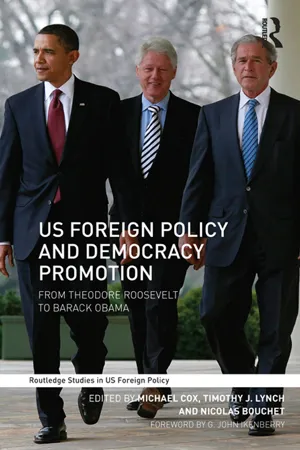 eBook - ePub
US Foreign Policy and Democracy Promotion
From Theodore Roosevelt to Barack Obama
- Michael Cox, Timothy J. Lynch, Nicolas Bouchet, Michael Cox, Timothy J. Lynch, Nicolas Bouchet(Authors)
- 2013(Publication Date)
- Routledge(Publisher)
In as much as the Soviets were seen as not only geopolitically expansionist, but also as seeking to expand their influence by installing communist regimes under their own control, so Truman’s commitment to democracy came to merge with his anti-communism to produce what came to be the classic Cold War binary mindset that identified all anti-communist forces as ‘free’, and to see ‘free’ and ‘democratic’ as synonymous. 13 The Truman Doctrine Gradual development of this merging of Truman’s attitudes – or, to put it another way, the distortion of his commitment to democratic values, or at least the overlaying of it with the imperatives of anti-communism – took place throughout 1946 to reach a culmination in the Truman Doctrine of 12 March 1947. It is worth noting, however, that Truman did not entirely submerge the contradiction within these attitudes, and showed through the rest of his presidency periodic signs of discomfort with the implications, notably with regard to the domestic anti-communism that he somewhat thoughtlessly unleashed. That notwithstanding, the Truman Doctrine speech stands as an undisputed landmark in the history of American engagement in world affairs and set down a clear, and as it turned out, irreversible, commitment to the idea of American intervention on the side of democracy. Moreover, democracy was defined a certain way: as a default position for nations and peoples that had not fallen under totalitarianism. Truman outlined how American aid to help solve Greece’s economic problems was linked to its political future; aid would directly promote democracy, which was threatened by external and internal subversive forces: Greece must have assistance if it is to become a self-supporting and self-respecting democracy. … There is no other country to which democratic Greece can turn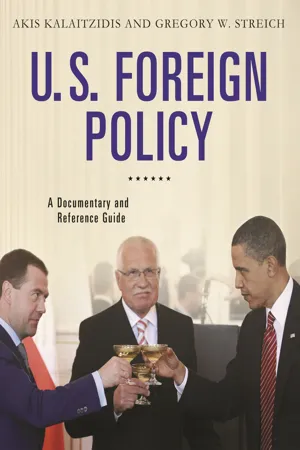 eBook - PDF
U.S. Foreign Policy
A Documentary and Reference Guide
- Akis Kalaitzidis, Gregory W. Streich(Authors)
- 2011(Publication Date)
- Greenwood(Publisher)
It is not enough to urge people to develop political pro- cesses similar to our own. Many foreign peoples, in Europe at least, are tired and frightened by experiences of past, and are less interested in abstract free- dom than in security. They are seeking guidance rather than responsibilities. We should be better able than Russians to give them this. And unless we do, Russians certainly will. (5) Finally we must have courage and self-confidence to cling to our own meth- ods and conceptions of human society. After all, the greatest danger that can befall us in coping with this problem of Soviet communism, is that we shall allow ourselves to become like those with whom we are coping. KENNAN 800.00B International Red Day/2 -2546: Airgram • Document: President Truman’s Speech to Congress: The Truman Doctrine • Date: March 12, 1947 • Significance: In this address, President Truman outlines what came to be known as the “Truman Doctrine.” • Source: Congressional Record, 80 Cong., 1 Sess., pp. 1980–1981. PRESIDENT HARRY S. TRUMAN’S ADDRESS BEFORE A JOINT SESSION OF CONGRESS, MARCH 12, 1947 Mr. President, Mr. Speaker, Members of the Congress of the United States: The gravity of the situation which confronts the world today necessitates my appearance before a joint session of the Congress. The foreign policy and the national security of this country are involved. One aspect of the present situation, which I wish to present to you at this time for your consideration and decision, concerns Greece and Turkey. Chapter 5 • Harry Truman to Lyndon B. Johnson 145 The United States has received from the Greek Government an urgent appeal for financial and economic assistance. Preliminary reports from the American Eco- nomic Mission now in Greece and reports from the American Ambassador in Greece corroborate the state- ment of the Greek Government that assistance is impera- tive if Greece is to survive as a free nation. eBook - PDF
Woodrow Wilson and Harry Truman
Mission and Power in American Foreign Policy
- Anne Pierce(Author)
- 2003(Publication Date)
- Praeger(Publisher)
Truman's policymakers were aware that many Americans saw the Truman Doctrine as offensive to the American character and American traditions. It was 184 Harry Truman popular neither with the public nor with Congress. It seemed to jump too dras- tically away from the cautiousness of the isolationists at the same time that it seemed to violate the open spirit of the internationalists. Americans were more likely to accept involvement in the world if there were limits to that involvement. As Charles Mee observes, they were, at that time, more likely to be generous toward the world if they could feel generous (i.e., if the humanitarian rather than the ideological or geopolitical aspects of policies were emphasized). 42 We shall see, however, that Truman himself was unwilling to de-emphasize the geopolitical and ideological aspects. He sought, rather, to nudge Americans to- ward acceptance of those aspects of American involvement in the world. Truman did, however, allow other policymakers to set the initial tone for the end product of all this thinking: the Marshall Plan. Moreover, he did concur with the major premise of the Marshall Plan: that the Europeans would be more firm in their democratic ideas and convictions if we helped them to help them- selves than if we sought to impose our ideology on them. The Marshall Plan called upon the Europeans jointly to devise a plan for reconstruction to which the United States would respond by infusing into Europe the appropriate eco- nomic and technological aid. As Truman described it in his Memoirs: What Marshall perceived in the plans which his State Department staff laid before him was the importance of the economic unity of Europe. If the nations of Europe could be induced to develop their own solution to Europe's economic problems, viewed as a whole and tackled cooperatively rather than as separate national problems, United States aid could be more effective and the strength of a recovered Europe would be better sustained. eBook - ePub
Britain and the United States in Greece
Anglo-American Relations and the Origins of the Cold War
- Spero Simeon Z. Paravantes(Author)
- 2020(Publication Date)
- Bloomsbury Academic(Publisher)
It was a policy that would justify bypassing international treaties, organizations, and laws whenever they did not coincide with American policy objectives. This is why Greece and the role played there by the British are so significant. Both simultaneously represented, and were direct causes of, the new American foreign policy that was in evidence after the declaration of the Truman Doctrine. The perceived threat of the USSR and its expansion were so great that the US freed itself from adherence to any organization/body that restricted its ability to counter Soviet influence. 61 Meanwhile, in the United States, the British were being attacked not only for their handling of affairs in Greece but also for their inability to manage their own economy. Britain’s slow economic recovery was used by the Republicans to argue against further US aid to the country. The Foreign Office believed that the best way to counter the criticism was to explain that the current difficulties were direct and lasting effects of the war, again referring to the British stand against the Nazis and linking the past with Britain’s future value as an investment and an indispensable ally against the spread of communism. 62 But the corollary of this view was that Britain also needed a strong Germany, not only as a buffer against the USSR but as a trading partner
Index pages curate the most relevant extracts from our library of academic textbooks. They’ve been created using an in-house natural language model (NLM), each adding context and meaning to key research topics.

