History

Good Neighbour Policy
The Good Neighbor Policy was a foreign policy initiative introduced by U.S. President Franklin D. Roosevelt in the 1930s. It aimed to improve relations with Latin American countries by promoting non-intervention and cooperation. The policy sought to replace the previous interventionist approach with a more respectful and cooperative relationship, emphasizing mutual respect and non-interference in the internal affairs of other nations.
Written by Perlego with AI-assistance
Related key terms
1 of 5
10 Key excerpts on "Good Neighbour Policy"
 eBook - ePub
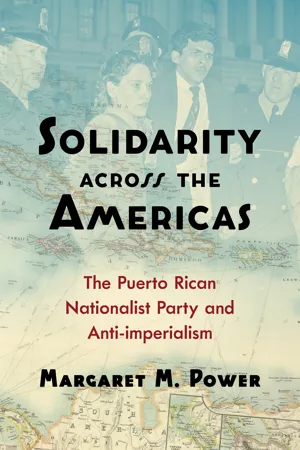
Solidarity across the Americas
The Puerto Rican Nationalist Party and Anti-imperialism
- Margaret M. Power(Author)
- 2023(Publication Date)
- The University of North Carolina Press(Publisher)
6The Good Neighbor Policy developed, in part, to ensure that Latin America would be a firm ally and provide a safe and reliable “backyard” in the upcoming war with Germany and Italy. As Justin Hart notes in reference to the Inter-American Peace Conference held in Buenos Aires in December 1936, at which Roosevelt reaffirmed the United States’ commitment to nonintervention in Latin America, “the specter of German rearmament and territorial expansion hung over the proceedings,” a perception that sharpened Washington’s determination to maintain good relations with governments throughout the hemisphere.7 Furthermore, dictatorships friendly to the United States, such as Rafael Trujillo in the Dominican Republic and Anastasio Somoza in Nicaragua, ruled much of Latin America. They had strong economic ties to the United States, which reduced the need for U.S. military intervention. Finally, British and French imperial power in the region had fallen steadily since World War I, which made the moment a propitious one for the United States to proclaim a policy based on mutual respect.8The Good Neighbor Policy not only reflected U.S. needs but also responded to the demands of Latin Americans to end foreign intervention in the region. At the Seventh International Conference of American States in Montevideo in 1933, every American nation, with the exception of Bolivia, agreed, “No state has the right to intervene in the internal or external affairs of another.”9 Delegates to the Inter-American Peace Conference in Buenos Aires extended and strengthened the nonintervention agreement of 1933 by pledging that their countries would resolve conflict with “pacific solutions.”10President Roosevelt attended the conference. He made the long journey to Buenos Aires by ship to assure Latin Americans that the U.S. government intended to fulfill its promises to respect regional sovereignty as set forth in the Good Neighbor Policy. Argentine president Augustín Justo went overboard to welcome the U.S. president. He decreed the day Roosevelt arrived a holiday and announced, “All the railroads will run special excursion trains to Buenos Aires for the occasion.”11 Roosevelt received a hero’s greeting when he arrived; throngs of people lined the streets of the Argentine capital and cheered him as his car passed.12 eBook - ePub
- William D. Pederson(Author)
- 2011(Publication Date)
- Wiley-Blackwell(Publisher)
Convention for the Maintenance, Preservation, and Reestablishment of Peace (Holden and Zolov 2000: 149–50). The convention expanded the spirit of the good neighbor, laid the foundation of hemispheric security from outside threats, and reiterated the principle of nonintervention. Historian David F. Schmitz states: “Whatever shortcomings the Good Neighbor policy had, it led to an improvement of relations as most people in Latin America welcomed it” (Schmitz 2007: 29).Perhaps the greatest test of the Good Neighbor policy came in 1938 when the Mexican government nationalized American- and British-owned oil companies. In a letter to the Mexican ambassador to the United States, Hull championed the cause of just compensation, while simultaneously upholding the American commitment to nonintervention (Holden and Zolov 2000: 150–2). During the first three decades of the twentieth century, a similar scenario might have resulted in a unilateral American military intervention to safeguard endangered American economic investment. The Roosevelt administration, seeking to uphold the Good Neighbor policy and cognizant of the American need for Mexican oil in the event of a global war, convinced the oil companies to accept a negotiated settlement for their nationalized investment.After World War II broke out in 1939, the 21 American republics issued the Declaration of Panama, a joint declaration of neutrality that called for a “security zone, three hundred to a thousand miles wide, wherein which war activity was to be prohibited” (Doenecke and Stoler 2005: 124–5). According to Dallek, Latin Americans were motivated “by considerations of their own safety and feelings of trust engendered by the Good Neighbor policy” (Dallek 1979: 205). To counter Axis propaganda in Latin America, Roosevelt created the Office for Coordination of Commercial and Cultural Relations between the American Republics. Roosevelt’s goal was to bolster Pan-Americanism, strengthen American cultural ties with Latin America, and diminish the impact of Axis cultural and commercial ties in Latin America that had expanded during the 1930s. Motion pictures were one of the most effective forms of communication in strengthening Pan-American solidarity. Between 1940 and 1943, Hollywood produced over two dozen motion pictures “based on Latin American themes or of particular interest to Latin Americans” (Holden and Zolov 2000: 159–61). Especially popular in Latin America were cartoons produced by the Walt Disney Studios. eBook - PDF
United States Foreign Policy in the Interwar Period, 1918-1941
The Golden Age of American Diplomatic and Military Complacency
- Benjamin Rhodes(Author)
- 2001(Publication Date)
- Praeger(Publisher)
One of the most obvious benefits of the Good Neighbor Policy was that a majority of the Latin American republics (Chile and Argentina were the exceptions) either declared war on the Axis or broke relations. Politically Roosevelt was not bashful about claiming credit for the Good Neighbor Policy. In reality Hull and especially Welles deserved recognition for carrying out the details. However, much of the driving force behind the Good Neighbor Policy was lost when Welles unexpectedly left the State Depart- ment in 1943. For many years it was assumed his resignation as under- secretary of state was the result of personality and policy differences with Hull. Recent scholarship has demonstrated that Welles's downfall was ac- tually the result of the exposure of his homosexuality; his enemies, notably Hull and Ambassador William C. Bullitt, were able to force his resig- nation. 14 The retirement of Welles meant that there was no one in the 126 United States Foreign Policy in the Interwar Period government with the expertise, the vigor, and the access to the White House to continue the most idealist and successful of New Deal foreign policies. NOTES 1. Cordell Hull, The Memoirs of Cordell Hull (New York, 1948), Vol. 1, 311. 2. Hull, Memoirs, Vol. 1,313. 3. Frederick W. Marks III, Wind Over Sand: The Diplomacy of Franklin Roosevelt (Athens, Georgia, 1988), 33; Bryce Wood, The Making of the Good Neighbor Policy (New York, 1961), 59-69; William E. Leuchtenburg, Franklin D. Roosevelt and the New Deal, 1933-1940 (New York, 1963), 208. 4. Hull, Memoirs, Vol. 1,319. 5. Lester D. Langley, The United States and the Caribbean, 1900-1970 (Athens, Georgia, 1980), 31-38, 154-57. 6. Hull, Memoirs, Vol. 1, 345. 7. Langley, United States and the Caribbean, 153; Irwin F. Gellman, Good Neighbor Diplomacy: United States Policies in Latin America, 1933-1945 (Balti- more, 1979), 35-36. eBook - ePub
FDR's Good Neighbor Policy
Sixty Years of Generally Gentle Chaos
- Fredrick B. Pike(Author)
- 2010(Publication Date)
- University of Texas Press(Publisher)
SECTION VLaunching and Targeting the Good Neighbor Policy Passage contains an image
16. Discarding the Burdens of InterventionismRoosevelt and Nonintervention: The Trickster in His ElementIn constructing a Good Neighbor policy, nonintervention was a key building block. Through his personal touch Franklin Roosevelt shaped and polished that building block. As a refined gentleman who prided himself on elegant manners, he was loathe to give overt offense. And in the 1930s, Latin Americans professed to find virtually no facet of Yankee behavior more offensive than overt intervention in their internal affairs. But far more than reluctance to give offense lay behind FDR’s espousal of nonintervention in hemispheric affairs. Roosevelt was also looking for positive, tangible payoffs—tantamount to the payoffs he garnered from voters in the American South by refusing to intervene in what they regarded exclusively as internal affairs.Roosevelt helped strengthen the Democratic hold on the “Solid South” through his willingness to allow the area’s white electorate a free hand in establishing the parameters of race relations. Similarly, he helped bring about a more harmonious hemisphere through his willingness to allow Latin Americans greater freedom than previous Washington administrations had accorded them in setting the terms of their relationship to Yankee capitalists. With his highly developed sense of reciprocity, of the niceties of tit-for-tat relationships, Roosevelt expected Latin Americans to respond to concessions he extended them as generously as white voters in the American South had responded. He expected Latin Americans to indicate their appreciation for favors extended by keeping the door open to American capitalists, at least to those good-mannered capitalists willing to conduct themselves according to the more demanding code about to be prescribed by New Dealers.
Passage contains an image
16. Discarding the Burdens of InterventionismRoosevelt and Nonintervention: The Trickster in His ElementIn constructing a Good Neighbor policy, nonintervention was a key building block. Through his personal touch Franklin Roosevelt shaped and polished that building block. As a refined gentleman who prided himself on elegant manners, he was loathe to give overt offense. And in the 1930s, Latin Americans professed to find virtually no facet of Yankee behavior more offensive than overt intervention in their internal affairs. But far more than reluctance to give offense lay behind FDR’s espousal of nonintervention in hemispheric affairs. Roosevelt was also looking for positive, tangible payoffs—tantamount to the payoffs he garnered from voters in the American South by refusing to intervene in what they regarded exclusively as internal affairs.Roosevelt helped strengthen the Democratic hold on the “Solid South” through his willingness to allow the area’s white electorate a free hand in establishing the parameters of race relations. Similarly, he helped bring about a more harmonious hemisphere through his willingness to allow Latin Americans greater freedom than previous Washington administrations had accorded them in setting the terms of their relationship to Yankee capitalists. With his highly developed sense of reciprocity, of the niceties of tit-for-tat relationships, Roosevelt expected Latin Americans to respond to concessions he extended them as generously as white voters in the American South had responded. He expected Latin Americans to indicate their appreciation for favors extended by keeping the door open to American capitalists, at least to those good-mannered capitalists willing to conduct themselves according to the more demanding code about to be prescribed by New Dealers. eBook - ePub
Thank God They're on Our Side
The United States and Right-Wing Dictatorships, 1921-1965
- David F. Schmitz(Author)
- 2009(Publication Date)
- The University of North Carolina Press(Publisher)
The Roosevelt administration again accepted the Republican answer to the difficult problem of providing stability without direct American military intervention. Moreover, it was clear that while the United States nominally supported democracy and hoped to promote and protect it internationally, Washington was more concerned with instability and the danger of freedom in what it perceived to be politically immature nations. The key to development anywhere was order, which would minimize distress during difficult periods of transition to modern economic and, eventually, political states. Until then, evidence indicated that strong rule was necessary in many nations to ensure that they did not attempt self-rule until they were free of the dangers from the left. The United States would support authoritarian rulers as long as order was preserved, they did not form alliances with any power that threatened the United States, and investments and trade were protected. The policy pendulum had swung fully to a position of support for right-wing dictators.Good Neighbor Batista
During his inauguration speech on 4 March 1933, Roosevelt announced that U.S. relations with the other American republics would be based on the “policy of the good neighbor . . . who resolutely respects himself and, because he does so, respects the rights of others.”108 Sumner Welles, an old friend of Roosevelt’s, who would oversee the establishment of this policy, had recommended to the newly elected president that his top priority should be “the creation and maintenance of the most cordial and intimate friendship between the United States and other republics of the American continent.”109 Seeking to improve relations with Latin America so as to increase international trade, aid economic recovery at home, and forestall unrest, the administration renounced the use of unilateral American intervention in the affairs of those nations. The announcement of the Good Neighbor Policy received a positive reception on both sides of the Rio Grande. The seemingly bold declaration was in reality a continuation of Stimson’s policy of ending direct American intervention while still preserving influence and stability. Only the methods, not the desired objectives of influence and stability, had changed.Roosevelt’s desire to end military intervention was similar to Stimson’s. As early as 1928, he had stated that “single-handed intervention by us in the internal affairs of other nations must end; with the cooperation of others we shall have more order in this Hemisphere and less dislike.”110 The others too often turned out to be dictators. Roosevelt made his concerns clear in December 1933. He announced that the “definite policy of the United States from now on is one opposed to armed intervention.” The problem of order remained. Roosevelt backed away from Wilson and Hughes when he stated that the “maintenance of constitutional government in other nations is not a sacred obligation devolving upon the United States alone.” He then slightly shifted the central concern when he noted that “the maintenance of law and the orderly processes of government in this hemisphere is the concern of each individual nation.”111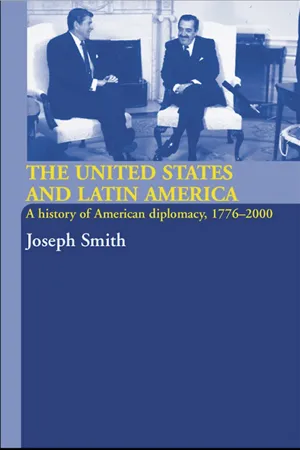 eBook - ePub
The United States and Latin America
A History of American Diplomacy, 1776-2000
- Joseph Smith(Author)
- 2005(Publication Date)
- Routledge(Publisher)
Despite Hoover’s good intentions, his administration did not witness a tangible improvement in inter-American relations or understanding. In fact, the amount of actual contact was arguably diminished because economic relations between Latin America and the United States were adversely affected by the depression. From 1929 to 1933 American exports to the region fell in value by more than 75 per cent, while imports declined by 68 per cent. In addition, the United States appeared decidedly unsympathetic to the economic plight of Latin American exporters because domestic political reasons dictated the maintenance of a strongly protectionist attitude that was symbolized by the passage in the US Congress of the Smoot- Hawley Tariff in 1930. While the onset of the Great Depression contributed to diplomatic uncertainty and undermined inter-American relations, it also marked a definite historical watershed for the United States. This occurred in 1932 when Herbert Hoover’s electoral defeat brought an end to over a decade of Republican control of the White House and paved the way for the ‘New Deal’ of Franklin D. Roosevelt.Franklin D. Roosevelt and the ‘Good Neighbor Policy’
Latin Americans were apprehensive over the choice of a ‘Roosevelt’ as the Democratic candidate in the 1932 presidential election because that surname was firmly associated with the aggressive policy of the Big Stick. Unlike his cousin Theodore, however, Franklin D. Roosevelt publicly announced a desire to act sympathetically towards the Latin American nations.7 As president, he basically continued Hoover’s conciliatory policy although it now acquired a new and fresh name as a result of a section taken from Roosevelt’s inaugural address of 4 March 1933: ‘In the field of world policy, I would dedicate this nation to the policy of the good neighbor – the neighbor who resolutely respects himself and, because he does so, respects the rights of others.’8 Though never precisely defined, like many of his political slogans, the concept of acting as a ‘good neighbor’ was attractive in terms of external public relations because it implied equality and mutual respect among nations. It would be applied by Roosevelt not, as he initially seemed to suggest, to include the whole world but specifically to the countries of the Western Hemisphere. Consequently, it was Roosevelt and not Hoover who has been popularly regarded as the originator of what became known as the ‘Good Neighbor Policy’.9In his first few months in the presidency, Roosevelt’s actions belied his proclaimed good neighbourly intentions. One of his initial foreign policy crises was the island of Cuba which was in civil and economic disorder resulting mainly from the collapse in the world price of sugar and the severe decline of sugar exports to the United States. President Gerardo Machado, who had been in power since 1924, had adopted ruthless emergency powers and was eventually overthrown in a military coup in August 1933. In the ensuing uncertainty considerable political pressure was put on Roosevelt for American military intervention under the Platt Amendment to restore constitutional government. While Roosevelt duly sent a small number of warships to patrol Cuban waters and present a show of military force, he would not order the landing of marines. ‘Despite the legal right we possessed’, Roosevelt’s secretary of state, Cordell Hull, later explained, ‘such an act would further embitter our relations with all Latin America.’10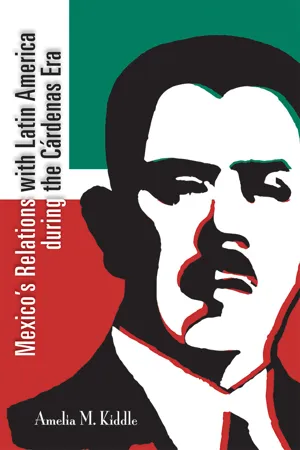 No longer available |Learn more
- Amelia M. Kiddle(Author)
- 2016(Publication Date)
- University of New Mexico Press(Publisher)
1 La Política del Buen Amigo and Its Practitioners The governing principle of the Mexican government’s foreign policy is the Política del Buen Amigo. This policy bears a great purpose, one which corresponds to sincere friendship and a profound interest in sharing the triumphs and concerns of friendly nations. It also fundamentally symbolizes the proposition, as laid out by international ethics, of nonintervention— neither directly nor indirectly—in the internal affairs of other nations, observed in letter and spirit, and demonstrates utmost respect for their ways of life and internal organization. — E D UA R D O H AY , April 27, 1936 L a Política del Buen Amigo guided Mexican relations with Latin America during the presidency of Lázaro Cárdenas. The name was an obvious play on Franklin Delano Roosevelt’s Good Neighbor Policy, announced during the US president’s inaugural address in 1933, but with strong antecedents in the policies of previous administrations. 1 La Política del Buen Amigo was first articulated by the Ministry of Foreign Affairs in 1935. 2 Like the Good Neigh-bor Policy, it was originally meant to characterize Mexico’s relations with all countries, but both policies evolved to apply specifically to Latin America. Mexico’s policy stated that, more than just a “good neighbor,” the govern-ment aimed to be a “good friend,” seeking to establish cordial relations with other countries and uphold the principle of nonintervention that character-ized Mexican diplomacy. Whether the name indicates one-upmanship or a 15 sense of humor on the part of the Cárdenas government, the two policies certainly shared a lot because of their common emphasis on cultural relations and nonintervention. La Política del Buen Amigo became the framework in which diplomats and private citizens operated and through which their over-tures were received during the Cárdenas era. Adherence to the principle of nonintervention had long characterized Mexico’s foreign policy. eBook - PDF
Beneath the United States
A History of U.S. Policy toward Latin America
- Lars Schoultz(Author)
- 2009(Publication Date)
- Harvard University Press(Publisher)
Relief and Rehabilitation Agreement in late 1943. Forty-four nations were supposed to cooperate, he wrote in his diary, so that the responsibility was not put “on the shoulders of the United States and Great Britain alone. But when I saw the swarthy faces of some of the representatives of countries like Honduras who sat in front of me at this table, I ‘had me doubts,’ so to speak, as to how much they would take of this burden.” 71 It is tempting to argue that the aging Stimson (born in 1867, he had first been appointed to federal office in 1906 by Theodore Roosevelt) was a quaint throwback to an earlier day, but in fact he was simply echoing the broadly prevailing values of his time. In the 1941 Rockefeller survey of U.S. 314 Becoming a Good Neighbor views about Latin Americans, respondents were handed a page containing nineteen adjectives and asked, “from this list, which words seem to you to describe best the people who live in Central and South America?” The five least -selected adjectives were “efficient” (5 percent), “progressive” (11 per-cent), “generous,” “brave” (both 12 percent), and “honest” (13 percent). The most frequently selected adjective (by 77 percent of the respondents) was “dark-skinned,” followed by “quick-tempered,” “emotional,” “back-ward,” “religious,” “lazy,” “ignorant,” “suspicious”—and then finally the first unequivocally positive trait: 28 percent said that Latin Americans were friendly. That was just 1 percent more than said they were dirty. Quite clearly, the Good Neighbor policy did not reach into the minds of U.S. leaders and the public to change the way in which they thought about Latin Americans. It was a policy that demanded a new surface respect for Latin America’s sensitivities: no Marines landing in Caribbean ports, fre-quent high-level meetings, elaborate visits by heads of state, and new bu-reaucracies to institutionalize the Pan American relationship. eBook - PDF
In Their Own Best Interest
A History of the U.S. Effort to Improve Latin Americans
- Lars Schoultz(Author)
- 2018(Publication Date)
- Harvard University Press(Publisher)
official may personally op-pose a dictatorship, it was impossible to be both a Good Neighbor and med-dlesome. This statement was sent to every U.S. envoy in Latin America over the signature of Secretary Hull and written in the first person to emphasize that this was more than just another cable from Washington: “I desire to make it clear that the Department expects its diplomatic representatives in Central America to conduct themselves in their relations with the Govern-ment to which they are accredited, and with the people of the countries, in exactly the same manner they would if they were accredited to one of the large republics of South America or with any non-American power; that is to say, they should abstain from offering advice on any domestic question, and if requested to give such advice they should decline to do so.” Even this did not give pause to Minister Corrigan, a recent political ap-pointee. Since Washington had decided it was no longer a question of com-plying with a 1923 treaty, Corrigan wrote that the unconstitutional re-election of a brutal dictator “brings up the question of whether there is not a moral responsibility implicit in the interpretation of the ‘Good Neighbor’ policy.” * Article V required the signatories “to maintain in their respective Constitutions the principle of non-reelection to the office of President and Vice-President,” and those whose constitutions lacked such a stipulation were obligated “to introduce a constitutional re-form to this effect.” PLEDGING TO BE A GOOD NEIGHBOR 133 Welles responded, pointedly “for the Secretary of State”: “Avoid expressing opinions or giving suggestions with reference to internal policies.” 80 THE DOWNSIDE OF any nonintervention policy is exactly what Minister Corrigan mentioned: the moral consequences of turning a blind eye to repression. As the war clouds gathered during the 1930s, some officials began referring to Latin America as the nation’s “soft underbelly” and arguing that U.S.
- John A. Gronbeck-Tedesco(Author)
- 2015(Publication Date)
- Cambridge University Press(Publisher)
54 Other reciprocal trade agreements with American republics followed with noticeable gains so that between 1933 and 1937, US imports from Latin America leaped from $330 million to 51 Gellman, Roosevelt and Batista, 8–9. 52 Pérez, Cuba under Platt, 279–80. 53 Dozer, Are We Good Neighbors? 25. 54 Whitney, State and Revolution, 134; Gellman, Roosevelt and Batista, 103, 114–15. Good or Bad Neighbors? 97 $705 million and its exports from $240 million to $640 million, a larger percent jump than US trade with Europe during the same years. Becoming better neighbors proved financially stabilizing for the United States. 55 While the new legislation promised to create more equitable financial relations, it kept Cuba solidly in the US fiduciary orbit, with the assertion that Cuba’s economic dependency on the United States was a function of its supposed natural state of perpetual “disorder.” Although US officials wanted to tout their ties with Cuba as more egalitarian, Good Neighbor Policy claims of economic independence clearly remained submerged beneath a paradigm of dependence. Economic diversification remained difficult for Cubans because national production still had to compete with US-manufactured goods and levels of productivity, and US compa- nies continued to manage a large amount of control over Cuba’s econ- omy. If Cuba had become the “acid test” for US sincerity, the results were mixed. Equal recognition and mutual respect did not necessarily ensure equal economic growth. Skeptics believed the new equitable trade leg- islation further entrenched the Cuban economy under the US yoke and viewed the Good Neighbor Policy as merely an extension of the Monroe Doctrine. 56 Following his failed mediation attempts, Sumner Welles assumed the responsibility of proselytizing new messages of Pan-Americanism that guaranteed US commitment to nonintervention, nonaggression, and mutual economic development.
Index pages curate the most relevant extracts from our library of academic textbooks. They’ve been created using an in-house natural language model (NLM), each adding context and meaning to key research topics.

