History

US Occupation of Haiti
The US occupation of Haiti refers to the period from 1915 to 1934 when the United States military intervened in Haiti. This intervention was prompted by political instability and economic interests. During this time, the US implemented various reforms and infrastructure projects, but also faced resistance from Haitian nationalists. The occupation had a lasting impact on Haiti's political and economic development.
Written by Perlego with AI-assistance
Related key terms
1 of 5
8 Key excerpts on "US Occupation of Haiti"
 eBook - PDF
Poverty in Haiti
Essays on Underdevelopment and Post Disaster Prospects
- M. Lundahl(Author)
- 2010(Publication Date)
- Palgrave Macmillan(Publisher)
This is why it is fitting to call the nineteenth century ‘crucial’. 31 What followed was more a case of ‘fine tuning’, to borrow an expression from the jargon of economic policy. 32 Five Decisive Events in the Economic History of Haiti 9 The American occupation In 1915, the US Marine Corps moved into Haiti and occupied the coun- try for the next 19 years. The reasons for the occupation are disputed, but it appears clear that President Wilson feared increased German influence in Haiti, not least given the strategically location of Môle St. Nicolas, opposite Guantánamo in Cuba. Economic factors presum- ably played a minor role. At the time, American investment in the coun- try was relatively limited. The same was true of American commercial interests. 33 The American occupation, above all else, represents a hiatus in the history of Haiti. The first few years were spent securing internal peace and order, and only in 1921 did the occupation enter into what may be labeled ‘a constructive phase’. As could be expected, the occupation forces met with resistance. Just before the landing of the Marine Corps, President Vilbrun Guillaume Sam was killed by a mob, and his torn limbs were paraded through the streets of the capital. This was further proof of the fact that Haiti continued to be torn by inner dissension and domestic strife, and that the country had, in fact, been in a more or less continuous state of civil war for 70 years, where loyalties were the only variable. The occupation put an end to all that. Prior to the occupation, Haiti had not one but many armies whose only purpose was to fight each other.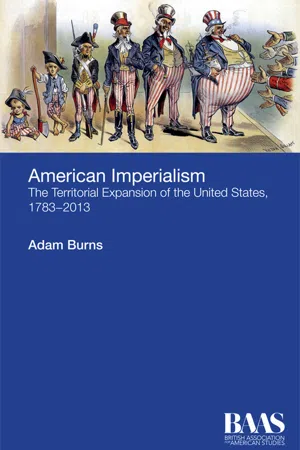 eBook - PDF
American Imperialism
The Territorial Expansion of the United States, 1783-2013
- Adam Burns(Author)
- 2017(Publication Date)
- Edinburgh University Press(Publisher)
33 The US cited similar rea-sons for intervening in Haiti as it had in Nicaragua: widespread violence, and the consequent danger to US residents and business interests in the country. 34 However, US fears of Haiti falling into enemy hands were also significant, and preclusive imperialism pro-vided part of the rationale for every Central American intervention occupation over annexation (1912–73) 143 following the Roosevelt Corollary to the Monroe Doctrine. From the start, Haitian nationalists remained hostile to the US takeover, and intermittent guerrilla warfare punctuated the early occupation, leading to the razing of settlements and shooting of rebels. 35 Between 1915 and 1916 , the US formulated a Haitian treaty that effectively committed them, morally and legally, to continued military occupation of the island until 1936 . 36 However, the treaty ‘negotiations’ made Wilson’s second secretary of state, Robert Lansing, remark that it was ‘more or less an exercise of force and an invasion of Haitian independence’. 37 The US took control of Haitian finances, created a Gendarmerie (constabulary) that was controlled by the US marines, and installed a US-friendly president who, in short order, dissolved the elected Haitian legislature. Historian Mary Renda contends that the occupation of Haiti was ‘one of several important arenas in which the United States was remade through overseas imperial ventures in the first third of the twentieth cen-tury’, and this was certainly the case across the Caribbean. 38 Dur-ing the occupation, US marines put down various insurgent guerrilla groups, introduced Jim Crow-style segregation laws, and even insti-tuted forced labour. African Americans in the United States became some of the foremost critics of the Wilsonian occupation, includ-ing members of the National Association for the Advancement of Colored People (NAACP).
- Michael L. Krenn, Michael L. Krenn, E. Nathaniel Gates(Authors)
- 2020(Publication Date)
- Routledge(Publisher)
The Afro - American Response to the Occupation of Haiti, 1915 - 1934 By BRENDA GAYLE PLUMMERIn 1915 the United States began a military occupation of Haiti which lasted two decades. Citing widespread violence, actual anarchy, and imminent danger to foreigners' lives and property, the federal government ordered Marines landed at Port-au-Prince. The United States rarely enjoyed harmonious relations with the Caribbean nations in the early twentieth century, and the Haitian occupation was unprecedented in both its duration and the extreme racism that characterized American behavior in the black republic. Historians have examined many facets of the United States' control of Haiti from 1915 to 1934, including reaction to the occupation from the American press.1 Scant attention, however, has been paid to the black American response to events in Haiti, and the role blacks played in opposing the occupation has been neglected.1 Hans Schmidt, The United States Occupation of Haiti, 1915-1934 (New Jersey, 1971); David Healey, Gunboat Diplomacy in the Wilson Era: The United States Navy in Haiti, 1915-1916 (Madison, 1976); John W. Blassingame, "The Press and American Intervention in Haiti and the Dominican Republic, 1904-1920," Caribbean Studies 9 (July 1969): 27-43.The reaction of black Americans to the Haitian occupation is significant because it reflects the great change during this era in blacks' self-assessment, and in their view of kindred peoples of African descent in other parts of the world. Well-known race leaders led the way in responding to the Haitian controversy, but once it became familiar to the public, ordinary black Americans reacted to the racial injustices they believed were occurring in Haiti. They wrote letters to the State Department, to the black press, and to the President of the United States; they attempted to use their leverage as Republican voters; and they agitated for participation in policymaking that affected Haiti.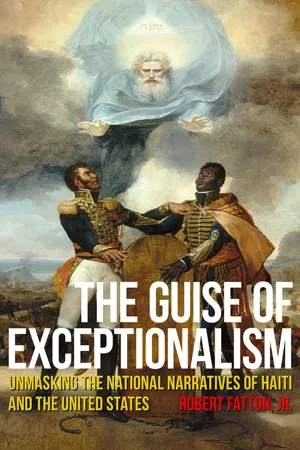 eBook - ePub
The Guise of Exceptionalism
Unmasking the National Narratives of Haiti and the United States
- Robert Fatton(Author)
- 2021(Publication Date)
- Rutgers University Press(Publisher)
CHAPTER 5The American Occupation and Haiti’s Exceptionalism
Whatever may have been the reasons advanced by Washington policy makers for the takeover of Haiti in 1915, it is clear that the American occupation had at best very limited success achieving its transformative goals. In fact, while it introduced modest infrastructural improvements in terms of roads and communications, it was marked by significant repression of local resistance movements.1 The most important legacy of the occupation was the centralization of power in Port-au-Prince through the creation of a more effective state bureaucracy, and more significantly, a national army. The army circumscribed the powers of regionally based armed bands controlled by “big men” and established a modicum of political order.Political order, however, did not imply popular acquiescence. It is true that many in the traditional Haitian elites initially collaborated with and even welcomed the occupiers. Many of these collaborators had authoritarian reflexes and shared some of the paternalistic and racist ideology of their American overlords. Convinced that Haitians were not prepared for any democratic form of self-government, these elites believed in the despotisme éclairé des plus capables (“enlightened despotism of the most capable”). In fact, despotisme éclairé had a double meaning: not only did it allude to intellectual enlightenment, but it also conveyed the veiled racist message that rule by the light-skinned minority was superior to that of the black majority.2 Thus, from their privileged class status and collaborationist position, Haitian rulers under the American occupation regarded the rest of their black compatriots—especially the peasantry—with contempt. This contempt reflected one of the fundamental contradictions of Haitian exceptionalism; it has always celebrated the blackness and Africanness of its citizens as proud descendants of Ginen, and yet it never managed to free its ruling class from powerful remnants of colonial racism, especially the Creole’s denigration of the African-born slave as Bossal eBook - ePub
- Shalini Puri, Lara Putnam, Shalini Puri, Lara Putnam(Authors)
- 2017(Publication Date)
- Palgrave Macmillan(Publisher)
Women in Haiti capitalized on the nation’s altered transportation landscape and the disruption of public space to manage their economic, social, and political lives during the period. As evidenced in Marie Louise’s letter, the occupied thoroughfares revealed the complexities of infrastructural development. Traffic on the streets and bridges of Haiti blurred the boundaries between occupied and occupiers, simultaneously revealing extreme social and political anxieties of the period and also facilitating exchanges in which women challenged and complied with the US military invasion.US Marines arrived in Haiti on July 28, 1915. The military occupation was characterized as the Caribbean frontier of World War One. According to US President Woodrow Wilson’s administration, Haiti’s weak state structure, its proximity to the US, and the prevalence of German merchants made the nation a potential breeding ground for anti-Allied forces. This regional concern for Allied interests was coupled with the paternalistic belief that Black Haitians were uncivilized and incapable of governing their own nation. As good neighbors, the US would use the military occupation to strengthen Haiti’s political and physical infrastructure through government restructuring, the implementation of martial law (1918), and the construction of schools, roads, and bridges.4In the first decade of the occupation the US celebrated the construction and reconstruction of over 500 miles of roads, bridges, and railways.5 This productive period of infrastructural development and reforms coincided with the most violent era of the occupation.6 Much of the violence was directly related to the development process governed by the corvée system. Under this system, individuals accused of a crime or those who failed to pay their property taxes could be forced to work on government construction projects without compensation, bringing harsh labor, long work hours, injury, even death. The brutality of the corvée system heightened frustrations and discontent with the American presence and encouraged Haitians to swell the ranks of anti-occupation movements, including the more politically oriented Union Patriotique eBook - ePub
Haiti's New Dictatorship
The Coup, the Earthquake and the UN Occupation
- Justin Podur(Author)
- 2012(Publication Date)
- Pluto Press(Publisher)
7 and allowed the U.S. Navy to operate from Haitian ports to maintain the blockade of the South.THE U.S. MARINE OCCUPATION: 1915–34Saddled with these crippling debts, Haiti was hardly able to move forward. The mulatto elite’s Liberal Party fought the black National Party for control through the nineteenth century.8 There were military conflicts between rivals for power within Haiti, local revolts and rebellions, and border wars with the Dominican Republic. As U.S. economic power grew in the nineteenth century, so too did its influence in Haiti. By the 1910s, this influence was symbolized by HASCO, The Haitian-American Sugar Company. Like United Fruit in the Latin American ‘banana republics’, HASCO was a major player in Haitian politics and a vehicle for U.S. influence in the country.In 1915, the U.S. Marines invaded Haiti. As always, the U.S. cited local politics and concerns for its business interests (including HASCO) as the reason for invasion. But this was a period in which the U.S. conducted several invasions in the Americas (Nicaragua was occupied from 1912 to 1933, the Dominican Republic from 1916 to 1924, Cuba since the Spanish–American war, and others). The U.S. privatized the National Bank, re-instituted forced labour, tied resistance leader Charlemagne Peralte’s body to a door and circulated the photograph. When the Marines left 19 years later in 1934, the U.S. reserved a ‘special role’ for itself.9 The U.S. left behind two military forces for use against the population, the ‘gendarmerie’ and the National Guard, which evolved into the Haitian Army (renamed Forces Armees D’Haiti, or FADH, in 1958). In 1935, the post-occupation government of Haiti granted a 25-year banana contract to the U.S. Standard Fruit and Steamship Company.10 eBook - PDF
Empire's Guestworkers
Haitian Migrants in Cuba during the Age of US Occupation
- Matthew Casey(Author)
- 2017(Publication Date)
- Cambridge University Press(Publisher)
Reconfigurations or expansions of economic, political, or 49 Plummer, Haiti and the Great Powers, 20, 97, 128. There were, however, numerous peasant uprisings in the South during the nineteenth century. See Smith, Liberty, Fraternity, Exile, 66–8. 50 “Vérité historique pour le Sud,” Le Nouvelliste, September 20, 1915. 51 Bellegarde-Smith, Haiti: The Breached Citadel, 105–12. For a description of Marines’ violence against the Caco Rebellion see Renda, Taking Haiti, 150–64. 52 Scott calls these “distance demolishing technologies.” Scott, The Art of Not Being Governed, xii. 76 Leaving US-Occupied Haiti juridical power (and not just territorial evictions) may bring dislocation or a loss of status that requires some kind of movement in response – even if it is not across a national border. Recognizing these dislocations and the shorter movements they engendered brings the effects of the occupation, the experiences of the Haitian peasantry, and the migratory movement to Cuba into sharper relief 53 (Map 2.2). The presence of US soldiers who received high wages and were accus- tomed to eating significantly more than Haitian subsistence farmers tested an area’s capacity to produce food, even when soldiers’ rations were being shipped into an area. In Aux Cayes, an officer noted that “import[ed] flour can be found in very large quantities tho[ugh] of poor quality; beef cattle are poor in quality and about sufficient in number to meet the demands of the native population, and this is not much.” The officer concluded that “an American force occupying Cayes could not . . . live on the country but must bring its supplies” since “this is not a country where people figure on supplying an occupying force.” Despite this, he recognized that US soldiers would purchase food from local markets. eBook - PDF
General History of the Caribbean UNESCO Volume 6
Methodology and Historiography of the Caribbean
- NA NA(Author)
- 2019(Publication Date)
- Palgrave Macmillan(Publisher)
35 Revolutionary France had sent General Marie-Joseph Hedouville to draw an irreversible wedge between Haitian revolutionaries, especially between dark-skinned Toussaint Louverture and his quadroon rival Rigaud. Michel and Sannon aside, members of the Societe published very few historical monographs during the occupation. One suspects that the dearth of important titles may have been due to the indirect impact of the occupation on research funding. The Haitian state never funded historical research directly. Both before and after the occupation, however, a small number of males from the middle classes who enjoyed the necessary ties to the govern- ment of the day would find their way to Europe on government scholarships (often for medicine or law) or as attaches to one or another diplomatic mission. Almost inevitably, some would turn to the wealth of documents available in French archives, mainly in Paris, becoming amateur - though not necessarily negligible - historians. Their reputation as historian could, in turn, enhance their public or private career in unrelated fields, including politics. By cutting drastically the number of Haitians making the inevitable tour of Paris on government subsidies, the United States rulers, perhaps unwit- tingly, reduced the Haitians' access to their traditional sources. Thus, the 34 Antoine Michel, 1934. 35 Jean Price-Mars, 1953. 465 General History of the Caribbean most notable books published during the occupation were based either on research that predated the Marines' invasion (Sannon), on materials collected in Haiti (Michel), or on research abroad supported, at least in part, by private means (Nemours, Leconte). Contacts abroad were the key to Abel-Nicolas Leger's Histoire diplomatique dRaili (Diplomatic history of Haiti), published in 1930, a book that won its already wealthy author the Ministry of Foreign Affairs.
Index pages curate the most relevant extracts from our library of academic textbooks. They’ve been created using an in-house natural language model (NLM), each adding context and meaning to key research topics.

