Politics & International Relations

Haitian Revolution
The Haitian Revolution was a successful anti-slavery and anti-colonial insurrection that took place in the French colony of Saint-Domingue from 1791 to 1804. It resulted in the establishment of Haiti as the first independent black republic in the Americas and the only nation born out of a successful slave revolt. The revolution had a profound impact on the institution of slavery and inspired liberation movements worldwide.
Written by Perlego with AI-assistance
Related key terms
1 of 5

12 Key excerpts on "Haitian Revolution"
 eBook - ePub
The Early Haitian State and the Question of Political Legitimacy
American and British Representations of Haiti, 1804—1824
- James Forde(Author)
- 2020(Publication Date)
- Palgrave Macmillan(Publisher)
8 At times, however, American and British writers looked to impact the recognition question by overtly suggesting that the hand of political friendship should be offered to Haiti’s early leaders. But these depictions were also often designed to impact debates on the legitimacy and effectiveness of Atlantic world forms of governance—including America’s and Britain’s. In both critiques and celebrations of Haiti’s independence, the early Haitian state subsequently became a central entity in transatlantic debates on how political leadership should operate in the Atlantic world in the early nineteenth century.The enormous impact of the Haitian Revolution on American and British debates of slavery and its abolition has been well established. This impact continued in the immediate aftermath of the Revolution as newspapers, pamphlets and literary texts continued to portray the shocking violence perpetrated by French colonial forces and Haitian Revolutionaries, as well as the destructive nature of the Revolution for the colonists and the colony as a whole.9 The political messages underpinning these narratives were largely “bifurcated” as pro- and anti-slavery supporters on both sides of the Atlantic looked back on the events in Saint-Domingue as vital instruments for their respective campaigns.10 Anti-slavery supporters such as James Stephen and Thomas Clarkson saw the success of the black revolutionaries as proof that slaves in the colonies not only desired emancipation but also had the necessary capabilities to achieve it on their own terms.11 At such a crucial time in anti-slavery debates in Britain and America, abolitionists asserted the idea that if their respective governments did not act swiftly, a second Saint Domingue would inevitably occur in the British colonies or in the southern slave states of America.12 Pro-slavery supporters mirrored this strategy of the abolitionists by playing on a similar fear and asserting that this revolutionary spirit could spread beyond the newly formed Haitian state—something Ashli White has termed the “contagion of rebellion”.13 eBook - ePub
The Expanding Blaze
How the American Revolution Ignited the World, 1775-1848
- Jonathan Israel(Author)
- 2017(Publication Date)
- Princeton University Press(Publisher)
CHAPTER 14 America and the Haitian Revolution Long regarded by white America as the most horrific and threatening of the revolutionary upheavals, the Haitian Revolution of 1791–1804 threw the entire Caribbean into turmoil and affected relations between whites and blacks throughout the New World for decades. This great eruption was not directly inspired or driven by the American Revolution but rather by the French; it powerfully interacted with developments in the United States, though, and impacted on the American Revolution’s legacy in a way that had enduring consequences for both the United States and Haiti, as well as profoundly changed the relationship between the United States and France. The Declaration of the Rights of Man and the Citizen, of August 1789, marked a new stage in the unfolding of the French Revolution and quickly injected a degree of social and political tension throughout the Caribbean, even though the white planters’ local assemblies in the French colonies for the moment remained sufficiently dominant to resist concrete changes in the islands’ institutions, laws, and caste system. During 1789–92, the ancien régime continued in the French Caribbean with only whites owning at least twenty-five black slaves being admitted to the island assemblies. Complete exclusion of free blacks from what some now considered to be their political rights, and their debarment from expressing their views, and from every public office and opportunity for upward mobility persisted without being directly challenged until the highly divisive five-month debate in the French National Assembly about the colonies and slavery that took place between May and September 1791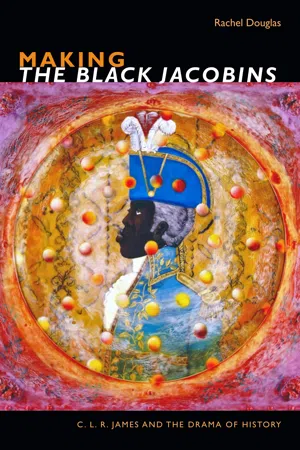 eBook - PDF
Making The Black Jacobins
C. L. R. James and the Drama of History
- Rachel Douglas(Author)
- 2019(Publication Date)
- Duke University Press Books(Publisher)
Rather, the radical antislavery of the Haitian Revolution is a story of major historical transformation of world importance where slaves vindicate themselves as active actors and as subjects of history in their own right; a vehement rejection of their condition as slaves—things, objects, and even “pieces of furniture” according to the Code Noir . 74 This inaugural self- fashioning that is the Haitian Revolution, whereby Haiti writes its own revo-lutionary agency, making its own history, thus already constitutes a radical rewriting of world history. Central to the present study are the multiple layers of rewriting that inter-sect through the linchpin of these two bastions of historical significance: the Haitian Revolution and C. L. R. James’s Black Jacobins . Rewriting is funda-mentally linked with the practice of history in the Caribbean. From its first appearance, The Black Jacobins itself revolutionized the formation, scope, and perspective of historiography through its bold reinterpretation of events that themselves radically rewrote revolution and the world of Atlantic slaves. Where these rewriting layers—historical reshaping by the events of the Hai-tian Revolution and historiographical transformations inaugurated by The Black Jacobins and its rethinking of the history of the colonized world— come together most forcefully is in James’s own extensive remaking of The Black Jacobins and in his reflections upon that long process of reconstruction itself. Chapter 2, “Making History,” also probes James’s collaboration with former protégé Eric Williams on ideas about capitalism and slavery. 75 The 1949 French edition of Les Jacobins noirs gave a major historical boost to Haiti’s celebrations of the tricinquantenaire —the 150th anniversary of the Haitian Revolution in 1954, only five years after this landmark publication.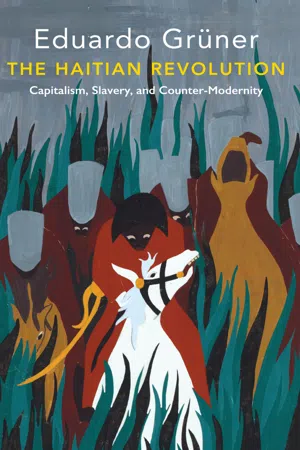 eBook - ePub
The Haitian Revolution
Capitalism, Slavery and Counter-Modernity
- Eduardo Grüner, Ramsey McGlazer(Authors)
- 2019(Publication Date)
- Polity(Publisher)
- The effects of this transformation were not only political and social, or “revolutionary” in the sense in which we usually understand this term. More subtly but also more profoundly, they were philosophical and cultural. For the first time in the history of the new world-system created and controlled by European colonialism, a practical refutation of its false universalism emerged. This refutation showed that Eurocentric, bourgeois, and capitalist “universalism” was merely the ideology proper to a party or part that, because of its dominance, could present itself as a whole, a totality. By making this claim to universality explicit (undoubtedly “with the best of intentions,” as we say), the French Revolution ironically and dialectically created the conditions for what we would now call its own deconstruction. This deconstruction was undertaken by those others who had apparently been subtracted from the “whole”: African American slaves.
- Far from being homogenous, this long process was richly “combined and uneven.” In history, parallel lines can intersect long before they reach infinity, and so even after the parallel but intersecting revolutions in France and Haiti, but especially before these revolutions, we find an immensely complex range of resistance movements, which took various political, social, ethnic, cultural, and religious forms. This is true to such an extent that it is difficult to establish statistical regularities, let alone conceptual formulas, that might account mathematically for – or help to determine “laws” specific to – these particular historical processes. (This is obviously not to discount the various general tendencies that have proven valid for the history of the world-system as a whole.) As Goethe famously said: “All theory … is grey. Life’s golden tree is green.”
Enter Saint-Domingue/Haiti: A Portrait of “Sugar Island” in 1791
In this section, I will return to several of the questions that I addressed in the last section on slave rebellions, and I will try to draw several theoretical conclusions in the process. But I will do this while also beginning to address the most important and revolutionary of the resistance movements organized by slaves. In this movement, “resistance” was transformed into an active offensive that managed to win political power and that resulted in the founding of the République noire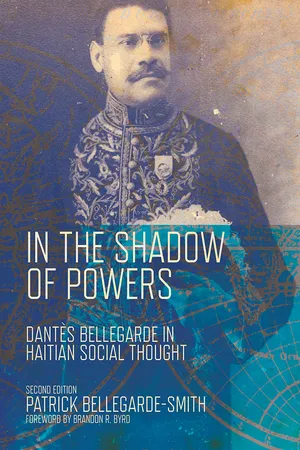 eBook - ePub
In the Shadow of Powers
Dantes Bellegarde in Haitian Social Thought
- Patrick Bellegarde-Smith(Author)
- 2019(Publication Date)
- Vanderbilt University Press(Publisher)
It did, however, effect a displacement of social groups through the elimination of the white upper stratum. Once the dust had settled on the Haitian Revolution and the counterrevolution was victorious—since the incremental decisions that could have led to momentous change had not been taken—the future social and political direction was almost certain. The incipient Haitian bourgeoisie answered the call of nationalism sweeping through Europe and the Americas in the wake of the Napoleonic military and political victories. 47 If nation building demanded that a national cultural identity be formally recognized, another priority was added for the nascent state. An ideology of government, with directions and powers to be defined, needed to be translated into institutions and practices. A new nation-state exercises new roles as it assumes the formal trappings granted by independence. It fills a gap at the highest level of organization, exercising its new sovereignty in selecting a form of government. In order to function in the international system, it must and does create a more sophisticated organization than it had hitherto needed in the economic, military, and diplomatic spheres. But historical facts establish precedents and define the particularity of a nation, thus becoming crucial in latter development. Hence, an early shift in policy, however slight, has portents for future choices that become increasingly limited as time passes, since institutions can be said to be in their infancy and therefore, more malleable. Haitian independence may have been an afterthought to the achievement of liberation for the slave, and freedom from petty social vexation for the affranchi, rather than an early deliberate goal. After independence, in any case, the urgency of consolidating the gains won by war reflected the compromises that the leadership was anxious to make eBook - PDF
Upholding Democracy
The United States Military Campaign in Haiti, 1994-1997
- John R. Ballard(Author)
- 1998(Publication Date)
- Praeger(Publisher)
PARTI HISTORICAL BACKGROUND "Haiti is imprisoned by its past." 1 Robert D. Heinl The internal conflict that resulted in the intervention of other nations into Haitian affairs in 1994 had deep roots in the culture and national character of Haiti. To place the military intervention in proper context, operation Uphold Democracy must be viewed from a perspective that includes Haiti's troubled past and Amer- ica's extensive involvement in Haitian affairs. Although French in cultural tradi- tion, Haiti has always had a strong, yet variable political and economic affilia- tion with the United States; and this long-standing relationship between the two nations had a dominant influence on planning and executing the operation. Haiti has a unique heritage. No clear understanding of Haitian affairs can be gained without an appreciation of the traumatic history of this, the world's first black republic. This history begins with the initial Spanish colonization of His- paniola and the subsequent development of the French colony of St. Domingue in Haiti. Haitian history took a radical turn when, spurred by the French Rev- olution, Toussaint L'Ouverture and his followers fought a war of independence against France. Thus, the first black republic issued from a bloody and divisive revolution, which profoundly marked its national character ever after. Unfortunately, the natural resources that made the French colony so prosper- ous were rapidly depleted once Haiti gained its independence and the Haitian people began to suffer from a plague of internal strife. This dissension was so severe that it destroyed the richness of the land and the promise that independ- ence had brought in 1804. A succession of regimes, poorly directed and ending in coups from the countryside, soon marked Haitian politics. During the nation's first century twenty-four rulers held sway in Port-au-Prince, yet only eight served a full term of office and only two retired peacefully. 2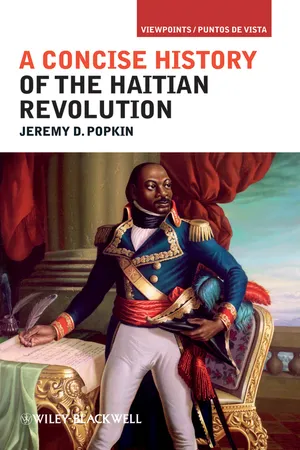 eBook - ePub
- Jeremy D. Popkin(Author)
- 2011(Publication Date)
- Wiley-Blackwell(Publisher)
bossales must have become blurred as they all participated together in the fighting and suffered together at the hands of the French. Dessalines’s insistence, in his 1805 constitution, that all Haitians, regardless of origin or skin color, now formed a single group reflected a certain reality: the revolution had forged a new national community, although not one as united as Dessalines had hoped.Despite the profound significance of the events of 1804 and 1805, not just for the people of the newly proclaimed nation of Haiti but for the entire western world, it would be a mistake to think that the story of the Haitian Revolution ended with the victory over the French and the establishment of new “imagined community” of Haitian citizens.2 Not until the middle of the nineteenth century was it clear what the lasting characteristics of Haitian society and politics would look like. Conflict over the country’s future direction soon became so violent that Dessalines, the determined general who had defeated the French, was assassinated. For fourteen years, from the beginning of 1807 to 1820, Haiti split apart, as the divisions between blacks and free men of color and between the northern and southern regions reasserted themselves in a simmering civil war. Instead of becoming one independent state, Haiti might well have developed into two rival countries.Internal divisions were not the only threat to the future of the experiment launched in 1804. Despite the conclusiveness of the French defeat, few whites at the time believed that a society governed by people of African ancestry could endure; most assumed that it was just a matter of time before some outside power succeeded in reasserting control over the island. France, Haiti’s former colonial overlord, refused to recognize the new country’s independence, and former colonists and government officials there continued to discuss plans to reoccupy the territory for several decades after the independence declaration of 1804. In the meantime, the Spanish and Portuguese colonies in central and South America followed Haiti’s lead in demanding their own independence, but, like the United States, they refused to recognize the black-ruled island as an equal partner in the new world of independent states that now made up the Americas. Disadvantaged by structural changes in the world economy that doomed any hope of recovering the prosperity of the colonial past, and marginalized by the rising tide of racialist prejudice that characterized the nineteenth century, Haiti found itself condemned to a precarious existence from which, many would argue, it has never really been able to escape. eBook - PDF
General History of the Caribbean UNESCO Volume 6
Methodology and Historiography of the Caribbean
- NA NA(Author)
- 2019(Publication Date)
- Palgrave Macmillan(Publisher)
As witnesses to this occupation, they felt they had to explain, however reluctantly, what had gone wrong. For this, they turned to nineteenth-century post-independence history and most especially to the elites' failed attempts to establish a working democracy. Neither the attention shown the nineteenth century at large nor the emphasis on its many aborted and trivial 'revolutions' was new. Earlier histor- ians had pondered on political upheavals, notably the 'revolution' of 1843. In 1843 a number of young and idealist members of the elites, mostly but not exclusively mulatres, had successfully challenged the despotic republic of Jean-Pierre Boyer, only to establish an equally despicable dictatorship that 463 General History of the Caribbean lasted merely a year. This mockery of a revolution set up the pattern for both the establishment and removal of Haiti's autocratic regimes. Even before 1915 it had been hard to reconcile such events and the glory of the 'real' Revolution. 32 The difference for the members of the Societe and their contemporaries was the widespread feeling that the verdict of a societal failure, a debatable diagnostic in the nineteenth-century, could not be questioned any more after 1915. In that context, post-independence history acquired new meaning, its analysis new relevance. Here again Sannon was a clear leader in establishing both the context and the purpose of historiography. His Essai historique sur la revolution haf- tienne de 1843 (Historical essay on the Haitian Revolution of 1843) (905) is a work of historical sociology that draws on newspapers and other publica- tions of the time to explain the dismal failure of the most spontaneous effort to establish parliamentary democracy in Haiti. Sannon blames this failure on what some theorists would call today 'the political culture' of the Haitian elites.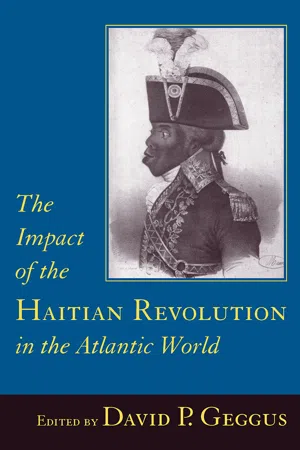
- David P. Geggus(Author)
- 2020(Publication Date)
- University of South Carolina Press(Publisher)
An attempt to unite the states into one nation in the 1848 revolutions failed and this was achieved only in 1871 with the founding of the second Reich that was succeeded in 1918 by the Weimar Republic, and in 1933, by the third Reich. 2. The perception of the Haitian Revolution in Germany partially contradicts the very interesting consideration of Michel-Ralph Trouillot’s “An Unthinkable History: The Hait-ian Revolution as a Non-Event,” in Trouillot, Silencing the Past: Power and the Production of History (Boston: Beacon Press, 1995), 70–107. For an extensive treatment of the reception of Haitian history in Germany during the first half of the nineteenth century see my Die deutsche Rezeption haitianischer Geschichte in der ersten Hälfte des 19. Jahrhunderts. Ein Beitrag zum deutschen Bild vom Schwarzen (Cologne: Böhlau,1992). For the role of Haiti in German fiction, see Herbert Uerlings, Poetiken der Interkulturalität. Haiti bei Kleist, Seghers, Müller, Buch und Fichte (Tübingen: Niemeyer, 1997). 3. For the role of the slave uprising in connection with the revolution see the detailed analysis in Carolyn E. Fick, The Making of Haiti: The Saint Domingue Revolution from Below (Knoxville: University of Tennessee Press, 1990). A general overview of the political history of the revolution can be found in T. Ott, The Haitian Revolution 1789–1804 (Knoxville: Uni-versity of Tennessee Press, 1973). 4. James G. Leyburn, The Haitian People (New Haven: Yale University Press, 1941), 42. 5. Benoit Joachim, “La reconnaissance d’Haïti par la France (1825): Naissance d’un nouveau type de rapports internationaux,” Revue d’histoire moderne et contemporaine 22 (1975): 369–96. 6. For the history of independent Haiti up to 1859 see David Nicholls, From Dessalines to Duvalier. Race, Colour and National Independence in Haiti (Cambridge: Cambridge Uni-versity Press, 1979), 33–102; Leyburn, Haitian People, 32–93. For the conflicting views on the regime of Soulouque see John E. eBook - ePub
Practices of Resistance in the Caribbean
Narratives, Aesthetics and Politics
- Wiebke Beushausen, Miriam Brandel, Joseph Farquharson, Marius Littschwager, Annika McPherson, Julia Roth, Joseph T. Farquharson(Authors)
- 2018(Publication Date)
- Routledge(Publisher)
He argues that the different references to the contradictory and violent past of Haiti from both external and internal viewpoints are a constitutive factor of Haitian culture and identity. Eser starts from the premise that “[t]he most salient historical event of Haitian history can be traced back to the revolution of enslaved people in 1791, a process of political resistance and emancipation, which, in 1804, led to independence and the constitution of the Haitian state” and stresses that the event continues to be an important historical point of reference which is highly charged with symbolic value. In his contribution, he looks at different imagologies of Haiti and provides a concise overview of the diverse cultural and political meanings that have been and continue to be attached to the Haitian Revolution on the international level, in the inner-Haitian debate on the subject, and in fictional, artistic discourses. Drawing on Walter Benjamin’s concept of the ‘dialectical image,’ Eser compares and contrasts these different “registers of knowledge” and perspectives on the Haitian Revolution with recent debates and discourses in and of Haiti through an investigation of the importance of the cultural legacy of the Haitian Revolution and its contemporary usage in Haitian society and culture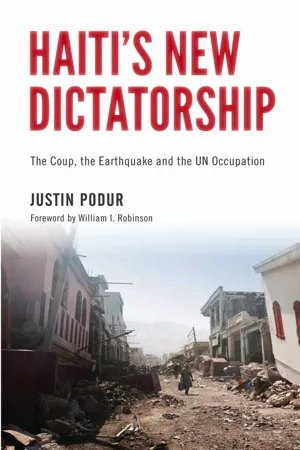 eBook - ePub
Haiti's New Dictatorship
The Coup, the Earthquake and the UN Occupation
- Justin Podur(Author)
- 2012(Publication Date)
- Pluto Press(Publisher)
1 HISTORICAL CONTEXTHaiti in the Americas from independence to today
Before starting the analysis of the post-2004 period, some historical context is necessary. Most books on Haiti include a short overview of the past, and there are several good histories. This background will emphasize the aspects of history that are important for understanding recent history: specifically, the constraints on Haiti’s economic and political sovereignty, imposed from the outside.HAITI IN THE COLONIAL PERIODWith the Dominican Republic, Haiti is one of two countries on the island of Hispaniola, whose indigenous inhabitants came into contact with Europeans in 1492 with Christopher Columbus’s first voyage to the Americas. Columbus left a settlement behind, and the devastation of the indigenous population through brutal violence, forced labour, and disease began immediately.1 Over the following century, the indigenous population of many of the new Spanish colonies was wiped out, reducing the forced labour pool accordingly. The Spanish then introduced African slaves in Hispaniola, as they did in Cuba and other colonies. Haiti was thus one of the first terminal destinations for the captured men and women of the transatlantic slave trade.In the sixteenth and seventeenth centuries, European colonial powers, including Spain, the Netherlands, England, and France, fought naval battles directly and through proxies (pirates) for colonial possessions in the Americas. The Caribbean was the major site of these conflicts. France began to settle colonists in western Hispaniola in the seventeenth century, and by the end of that century the Spanish ceded the western part of Hispaniola to the French, who named the colony St Domingue.St Domingue became France’s most important colony and a major source of its wealth. St Domingue’s wealth was from a variety of export crops, especially sugar and coffee, but also tobacco, cocoa, cotton, indigo, and others, produced with slave labour for European markets. In the eighteenth century the colonial capital, Port-au-Prince, was destroyed twice by major earthquakes, once in 1751 and again in 1770. By the late eighteenth century, the slave population was far higher than the white population. The slaves’ resistance was constant and, in various ways, successful: they raided plantations, freed others, and, like slaves in Brazil, Colombia, elsewhere in the Caribbean, and the United States, they founded maroon societies of escaped slaves. The history of slavery and of resistance continues to have a powerful resonance in Haiti’s culture today. eBook - PDF
Empires of the Imagination
Transatlantic Histories of the Louisiana Purchase
- Peter J. Kastor, François Weil, Peter J. Kastor, François Weil(Authors)
- 2009(Publication Date)
- University of Virginia Press(Publisher)
France’s 1795 constitution included a statement that made clear that it was to be applied in the colo-nies as it was in the metropole, thus eliminating any juridical and political distinctions between the two regions. The entire population of the colony of Saint-Domingue was represented, frequently by elected officials of Af-rican descent and in one case by one who was African-born, Jean-Baptiste Belley, in France’s representative bodies in Paris. In Saint-Domingue by the late 1790s, meanwhile, power was firmly in the hands of Toussaint-Louverture.5 The radical antislavery colonial order was challenged repeatedly in the years after 1794. But it was only after Napoleon Bonaparte’s rise to power in 1799 that it came under direct and sustained assault within the The Haitian Revolution and the Sale of Louisiana 97 French state itself. Bonaparte came to believe both that it was necessary for France to recover the pre-1789 levels of its colonial production and that in order to do so he would have to destroy the power of the new elites in the Caribbean, particularly Louverture. Driven by these perceptions, from the end of 1799 through 1803, Bonaparte made a series of choices that led to open conflict in Saint-Domingue, the reestablishment of slavery in the French empire, the independence of Haiti, and the cession of Louisi-ana. Unfortunately for historians, he left few written traces of the evolu-tion of his thought on colonial policy during these years — much of what we know of his opinions comes from reports made by those who worked around him during these years — and as a result it is difficult to know precisely when or how he came to the decisions he did, and how seriously he considered the paths not taken. Nevertheless, it is possible to outline the major influences and turning points in the ultimately disastrous series of choices made by the First Consul.6 Napoleon Bonaparte came to power through the famous coup of 18 Brumaire An VIII (9 November 1799).
Index pages curate the most relevant extracts from our library of academic textbooks. They’ve been created using an in-house natural language model (NLM), each adding context and meaning to key research topics.

