History

Toussaint Louverture
Toussaint Louverture was a leader of the Haitian Revolution, which resulted in the abolition of slavery and the establishment of Haiti as the first independent black republic. Born into slavery, Louverture rose to prominence as a military and political leader, successfully leading the fight against French, Spanish, and British forces. His legacy as a revolutionary and visionary leader continues to inspire movements for freedom and equality.
Written by Perlego with AI-assistance
Related key terms
1 of 5
10 Key excerpts on "Toussaint Louverture"
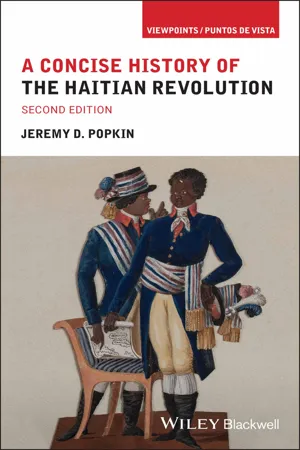 eBook - PDF
- Jeremy D. Popkin(Author)
- 2021(Publication Date)
- Wiley-Blackwell(Publisher)
A Concise History of the Haitian Revolution, Second Edition. Jeremy D. Popkin. © 2022 John Wiley & Sons Ltd. Published 2022 by John Wiley & Sons Ltd. T he departure of the French emancipator Sonthonax for France in late 1797 left no doubt that Toussaint Louverture had become the most powerful figure in Saint-Domingue. In the four years since he had joined the French in 1794, the black general had defeated the foreign invaders who had threatened the colony and skillfully outmaneuvered both the French authorities and his rivals for power in the colony. He now had the chance to implement his ideas about how a society without slavery could be developed in what had been the most extreme example of a “slave society” in the Americas. In the years from 1798 to 1801, Louverture laid the basis for what the several modern Haitian scholars have called the “Louverturian state,” a system of centralized authoritarian govern- ment that has had a lasting influence on Haiti’s destiny. 1 Louverture’s ex- periment in state-building came at a high price, however. As he tried to create a powerful government capable of protecting the freedom of the black population from slavery, he found himself caught up in a series of conflicts with opponents who resented his authority. These opponents included his rival André Rigaud and other “anciens libres,” members of the mixed-race elite, who resented the rise of a black man to the colo- ny’s top position. They also came to include many ordinary members of the island’s black population, whose vision of freedom was more con- crete than his, centering on their right to claim land for themselves and establish self-sufficient farms. By 1801, for the first time, he had to defeat 4 Toussaint Louverture in Power, 1798–1801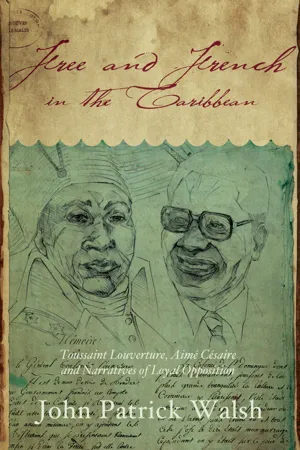 eBook - ePub
Free and French in the Caribbean
Toussaint Louverture, Aimé Césaire, and Narratives of Loyal Opposition
- John Patrick Walsh(Author)
- 2013(Publication Date)
- Indiana University Press(Publisher)
Boromé privately described him as a “double-dealer [fourbe],” while Geggus resigns himself to the mysteriousness of Toussaint: “The man remains, as ever, an enigma” (135). 24 It is perhaps impossible to avoid rendering judgment on Toussaint as a world historical figure. Perhaps the space between historical and mythical representation has collapsed in the figure of Toussaint. Yet it is clear that the biographical approach has led to competing representations. 25 For my purposes, it is necessary to appreciate historical renderings based on both archival evidence and well-supported imagination in order to read the “discursive opening” of letters and reports that begin in earnest in the spring of 1794. 26 The Haitian Revolution enabled the “literary orbit” of Toussaint Louverture (Dubreuil, 121). Dubreuil finds him a “character for himself and for others. King of tragedy, despotic and sublime,” going so far as to attribute to Toussaint the distinction of the “opening of indigenous speech in French”: “In many respects, Toussaint Louverture makes possible [favorise] the birth of francophone literature” (121). As others have done before him, Dubreuil plays on the polysemic dimension of “Louverture” to consider the ways in which his words and deeds “ring out” for the generations that followed him. There is no doubt that Toussaint was a “pioneer” in the critique of French colonialism, but it is important to nuance this declaration by looking more closely at the variety of writings in which he narrated his movement from the insurgent camps to royalist Spain and finally to the French Republic. To read Toussaint is to stay close to the documents but also to imagine listening to a gifted storyteller eBook - PDF
Slave Revolt on Screen
The Haitian Revolution in Film and Video Games
- Alyssa Goldstein Sepinwall(Author)
- 2021(Publication Date)
- University Press of Mississippi(Publisher)
Lissade explains Louverture’s role in stabilizing currency values throughout Hispaniola when his armies ruled over Spanish Santo Domingo. The film then turns to the early 1800s. It discusses the Leclerc expedition, Toussaint’s imprisonment, and the return of his remains to Haiti in 1983. Jacques-Antoine Auguste discusses the phenomenon of France reclaiming Toussaint in the twenty-first century. He reminds his viewers that France betrayed Toussaint while he was alive, and he insists that Louverture must be seen “as a Haitian head of state, not a French general” (17:03). The narra-tor reads quotes by Toussaint about his wishes for the happiness of Saint-Domingue’s inhabitants, while the camera pans over some of his possessions (such as weapons) that are still in Haiti, at MUPANAH (the Musée du Pan-théon National Haïtien). The film closes with laments about Toussaint’s fading memory in Haiti. Vérilus interviews Michel-Philippe Lerebours, director of the Musée d’art haïtien. Lerebours complains that schoolchildren and others know Toussaint’s name, but do not understand who he was, especially compared to Dessalines. Lerebours laments that some people “pass his statue on the Champ de Mars [in Port-au-Prince] and . . . don’t even realize what they are looking at. . . . They regard it with indifference, as if it were the statue of a foreigner” (19:26). He concludes that “our [historical] memory is seriously in peril, and some-thing must be done so that this memory survives.” The film’s last word goes to Durand, who was later a victim of the 2010 earthquake; he calls Toussaint not just a “planetary genius,” but a “cosmic one” (20:03). Even if it had not been Vérilus’s intention, using French made it easier for foreigners to view the film. French documentarians Laurent Lutaud and Georges Nivoix saw Vérilus’s film, then invited him to collaborate on their documentary on Toussaint (discussed in chapter 6).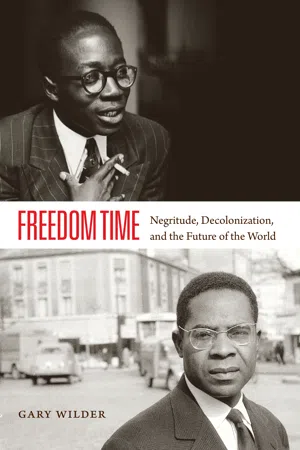 eBook - PDF
Freedom Time
Negritude, Decolonization, and the Future of the World
- Gary Wilder(Author)
- 2015(Publication Date)
- Duke University Press Books(Publisher)
189 But just as Césaire had to liberate Schoelcher’s legacy from the offi cial republican commemoration of abolition, Louverture’s legacy had to be disentangled from mythic narratives that fixed him as the father of Haitian independence. Memories of Louverture, of course, never disappeared. His stature only grew during the nineteenth century as the specter of the Hai-tian Revolution haunted French policymakers and inspired peoples of Afri-can descent. 190 But the revolutionary and utopian specificity of Louverture’s constitutional initiative was often obscured. Haitian independence helped create the appearance of a necessary equiva-lence among anticolonialism, political emancipation, and national indepen-dence. This conflation was later reinforced by activists and scholars who viewed the Haitian Revolution through the lens of twentieth-century anti-colonialism. Commentators often interpreted Toussaint’s refusal to declare national independence as a failure to do so; his commitment to partnership with France has been criticized as poor judgment, false consciousness, or in-strumental duplicity. Césaire’s postwar projects for decolonization suffered these same accusations and should be situated within Louverture’s lineage. But to claim that Césaire’s turn to federation was mediated by the legacy of Louverture is not to suggest that he simply imitated the Precursor. Césaire enacted a range of sometimes ambivalent identifications. His engagement with Haitian history informed his strategic orientation to politics and his programmatic writings about “true” decolonization as a revolutionary over-coming of colonialism with indispensable political, socioeconomic, cultural, and psychic dimensions. He conjured the revolution in Saint-Domingue as a portentous precedent for the Antillean revolution he warned would come if France continued to treat the departments as colonial possessions. 191 Yet the eBook - ePub
What You Do Is Who You Are
How to Create Your Business Culture
- Ben Horowitz(Author)
- 2019(Publication Date)
- Harper Business(Publisher)
Louverture’s response was to publish a justification of the Haitian Revolution that laid out his theory of race and culture. As Philippe Girard wrote, “One by one he listed Vaublanc’s accusations; one by one he took them apart. Blacks were not lazy and ignorant savages: slavery had made them so. Some violence had indeed taken place in the Haitian Revolution, but violence had also taken place in the French Revolution, he reminded his readers; the slaves had in fact proved remarkably merciful toward the planters who had so cruelly oppressed them.” Louverture demonstrated that these former slaves had elevated their culture to a point where he could in justice close the letter by reaffirming black freedmen’s “right to be called French Citizens.”In 1798, after Louverture negotiated peace and a diplomatic relationship with the British, the London Gazette wrote:Toussaint L’Ouverture is a negro and in the jargon of war has been called a brigand. But according to all accounts, he is a negro born to vindicate the claims of this species and to show that the character of men is independent of exterior color.This newspaper, in a nation that traded more African slaves than any other, published that encomium thirty-five years before Britain abolished slavery. As Louverture had envisioned, Europeans were beginning to see that it was the culture of slavery rather than the nature of the slaves themselves that shaped their behavior.Some Americans began to see it that way, too. In 1798, during a rift with France, the U.S. Congress banned all trade with France and its colonies. Commerce to and from Saint-Domingue came to a standstill. Louverture sent a man named Joseph Bunel to see the U.S. secretary of state, Thomas Pickering, about lifting the embargo. Louverture shrewdly selected a white man as his ambassador to appeal to the sensibilities of the slave-owning country. It worked. In 1799, the U.S. Congress authorized President John Adams to exempt from the trade embargo any French territory that did not interfere with American trade. The law was so transparently intended for Saint-Domingue that it was nicknamed “the Louverture clause.”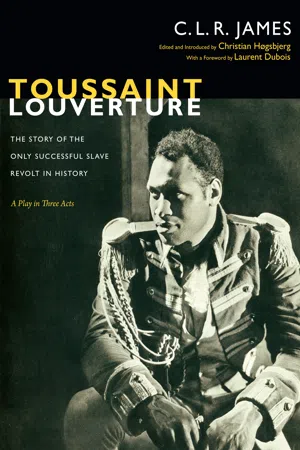 eBook - PDF
Toussaint Louverture
The Story of the Only Successful Slave Revolt in History; A Play in Three Acts
- C. L. R. James, Christian Høgsbjerg(Authors)
- 2012(Publication Date)
- Duke University Press Books(Publisher)
L. R. James is a Negro writer, born in the West Indies in 1901. After teach-ing and miscellaneous journalism, he came to England in 1932. He writes for the Manchester Guardian and other papers. He hopes to publish next year a political study of Toussaint Louverture and the Haitian Revolution. [Note by the Author.—In July 1789, the French portion of San Domingo (today Haiti) was the richest and most valuable colony in the world. Thirty thousand whites and a similar number of mulattoes controlled the produc-tion of vast wealth by the ruthless exploitation of half a million slaves. In Au-gust 1791, the slaves, stirred to action by the conflict between whites and mu-lattoes, rose in revolt against their masters. They encamped in the mountains and waged a guerrilla warfare against the French colonial government, which was torn by its own dissensions and the bewildering sequence of events in revolutionary France. In the early years of the revolution, the various Com-missioners sent out by the French government (of whom Roume was one) might have come to terms with the revolted slaves, then undisciplined and unorganised. But all such attempts were foiled by the treachery and intransi-gence of the local ruling class. Out of the turmoil of revolution and civil war arises a powerful Negro army led by three outstanding figures, Dessalines, Christophe, and, incomparably the greatest of them all and the undisputed chief, Toussaint Louverture. Freedom is the watchword of commanders and soldiers alike. The mulattoes meanwhile have organised themselves and seized the south of the colony. The French planters, in despair, invite the British government to conquer the colony and re-establish slavery. The British send an expeditionary force. In this confusion the Negroes steadily become the most powerful force in the country and Toussaint’s army is offi-cially recognised by the government in France. After long and arduous years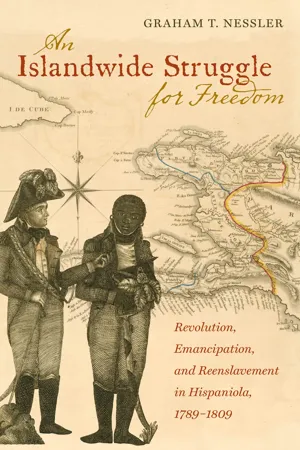 eBook - ePub
An Islandwide Struggle for Freedom
Revolution, Emancipation, and Reenslavement in Hispaniola, 1789-1809
- Graham T. Nessler(Author)
- 2016(Publication Date)
- The University of North Carolina Press(Publisher)
Meanwhile, the thousands of freed men and women who comprised the bulk of Toussaint’s power base were becoming increasingly apprehensive as their once-trusted leader, intent on maximizing plantation revenues, imposed restrictive labor regimes modeled substantially on that of Sonthonax that tied the former slaves to their old plantations or the military. Toussaint also parceled out many abandoned plantations to his loyal officers and even invited back many of the refugee planters who had once held the cultivateurs in bondage. 50 All this led some of these discontented ex-slaves to engage in periodic armed resistance that Toussaint swiftly crushed. 51 Toussaint’s ability to thwart these varied challenges to his authority depended on a masterful command of the arts of war and politics, a willingness to employ brute force, an indefatigable intensity (Toussaint reportedly slept only a few hours per night), and a powerful charisma enhanced by skillful appeals to the ideals of liberty and equality. Toussaint shared many of these qualities with Napoleon, whose military conquests in the 1790s in parts of Europe and the Middle East paralleled Toussaint’s martial triumphs in Hispaniola. 52 Napoleon’s ability to translate his military victories and professed loyalty to revolutionary ideals into widespread political support enabled his coup d’état of 18 Brumaire year VIII (9 November 1799), which overthrew the Directory and replaced it with a regime headed by Napoleon known as the Consulate. 53 Toussaint’s assumption of authority over France’s most prized colony around the same time made him Napoleon’s most formidable ally—and potential adversary—in the Caribbean. Aware of their interdependence and of the other’s power, both men maintained a cautious coexistence in the final years of the eighteenth century eBook - ePub
Haiti In The World Economy
Class, Race, And Underdevelopment Since 1700
- Alex Dupuy(Author)
- 2019(Publication Date)
- Routledge(Publisher)
The uprising signalled the existence of significant divisions among the members of the newly formed ruling class under Louverture's leadership. There were those who, like Moise, supported the aspirations of the masses for a more radical redistribution of the colonial estates and opposed any compromise with the French. With the execution of Moise, Louverture destroyed his left wing, an act that would prove later to have been perhaps his gravest error (James 1963, 286-287). Others, like Dessalines and Christophe, stood for the system of plantation production for export endorsed by Louverture, but opposed the alliance Louverture sought with the former French planters. They represented the more nationalist wing of the new ruling class and would eventually break with Louverture, but not until after Bonaparte's expedition to restore slavery sparked a new wave of revolts and the final war of independence.The Fall of Louverture and the Struggle for Independence
Bonaparte never accepted the legitimacy of Louverture, his regime, or its Constitution. After the restoration of peace in France with the signing of the Treaty of Lunéville between France and Austria in February 1801 and the Peace of Amiens in March 1802 between England and France, Bonaparte made plans to send an expedition to retake possession of Saint-Domingue and restore slavery. James may be right to argue that the defeat of the Jacobin democratic republic in France in 1794 made it possible for the French bourgeoisie to contemplate retaking Saint-Domingue. It could well be that if the Jacobins had consolidated their power and the democratic republic, "Haiti would have remained a French colony, but an attempt to restore slavery would have been most unlikely" (James 1963, 283).But Bonaparte's coup d'état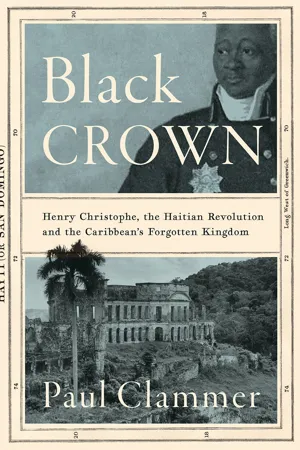 eBook - ePub
Black Crown
Henry Christophe, the Haitian Revolution and the Caribbean's Forgotten Kingdom
- Paul Clammer(Author)
- 2023(Publication Date)
- Hurst Publishers(Publisher)
According to the account of one sympathetic French general who knew Christophe, he was ‘so modest that his friends had to beg him to apply for the rank’, but Louverture was more confident in his officer and commended him for his particular role in defending the city against the internal threats carried by Rigaud’s partisans. The events of Jacmel went unmentioned. 42 Even before the conquest of Santo Domingo Louverture had begun to plan for Saint-Domingue’s future. As always, the plantation was at the heart of his plans. In October 1800 he issued a strict decree that would govern the way that the plantations were to be run under his rule, effectively putting them under martial law. Workers were banned from leaving their plantations and ordered to obey their managers as if they were under military command. Vagrancy was to be severely punished and the army made responsible not just for administering discipline but also for the productivity of the plantations. Along with their new military promotions, Dessalines and Moyse were also made Inspectors of Agriculture—military enforcers of plantation labour. 43 In a later decree, Louverture banned the sale of small plots of land for private cultivation lest they draw labour away from the sugar and coffee plantations, and attempted to bring in an internal identity card that reminded many of the pass once issued by masters that was used to allow their slaves to travel to markets. 44 ‘If I made my people work it was for them to understand the price of liberty without license, it was to prevent the corruption of morals,’ Louverture would record later, ‘It was for the general happiness of the island, and in the interest of the republic.’ 45 It was an outlook that greatly appealed to Christophe, and in later years when drawing up his own set of laws to govern Haiti he was profoundly influenced by the disciplined morality of Louverture’s agricultural programme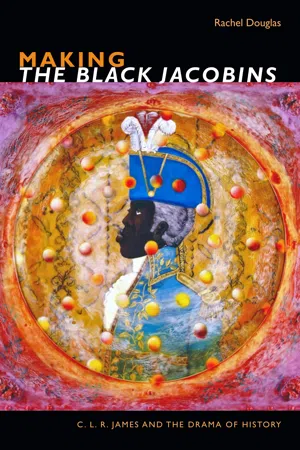 eBook - PDF
Making The Black Jacobins
C. L. R. James and the Drama of History
- Rachel Douglas(Author)
- 2019(Publication Date)
- Duke University Press Books(Publisher)
Against the backdrop of barbaric slave treatment, there are strains of Mozart playing, as the planter and French representative drink to liberty, equality, fraternity, and the motto of the new French Republic after Bullet has tried to convince his guest that such notions do not apply to the slaves because of their sup-posed subhumanity. In its original formation, then, the first scene would have ended with the Colonial Association president and French representative drinking to one interpretation of the French revolutionary motto “Liberty, Equality, Fra-ternity,” one which denies that black slaves are even human beings. There-after, scene 2 would have opened with early Haitian leader Boukman also proclaiming “Liberty—Equality—Fraternity.” This mirroring of the French revolutionary motto at the end of scene 1 and the beginning of scene 2 would have underlined the importance of such notions to the slaves and their own understanding of the French Revolution and its motto. Toussaint Louverture Takes Center Stage | 45 The nalis script gives the best indication of what changed in the play as performed. Now, we start with the slaves themselves and a brief depiction of the Bois Caïman ceremony, during which the first major slave revolt of the Haitian Revolution was planned. Both versions outline differences between Toussaint and Dessalines’s leadership styles, lingering on what we could call, after Paul B. Miller, Toussaint’s “enlightened hesitations” to drink the blood of the sacrificial animal as Dessalines and the others encourage him to par-take symbolically of the revolution. 39 Toussaint’s enlightened hesitations mean that he literally “remains motionless” and “still hesitates” until he at last responds to the crowd’s incitement: “He takes the vessel into his hands and drinks” ( nalis , 4).
Index pages curate the most relevant extracts from our library of academic textbooks. They’ve been created using an in-house natural language model (NLM), each adding context and meaning to key research topics.

