History

Harriet Tubman
Harriet Tubman was an African American abolitionist and political activist who played a pivotal role in the Underground Railroad, a network of safe houses and routes that helped enslaved people escape to freedom. She also served as a spy and scout for the Union Army during the American Civil War. Tubman's courageous efforts to fight against slavery and advocate for civil rights have left a lasting impact on American history.
Written by Perlego with AI-assistance
Related key terms
1 of 5
6 Key excerpts on "Harriet Tubman"
 eBook - ePub
When God Lost Her Tongue
Historical Consciousness and the Black Feminist Imagination
- Janell Hobson(Author)
- 2021(Publication Date)
- Routledge(Publisher)
4Cultural currency and the value of Harriet Tubman
DOI: 10.4324/9780429243554-6They wouldn’t give a sixpence for me. – Harriet TubmanHarriet Tubman’s name resonates in American culture. Celebrated for her status as a self-emancipated woman who guided others to freedom, the incomparable Tubman would become the most famous of the “conductors” on the Underground Railroad in the antebellum U.S. Since their time in this country, enslaved African Americans routinely made escapes from slavery; however, it was not until the 1830s that abolitionists formalized the Underground Railroad as a secret network aiding those who wished to escape their “chattel” status, a history well documented by the network’s most renowned “station master,” William Still.1As an antislavery activist community, which included both Black and White allies – enslaved and free – Underground Railroad secret operatives hid freedom seekers in their homes or churches, transported them on wagons or boats, and spread secret communication codes through letters and word-of-mouth. The most skilled of these navigators worked as guides, or “conductors,” for those seeking freedom in northern states and across the border in Canada – the latter an eventual destination once the U.S. Congress passed the 1850 Fugitive Slave Law that legitimized the recapture of those who had escaped from slavery. While freedom seekers in other regions of the country used different escape routes and other means to resist slavery,2 Tubman carried out much of her heroic work along the Eastern Shore.The skills that Tubman honed as an Underground Railroad conductor shaped her later work as a Union Army nurse, spy, and scout during the U.S. Civil War. She also became the first woman in U.S. history to lead a military raid that ultimately freed nearly 800 slaves. Through all these accomplishments, Tubman earned her reputation as “Moses,” as nicknamed by William Lloyd Garrison, editor of the abolitionist newspaper The Liberator.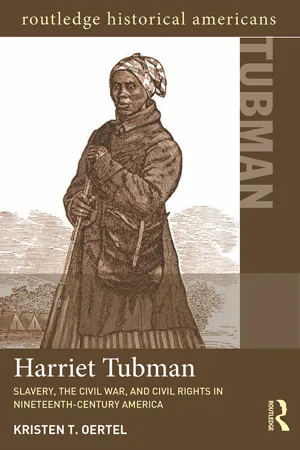 eBook - ePub
Harriet Tubman
Slavery, the Civil War, and Civil Rights in the 19th Century
- Kristen T. Oertel(Author)
- 2015(Publication Date)
- Routledge(Publisher)
29 America’s tragic flaws must be paired with its triumphs because much of American identity is embedded in that central tension between the ideals of democracy and the practice of oppression; furthermore, American students need to see the human in history. A litany of heroic acts and larger-than-life historical figures places the past on a pedestal, making it more difficult for students to connect with history and learn from it.Thus Harriet Tubman’s courageous feats on the Underground Railroad and her accomplishments while serving in the Union army must be discussed alongside the unfortunate truths of black and female inequality in order to absorb the full breadth of her life and its challenges. Tubman, like many African Americans living in the nineteenth century, struggled with poverty, racism, and sexism throughout her lifetime and died nearly penniless. The fact that one of the most well-known black women in the United States repeatedly found herself in dire living conditions attests to the larger structural inequalities that wove their way into American society. If we only focus on the hero, on the Tubman who stands above the crowd and “beats” the slave catchers, we forget a much larger part of the story, the injustices that persistently weighed Tubman down before and after her storied career on the UGRR.And yet, the Tubman myth prevails in American culture, even as more complicated portraits of her show up on library shelves and in college classrooms. The proliferation of children’s books that focus on Tubman continues, but the more recent texts take into account the centrality of slavery in American history and offer a surprisingly honest account of its brutality. For example, Harriet Tubman, Secret Agent , published by National Geographic in 2006, opens with a bold and unadulterated vision of the institution: “Long before the Civil War began, Harriet Tubman started her own war against slavery. Born a slave, she worked day after day and year after year on Maryland farms. The daughter of one master whipped her, scarring her for life. Another master fractured her skull. She saw her sisters taken away by slave traders.” Author Thomas B. Allen expanded the typical chronology presented in many children’s books and highlights Tubman’s service in the Union army. In fact, the subtitle of the book, How Daring Slaves and Free Blacks Spied for the Union During the Civil War , reveals this focus, and Allen provides a cast of characters that includes lesser-known abolitionists like Alexander Milton Ross and other female spies like Elizabeth Van Lew. He acknowledges that Tubman worked inside a network of free blacks and slaves, claiming, “She was not alone. She was one of countless—and usually unknown—African-Americans who served the Union as spies.” 30 eBook - PDF
Ladies in Arms
Women, Guns, and Feminisms in Contemporary Popular Culture
- Teresa Hiergeist, Stefanie Schäfer, Teresa Hiergeist, Stefanie Schäfer(Authors)
- 2024(Publication Date)
- transcript Verlag(Publisher)
Her dangerous, yet suc- cessful secret journeys into the slave states to rescue bondswomen, men, and children have immortalized her in the minds of Americans. […] Yet, very little is really known about Harriet Tubman. (»From« 45, emphases mine) With only a few historical sources and studies dominating the discourse, Tubman’s life and work have become shrouded in myth, and there has been »a need to redis- cover Harriet Tubman,to separate reality from myth and to construct a richer histor- ical account of her life« (»From« 2004: 50). Larson’s own work as well as biographical studies by Jean M. Humez (Harriet Tubman: The Life and the Life Stories, 2003), Cather- ine Clinton (Harriet Tubman: The Road to Freedom, 2004), or Kerry Walters (Harriet Tub- man: A Life in American History, 2020), and the collection Harriet’s Legacies: Race, Histor- ical Memory, and Futures in Canada (ed. by Ronald Cummings and Natalee Caple, 2022) have been essential to this ongoing reassessment of Tubman’s life and activism. Mil- ton Sernett points out the magnitude of this endeavor even within the national con- text of the US as he explains that »by learning about Harriet Tubman and her place in the American memory, we learn about ourselves as American people«. Referencing David Blight, he argues that she »may be America’s most malleable icon, with signif- icance for much more than how we are to remember the nation’s struggle with the issue of slavery« (2007: 3, emphasis mine). Walters elaborates that Tubman had, in fact, »disappeared for years from public memory after her death in 1913 – the first disremembrance – only to be further hidden from view, when she finally resurfaced as a heroine in children’s books, by fanciful stories and charming legends that often have little grounding in fact – a second disremembrance« (2020: vii). eBook - ePub
Canadian Cultural Heritage 4-Book Bundle
Molly Brant / Louis Riel / Harriet Tubman / Simon Girty
- Peggy Dymond Leavey, Sharon Stewart, Rosemary Sadlier, Edward Butts(Authors)
- 2015(Publication Date)
- Dundurn Press(Publisher)
Through my mother’s family, I am a descendant of those who made their way to Canada through their contact with the Underground Railroad. Because of this I am particularly interested in the courage of these freedom seekers and am fascinated by the ways in which they came to be free. Unfortunately, I am deeply aware of how little information is known or made available about the systems they used. Despite the importance of this heritage being passed down through the generations to contemporary black and wider community members, particularly through oral tradition, many personal experiences of freedom seekers remain hidden forever. Due to the historic nature of many of the quotations in this book, they may contain archaic and unconventional spellings. The publisher has chosen to lowercase “black.”Harriet Tubman was committed to helping her family and this prompted her to carry out several crossings to rescue her relatives. I wondered if perhaps within the fabric of the stories of the Tubman family there would be details that would extend our knowledge of Harriet and the secret routes she used? Or if perhaps her legacy had lived on through the presence of her descendants? Because the descendants might hold the answer to some of the missing pieces, I began a study of Tubman’s family legacy, as well as her own historical legacy. I met with many descendants from both the United States and Canada and I have included a section on Harriet’s North American genealogy, reflecting her family in both the United States and Canada.I feel that information about her family is important to our understanding of Tubman, the Underground Railroad, and the settlement of people of African descent. It is important for those who have made the run for freedom and never arrived, for those buried in forgotten or hidden cemeteries without our knowledge, and for those of us, like Harriet, who realize that one person can make a difference. Passage contains an image
Introduction
IntroductionThis book will provide some new interpretations and information on the most notable African-American/African-Canadian conductor on the legendary Underground Railroad: Harriet Tubman. Based upon interviews with Tubman descendants, archival materials, and extant literature, this book will acquaint the reader with the experience and contribution of just one of the many notable, identified leaders on the Underground Railroad, placing her in a local, regional, international, and global context.The Underground Railroad was the first freedom movement of the Americas and is credited with infusing Canada with a number of black people. How did it work? Where did people come into Canada? How were they treated upon their arrival? How is it that we spoke of these things in certain places and why was this missing from the education that I was receiving at school? eBook - ePub
Canadian Cultural Heritage Bundle
Louis Riel / Harriet Tubman / Simon Girty
- Sharon Stewart, Edward Butts, Rosemary Sadlier(Authors)
- 2013(Publication Date)
- Dundurn Press(Publisher)
Harriet Tubman
Passage contains an image
Introduction
This book will provide some new interpretations and information on the most notable African-American/African-Canadian conductor on the legendary Underground Railroad: Harriet Tubman. Based upon interviews with Tubman descendants, archival materials, and extant literature, this book will acquaint the reader with the experience and contribution of just one of the many notable, identified leaders on the Underground Railroad, placing her in a local, regional, international, and global context.The Underground Railroad was the first freedom movement of the Americas and is credited with infusing Canada with a number of black people. How did it work? Where did people come into Canada? How were they treated upon their arrival? How is it that we spoke of these things in certain places and why was this missing from the education that I was receiving at school?The nature of slavery did not lend itself for many to keep detailed records. For slave owners, the date and place of the birth of the offspring of enslaved women was not always recorded and was left to memory. Many now feel that ancestral memory has power; that “indigenous knowledge” has value not always accepted or recognized. However, the selling of slaves had an impact on plantation memory. No one may have remained in your circle who could verify your date of birth, or even your parentage. No one may have realized the need to do so. When an enslaved African was sold, and once that memory was gone, it was as if a library had been lost. The stories about your birth, issues on your plantation, would be lost unless there had been an opportunity for this information to be passed down through African oral tradition or recorded by slave owners.To this end, there are several dates for Harriet Tubman’s birth in the literature. A descendant fervently believed Tubman to have been born in 1820, “if not earlier.” Harriet Tubman herself indicated that she was “about seventy-five years old” in 1898 as she was trying to ensure that she receive her back pay for her military service and status as a widow. Was she being modest about her age, or is it that she did not know her exact age and took her best guess? Another famous black abolitionist, Frederick Douglass, took February 14th to be his birth date as he had never been provided with documentation to indicate otherwise.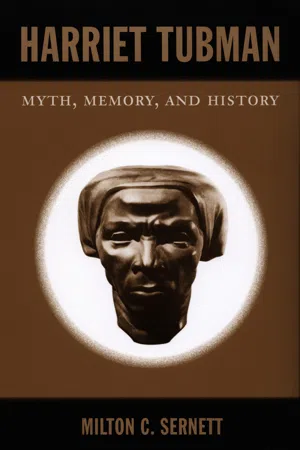 eBook - PDF
Harriet Tubman
Myth, Memory, and History
- Milton C. Sernett(Author)
- 2007(Publication Date)
- Duke University Press Books(Publisher)
Plate 6. “Harriet Tubman’s Underground Railroad.” Copyright © Paul Collins. Courtesy Paul Collins, Collins Fine Art, Grand Rapids, Michigan. Plate 7. Aaron Douglas’s painting “Spirits Rising” (1930–31), which is also known as the Harriet Tubman and Alfred Stern mural. Oil on canvas. At the Rose Mae Withers Catchings Personal Development Complex, Bennett College, Greensboro, North Carolina. Commissioned by Alfred Stern of Chicago, son-in-law of the philanthropist Julius Rosenwald, for Bennett College. Illustration in Richard J. Powell, Black Art: A Cultural History , 2d ed (London: Thames and Hudson, 2002), 65, illustration 36. Plate 8. “Harriet Tubman” (circa 1945), by William H. Johnson. Smithsonian American Art Museum, 1967.59.1146. Courtesy Smithsonian American Art Museum. Plate 9. Harriet Tubman U.S. postage stamp, thirteen cents. First issued in 1978. In the author’s collection. sarah Bradford ’s Harriet Tubman 117 the Civil War veteran. The wedding took place in Auburn’s Central Pres-byterian church, which was organized in 1861 as on offshoot of Auburn’s Second Presbyterian church. Fowler, an abolitionist, and a group of sup-porters had withdrawn from Second Presbyterian after conservatives pressured Fowler’s Presbyterian supervisors to demand that he cease preaching so violently against the South’s “peculiar institution.” One of Fowler’s backers was Charles P. Wood. These Christian “come-outers” replicated a pattern common to many churchgoing abolitionists during the abolition controversy. Christians with abolitionist convictions sepa-rated themselves from impure assemblies, either voluntarily or under duress, and formed new churches and, in some instances, new denomi-nations such as the Wesleyan Methodists and Free Presbyterians.26 Tub-man would have felt at home at Fowler’s Central Presbyterian church, which initially met in rooms of the Young Men’s Christian Association on Genesee Street.
Index pages curate the most relevant extracts from our library of academic textbooks. They’ve been created using an in-house natural language model (NLM), each adding context and meaning to key research topics.

