Social Sciences

Harriet Martineau
Harriet Martineau was a pioneering sociologist and writer known for her contributions to the field of social sciences. She is celebrated for her work in feminist theory, political economy, and social reform. Martineau's influential writings and advocacy for social justice continue to inspire scholars and activists in the study of society and its structures.
Written by Perlego with AI-assistance
Related key terms
1 of 5

10 Key excerpts on "Harriet Martineau"
 eBook - ePub
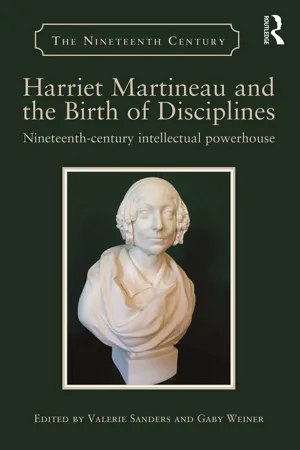
Harriet Martineau and the Birth of Disciplines
Nineteenth-century intellectual powerhouse
- Valerie Sanders, Gaby Weiner(Authors)
- 2016(Publication Date)
- Routledge(Publisher)
28Susan Hoecker-Drysdale, a contributor to this volume, published a book-length sociological biography, Harriet Martineau: First Woman Sociologist, in 1992. From the early 1990s onward, Canadian sociologist Lynn McDonald included Martineau in her surveys of the origins and founding of the social sciences,29 and as we have seen in the Introduction, the inaugural working seminar of the informally organized Harriet Martineau Sociological Society convened on Mackinac Island, Michigan, in 1997.30 Pat Lengermann and Jill Niebrugge-Brantley made Martineau central to their widely cited 1998 text/reader on the women founders.31At the turn of the twenty-first century, Joe Feagan, in his 2000 presidential address to the American Sociological Association,32 made a strong plea for sociologists to pay attention to Martineau, Jane Addams, W.E.B. Dubois and other early sociologists, and to recognize their frequent superiority over many of the more commonly cited white male sociologists such as de Tocqueville. In concert with Feagan’s appeal, Harriet Martineau: Theoretical and Methodological Perspectives appeared in 2001, based largely on papers presented during the 1997 Mackinac seminar. The subsequent activities and substantive work completed by the small group of scholars in the Harriet Martineau Sociological Society have been reported variously by myself and Deborah Logan,33 and need not be repeated here. To summarize, a few sociologists are actively explicating Martineau’s foundational ideas, but the overall impact on the discipline as a whole has been relatively superficial (as John Vint and Keiko Funaki have similarly noted in Chapter 3 in relation to Martineau’s impact on economic theory, despite the popularity of her Illustrations of Political Economy). Beginning with the late 1990s, Martineau is increasingly cited in introductory textbooks as a foundational figure,34 but rarely do sociologists make substantive use of her ideas and insights in the same way they routinely employ those of Tocqueville, Durkheim, or Weber. Indeed, the foundational patriarchal mechanisms35 that obscured Martineau’s sociological contributions in the first place now seem resurgent and as virulent and widespread as ever.36 The perspectival gulf dividing privileged, status quo mainstream patriarchal visions of the discipline, on the one hand, and more inclusive, critical perspectives, on the other, is sharply illustrated by comparing the tone and content of two volumes prepared to commemorate the centennial of the American Sociological Association (ASA). Craig Calhoun’s volume (published by the University of Chicago Press with a subvention from the ASA) generally represents ‘business as usual’ whereas Tony Blasi’s work is an exemplary study in inclusive challenges to the standard, entrenched views of establishment sociology.37 eBook - ePub
Prose by Victorian Women
An Anthology
- Andrea Broomfield, Sally Mitchell(Authors)
- 2013(Publication Date)
- Routledge(Publisher)
II. Harriet Martineau(1802–1876)When writing her own obituary for the Daily News, Harriet Martineau categorized herself as a popularizer of other people’s ideas. She concluded that her “original power was nothing more than was due to earnestness and intellectual clearness within a certain range.... In short, she could popularise, while she could neither discover or invent” (June 29, 1876). Martineau did indeed gain a reputation as a popularizer of others’ ideas; however, she was also an intellectual in her own right. Over the course of her lifetime she espoused theories on a vast array of subjects, including theology, political economy, the woman question, abolition of slavery, household management, and invalidism. No matter what her topic, Martineau worked to advance the cause of rationality, often employing positivism and utilitarianism to help explain human behavior. Although considered by her contemporaries to be a social reformer, Martineau did not believe political legislation could lead to change; she argued instead that if people were educated to think rationally, without emotion or convention interfering with their logic, reform would follow naturally. Ultimately, Martineau’s arguments for public education, laissez-faire economics, and female equality directly influenced discussion and reform in her time, thus making her one of Victorian Britain’s most influential women of letters.Harriet Martineau was born on June 12, 1802, in Norwich, to Thomas and Elizabeth Rankin Martineau. She was the sixth of eight children. A sickly child, susceptible to periods of depression and loneliness, she sought the comforts of religion as well as the companionship of her younger brother, James, to help counteract her melancholia. Martineau initially was educated at home under the tutelage of her older siblings. She learned French, Latin, writing, and arithmetic before being sent at age eleven to a Unitarian school conducted by Isaac Perry. When the school closed two years later, she resumed studying at home with professional tutors. Throughout her adolescence, Martineau maximized her opportunity to obtain an education superior to that given to most nineteenth-century middle-class girls. eBook - PDF
- Syed Farid Alatas, Vineeta Sinha(Authors)
- 2017(Publication Date)
- Palgrave Macmillan(Publisher)
Her efforts were empirical and analytical rather than abstract or speculative. Engaging with her ideas reveals that she had a profound and deep interest in theorizing social, economic and political domains, which she saw as complex and often contradictory. While being on the margins of professional sociology, Martineau thought systematically and methodically about society and proposed social reforms, moving away from theological and religious explanations of sociological phenomena. Martineau was a pioneering social thinker, theorist and methodologist. She carefully demarcated the subject matter of sociology, proposed a method of inquiry for scrutinizing society and offered a critique of forms of domination and inequalities in aspiring towards a progressive society. Sociology for Martineau was neither philosophical speculation nor abstract theorizing but had to have a practical, empirical impact. That is to enhance knowledge and under- standing produce the necessary social reforms for the greater good. A. Rossi 65 in 1973 and then S. Hoecker-Drysdale in 1992 referred to Martineau as ‘the first woman sociologist’ and her biographer R. K. Webb declared that for years Martineau was ‘preaching sociology with- out the name’. 66 A. Rossi in The Feminist Papers reaches a similar finale: ‘Crusty, garrulous, a prodigious writer, forerunner of the discipline of sociology, not yet born, Harriet Martineau stands as an early ardent defender of women’s rights, the first woman sociologist. . . . ’ 67 The fact that Martineau is now at least mentioned and present in some intro- ductory sociology texts, sociology theory texts and encyclopaedias 68 65 Apart from a handful of feminists in the 1970s and 1980s (Poovey 1988; Rossi 1973; Spender 1982), Martineau’s work have not been engaged by many contemporary feminist scholars. Part of the reason for this as reasoned by McDonald (1994) is due to the critique of empiricist methodology in feminist scholarship today. eBook - ePub
- William Henderson(Author)
- 2006(Publication Date)
- Routledge(Publisher)
4 Harriet Martineau or ‘when political economy was popular’
The significance of Harriet Martineau in the intellectual history of economics is beginning to be reappraised. Shackleton first raised the issue in a survey of women in economics in which Maria Edgeworth, Jane Marcet and Harriet Martineau are mentioned together with Rosa Luxemburg and Joan Robinson.1 The relevance of Edgeworth, Marcet and Martineau might be summed up as ‘economic thought and social consequences’. Of the three, Harriet Martineau is probably the most significant, having made a tremendous impact on the popular discussion of political economy from 1832 to 1834 with the publication of her monthly Illustrations of Political Economy.2 Shackleton, in a later article, claims that Martineau’s reputation as an economics writer has been undermined by hostile critics in the later history of economic thought.3 In making this claim, Shackleton is substantially correct, though there are some exceptions.In terms of intellectual history more widely defined, Harriet Martineau has a distinguished position in her own right. Her Autobiography has recently been republished by Virago and, over the years, she has been the subject of several biographies and scholarly works.4 In the context of the development of the social novel and of Benthamite5 and anti-Benthamite writing, Martineau is, in terms of the Illustrations at least, also given growing recognition.In the intellectual history of economics, Martineau has been acknowledged as a friend of Malthus’s last years and as a supporter of reform, laissez-faire and free trade. Her writings are considered to have shaped public understanding of laissez-faire both in the UK and in the USA.6 Nassau W. Senior called on her during her morning visiting period in the 1830s and also attended at least one of her dinner parties.7 Her presence at the dinner party at which Harriet Taylor first met John Stuart Mill also gets her mentioned in the context of the social ambit of the Political Economists. As she was fond of discussing the first meeting publicly, she eventually earned Harriet Taylor Mill’s dislike. John Stuart Mill also came to dislike her but more because of what he saw as her opinionated personality.8
- Marcia Texler Segal, Vasilikie (Vicky) Demos, Marcia Texler Segal, Vasilikie (Vicky) Demos, Marcia Texler Segal, Vasilikie Demos(Authors)
- 2008(Publication Date)
- Emerald Group Publishing Limited(Publisher)
Harriet Martineau: THE FORERUNNER OF CULTURAL STUDIES Anna Dryjanska ABSTRACT Although Harriet Martineau’s death predates the establishment of cultural studies by nearly a century, the writing of this first woman sociologist and founder of the field, evidences several key ways in which her work anticipates the emergence of the new field. Martineau’s social and political philosophy, concern with the emancipation of subordinate groups, and ethnographic method parallels major cultural studies tenets. In line with the quality of life concerns now associated with cultural studies, she identified personal happiness as a major concern for society. She was an advocate of democracy and capitalism as the way forward, as well as of education for all. Martineau argued that work was critical to individual lives and the health of society, and she was adamant about the right for people to freely choose the work they wanted to do. Martineau wrote extensively on the social issues of her time, identifying gender, racial and class tensions, and was particularly concerned with the woman question and the emancipation of women. Advancing Gender Research from the Nineteenth to the Twenty-First Centuries Advances in Gender Research, Volume 12, 63–77 Copyright r 2008 by Emerald Group Publishing Limited All rights of reproduction in any form reserved ISSN: 1529-2126/doi:10.1016/S1529-2126(08)12005-7 63 Cultural Studies, first associated with Richard Hoggart, the individual who coined the term in 1964 and the founder of the Birmingham Centre for Contemporary Cultural studies (CCCS), rose to importance as a social scientific field under Stuart Hall who succeeded Hoggart as director of the center (During, 2003). Cultural studies examines the links between culture, politics, and economics using one or more of the following approaches: culturalism, structuralism, poststructuralism, the politics of difference, psychoanalysis, and Marxism (Barker, 2005). eBook - ePub
The Socio-Literary Imaginary in 19th and 20th Century Britain
Victorian and Edwardian Inflections
- Maria Bachman, Albert Pionke, Maria K. Bachman, Albert D. Pionke, Maria Bachman, Albert Pionke, Maria K. Bachman, Albert D. Pionke(Authors)
- 2019(Publication Date)
- Routledge(Publisher)
While her reputation as a sociologist continues to be held in thrall to the “jealousy of men,” Martineau does have her champions among modern sociologists. 60 Scholarly interest in Martineau continued sporadically throughout the early twentieth century, with a notable boost from historian R. K. Webb’s biography, Harriet Martineau. A Radical Victorian (1960). Webb—who, unfortunately, does not comment on Martineau’s abilities as a historian—insightfully noted that she had “for years been preaching sociology without the name.” 61 Shortly after, sociologist Seymour Lipset published an edition of the long out-of-print Society in America (1962), followed by Alice Rossi’s definitive assertion in The Feminist Papers that Martineau was the “first woman sociologist” (1973). 62 By the 1990s, Martineau studies was a field rich in multi-disciplinary assessments, from Valerie Sanders’ literary analysis in Reason Over Passion (1986) and Gaby Weiner’s reprint of the Autobiography (1983) to Hoecker-Drysdale’s Harriet Martineau: First Woman Sociologist (1992) and Elisabeth Arbuckle’s Harriet Martineau in the London Daily News (1994). Well before the Comte project, Mary Jo Deegan writes, Martineau “authored the first systematic methodological treatise in sociology [ HTO ], [and] conducted extended international comparative studies of social institutions… eBook - PDF
Victorian Narratives of the Recent Past
Memory, History, Fiction
- Helen Kingstone(Author)
- 2017(Publication Date)
- Palgrave Macmillan(Publisher)
Harriet Martineau (1802–1876), journalist, novelist, educationalist, and popularizer, proto-sociologist and, briefly, historian, at once repre- sents many facets of the Victorian “man of letters,” and, as a woman, outstrips any generalizations about it. She does not fit comfortably into any single category, and neither do her writings. As Valerie Sanders has expressed it, “her mode is essentially impure; she blurs the lines between fact and fiction, travelogue and theology, national history and autobio- graphy.” 8 She has been recognized by modern scholars for her place in the histories of sociology and feminism, 9 and for her Autobiography (1855; published 1877), which details her unhappy and disturbed child- hood, her loss of religion (and resultant estrangement from her beloved brother, Unitarian theologist James Martineau), and her Positivist faith in a secular teleology of progress. 10 Her History has recently drawn new attention for its relationship to this autobiography, as well as for its national and imperial implications, but there has been little specific recognition of its anomalous status as a history of the recent past. 11 Although her only distinguished predecessor as a female historian, Catharine Macaulay (1731–1791), had begun a History of England from the Revolution to the Present Time in a Series of Letters to a Friend (1778), her focus was solely on political history, and only the first volume was ever completed (covering 1688 to 1733). 12 Martineau’s work, by contrast, both attempts a social panorama, and embraces the form and label of contemporary history writing. Martineau’s History was published in three stages over a number of years. Her first edition (which will be the focus in this chapter), The History of England during the Thirty Years’ Peace (1849), was taken over from her publisher Charles Knight, who had begun the work in 1846 but found he lacked the time to complete it. eBook - ePub
The Popularization of Malthus in Early Nineteenth-Century England
Martineau, Cobbett and the Pauper Press
- James P. Huzel(Author)
- 2017(Publication Date)
- Routledge(Publisher)
Illustrations.4. See Valerie Kossew Pichanick, Harriet Martineau: The Woman and Her Work (Ann Arbor: University of Michigan Press, 1980), 52 (hereafter cited as Harriet Martineau) and R. K. Webb, Harriet Martineau: A Radical Victorian (London: Heinemann, 1960), 113 (hereafter cited as Radical Victorian). Compare these sales with John Stuart Mill’s Principles of Political Economy (1848) which sold only 3,000 copies in four years. See Pichanick, Harriet Martineau, 50.5. Vera Wheately, The Life and Work of Harriet Martineau (London: Secker and Warburg, 1957), 96 (hereafter cited as Life and Work of Martineau).6. Gillian Thomas, ‘Harriet Martineau’ in Victorian Prose Writers Before 1867, vol. 55, Dictionary of Literary Biography, ed. William B. Thesing (Detroit, MI, Washington, DC, London: Bruccoli, Clark, Layman, 1987), 172. Vera Wheately claims that Martineau’s reputation increased by ‘leaps and bounds’ to the point that ‘she could not walk in public places without being stared at and pointed out as the authoress of Illustrations of Political Economy’. Wheately, Life and Work of Martineau, 96.7. Harriet Martineau, Poor Laws and Paupers Illustrated, 4 vols. (London: Charles Fox, 1833–34). Hereafter cited as Poor Laws.8. Jane Marcet, Conversations on Political Economy; In Which the Elements of that Science are Familiarly Explained (Philadelphia, PA: Moses Thomas, 1817), vi (hereafter cited as Conversations). James Mill is quoted in Pichanick, Harriet Martineau, 51.9. Martineau, Illustrations, 1: xvi and xiv. Martineau believed her series was ‘craved by the popular mind’. Cited in Caroline Roberts, The Woman and the Hour: Harriet Martineau and Victorian Ideologies (Toronto: University of Toronto Press, 2002), 10. Hereafter cited as Woman and the Hour
- Rebecca Styler(Author)
- 2016(Publication Date)
- Routledge(Publisher)
By means of the unique opportunities afforded by the periodical press, and by seizing and extending the unconventional opportunities available to women of Rational Dissent, Martineau forged for herself a unique role as a significant writer for the denomination. She consolidated and politicized Unitarian thought at a crucial moment, when many of its followers were gaining the franchise and cherished high hopes of modernizing society, thus shaping their identity as an emerging citizenry. Her writings promote, in religious terms, the values of liberal individualism and of egalitarian democracy. Above all, Martineau embodied the message which she preached, of the self-directed individual who succeeds on entirely meritocratic grounds by winning influence through her ability to respond to the demands of her readership. Martineau thereby develops the humanist logic inherent in rational religion, to make theology itself a secular activity which is practised by the secular writer, in a market-led context where being female is no disqualification.1 Dorothy Mermin, Godiva’s Ride: Women of Letters in England, 1830–1880 (Bloomington: Indiana University Press, 1993), p. 105.2 Valerie Sanders, ‘“Absolutely an Act of Duty”: Choice of Profession in Autobiographies by Victorian Women’, Prose Studies , 9:3 (Dec 1986): 54–70; p. 54. Deborah Logan, The Hour and the Woman: Harriet Martineau’s ‘Somewhat Remarkable’ Life (DeKalb: Northern Illinois University Press, 2002), p. 4.3 The term ‘Unitarian’ was first claimed by a chapel in 1774, after which its use increased and gradually replaced what had been known as ‘Rational Dissent’. I use the former term to refer to the nineteenth-century denomination, while the latter refers to its eighteenth-century counterpart.4 Autobiography , with memorials by Maria Weston Chapman, 2nd edn (3 vols, London: Smith, Elder & Co., 1877), vol. 1, pp. 116, 121, 157.5 [Anon.], ‘Miss Martineau’s Prize Essays’, Monthly Repository , 6 (1832): 475–84; p. 476. References to the Monthly Repository will be abbreviated to MR , and refer to the new series (starting 1827) unless first series is specified; and R.H. Horne, ‘Harriet Martineau and Mrs Jameson’, in A New Spirit of the Age eBook - ePub
Wanderers
A History of Women Walking
- Kerri Andrews(Author)
- 2020(Publication Date)
- Reaktion Books(Publisher)
FIVE Harriet Martineau For the first time in my life I am free to live as I please; & I please to live here. My life is now (in this season) one of wild roving, after my years of helpless sickness. I ride like a Borderer, – walk like a pedlar, – climb like a Mountaineer, – sometimes on excursions with kind & merry neighbours, – sometimes all alone for the day on the mountain. Harriet Martineau to Ralph Waldo Emerson, 2 July 1845 H arriet Martineau was born in Norfolk, the sixth of eight children of a Unitarian minister – the descendant of Huguenot refugees from France – and his wife. Over the course of a fifty-year literary and intellectual career, Martineau built an international reputation as a sociologist, abolitionist, novelist and campaigner for women and the poor. She was also a professional journalist and travel writer whose accounts of her journeys to America and to Egypt and the Middle East were enormously popular, and she consulted with government about legal reforms and social policy in Britain. The range of her intellectual interests is intimidating, and the energy with which she pursued them exhausting; by the end of her life, she had published 35 books on topics from political economy to the methodology of sociology, to guided walks in the Lake District. Harriet Martineau was in her early forties when she wrote to her dear friend – the American essayist Ralph Waldo Emerson – in the summer of 1845, but in some ways, she had been alive for just a few months. For half a decade until the previous autumn, she had been confined to her bed in Tynemouth, a village on the coast near Newcastle, by a dangerous and persistent sickness that resisted all medical interventions
Index pages curate the most relevant extracts from our library of academic textbooks. They’ve been created using an in-house natural language model (NLM), each adding context and meaning to key research topics.

