History

Underground Railroad
The Underground Railroad was a network of secret routes and safe houses used by enslaved African Americans to escape to free states and Canada in the 19th century. It was not an actual railroad, but a metaphor for the covert system that helped thousands of individuals seek freedom from slavery. The network was operated by abolitionists and sympathetic individuals who risked their lives to assist escaping slaves.
Written by Perlego with AI-assistance
Related key terms
1 of 5
10 Key excerpts on "Underground Railroad"
 eBook - ePub
- Thomas Dresser(Author)
- 2017(Publication Date)
- The History Press(Publisher)
34While the danger and bravery fell primarily on black shoulders, it was risky for the white people who harbored the fugitives, as the federal response to fugitives grew more intense in response to the pleas of southern slave owners. “The Underground Railroad represents a moment in our history when black and white Americans worked together in a just cause.”35 With the current popular interest in the Underground Railroad, it is important to recognize that it was a joint effort between black and white. “In the entire history of slavery, the Railroad offers one of the few narratives in which white Americans can plausibly appear as heroes. It is also one of the few slavery narratives that feature black Americans as heroes—which is to say, one of the few that emphasize the courage, intelligence, and humanity of enslaved African-Americans rather than their subjugation and misery.”36Historian Foner goes on, “The story of the Underground Railroad remains one with an extraordinary cast of characters and remarkable tales of heroism, courage, and sheer luck.”37 As the political divide over slavery widened, Foner states that the Underground Railroad, although operating undercover, attained a “quasi-public” status in the years leading up to the Civil War.Abolitionists worked not only to free slaves but also to provide opportunities once the fugitives settled in the North. “Underground Railroad operatives were deeply involved in campaigns for equal citizenship for northern free blacks, including the right to vote, access to public education, and economic opportunity.”38And Canada offered a safety zone for fleeing fugitives. “Canada offered blacks greater safety and more civil and political rights—including serving on juries, testifying in court, and voting—than what existed in most of the United States.”39 Historian Foner continues: “The vast majority of runaway slaves went onward from New York City headed to Canada via that region, where antislavery sentiment had spread rapidly and the Underground Railroad operated with amazing impunity.”40 eBook - ePub
- Michelle Arnosky Sherburne(Author)
- 2013(Publication Date)
- The History Press(Publisher)
Part IITHE UNDERGROUND RAILROAD NETWORK Passage contains an image
Chapter 5NETWORKINGVERMONTERS ’ ROLESThe Underground Railroad was a way to fight slavery directly. Abolitionists chose to take action, knowing that helping one slave to freedom was one step closer to freeing all the slaves. As more slaves escaped and worked their way north, the necessity grew for a network of people to facilitate their escapes. It became apparent that aid couldn’t be counted on by chance or luck due to the large number of slaves on the freedom exodus.The Underground Railroad network is a misunderstood, controversial part of our history. Facts are difficult to separate from stories and information hard to piece together due to its secret nature. Siebert wrote his books in comprehensive, layman terminology so people could understand this complex networking.Conversations even today about the Underground Railroad are commonly laden with misinformation and misconceptions. Some people, not just children, think it was an actual train that picked up runaways and any house near railroad tracks qualifies as an Underground Railroad safe house. This author has interviewed many Vermont and New Hampshire residents about the subject, and the “train ran right by my uncle’s house” too often follows a query. Old houses with unique spaces and secret chambers are typically presumed to be related to the Underground Railroad. That is why it is important to get factual information about the Underground Railroad.In Forever Free: The Story of the Emancipation Proclamation, Dorothy Sterling wrote, “The Underground Railroad wasn’t really a railroad, of course. Its tracks were country lanes, its locomotives farm wagons and carriages, its conductors ordinary people—Quakers, Yankees, free Negroes, Presbyterians, Jews.”This map of New England depicts major Underground Railroad routes that went through the states including two through Vermont from Massachusetts and New York. Illustration by Charles E. Metz, architect
Passage contains an image
Chapter 5NETWORKINGVERMONTERS ’ ROLESThe Underground Railroad was a way to fight slavery directly. Abolitionists chose to take action, knowing that helping one slave to freedom was one step closer to freeing all the slaves. As more slaves escaped and worked their way north, the necessity grew for a network of people to facilitate their escapes. It became apparent that aid couldn’t be counted on by chance or luck due to the large number of slaves on the freedom exodus.The Underground Railroad network is a misunderstood, controversial part of our history. Facts are difficult to separate from stories and information hard to piece together due to its secret nature. Siebert wrote his books in comprehensive, layman terminology so people could understand this complex networking.Conversations even today about the Underground Railroad are commonly laden with misinformation and misconceptions. Some people, not just children, think it was an actual train that picked up runaways and any house near railroad tracks qualifies as an Underground Railroad safe house. This author has interviewed many Vermont and New Hampshire residents about the subject, and the “train ran right by my uncle’s house” too often follows a query. Old houses with unique spaces and secret chambers are typically presumed to be related to the Underground Railroad. That is why it is important to get factual information about the Underground Railroad.In Forever Free: The Story of the Emancipation Proclamation, Dorothy Sterling wrote, “The Underground Railroad wasn’t really a railroad, of course. Its tracks were country lanes, its locomotives farm wagons and carriages, its conductors ordinary people—Quakers, Yankees, free Negroes, Presbyterians, Jews.”This map of New England depicts major Underground Railroad routes that went through the states including two through Vermont from Massachusetts and New York. Illustration by Charles E. Metz, architect eBook - PDF
Going Underground
Race, Space, and the Subterranean in the Nineteenth-Century United States
- Lara Langer Cohen(Author)
- 2022(Publication Date)
- Duke University Press Books(Publisher)
By 1845, Frederick Douglass declared that the Underground Railroad “has been made most emphatically the up- perground railroad.” 11 As a rhetorical construction, the Underground Railroad took on a life of its own, which often bore little resemblance to fugitives’ actual modes of escape. Perhaps the most widespread example of this transformation was the literalization of the Underground Railroad as an actual train running beneath the earth. Some Southerners reportedly believed this to be true, but more often it was Northern antislavery newspapers and activists who pictured the Underground Railroad as a real subterranean train. These accounts reimagined an underground movement as actual underground movement. They routinely referred to “agents,” “conductors,” “passengers,” “cars,” “tracks,” “stations,” and “stockholders” with an enthusiasm that seem- ingly outstrips this language’s strategic usefulness, despite now-familiar descriptions of it as a “code.” In 1844, for example, Illinois minister and radical antislavery activist John Cross published what the Liberator called a “flaring handbill” promoting the Underground Railroad that pictured “the train just plunging under the earth.” The advertisement, which Cross ran in the Chicago Western Citizen, invited “Gentleman and Ladies, who may wish to improve their health or circumstances, by a northern tour,” to take passage on the “Liberty Line,” traveling on “improved and splendid Loco- motives” (figure 3.1). eBook - ePub
Don’t Know Much About® the Civil War
Everything You Need to Know About America's Greatest Conflict but Never Learned
- Kenneth C. Davis(Author)
- 2009(Publication Date)
- William Morrow(Publisher)
Both escapes—by the Crafts and Douglass—made international celebrities of these former slaves. The Crafts made their escape relying mostly on their own wits until they reached Philadelphia. There, like Douglass, they received help. The last phase of the Crafts' escape and Douglass's route brought them in touch with the Underground Railroad, a legendary chapter in American history that has been both mythologized and misunderstood.The first myth concerning the Underground Railroad is that it was the creation of benign whites who oversaw its efficient, friendly operation. The second is the number of slaves who actually used it. Called by some the Liberty Line, the Underground Railroad was a loose national network of mostly black abolitionists who illegally helped fugitive slaves reach safety in the free states or Canada. Begun in the 1780s under the auspices of Quakers and other church groups, the network gradually grew into a widespread chain of safe houses along routes to the free states and Canada (although some escapes from the Deep South went through Mexico, where slavery was also illegal). There was never any actual railroad, but the system gradually came to be called the Underground Railroad, and the safe houses became known as stations or depots. Along the route, black fugitives were concealed, provisioned, and guided from one stop to the next, often at great risk to the “conductors” and “station-masters.”Although routes ran all the way north from the Deep South, most of those who escaped successfully were, like Frederick Douglass, from the upper South. Also like Douglass, those most able to escape were generally unattached young men. Some were highly skilled, although few were literate. Flights by families or couples, like the Crafts, were rare. The slaves were often initially contacted by a conductor posing as a peddler or mapmaker.Traveling by night, many of the fugitives relied on rumors of safe houses and little more than the North Star for guidance. Usually they sought isolated stations (farms) or vigilance committees in towns a night's journey apart, where sympathetic free blacks could effectively conceal them. By day, they hid in barns and caves, fed and cared for by the stationmaster. Eventually other conductors met them at such border points between the free and slave states as Cincinnati, Ohio, and Wilmington, Delaware, until they made their way to the Great Lakes ports of Detroit, Sandusky, Erie, and Buffalo—all terminals for the final leg of the journey into Canada and freedom.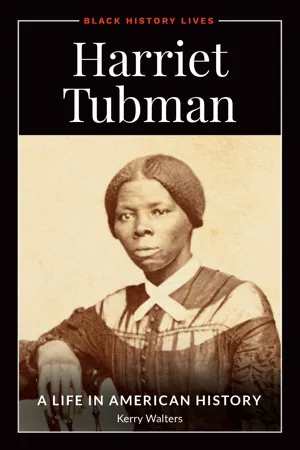 eBook - ePub
Harriet Tubman
A Life in American History
- Kerry Walters(Author)
- 2019(Publication Date)
- ABC-CLIO(Publisher)
Chicago Western Citizen carried an illustration of a heavily passengered train steaming into an underground tunnel. Captioned “Liberty Line,” the ad boasted that “the improved and splendid Locomotives” regularly ran clients between “Patriarchal Dominion and Libertyville, Upper Canada. Gentlemen and Ladies, who may wish to improve their health or circumstances, by a northern tour; are respectfully invited to give us their patronage” (Harris 1904, 16).Supporters and critics of the Underground Railroad soon began using rail terminology to refer to it. Escape routes became “lines” or “tracks.” Fugitives were referred to as “passengers” or sometimes as “packages.” Volunteers became “conductors” or “agents,” safe houses became “stations” or “depots,” and the people who owned them “stationmasters.” Citizens who weren’t directly involved as either agents or stationmasters but who contributed supplies and funds were known as “stockholders.”The nomenclature that became associated with the Underground Railroad was deliberately cryptic because all the activities along it were necessarily secretive. It also contributed to the aura of mystery that surrounded the enterprise, and from that mystery arose any number of legends that ballooned the Railroad’s actual accomplishments. It was soon falsely presumed, for example, that it had meticulously charted routes traversing every village, town, and city in the nation and that agents and stationmasters took special oaths, punishable if broken by a sure and horrid death, should they divulge the Railroad’s secrets. In fact, however, there’s no evidence of such secret oaths, and the liberty lines only sketchily penetrated the borders of slave states such as Maryland, Virginia, Delaware, and Kentucky in the Upper South, and were virtually absent in the Deep South. They ran primarily in the free states.What this meant is that slaves fleeing bondage were usually responsible, unless they had an experienced guide like Harriet Tubman, for finding their way to the nearest Underground Railroad station on their own. Some free blacks in the border slave states, especially Maryland and Delaware, were willing to aid runaways as best they could, offering them temporary places to rest and a little food. Word-of-mouth directions on where to find these friendly havens, as well as the safest back roads to take northward, circulated throughout slave communities. For the most part, fugitive slaves, many of whom had never ventured far from their plantations and for whom the “North” was often vaguely imagined as being thousands and thousands of miles distant, had to initiate their own escapes. Masters, in an effort to deter escape attempts, contributed to the confusion by frequently exaggerating the geographical distance to the free states. eBook - PDF
- Michaël Roy(Author)
- 2021(Publication Date)
- Cambridge University Press(Publisher)
Networks The Underground Railroad Jesse Olsavsky In a revealing letter, Frederick Douglass wrote, “My connection with the Underground Railroad began long before I left the South [] and was continued as long as slavery continued, whether I lived in New Bedford, Lynn, or Rochester, N.Y.” In those few words, Douglass identified his life with the Underground Railroad. The Underground Railroad, that is, slaves’ organized exodus from the “prison house” of slavery, was Douglass’s first and most sustained form of revolutionary activism, basic to every facet of his knowledge and action. For Douglass, the Underground Railroad was a vast movement. It began in the secret forms of communication and education he and so many other slaves took part in daily. The Underground Railroad began as underground knowledge. “Knowledge is power,” as Douglass said, and power leads to action (LW :). Underground knowledge empowered mass exodus. Mass exodus led to organized assistance to runaways, revolu- tionary plotting, and public, “aboveground” activism – all of which Douglass engaged in unceasingly, from to the final downfall of slavery. Such actions created knowledge again, in new forms. Douglass’s literary oeuvre and political thought were meditations upon the Underground Railroad. As Douglass’s three-decade work in the Underground Railroad reveals, fugitive resistance was not a subsidiary wing of “aboveground” abolitionism but constitutive to abolitionism, grounding the movement in the storm and stress of slaves’ own knowledge and action. Underground Knowledge In his autobiography Life and Times of Frederick Douglass (, ), Douglass claimed that from the age of “seven or eight” he was “already a fugitive from slavery in spirit and purpose” (LT ). By this he meant that from an early age, he had been learning the secret sensibilities and knowledge that slaves used to thwart their masters. eBook - PDF
On the Edge of Freedom
The Fugitive Slave Issue in South Central Pennsylvania, 1820-1870
- David G. Smith(Author)
- 2014(Publication Date)
- Fordham University Press(Publisher)
Others, however, did contact the rough network of safe houses and escape routes in south central Pennsylvania, which constituted that region’s “Underground Railroad.” Unfortunately, the risks of the border meant that much of the work was unpublicized and undocumented, leaving little his- 30 South Central Pennsylvania and Fugitive Slaves torical record. What we know today of escape routes for fugitives has to be teased out of legend, lore, and rumor. Escape Routes Discussing “routes” of the Underground Railroad immediately makes the escape of fugitive slaves sound too regularized. The main factor causing the Under- ground Railroad to be decentralized was the fugitives themselves. Almost none of them carried maps; some might have directions or know the name of possibly friendly families or communities. Many made it through risky areas on their own, unaware that there were willing helpers. Because those areas also con- tained people, both white and black, who were eager to turn them in, many fugi- tives wisely relied solely on their own resources. Sometimes Underground Railroad workers themselves deliberately con- tributed to this confusion over routes and tactics. Graceanna Lewis, a Quaker naturalist involved in helping runaway slaves, indicated that there were several directions in which her family forwarded fugitives from their Chester County home, depending on which heading seemed safest. A modern scholar of the Un- derground Railroad, Tracey Weis, has pointed out that multiple routes often in- creased safety because it lowered the traffic on any one route. If all fugitives went along the same roads and paths, it would be easy for the escape routes to become known and for fugitives to be recaptured. Many routes were determined by simple geography. The Appalachian moun- tain ranges extended into Pennsylvania, and many slaves in the Shenandoah Val- ley escaped northward, keeping the mountains to their left as a guide. eBook - ePub
The Underground Railroad from Slavery to Freedom
A Comprehensive History
- Wilbur H. Siebert(Author)
- 2012(Publication Date)
- Dover Publications(Publisher)
CHAPTER XTHE Underground Railroad IN POLITICS
TO set forth the political aspect of the Underground Railroad is not easy. Yet this side must be understood if the Underground Railroad is to appear in its true character as something more than a mere manifestation of the moral sentiment existing in the North and in some localities of the South. The romantic episodes in the fugitive slave controversy have been frequently described; but it has altogether escaped the eye of the general historian that the underground movement was one that grew from small beginnings into a great system ; that it must be reckoned with as a distinct causal factor in tracing the growth of anti-slavery opinion; that it furnished object lessons in the horrors of slavery without cessation during two generations to communities in many parts of the free states ; that it was largely serviceable in developing, if not in originating, the convictions of such powerful agents in the cause as Harriet Beecher Stowe and John Brown ; that it alone serves to explain the enactment of that most remarkable piece of legislation, the Fugitive Slave Law of 1850 ; and, finally, that it furnished the ground for the charge brought again and again by the South against the North of injury wrought by the failure to execute the law, a charge that must be placed among the chief grievances of the slave states at the beginning of the Civil War.GERRIT SMITH, M.C., the multi-millionnaire, whose mansion in Peterboro, New York, was a station.CHARLES SUMNER, THE CHAMPION OF THE FUGITIVE SLAVE IN THE SENATE OF THE UNITED STATES.JOSHUA R. GIDDINGS, M.C., who kept a room in his house in Jefferson, Ohio, for fugitivesRICHARD H. DANA, JR., eBook - ePub
The Underground Railroad from Slavery to Freedom
A comprehensive history
- Wilbur Henry Siebert(Author)
- 2015(Publication Date)
- Perlego(Publisher)
(From a photograph in the possession of the Kansas State Historical Society.)CHAPTER XI
EFFECT OF THE Underground Railroad
The effect of Underground Railroad operations in steadily withdrawing from the South some of its property and thus causing constant irritation to slave-owners and slave-traders has already been commented upon. The persons losing slaves of course regarded their losses as a personal and undeserved misfortune. Yet, considering the question broadly from the standpoint of their own interests, the work of the underground system was a relief to the masters and to the South. The possibility of a servile insurrection was a dreadful thing for Southern minds to contemplate; but they could not easily dismiss the terrible scenes enacted in San Domingo during the years 1791 to 1793 and the three famous uprisings of 1800, 1820 and 1831, in South Carolina and Virginia. The Underground Railroad had among its passengers such persons as Josiah Henson, J. W. Loguen, Frederick Douglass, Harriet Tubman, William Wells Brown and Henry Bibb; it therefore furnished the means of escape for persons well qualified for leadership among the slaves, and thereby lessened the danger of an uprising of the blacks against their masters. The negro historian, Williams, has said of the Underground Road that it served as a "safety-valve to the institution of slavery. As soon as leaders arose among the slaves, who refused to endure the yoke, they would go North. Had they remained, there must have been enacted at the South the direful scenes of San Domingo."[965]It is difficult to arrive at any satisfactory idea of the actual loss sustained by slave-owners through underground channels. The charges of bad faith against the free states made in Congress by Southern members were sometimes accompanied by estimates of the amount of human property lost on account of the indisposition of those living north of Mason and Dixon's line to meet the requirements of the fugitive slave legislation. Thus as early as 1822, Moore, of Virginia, speaking in the House in favor of a new fugitive recovery law, said that the district he represented lost four or five thousand dollars worth of runaway slaves annually.[966] In August, 1850, Atchison, of Kentucky, informed the Senate that "depredations to the amount of hundreds of thousands of dollars are committed upon the property of the people of the border slave states of this Union annually."[967] Pratt, of Maryland, said that not less than $80,000 worth of slaves was lost every year by citizens of his state.[968] Mason, of Virginia, declared that the losses of his state were already too heavy to be borne, that they were increasing from year to year, and were then in excess of $100,000 per year.[969] Butler, of South Carolina, reckoned the annual loss of the Southern section at $200,000.[970] Clingman, of North Carolina, said that the thirty thousand fugitives then reported to be living in the North were worth at current prices little less than $15,000,000.[971] Claiborne, the biographer of General John A. Quitman, who was at one time governor of Louisiana, indicated as one of the defects of the second Fugitive Slave Law its failure to make "provision for the restitution to the South of the $30,000,000, of which she had been plundered through the 100,000 slaves abducted from her in the course of the last forty years" (1810-1850);[972] and the same writer stated that slavery was rapidly disappearing from the District of Columbia at the time of the enactment of the new law, the number of slaves "having been reduced since 1840 from 4,694 to 650, by 'Underground Railroads' and felonious abductions."[973]
- Robert H. Churchill(Author)
- 2020(Publication Date)
- Cambridge University Press(Publisher)
Bordewich, Bound for Canaan: The Underground Railroad and the War for the Soul of America (New York: Amistad, 2005), 51–56; Barrett, in Blassingame, Slave Testimony, 190; and John Rankin, Letters on American Slavery (Newburyport: Charles Whipple, 1836), 18. 12 The Constitution of the American Anti-Slavery Society (New York: American Anti- Slavery Society, 1838), 3. On the antislavery movement, see Manisha Sinha, The Slave’s Cause: A History of Abolition (New Haven: Yale University Press, 2016); John Stauffer, The Black Hearts of Men: Radical Abolitionists and the Transformation of Race (Cam- bridge, MA: Harvard University Press, 2001); Andrew Delbanco, The Abolitionist Imagination (Cambridge, MA: Harvard University Press, 2012); Richard S. Newman, The Transformation of American Abolitionism: Fighting Slavery in the Early Republic (Chapel Hill: University of North Carolina Press, 2002); Seymour Drescher, Abolition: A History of Slavery and Antislavery (New York: Cambridge University Press, 2009); Alison S. Kraditor, Means and Ends in American Abolitionism: Garrison and His Critics on Strategy and Tactics, 1834–1850 (New York: Ivan R. Dee, 1989); Julie Roy Jeffrey, The Great Silent Army of Abolitionism: Ordinary Women in the Antislavery Movement (Chapel Hill: University of North Carolina Press, 1998); Stanley Harrold, The Abolition- ists and the South, 1831–1861 (Lexington: University Press of Kentucky, 1995); John R. McKivigan, The War against Proslavery Religion: Abolitionism and Northern Churches, 1830–1865 (Ithaca, NY: Cornell University Press, 1984); James Brewer Stewart, Holy Warriors: The Abolitionists and American Slavery (New York: Hill and Wang, 1976); Ronald G.
Index pages curate the most relevant extracts from our library of academic textbooks. They’ve been created using an in-house natural language model (NLM), each adding context and meaning to key research topics.

