Literature

The Interesting Narrative of the Life of Olaudah Equiano
"The Interesting Narrative of the Life of Olaudah Equiano" is an autobiography that recounts the experiences of Olaudah Equiano, a former slave who became a prominent abolitionist in the 18th century. Equiano describes his capture in Africa, the Middle Passage, and his life as a slave in the Americas. The narrative also highlights his journey to freedom and his advocacy for the abolition of the slave trade.
Written by Perlego with AI-assistance
Related key terms
1 of 5

10 Key excerpts on "The Interesting Narrative of the Life of Olaudah Equiano"
 eBook - PDF
Reading African American Autobiography
Twenty-First-Century Contexts and Criticism
- Eric D. Lamore(Author)
- 2017(Publication Date)
- University of Wisconsin Press(Publisher)
66 Olaudah Equiano in the United States Abigail Mott’s 1829 Abridged Edition of the Interesting Narrative eric-d.-lamore There are many questions about Equiano which have not been satisfactorily answered. s.-e.-ogude , “Introduction to the New Edition [of Equiano’s Travels]” The Interesting Narrative of the Life of Olaudah Equiano, or Gustavus Vassa, the African. Written by Himself, a text first published in London in 1789, remains a frequently read and debated eighteenth-century autobiography. 1 Equiano’s life narrative is one of the most sophisticated literary texts from the eighteenth-century Atlantic world. Histo- rians of slavery, the eighteenth-century Atlantic world, and abolitionist movements as well as scholars of United States, British, African, and Caribbean literatures continue to study and teach the Interesting Narrative because this autobiography provides the most detailed firsthand account of African cultural customs and the dynamics of the eighteenth-century transatlantic slave trade written by an individual of African de- scent in the English language. Given the inestimable cultural value of this life narra- tive, thousands of students from around the world read all of or portions from the Interesting Narrative each academic year in history, literature, and social science courses. 2 Biographers, literary critics, and historians have benefited immensely from utilizing Paul Gilroy’s influential thinking on the black Atlantic in positioning Equiano—along with other writers from the early black Atlantic—not as a product of a single nation but as part of a larger, interconnected Atlantic world. While critics have studied Equiano’s and his autobiography’s relationship to Great Britain and Africa in some detail, the writer’s and his text’s connections to the North American colonies have not received adequate attention beyond the heated debate on whether he was born in the Carolinas. eBook - PDF
- Lisa Lowe(Author)
- 2015(Publication Date)
- Duke University Press Books(Publisher)
In this sense, when Equiano’s autobi-ography echoes Cugoano’s account, it evokes this longer, unremediated collective condition of inhuman cruelty and survival. British abolition-ists read Equiano’s Interesting Narrative as a life that fulfilled Christian redemption and liberal economy. Yet slaves, ex-slaves, and others could “listen” to the complex tones of Equiano’s narrative, and hear the “other-ness” embedded within the text. They might recognize the allusions to death as deliverance from slavery, the double voicing one hears if listen-ing to the lower frequencies, what Fred Moten calls the “freedom drive” dissonant to commodification and objectification, heard beneath and through a dominant genre. 28 Likewise, inasmuch as the “freedom” of the second half of the autobiography may work to redeem the “enslavement” of the first half, the narrative form cannot overcome the most profound offenses with which The Interesting Narrative begins: the slave traders’ indifference to the sufferings of men, women, and children captured and chained, the terror and claustrophobia of the Middle Passage, the inhu-man trade in human beings. Although The Interesting Narrative formally declares the conditions of slavery transcended by his individual liberty, their residues remain after the formal translation of colonial slavery into the conventions of the liberal autobiographical genre. Perhaps equally important, Equiano has held a significant place in Af-rican American letters, and in the slave narrative tradition that followed him, heralded as a forerunner of the nineteenth-century African Ameri-can slave narratives of Frederick Douglass, Harriet Jacobs, and others. 29 The Interesting Narrative exemplified crucial features of the antebellum slave narratives, which, as Frances Smith Foster has observed, drew on the Judeo-Christian structure of mortification, conversion, struggle, and
- Chiara Cillerai(Author)
- 2017(Publication Date)
- Palgrave Macmillan(Publisher)
Equiano’s manipulation of the narrative subject’s position in the opening chapter of his book calls for a different understanding of his experience that includes the indictment of all parties involved: his com- patriots who are the original kidnappers, the European traders, his own eventual involvement in the slave trade, and the European public who witness the abuses and remain silent. As the transculturation process takes place, Equiano’s identity never becomes completely national or identifiable with one specific group, and The Interesting Narrative’s nar- rator remains fundamentally trans-cultural rather than simply national—a quality that enables him to be powerfully critical. Equiano writes with an accent and his position within the culture never become one of com- plete assimilation (Giunta 2002, 2). 11 When talking about his own Englishness, Equiano uses the adverb “almost” (Equiano 2003, 77). His membership in the cultural and social world of the British Empire is always going to be marked by marginality. Because of the insecurity any form of identification marked by difference generates, Equiano finds new ways to define identification itself (Edwards 1969, V–LXXII). 12 The various names and qualifiers listed in the title page—The Interesting Narrative of the Life of Olaudah Equiano, or Gustavus Vassa, the African, Written by Himself—mark the multiplicity of identities the 11 I borrow the concept of writing with an accent from Edvige Giunta’s work. Giunta has described the concept as follows: “I use the word ‘accent’ to refer to a series of ele- ments—narrative thematic, linguistic—that, collectively, articulate the experience of living between cultures. eBook - PDF
- F. Ndi(Author)
- 2015(Publication Date)
- Langaa RPCIG(Publisher)
113 Chapter 5 Olaudah Equiano, Gustavus Vassa, Negotiating Identity in a Trans-Atlantic World 1 Rebecca A. Carte First published in 1789, The Interesting Narrative of the Life of Olaudah Equiano or Gustavus Vassa, the African, Written by Himself presents scholars with a unique memoir; one of only a few penned by an individual who not only survived enslavement and procured his own manumission, but moreover was later able to write about his experience and manage to have it published. 2 Additionally, for over two centuries readers have been fascinated by the extent of his travels, both forced and voluntary, which took Equiano from Africa to the Caribbean, the British colonies to the Iberian Peninsula, and England to the North Pole. Indeed his life stands out as unique in many ways and the narrative, part socio-economic and political treatise; part spiritual autobiography, and part travel memoir has been well studied over the centuries. Upon its publication the text was well circulated in both the New World and the Old, meriting no less than eight editions and translation into Dutch, Russian and German before Equiano died in 1797. Since its republication in the 1960’s the text has been studied extensively by literary and historical scholars alike. In fact, Janelle Collins proclaims in her 2006 article, “Passage to Slavery, Passage to Freedom”: “The international scholarly 1 This article is based on a paper originally presented on June 19, 2013 as a part of my participation with Georgia College & State University in collaboration with the University of Hassan II at the conference, Land, Culture, and People: The Atlantic and Mediterranean Spaces in Marrakesh, Morocco. 2 Olaudah Equiano (c. 1745- March, 1797). From here forward I will refer to the subject as Olaudah or Equiano. 114 attention focused on Equiano has been so extensive and varied in the past two decades that ‘Equiano Studies’ has become a veritable subcategory within the slave narrative genre” (210). eBook - ePub
- Peter J Kitson, Debbie Lee, Anne K Mellor, James Walvin, David Dabydeen, Sukhdev Sandhu(Authors)
- 2020(Publication Date)
- Routledge(Publisher)
The Interesting Narrative of the Life of Olaudah Equiano, or Gustavus Vassa, the African (London, 1789)Olaudah Equiano (c. 1745–97) was born in the Ibo village of Essaka, in what is now Nigeria. The youngest son of slave-owning parents, he was kidnapped at the age of eleven and sold into slavery. After surviving the Middle Passage, he found himself working in a plantation house in Virginia before being sold to Michael Pascal, a lieutenant in the Royal Navy. Pascal christened him Gustavus Vassa after a sixteenth-century Swedish freedom fighter, a name which, as personal inscriptions and letters to the press reveal, Equiano used for most of his life.Coming to England for the first time in 1757, Equiano stayed in Falmouth and London where he slowly learned to read and write. He spent much of the next five years aboard British ships fighting the French in the Mediterranean. At the end of 1762 he was sold to Captain James Doran who, five months later, sold him on to a Quaker merchant named Robert King. Equiano worked for four years as a small goods trader both in the West Indies and various North American plantations using the money he earned during this period to purchase his freedom for £40 in 1766. The following year he returned to London where he practised hairdressing before his maritime twitchings got the better of him and pushed him towards the oceans where he adventured away the next few years serving under various ship captains. In 1773 he was part of Constantine Phipps’ pioneering voyage to the North Pole in search of a passage to India; another member of the expedition who later found fame was Horatio Nelson.Equiano spent much of the final two decades of his life campaigning inexhaustibly against the slave trade. In 1783 he was responsible for notifying Granville Sharp about 132 Africans who had been thrown overboard from the Liverpool slave ship, the Zong, for insurance purposes. His growing status amongst London blacks was rewarded by his appointment in November 1786 as commissary in charge of provisions for the 359 impoverished blacks who had decided to take up the Government’s offer of an assisted passage to Sierra Leone. Angered by the embezzlement perpetrated by one of the official agents, he notified the authorities but was dismissed from his post. The affair did not curtail his politicking: he wrote letters to the press, penned caustic reviews of anti-Abolitionist propaganda, and became an increasingly effective speaker for the Society for the Abolition of the Slave Trade as well as the more radical London Corresponding Society. eBook - PDF
- C. Kaplan, J. Oldfield, C. Kaplan, J. Oldfield(Authors)
- 2010(Publication Date)
- Palgrave Macmillan(Publisher)
As a spiritual autobiography, the story of Equiano’s life offered his readers a conver- sion narrative any of them could imitate, as his frontispiece emphasises. Profit was another motive for publication, as Equiano’s control of the production and distribution of The Interesting Narrative demonstrates. The primary motive for publication, indicated by Equiano’s dedication of the book to the Members of the House of Commons and the House of Lords, was his explicit desire to contribute to the cause of abolishing the transatlantic slave trade. Equiano’s related goal of abolishing the 82 Equiano’s Paradise Lost institution of slavery is less explicit in his Interesting Narrative than in his earlier newspaper publications. Probably intentionally rather than fortuitously, Equiano’s autobiography appeared to be part of the coor- dinated attack from inside and outside Parliament on the transatlantic slave trade. The care with which Equiano prepared and presented The Interesting Narrative is reflected in the timing of its publication. Organised and sustained opposition to the transatlantic African slave trade was a very recent development when the autobiography first appeared. Mainly through the efforts of the philanthropist Thomas Clarkson, from 1787 on the organised opposition to the African slave trade gathered, pub- lished and offered to Parliament evidence against the infamous practice. But before 1789 the evidence and arguments against the slave trade came from white voices alone. The only published black witnesses were clearly fictitious, found, for example, in the poems of Hannah More and William Cowper. 4 Clarkson, one of Equiano’s original subscribers, acknowledged the desirability of hearing the African victim’s point of view. In An Essay on the Slavery and Commerce of the Human Species (London, 1786), Clarkson dramatised the transatlantic slave trade by placing the trade in ‘the clear- est, and most conspicuous point of view’. eBook - PDF
Redefining American Identity
From Cabeza de Vaca to Barack Obama
- B. Railton(Author)
- 2011(Publication Date)
- Palgrave Macmillan(Publisher)
. . . The Narrative wears an hon- est face.” Yet while Equiano does include among these peripheral materials a letter to Parliament in which he frames his text as “the production of an unlettered African,” he elsewhere distances the ele- ments of his past experiences from those of his present identity. For 6):3098-32%6=86%27*361%8-327 example, he ends the note “To the Reader” with which he prefaces the testimonials by appealing “to those numerous and respectable persons of character who knew me when I first arrived in England, and could speak no language but that of Africa.” While he references that linguistic history in order to counter explicitly the “invidious falsehood” about his Caribbean heritage, it likewise implicitly illus- trates how far the author of this note, and the entire narrative to follow, has come from that moment; how much, that is, his language and culture are now those of Africa and England and the journeys he has taken and self he has become, between and beyond both worlds. If, as he writes to Parliament, verifying his African origins can partly illustrate “the horrors of that trade [by which] I was first torn away from all the tender connections that were naturally dear to my heart,” it can also—and more prominently in the narrative as a whole—illuminate why he “regard[s] myself as infinitely more than compensated by the introduction I have thence obtained” to that new world and identity (xxvii–xxxvii). The first chapter of the narrative itself similarly modulates between Equiano’s specific, originating national and racial cultures and the more individual identity toward which his life and text will move. The narrative opens with a metatextual paragraph in which Equiano reflects explicitly on the subject of “those who publish their own memoirs,” and more exactly on the kind of identity and life that his memoir will depict. eBook - ePub
Uncomfortable Situations
Emotion between Science and the Humanities
- Daniel M. Gross(Author)
- 2017(Publication Date)
- University of Chicago Press(Publisher)
Suffice it to say in summary this is a very different kind of phenomenology that loses its bearing outside of the rhetorical situation broadly conceived, including both the no-go zones of common currency and conversation that would (but doesn’t) give Equiano a voice in some traditional sense of public sphere representation. Also his loud statement as we have received it—his Interesting Narrative —constantly challenges his reader to take the material at face value even when he demonstrates over and over how that value is in some basic ways phantasmatic and impossible to cash. We cannot bank upon the fact that Equiano is really happy, truly grateful, and so on through the narrative, as we are time and again thrown back upon the system that makes such guarantees impossible. In the end Equiano is neither here nor there, neither secured in the practical world where he does his business, nor in the spiritual world where he tends. As such the narrative Equiano gives us is not tiresome in the least, recalling the words of Wollstonecraft, but vivifying as only a narrative of such improbability can be. And no further explanation should be needed how a narrative such as this speaks directly to a science of emotion, without reducing to it. eBook - PDF
Discourses of Slavery and Abolition
Britain and its Colonies, 1760-1838
- B. Carey, M. Ellis, S. Salih, B. Carey, M. Ellis, S. Salih(Authors)
- 2004(Publication Date)
- Palgrave Macmillan(Publisher)
Cannibalism becomes one feature amongst others and is thereby relativized. Such a conceptualization of cannibalism undermines the attempt to banish the abject from the cen- tre; Equiano returns projected fears to the centre and thereby empties out the cannibalism trope. While holding Igbo culture in high esteem, the Anglophile Equiano also demonstrates an admiration for English culture. But rather than swallowing English culture wholesale, he appropriates it, transforms it, and partly adapts it. London had a large number of black residents in the late eighteenth century: Peter Fryer, in Staying Power, puts the figure at 10,000. 27 Their presence critically and irrevocably changed England, creating a multiculturalism avant la lettre, memorably reinvoked by S. I. Martin in his historical novel Incomparable World. 28 The hybrid ‘cul- tural work’, to borrow Jane Tompkins’s term, and the new configura- tions it enables, was reflected and partly brought about by writers such as Ignatius Sancho, Ottobah Cugoano, and Olaudah Equiano. 29 Equiano both ‘swallows’ English culture and is ‘swallowed’ by it; distinctions are blurred and processes of mutual transformation, though not balanced, are in fact multi-directional ones. The Interesting Narrative can be read in the context of an array of genres: autobiography, spiritual autobiography, travelogue, picaresque text, testimonio/confession, ethnography, and economic treatise 102 Mark Stein among them. In some respects the Narrative can also be considered a Robinsonade. Equiano’s travelogue and autobiography was first published in 1789 as The Interesting Narrative of the Life of Olaudah Equiano, or Gustavus Vassa the African, Written by Himself, seventy years after the publication of The Life and Strange Surprizing Adventures of Robinson Crusoe … Written by Himself (1719). Both Crusoe and Equiano are ‘self-made men’, although as a slave Equiano was not well placed for this role.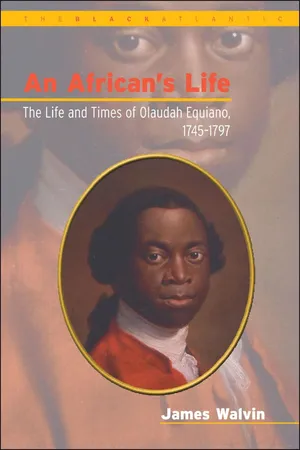 eBook - PDF
African's Life, 1745-1797
The Life and Times of Olaudah Equiano
- James Walvin(Author)
- 2000(Publication Date)
- Continuum(Publisher)
3 Once more, it did Equiano's image no harm to tell his readers that he had been encouraged to think of attending university and entering the priesthood. Along with the book from which these cultured images emerged, it was another example of Equiano's determination to speak to African potential. He wrote not merely for himself, but for Africans at large. How many other Africans might flourish if the shackles of slavery were permanently removed? Equiano's ship, already loaded with fruits, wines and money, moved on to Cadiz, where it took on 'about two tons more of money', before returning to England in June 1775. On this, as on other voyages, Equiano actively promoted his religious 110 An African's Life ideas among his fellow sailors. When, in the teeth of contrary winds, the captain blasphemed, Equiano joined in a young passenger's criticisms of such talk, urging blasphemers to give thanks for their blessings. Within the day, Equiano's ship had picked up a small boat of n shipwrecked men, all half-drowned and on the point of starvation. They were Portuguese, from a ship which had suddenly capsized when its load of corn shifted, and they would surely have died had they not been rescued. They promptly 'bowed themselves on their knees, and, with hands and voices lifted to heaven, thanked God for their deliverance'. The captain seemed especially thankful that the Lord had spared him, and Equiano took the opportunity 'of talking to him on the providence of God'. 4 It seems, again, an unusual encounter: an African and ex-slave discussing theology with a distressed shipwrecked Portuguese mariner on the high seas. Though it may seem unusual today, in that swirling mixture of humanity and cultures which was the Atlantic slave system, such encounters were commonplace on both sides of the Atlantic. Most such encounters took place on land, of course, but many were at sea.
Index pages curate the most relevant extracts from our library of academic textbooks. They’ve been created using an in-house natural language model (NLM), each adding context and meaning to key research topics.

