Literature

Nelson Mandela
Nelson Mandela was a South African anti-apartheid revolutionary and political leader who served as the country's president from 1994 to 1999. He was a symbol of resistance against the oppressive apartheid regime and spent 27 years in prison for his activism. Mandela's autobiography, "Long Walk to Freedom," is a powerful literary work that chronicles his life and the struggle for equality in South Africa.
Written by Perlego with AI-assistance
Related key terms
1 of 5


7 Key excerpts on "Nelson Mandela"
 eBook - ePub
On Literary Attachment in South Africa
Tough Love
- Michael Chapman(Author)
- 2021(Publication Date)
- Routledge(Publisher)
9 The Power of …Nelson Mandela: A Literary Consideration
DOI: 10.4324/9781003176237-10A Long Walk
During my lifetime I have dedicated myself to the struggle of the African people. I have fought against White domination and I have fought against Black domination. I have cherished the ideal of a democratic and free society in which all persons live together in harmony and with equal opportunities. It is an ideal which I hope to live for and to achieve. But if needs be, it is an ideal for which I am prepared to die.(1990b, p. 189)These are Nelson Mandela’s by now famous closing words as a defendant in the Rivonia trial (20 April 1964). Advocate for the defence, George Bizos, added the qualifier, ‘if needs be’, while the antitheses, the parallel structures, and the resonance of repetition link the power of Mandela’s words to an achievement in which the political figure rises above the politics of the day. One thinks of Lincoln, Churchill (who, we may recall, received a Nobel Prize in Literature), Nehru at Indian independence, Kennedy, Luther King, and, most recently, Nelson Mandela. Prior to the Rivonia trial Mandela, as the commander of the then military wing of the African National Congress (ANC), had stood trial in 1962 for incitement to strike and leaving the country without a passport. On that occasion his words from the dock turned his trial into an indictment of white domination, as encapsulated in the single phrase, ‘a Black man in a White court’ (1990a, p. 125).1Words continued to exercise the evolution of Mandela’s thought whether in the confinement of his cell, in discussion with other political prisoners, in surreptitious entries in calendars and notebooks, and, subject to prison regulations, in letters to his wife and children:Dear WinnieI have just read a book by our famous writer about the Karoo [Olive Schreiner’s The story of an African farm eBook - PDF
Africa’s Best and Worst Presidents
How Neocolonialism and Imperialism Maintained Venal Rules in Africa
- Nkuzi Mhango(Author)
- 2016(Publication Date)
- Langaa RPCIG(Publisher)
“I would say that the whole life of any thinking African in this country is driven continuously to a conflict between his conscience on the one hand and the law on the other…The law as it is applied, the law as it has been developed over a long period of history, and especially the law as it is written by the Nationalist Government is law which in our view is immoral, unjust and intolerable. Our consciences dictate that we must protest against it, that we must oppose it and that we must attempt to alter it.” Nelson Mandela, 1962, adapted from Bukurura, (2003). M M andela’s legacy As a humble and conscionable person, Mandela will be remembered for his simplicity and openness among countless qualities he had. He used to say that he was not an angel but a sinner who was trying. Above all, Mandela set the tone, and the pace in visualising a peaceful world. His reconciliatory approach informs us that even protracted conflicts are resolvable if there is a genuine and unshakable resolve and commitment to truly do so. It was like a daydreaming to think that, first of all, Apartheid would be pulled 123 down in our lifetime; and secondly, that whites and indigenous Africans in South Africa would be reconciled so as to live together as one rainbow nation as Tutu coined it. When it comes to democracy, Mandela was second to none. He believed in the rule of law that empowers and incorporates all stakeholders which is opposed to the awkward tendency of many African leaders who think they are the ones who were created to rule others. His early exodus from office set another precedent that everybody can rule. Mandela did not see any logic in extending his rule or clinging to power just like corrupt and myopic rulers who tamper with the constitutions of their countries to remain in power illegally. Leaving back a very cohesive and transiting country adds another accolade to Mandela. eBook - ePub
- Elleke Boehmer(Author)
- 2013(Publication Date)
- Zed Books(Publisher)
3 Like Obama, Mandela has always been quick to acknowledge the support of those who sustained his career. As Mandela put it in an interview with African-American television host Oprah Winfrey:If there is any significant role that I played it was that of being a vessel through which the struggle was presented to the nation and the world. The struggle had to have a symbol for it to be effective. The great men and women of the struggle chose that I be that symbol.4Although it is true that Mandela’s good guidance and charisma represented important sources of inspiration for the making of post-apartheid South Africa, he was right to forswear authorship of the new South African democracy in this way. It was not merely the modesty of the loyal party man that motivated such statements, but his keen insight into the business of politics as well. With Mandela, it is manifestly the case that his leadership alone cannot explain the historical development in South Africa from apartheid to freedom. Inner radiance alone cannot account for why his icon should loom so large in the world’s imagination.The true picture – the real-life ‘Madiba magic’ – is more complicated than the story of individual specialness suggests, even though that radiance remains an important ingredient. Mandela’s leadership is based in a quality of character certainly, but this is combined with other key traits, not least his fine talents for negotiation and arbitration, his insights into his political opponents, and his career-long proximity to several outstanding colleagues and friends, themselves astute political minds, particularly Oliver Tambo, Walter Sisulu and Ahmed Kathrada. Then there is Mandela’s talent as a performer – his facility for finding the words and the attire to draw out, appeal to and convince an audience. As his previously quoted comment to Oprah Winfrey suggests, Mandela has always been acutely aware of, and able to mould, his own iconicity. He is able to play to the way in which the unfolding of his life can be seen to underpin South Africa’s long road to freedom, just as Obama’s presidential triumph in 2008 can be viewed as representing the fulfilment of Martin Luther King’s dream – as Obama himself signalled in his acceptance and inaugural speeches as president of the United States in 2008 and 2009. Both Mandela and Obama were trained as lawyers, and share a keen sense of the powers of verbal advocacy and defence.
- Robert C. Pirro(Author)
- 2011(Publication Date)
- Continuum(Publisher)
CHAPTER 5 Nelson Mandela: Tragedy in a Divided South Africa[In retirement, I will] do all the things I’ve missed: be with my children and grandchildren and with my family; the ability to sit down and read what I would like to read. You know, in prison—although it was a tragedy to spend twenty-seven years in prison—one of the advantages was the ability to sit down and think. This is one of the things I miss most.Nelson Mandela1In the political transformation that South Africans experienced in the decade after his February 10, 1990, release, Nelson Mandela played an indispensable role. Over his 27-year incarceration, Mandela became one of the foremost rallying symbols of the liberation struggle in South Africa. He was instrumental during the late 1980s in helping the leaders of the South African apartheid regime to appreciate the advantages of pursuing a negotiated settlement with their opponents. Once free, Mandela was a central player in the negotiations that led the regime finally to accept elections on the basis of the principle of one person, one vote. After his election in 1994 as the first African President of the Republic of South Africa, Mandela promoted the reconciliation of previously warring factions through his leadership of a government of national unity and through his resort to several symbolic public gestures.2 With his decision to serve only one term and his subsequent retirement from high state and party offices, Mandela has earned further praise both for seeking to end South Africa’s dependence on his charismatic leadership and for setting an example of the orderly, constitutional transfer of power.3It should come as no surprise that Mandela’s life, so variable in its private fortunes and so significant in its public consequences, has become the subject of many biographies. In several of these biographies, Mandela’s life is explicitly characterized in terms of tragedy. Mandela’s reference to the “tragedy” of “spending twenty seven years in prison” concludes the final chapter of Martin Meredith’s 1997 biography. In the prologue of his 1999 authorized biography, Anthony Sampson quotes the newly elected Mandela reflecting about the “tragedy” of his past incarceration in similar terms: “It was a tragedy to lose the best days of your life, but you learned a lot. You had time to think—to stand away from yourself, to look at yourself from a distance, to see the contradictions in yourself.”4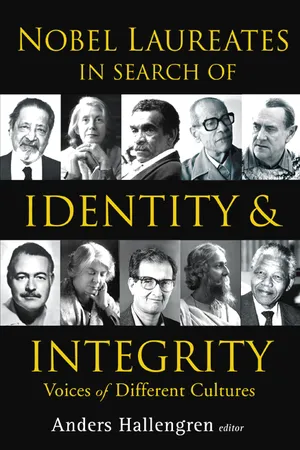 eBook - PDF
Nobel Laureates In Search Of Identity And Integrity: Voices Of Different Cultures
Voices of Different Cultures
- Andres Hallengren(Author)
- 2005(Publication Date)
- World Scientific(Publisher)
The few exceptions are schools and educational institutions, such as the Nelson Mandela School of Medicine in Durban and Dr. Nelson Mandela High School in the Western Cape; or, to look abroad, 232 M A N D E L A ‘Nelson Mandela School’ in the German Democratic Republic, founded in 1984, and Nelson Mandela School of Public Policy and Urban Affairs in Baton Rouge, LA, USA. A significant and very telling feature, however, witnessing his care for the future generations, is the Nelson Mandela Children’s Fund, established when President Nelson Mandela pledged one-third of his salary for five years. Conclusion Thus, we see how one man’s remarkable life has reached its fulfillment and has blossomed into a national vision. Inspired by myriad influences, taking the best from both his Native heritage, from the example of foreign freedom movements, and even from the history and literature of his oppressors, Nelson Mandela forged a vision of humanity that encompasses all peoples and that sets the hallmark for the rest of the world. When the Norwegian Nobel Committee decided to award the Nobel Peace Prize for 1993 to Nelson R. Mandela and Frederik Willem de Klerk, it was pointed out that their achievement was made by “looking ahead to South African reconciliation instead of back at the deep wounds of the past.” The committee also observed that South Africa has been the very symbol of racially conditioned suppression, and that the peaceful termination of the apartheid regime accordingly “points the way to the resolution of similar deep-rooted conflicts elsewhere in the world.” In his Nobel lecture, Nelson Mandela referred to the organic world-view expressed already in the manifesto of 1944, calling himself a mere representative of the millions of people across the globe who “recognised that an injury to one is an injury to all;” which is the essence of ubuntu philosophy universally applied. ❄ Bibliography ❆ 233 V. S. Naipaul W ORKS The Mystic Masseur .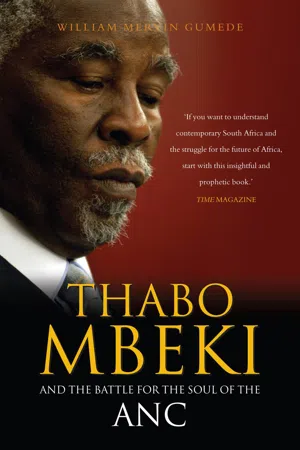
- William Mervin Gumede(Author)
- 2008(Publication Date)
- Zed Books(Publisher)
His escaping mandela’s shadow ability to forgive those responsible for his almost three decades of incarceration was the perfect foil to the naysayers who predicted that the conflict and divisions in South Africa ran too deep for peace and reconciliation ever to become reality. Mandela’s most valuable contribution to the fledgling democracy was to cobble together a broad-based consent for the new order. His purpose was to ‘carve out a new breathing space where pulses could settle, enmities subside and affinities become recast’. 11 Throughout the transition, his leadership served both to maintain the poor black majority’s trust and loyalty towards the ANC, and to alleviate the fears of the predominantly white middle class, pampered and pandered to during white rule, and frightened of black majority rule. 12 Like Mbeki, Mandela is extremely conscious of his place in history. He wants to be remembered as the extraordinary man who emerged from twenty-seven years in prison without rancour, to lead a divided South Africa into the future. During an address at the University of Potchefstroom in February 1996, he said: ‘I will pass through this world but once, and I do not want to divert my attention from my task – which is to unite the nation.’ 13 Even more revealing was his next sentence: ‘I am writing my own testament because I am nearing my end. I want to be able to sleep till eternity with a broad smile on my face knowing that the youth, opinion-makers and everybody is stretching across the divide, trying to unite the nation.’ 14 Gandhi, too, dreamt of uniting India’s diverse groups. Mandela’s broad societal authority was akin to that of a benign patriarch, guided by the principles of inclusivity. Indeed, his leadership stemmed largely from his moral authority. For Mandela, as for Gandhi, the moral integrity of a leader is crucial. By contrast, Mbeki is generally considered a visionary,‘can-do’ politician.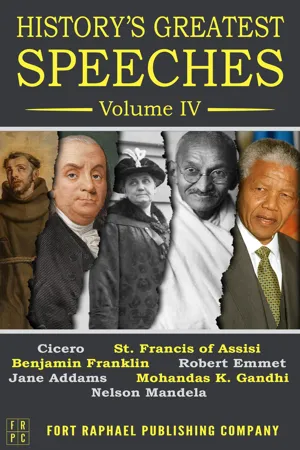 eBook - ePub
- Benjamin Franklin, Mohandas K. Gandhi, Nelson Mandela(Authors)
- 2021(Publication Date)
- Ft. Raphael Publishing Company(Publisher)
Nelson MandelaI AM PREPARED TO DIE
A towering figure throughout his entire life and career- even while imprisoned - Nelson Mandela (1918-2013) was a South African civil rights activist and political revolutionary who, upon his release from jail, served as President of the African National Congress (ANC) from 1991 to 1997 and then as the first black President of South Africa following the collapse of apartheid.Years before, however, in the late 1950's Mandela helped co-found the militant Umkhonto we Sizwe movement which led a sabotage campaign against the all-white government of South Africa. For his involvement with Umkhonto, Mandela was arrested and tried for conspiracy.What follows is Mandela’s statement to the court prior to his sentencing, slightly abridged for this presentation.When the speech concluded, Mandela would be sentenced to life imprisonment and would be incarcerated for the next twenty-seven years.* * * * * * * * * * I am the First Accused.I hold a Bachelor's Degree in Arts and practised as an attorney in Johannesburg for a number of years in partnership with Oliver Tambo. I am a convicted prisoner serving five years for leaving the country without a permit and for inciting people to go on strike at the end of May 1961.I have done whatever I did, both as an individual and as a leader of my people, because of my experience in South Africa and my own proudly felt African background, and not because of what any outsider might have said.In my youth in the Transkei I listened to the elders of my tribe telling stories of the old days. Amongst the tales they related to me were those of wars fought by our ancestors in defence of the fatherland. I hoped then that life might offer me the opportunity to serve my people and make my own humble contribution to their freedom struggle. This is what has motivated me in all that I have done in relation to the charges made against me in this case.
Index pages curate the most relevant extracts from our library of academic textbooks. They’ve been created using an in-house natural language model (NLM), each adding context and meaning to key research topics.

