Politics & International Relations

Marcus Garvey
Marcus Garvey was a Jamaican political leader and activist who founded the Universal Negro Improvement Association (UNIA) in the early 20th century. He advocated for the economic and political empowerment of black people worldwide and promoted the concept of Pan-Africanism. Garvey's ideas and efforts had a significant impact on the civil rights movement and the struggle for racial equality.
Written by Perlego with AI-assistance
Related key terms
1 of 5

10 Key excerpts on "Marcus Garvey"
- K. Dunn, T. Shaw, K. Dunn, T. Shaw(Authors)
- 2001(Publication Date)
- Palgrave Macmillan(Publisher)
The dissemina- tion of ideas of racial equality and national self-determination was anathema at the time to the USA and the European colonial powers, respectively. More than that, the report underlined the significance and forthcoming impact that Marcus Garvey and his UNIA had on the world order which emerged after the First World War. This chapter provides a critical analysis of the thinking and activities of Marcus Garvey, a West Indian of African ancestry, who offered far-reaching, but intensely con- troversial positions on Africa and Africans in the twentieth century. 1 Born in the ossified race±class structure of late nineteenth-century Jamaica, and with only a modicum of formal education, Garvey would by the early 1920s become one of the world's central figures of black liberation and critics of global racial supremacy which was pervasive during the late nineteenth and early twentieth centuries. But why specifically should Garvey be of interest at the turn of the twentieth century? After all, official colonialism is dead. The former colonies now have equal juridical rights in international law, interna- tional institutions, and in terms of the official norms that govern inter- national relations. Moreover, Africans, and peoples of African ancestry in the diaspora, are no longer subjected to official (that is, state organ- ized) dispossession, marginalization, or subordination. At the domestic level, therefore, African peoples have become participants in their own governance, and, globally, African states and states dominated by Af- rican descended populations have joined the `international community.' The foregoing `achievements,' one can argue, have pretty much satisfied the fundamental goals sought by Garvey, and if this is indeed the case, there is not a great deal more to be extrapolated out of his work and thinking. But as Kevin Dunn notes in the Introduction to this volume, the marginalization of Africa in the international system, and within Randolph B.
- Claudrena N. Harold(Author)
- 2014(Publication Date)
- Routledge(Publisher)
3Claiming nearly five hundred UNIA divisions and branches by the mid-1920s, the Jim Crow South distinguished itself as a major stronghold of the Garvey movement. No small factor in the UNIA’s success was the charismatic personality of Marcus Garvey. Fiercely independent, the Jamaican-born nationalist appealed not only to black women and men who had spent all of their lives under the oppressive system of Southern Jim Crowism, but also to many West Indians who settled in the South during the first two decades of the twentieth century. Moved by Garvey’s Pan-African message of black pride, race unity, and economic independence, these black immigrants recognized the extent to which his personal triumphs, political struggles, and internationalist perspective corresponded with their own. Moreover, they embraced a man whose life had also been tremendously impacted by racism, economic dislocations and transformations in the Caribbean, and British imperialism.4The Political Rise of Marcus Mosiah GarveyThree years after the Berlin Conference officially sanctioned Europe’s ruthless partition of Africa, Sarah Richards gave birth to Marcus Garvey on August 17, 1887, in the seaport town of St. Ann’s Bay, Jamaica.5 Legalizing her union with Garvey’s father two years after her son’s birth, Sarah married Malchus Mosiah Garvey on December 15, 1889. Details on Marcus’ early life are rather hazy and at times contradictory, but by most accounts, the precocious youngster received a quality education at the Anglican Church School until he commenced his printer’s apprenticeship under his godfather, Alfred Burrowes. Searching for opportunities greater than those offered in his hometown, Garvey, in 1906, relocated to Kingston, Jamaica, where he gained employment at the Government Printing Office and strengthened his political skills as the vice-president of the Kingston Typographical Union. Finding himself blacklisted as a result of his involvement in trade union politics, Garvey in 1910 decided to follow the scores of Jamaican workers who searched for better economic opportunities in Central America. The twenty-three year old landed a job as a timekeeper on a United Fruit Company plantation in Costa Rica. Not long after his arrival, Garvey started to question those who portrayed Central America as a land of opportunity for West Indian laborers. “What black people had to brave sickened him,” Garvey’s second wife, Amy Jacques, noted in Garvey and Garveyism. “Daily,” she continued, “they had to encounter snakes, swamps and wild tigercats. Mutilated black bodies in the rivers and bushes were common sights.”6 Shaken by the exploitative conditions under which West Indians labored in Costa Rica, Garvey pleaded with the British Consul there to offer some type of protection to exploited Jamaican workers. Needless to say, his requests fell on deaf ears.7 To draw attention to the plight of exploited black workers, Garvey launched a newspaper entitled La Nation, but his journalistic endeavor proved unsuccessful. Trekking Garvey’s next steps is somewhat difficult given the paucity of primary sources on this part of his career, but according to Amy Jacques, Garvey spent some time in Ecuador, Nicaragua, Venezuela, Colombia, and Panama.8
- Jerome Teelucksingh(Author)
- 2016(Publication Date)
- Palgrave Macmillan(Publisher)
© The Editor(s) (if applicable) and The Author(s) 2016 Jerome Teelucksingh Ideology, Politics, and Radicalism of the Afro-Caribbean 10.1057/978-1-349-94866-6_2Begin Abstract2. Marcus Garvey’s Caribbean Legacy
End AbstractJerome Teelucksingh 1(1) Department of History, University of the West Indies, St. Augustine, Trinidad and TobagoDuring his childhood, Marcus Mosiah Garvey heard of stories of maroon leaders as Quaco and Cudjoe. These served to inspire Garvey and influenced his course in life.1Employed as a printer at St. Ann’s Bay and later in Kingston, Garvey understood the privations and challenges of the working class. He was a child of the working class who rose to prominence and made an impact on the global Pan-African movement. Undoubtedly, Garvey, the Jamaican national hero and freedom fighter, was one of the most influential leaders of the African diaspora in the early decades of the twentieth century. His emphasis on race consciousness, African economic self-reliance, and the political regeneration of Africa was appealing to millions of persons. Garveyism was to have both a positive and a negative impact on the labour movement in the Caribbean.In 1907, he identified with trade unionism and was elected as Vice-President of the Compositors branch of the Kingston Typographical Union, an affiliate of the International Typographical Union of the American Federation of Labour. Later, as a timekeeper on a banana plantation of the United Fruit Company in Costa Rica, he was arrested for instigating fellow West Indian labourers to protest against labour conditions in the banana industry. Similarly, in Panama where West Indians were employed, Garvey identified with the work of the Colon Federal Labour Union in 1911. eBook - PDF
Icons of African American Protest
Trailblazing Activists of the Civil Rights Movement [2 volumes]
- Gladys L. Knight(Author)
- 2008(Publication Date)
- Greenwood(Publisher)
The impulse to return home was revived in the twentieth century, as lead- ers like Marcus Garvey strove toward self-determination and self-government for the descendants of Africa. Marcus Garvey 187 These relationships instilled in Garvey a profound love for his heritage and an intense desire to learn more about the culture and history that bound blacks all over the world together. He supplemented his discussions with trips to the library, where, slumped over a mountain of books, he fervently built up his knowledge of Africa. The information he discovered debunked the prevailing misconception of a barbaric continent. Precolonial Africa was home to complex societies and lav- ish empires with opulent traditions in art, music, dance, and religion. Through colonialization, foreign countries had subjugated the indigious populations and exploited the abundant natural resources: minerals, precious metals, oil, and timber. During the African Diaspora, countless Africans had been scattered throughout North and South America, Europe, Asia, and Australia—largely to toil as slaves. Garvey and his family were a product of this diaspora, as were the myriad blacks he met around the world. Garvey realized they were, in actu- ality, connected by a common oppression, a common cultural identity, and a common homeland. But that homeland was no longer available to them, as it belonged to the people who had remained in Africa. Blacks had been effectively stripped of a national identity. Between December 1913 and January 1914, Garvey visited France, Spain, and other European countries. The trip produced bleak results. Conditions in Continental Europe were no better for men and women of African descent, who comprised the poor, the neglected, and the powerless. Garvey could not find any place where blacks exhibited independence and power. eBook - PDF
I Will Wear No Chain!
A Social History of African American Males
- Christopher B. Booker(Author)
- 2000(Publication Date)
- Praeger(Publisher)
The ultimate goal of UNIA efforts was the founding of a black nation. Thus, standing apart from the accommodationism of Booker T. Washington and from the efforts aiming at "social equality" of the National Association for the Advancement of Colored People (NAACP) and others, Garvey set the UNI A's sight on an independent black nation. Garvey told Africans worldwide, "Never be satisfied to always live under the government of other people because you shall ever be at their mercy." 67 One of the key aspects of Marcus Garvey's legacy is that he put forth an urban model of assertive, race-conscious, and militant manhood to masses of African Americans. It was as much an attitude and perspective as it was a specific ideology. Clearly, had such an attitude or perspective been implemented consistently in the Jim Crow South of the era, violence would have been the inevitable outcome. It was clearly a product of the new urban milieu, with its cosmopolitan influences, its accelerating sense of empowerment and confidence. The formal ideology of Garvey and the ideology and practice of Garveyites must be clearly distinguished. A wide range of individuals embraced Garveyism, as its general program struck a responsive chord in millions of African Americans, West Indians, Central Americans, and Africans. The editors of the Messenger, hardly allies of Garvey, fairly summed up Garvey's contribution: Garvey has done much good work in putting into many Negroes a backbone where for years they have had only a wishbone. He has stimulated race pride. He has instilled a feeling into Negroes that they are as good as anybody else. He has inspired an interest in Negro traditions, Negro history, Negro literature, Negro art and culture. He has stressed the international aspect of the Negro problem. 68 Yet, Garvey presented the black man as the embodiment of black humanity, glorifying him and projecting him to greatness as a leader, ruler, or commander. eBook - PDF
Black Empire
The Masculine Global Imaginary of Caribbean Intellectuals in the United States, 1914–1962
- Michelle Ann Stephens, Donald E. Pease(Authors)
- 2005(Publication Date)
- Duke University Press Books(Publisher)
Marcus Garvey, black emperor 89 own appointment as both the organization’s ‘‘President’’ and its ‘‘Traveling Commissioner.’’ ∂Ω Had things developed di√erently, Marcus Garvey could have had a di√er-ent influence on the history of black nationalism once he returned to Jamaica in 1914. His activities in the island of his birth after his time in England fit neatly into the paths which led many a colony into the movement for national independence. However, Garvey deviated from the path taken by his cohorts in the colonial intelligentsia and began to draw on the experiences of other diasporic communities in constructing his own politics for the race. Upon his return to Jamaica Garvey called for the replacement of the colonial system of education with ‘‘African American style’’ colleges inspired by Booker T. Washington’s Tuskegee Institute. Garvey was sharply criticized by his peers for this idea, ‘‘the more articulate circles’’ of Jamaican intellectual and political society whom Garvey would also describe as ‘‘Men and women as black as I and even more so, [who] had believed themselves white under the West Indian order of society.’’ ∑≠ Armed with the knowledge of international black working conditions gained from his travels throughout Central America and England and drawn to the developing racial ideologies of the New Negro in the United States, Garvey returned to Jamaica only to find that his racialized and politicized sense of the world gained from his travels abroad was unpopu-lar: ‘‘I was simply an impossible man to use openly the term ‘negro.’ ’’ It was at this point that Garvey made a historical decision: ‘‘I had to decide whether to please my friends and be one of the ‘black-whites’ of Jamaica, and be reason-ably prosperous, or come out openly, and help improve and protect the integ-rity of the black millions, and su√er. I decided to do the latter.’’ ∑∞ That decision would ultimately lead to his migration to the United States.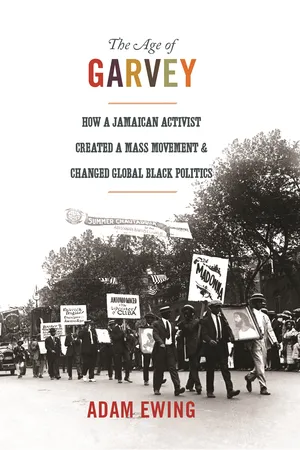 eBook - ePub
The Age of Garvey
How a Jamaican Activist Created a Mass Movement and Changed Global Black Politics
- Adam Ewing(Author)
- 2014(Publication Date)
- Princeton University Press(Publisher)
“As they tried to oppose the religion of Christ by nailing Christ to the cross,” declared Garvey, “so in the death of one leader of the Universal Negro Improvement Association, the work … will be carried forward with stronger force and power.” 49 Left for dead in 1923, the UNIA was reborn in its second period. As was the case with the “New Negro” following the war, the rebranding of the organization was rhetorical, an attempt to capture a Zeitgeist that had emerged not from top-down decision making but from acts big and small, by blacks and whites, by citizens and subjects in Africa, Europe, and the Americas. Marcus Garvey’s genius was not in his ability to imagine new futures or craft new ideas, but to give expression to—and provide an organizational vessel for—the unruly stream of black internationalism as it flowed down from the ages and crashed against the dikes of interwar white supremacy. Garvey’s success at building a workable mass politics out of the ferment of the Great War is well known. But his true contribution to global politics came later, during the frustrating decades of the 1920s and 1930s, and through the agency of men and women who adopted the infrastructure of Garveyism to pursue their own ends, and not always in ways that Garvey himself would have approved. For Garvey, a man with autocratic impulses and imperial ambitions, this must have been a perplexing irony indeed. The organizational insights that sustained his movement, that broadcast his name and his program across the world, precluded much of Garvey’s participation. He shone too brightly to work in the shadows. Yet it was here, amidst ostensible retreat, and in a variety of guises, that the Age of Garvey was forged.
- S. Mark, Stanley Trapido, S. Marks(Authors)
- 2014(Publication Date)
- Routledge(Publisher)
CHAPTER SEVEN‘Africa for the Africans’: the Garvey movement in South Africa, 1920–1940
Robert A. Hill and Gregory A. Pirio‘After all is said and done, Africans have the same confidence in Marcus Garvey which the Israelites had in Moses.’ Enock Mazilinko, Johannesburg, South Africa, Negro World, 9 February 1929At a meeting called by the African National Congress (ANC) at the Parade in Cape Town in May 1930, ‘an American Negro’ was said to have amused the crowd when, in his address, he urged that they ‘substitute for the pictures of “English royalty and lords” hanging in their homes the likenesses of Kadalie, Thaele and, among others, Marcus Garvey, who, he predicted, would one day “sit in the chair of your South African Parliament which Hertzog occupies today”.’1 The speaker was Arthur McKinley whom Edward Roux would later describe in Time Longer Than Rope as having been one of Garvey’s ‘most vociferous followers in South Africa’.2 McKinley’s pronouncements that afternoon may well have sounded slightly comic in the attenuated political circumstances of 1930, at a time when the post-war mobilisation of African protest had already exhausted itself. Yet, as we propose to show in this paper, such declarations flowed logically from the radical nationalist perspective that the Garvey movement had advanced, starting in 1920 on the question of the South African state. Furthermore, the documentary record confirms, in our view, the historical accuracy of McKinley’s conception of Kadalie, Thaele and Garvey as a political triad.Variously known as the ‘Africa for the Africans’ movement, a motto which signified its historic link with the antecedent phenomenon of Ethiopianism,3 the Garvey movement developed in South Africa after the First World War into a potent expression of mass-based African nationalism. Under its ideological stimulus, moreover, the old liberal ideology that had provided the chief political rationale of the African petit-bourgeois leadership, namely, the impartiality and supremacy of Britain as the ultimate protector of African interests, was undermined. Its displacement was to be aptly summed up by ‘a native female from Benoni’ who, in recommending to the annual meeting of the ANC in April 1925 that Africans boycott the visit of the Prince of Wales, let it be known – ‘The Dutch had been given the right to rule by the English in this country and it was therefore immaterial whether the Dutch or English ruled in this country.’ In place of what had become a debilitating political illusion, there arose after the First World War a new emancipatory vision under the general aegis of the revitalised cry, ‘Africa for the Africans’. At the level of popular consciousness, the various phases of African resistance were welded together to express a new sense of common political and racial destiny. It was this fusion of political sensibility that ultimately validates McKinley’s tribute to the emblematic qualities of Kadalie, Thaele and Garvey. Likewise, James Stehazu, another Cape Town Garveyite, was to express the same awareness when, in 1932, he asserted that ‘Marcus Garvey is now admitted as a great African leader’.4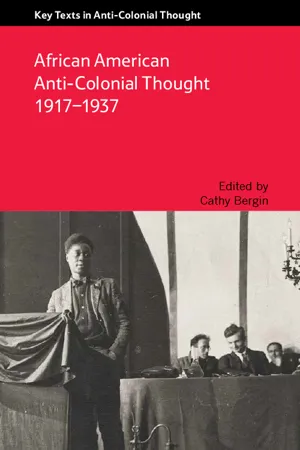
- Cathy Bergin(Author)
- 2016(Publication Date)
- Edinburgh University Press(Publisher)
Chapter 4 Responses to Garveyism The responses to Garveyism in the black radical press of the time are a rich source of complex and contradictory assertions of an American politics attuned to anti-colonial struggles abroad. The hostility from the black Left in particular to Garveyism, and Garvey’s own distancing of the UNIA from the Left, open up an often unpleasant, but fascinating, space for polemi-cal assertions of the meaning of black freedom both domestically and in the colonies. Claude McKay’s characterisation of Garveyism as ‘curiously bourgeois-obsolete and fantastically utopian’ in his article for The Liberator (April 1922) is one which also acknowledges the attraction of Garveyism in the face of US racism. Like many of the texts here, McKay’s article dem-onstrates the significance of Garveyism as an influence on anti-colonial politics and a repudiation of Garveyism as a strategy of resistance to racial oppression at home and abroad. The reaction to Garveyism also opened up a space for prejudice against Caribbean migrants to the USA which is encapsulated in W. A. Domingo’s angry letter to The Messenger in March 1923 and Chandler Owen’s clunky defensive response. Marcus Garvey (By W. E. B. Du Bois, The Crisis , December 1920) Marcus Garvey was born at St. Ann’s Bay, Jamaica, about 1885. He was educated at the public school and then for a short time attended the Church of England Grammar School, although he was a Roman Catholic by religion. On leaving school he learned the printing trade and followed it for many years. In Costa Rica he was associated with Marclam Taylor in publishing the Blue field’s Messenger. Later he was on the staff of La Nation. He then returned to Jamaica and worked as a printer, being foreman of the printing department of P. Benjamin’s Responses to Garveyism 123 Manufacturing Company of Kingston. eBook - ePub
Black Cosmopolitanism and Anticolonialism
Pivotal Moments
- Babacar M'Baye(Author)
- 2017(Publication Date)
- Routledge(Publisher)
Ultimately, Diagne’s Pan-Africanism and cosmopolitanism were thin in comparison with Garvey’s since they did not inspire him to openly denounce French colonialism or strongly embrace black struggle for autonomy and equality. Unlike Diagne, Garvey had the resolve and faith in the possibility of a free and independent Africa that was not obligated to mirror the West or surrender to its power. Being controlled by the French colonial administration, Diagne lacked the impetus of Garvey’s Pan-Africanism and, thus, rejected the Jamaican’s “Africa for the Africans” ideology as radicalism and Bolshevism. In doing so, Diagne surrendered to the colonial pressures that France put on him by expecting him to rid Senegal of Garvey. Resisting Diagne’s propaganda, Garvey challenged the deputy’s dubious role in the French empire in radical ways while indirectly influencing a few Senegalese to mobilize against colonialism. As is visible in the UNIA’s presence in colonial Senegal, Garvey played an important role in the dominion’s history by inspiring a few of its leaders to embrace the idea of Pan-African unity. As I will show in forthcoming chapters, Garvey’s impact in Africa was more far-reaching, since the Jamaican also influenced other Francophone African leaders such as Touvalou and Lamine Senghor who also deployed radical resistances against Diagne’s cosmopolitan and colonialist propagandas.Bibliography
Adefuye, Adebowale. “Marcus Garvey and Nigeria.” In Garvey: His Work and Impact, edited by Rupert Lewis and Patrick Bryan, 189–198. Trenton, NJ: Africa World Press, 1991.“Africa for Africans! Is Not Negro Slogan.” In The Marcus Garvey and Universal Negro Improvement Association Papers, Vol. 4, edited by Robert Hill, 32. Los Angeles: University of California Press, 1985.Angrand, Jean-Luc. Céleste ou le temps des Signares. Sarcelles, France: Éditions Anne Pépin, 2006.“Article in La Dépêche Coloniale et Maritime [Paris, 4 September 1921]. The Pan-Black Congress: Two Opposing Doctrines.” The Marcus Garvey and Universal Negro Improvement Association Papers
Index pages curate the most relevant extracts from our library of academic textbooks. They’ve been created using an in-house natural language model (NLM), each adding context and meaning to key research topics.

