Politics & International Relations

Huey Newton
Huey Newton was a prominent figure in the Black Power movement and co-founded the Black Panther Party in 1966. He advocated for self-defense and empowerment of the African American community, and his party's activities included community programs and monitoring police behavior. Newton's ideas and activism had a significant impact on the civil rights movement and the struggle for racial equality in the United States.
Written by Perlego with AI-assistance
Related key terms
1 of 5

7 Key excerpts on "Huey Newton"
 eBook - PDF
- Rick Elgendy, Joshua Daniel(Authors)
- 2015(Publication Date)
- Palgrave Macmillan(Publisher)
Born in 1942, Huey P. Newton was the seventh of seven chil- dren. 13 As a child, his family moved from Louisiana to California, where he was an unhappy student, often fighting with his class- mates. As an adolescent he taught himself to read, and began devouring political books. In 1966, he formed the Black Panther Party with Bobby Seale. The first activity of the Panthers was to organize police patrols: groups of black people who would follow police officers through black neighborhoods in order to witness abuses, and to intimidate police so that abuses would not occur. Newton led the drafting of a ten point list of demands adopted by 160 ● Vincent Lloyd the Panthers, including demands for full employment, for hous- ing, for education, and for an end to economic exploitation and police brutality. The first demand on this list asserts that power is the prerequisite for freedom: “We want freedom. We want power to determine the destiny of our Black Community. We believe that black people will not be free until we are able to determine our destiny.” The tenth demand, demanding a United Nations plebi- scite to determine the future of the “black colony” in America, is notable for quoting, verbatim, the first two paragraphs of the Declaration of Independence in its explication—“When, in the course of human events, it becomes necessary for one people to dissolve the political bonds which have connected them with another, and to assume, among the powers of the earth, the sepa- rate and equal station to which the laws of nature and nature’s God entitle them . . . ”. 14 As the Declaration of Independence cita- tion suggests, the Panthers were particularly, and somewhat para- doxically, concerned with framing their work within the context of an American legal framework. Newton thought it important to be able to cite state laws in confrontations with police.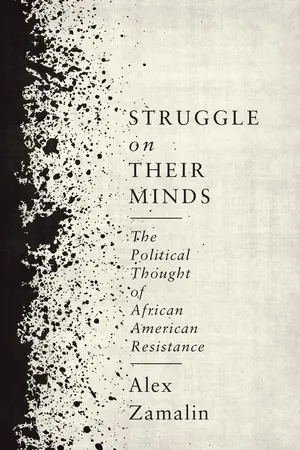 eBook - ePub
Struggle on Their Minds
The Political Thought of African American Resistance
- Alex Zamalin(Author)
- 2017(Publication Date)
- Columbia University Press(Publisher)
3 Huey Newton, THE BLACK PANTHERS, AND THE DECOLONIZATION OF AMERICAA n iconic photograph taken in 1967 captured everything Americans thought they knew about Huey P. Newton, the minister of defense and founding member of the Black Panther Party for Self-Defense, which was created in 1966. Seated in a peacock wicker chair, adorned in a leather jacket, white collared shirt, jeans, and his signature beret, tilted to the right, while holding a rifle in his right hand and spear in his left, the twenty-five-year-old Newton looks directly ahead at the camera, unflinching; a zebra skin lies at his feet. This photo was the cultural image of Black Power—aggressive, stoic, and centered on a militant form of self-defense, which tried to combine elements of African and modern culture to liberate black Americans from the repressive American state and capitalist system that was pushing them toward a slow death.1In the late 1960s, few American groups were as militant and loud in their opposition to American society as the Black Panthers. And Americans heard them. White liberals patting themselves on the back about their progressive racial thinking shook with horror at the scene of armed black men in paramilitary gear walking the streets of Oakland. Those relatively few black Americans trying so desperately to integrate into the American middle class rebuked them, but young radicals who were becoming increasingly disenchanted about the Vietnam War cheered them on.2FIGURE 3.1 Huey Newton sitting in wicker chair, 1967.Source : Courtesy of Collection Merrill C. Berman.On one level, the Panthers stood against much in American political culture. Their Marxist call to resist American capitalism was anathema to liberals, many of whom came of age during the postwar economic boom of the 1950s and were schooled in an American history that had always made personal wealth and rugged individualism synonymous with a successful, meaningful existence.3 The Panther code of armed self-defense countered Martin Luther King Jr.’s plea for nonviolence and James Baldwin’s plea for universal love in the name of humanity.4 eBook - PDF
Icons of African American Protest
Trailblazing Activists of the Civil Rights Movement [2 volumes]
- Gladys L. Knight(Author)
- 2008(Publication Date)
- Greenwood(Publisher)
Newton Foundation. It serves as a repository for Black Panther Party history and information. See also Elaine Brown; Stokely Carmichael; Angela Davis; W.E.B. Du Bois; Martin Luther King, Jr.; Malcolm X; Al Sharpton; and Robert F. Williams. 440 Icons of African American Protest FURTHER RESOURCES Collier, Peter, and David Horowitz. Destructive Generation: Second Thoughts about the Sixties. New York: Simon & Schuster, 1996. Forbes, Flores A. Will You Die with Me? My Life and the Black Panther Party . New York: Atria Books, 2006. Hilliard, David. Huey: Spirit of the Panther . New York: Thunder’s Mouth Press, 2006. Horowitz, David. Hating Whitey and Other Progressive Causes. Dallas: Spence Publishing Company, 1999. A Huey P. Newton Story . Directed by Spike Lee. 40 Acres & A Mule Filmworks, 2004. ‘‘It’s about Time.’’ Black Panther Party Legacy & Alumni (March 2008). See http:// www.itsabouttimebpp.com/index.html. Newton, Huey P. The Huey P. Newton Reader . New York: Seven Stories Press, 2002. Newton, Huey P. Revolutionary Suicide. New York: Writers & Readers Publishing, 1995. Newton, Huey P. ‘‘War against the Panthers: A Study of Repression in America.’’ Mindfully.Org (March 2008). See http://www.mindfully.org/Reform/War-Against- Panthers-Newton1jun80.htm. Seale, Bobby. Seize the Time: The Story of the Black Panther Party and Huey P. Newton. New York: Random House, 1970. Huey P. Newton 441 This page intentionally left blank eBook - PDF
Liberated Territory
Untold Local Perspectives on the Black Panther Party
- Yohuru Williams, Jama Lazerow, Yohuru Williams, Jama Lazerow(Authors)
- 2009(Publication Date)
- Duke University Press Books(Publisher)
The sociologist Jimi Mori’s ‘‘The Ideological Development of the Black Panther Party,’’ Cornell Journal of Social Relations 12, no. 2 (fall 1977): 137– 55, again relying on theory and the foundational works mentioned above, re-mains one of the most insightful analyses of party ideology despite its focus on the national story and the absence of attention to any but national leaders. ∫π Helen Stewart, ‘‘Bu√ering: The Leadership Style of Huey P. Newton, Co-Founder of the Black Panther Party’’ (Ph.D. diss., Brandeis University, 1980), 2. ∫∫ For the story of Newton’s mother insisting on $5,000 for her cooperation in a journalist’s early book on the Panthers, see Schanche, The Panther Paradox , 146–47. ∫Ω S. J. Gu√ev, ‘‘Bobby Seale Now Living in Denver,’’ Gettysburg Times , July 15, 1982, 7. Ω≠ The same year, from a di√erent political perspective and compromised by speculation about the deal he had made to return to the United States, Eldridge Cleaver published his post-exile autobiography, Soul on Fire (Waco: Word, 1978). Tracing his evolution from criminal to revolutionary to conservative born-again Christian, and providing some new details about his beliefs and actions at dif-ferent moments in time, the book revealed little about the internal workings of the party itself. Ω∞ M. Newton, Bitter Grain. Ω≤ Ibid. Quotations are from the back of the 1991 edition. Ω≥ His one-page summary of the Massachusetts story, for example, contains some eight errors (156). For more on that story, see Jama Lazerow’s essay ‘‘The Black Panthers at the Water’s Edge: Oakland, Boston, and the New Bedford ‘Riots’ of 1970’’ in this volume. Ω∂ M. Newton, Bitter Grain , quotation, 216. Ω∑ John Chamberlin, ‘‘Chaplin’s View Queer,’’ Coshocton (Ohio) Tribune , May 6, 1970. ‘‘The Panthers do good things. They feed children. Eldridge Cleaver writes eloquent books, and some of his essays may live as literature.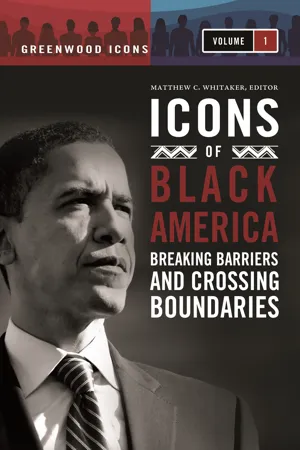 eBook - PDF
Icons of Black America
Breaking Barriers and Crossing Boundaries [3 volumes]
- Matthew Whitaker(Author)
- 2011(Publication Date)
- Greenwood(Publisher)
Huey P. Newton (1942– 1989) and Bobby Seale (1936–) Ted Streshinsky/Corbis Huey P. Newton and Bobby Seale emerged as symbols of ultra-militant black radicalism beginning in October 1966 when they founded the Black Panther Party for Self Defense (BPP). Dedicated initially to organizing blacks to pro- tect themselves and their neighborhoods against police brutality in Oakland, California, the BPP developed as a revolutionary, broad-based self-help, political and social action organization. Its signature “Ten Point Program” (TPP) demanded major reforms to improve the circumstances and conditions of life for blacks and other oppressed peoples in the United States. “We want land, bread, housing, education, clothing, justice, peace and people’s com- munity control of modern technology,” the TPP declared in its final summary point. Spreading nationally, particularly to urban centers with significant black populations, and later internationally, the BPP drew attention dramati- cally with its militancy and deadly clashes with law enforcement. Newton’s and Seale’s public images grew with the BPP to almost legendary dimensions as friends and foes contrived, exaggerated, and fabricated accounts of their actions and intentions. Their images soared, particularly in the late 1960s- counterculture, especially after Federal Bureau of Investigation (FBI) Director J. Edgar Hoover in September 1968 publicly declared the BPP “the greatest threat to the internal security of the country” and virtually ordered FBI agents and assets to harass and destroy the BPP, its members, and supporters (Cleaver and Katsiaficas, 8). Newton and Seale were both southern-born: Seale in Dallas, Texas, and Newton in Monroe, Louisiana. They migrated with their families to Oakland in 1945, part of a rising wave of Southern blacks moving to opportunities World War II created. They met for the first time almost 20 years later as students at California’s northern Alameda County’s Merritt College.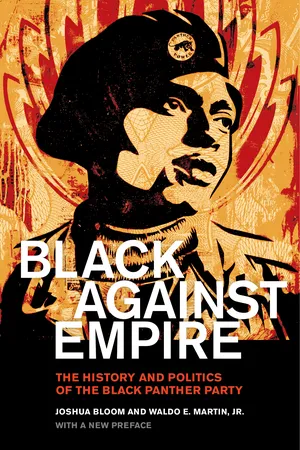 eBook - PDF
Black against Empire
The History and Politics of the Black Panther Party
- Joshua Bloom, Waldo E. Martin Jr.(Authors)
- 2016(Publication Date)
- University of California Press(Publisher)
Through his teen years, Huey fought constantly. 6 Unlike Melvin, Huey was not a bookworm. For years he rebelled at school. By the time he entered the eleventh grade, he still could not read, and his teachers often told him Huey and Bobby | 21 he was unintelligent. But outside of school, he had been learning how to think. With Melvin, he memorized and analyzed poetry. When a coun-selor in his high school told him he was “not college material,” Huey decided to prove him wrong. Over the next two years, through intense focus and will, he taught himself to read, graduated high school, and in 1959, enrolled in Merritt College. 7 By the time Huey Newton became involved in the Afro-American Association at Merritt, he could debate theory as well as any of his peers. Yet he had a side that most of the budding intellectuals around him lacked; he knew the street. He could understand and relate to the plight of the swelling ranks of unemployed, the “brothers on the block” who lived outside the law. Newton’s street knowledge helped put him through college, as he covered his bills through theft and fraud. But when Newton was caught, he used his book knowledge to study the law and defend himself in court, impressing the jury and defeating sev-eral misdemeanor charges. In 1962, at a rally at Merritt College opposing the U.S. blockade of Cuba, Newton’s political life took a leap forward: there, he met fellow student Bobby Seale, with whom he would eventually found the Black Panther Party. The rally featured Donald Warden, leader of the Afro-American Association. Warden praised Cuba’s Fidel Castro and voiced opposition to domestic civil rights organizations. After the speeches, an informal debate began among the students, during which Newton convinced Seale that the U.S. policy in Cuba was wrong and also made him question mainstream civil rights organizations. Newton impressed Seale with his command of the argument presented by E.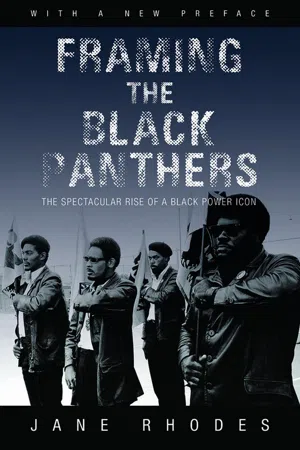 eBook - ePub
Framing the Black Panthers
The Spectacular Rise of a Black Power Icon
- Jane Rhodes(Author)
- 2017(Publication Date)
- University of Illinois Press(Publisher)
An accomplished black actor named Roger Guenveur Smith opened his one-man play about Huey Newton at a well-known independent theater in Los Angeles. Smith's A Huey P. Newton Story eventually made its way into the theatrical mainstream, with performances at the New York Shakespeare Festival and a film version on cable television directed by Spike Lee. The simultaneous appearance of these varied cultural products was mutually advantageous for all—readers of the Black Panther memoirs were a natural audience for A Huey Newton Story, while the play's program carried an advertisement for the film Panther with the provocative claim “There is a Black Panther born in the ghetto every 20 minutes.” Implicit in this campaign to market the Black Panthers was a sense that the social and political conditions that were the catalyst for widespread black rebellion in the 1960s were producing another generation of the angry and disenfranchised. 15 This resurgent interest in the Black Panther Party occurred during a period when urban communities of color across the United States boiled over with discontent, as starkly epitomized by the 1992 Los Angeles uprising. In the early 1990s, significant segments of the black population were gripped by economic disparity and decline. The black middle class increased significantly during the 1980s, with many moving to the suburbs, but the majority of African Americans were left out of this prosperity. The black-white income gap worsened after two decades of improvement, with college-educated black men earning about 80 percent of what their white colleagues made, and black unionized workers earning 85 percent of whites’ wages. Meanwhile, one-quarter of young black males were caught up in the criminal justice system, and their life expectancy actually declined, leading scholars to conclude that life chances for African Americans were getting worse rather than better
Index pages curate the most relevant extracts from our library of academic textbooks. They’ve been created using an in-house natural language model (NLM), each adding context and meaning to key research topics.

