History

Black Panther Party
The Black Panther Party was a revolutionary socialist organization founded in 1966 in the United States. It aimed to challenge police brutality and systemic racism, advocating for the empowerment and self-defense of African American communities. The party also provided social programs such as free breakfast for children and healthcare clinics, leaving a lasting impact on the civil rights movement.
Written by Perlego with AI-assistance
Related key terms
1 of 5
11 Key excerpts on "Black Panther Party"
 eBook - PDF
- Gerald D. Jaynes(Author)
- 2005(Publication Date)
- SAGE Publications, Inc(Publisher)
The Black Panthers advocated militant self-defense of minority communities against the U.S. government and sought to establish revolutionary Black Panther Party ——— 121 socialism through mass organization and community-based programs. ORIGINS The Black Panther Party arose in the mid-1960s dur-ing the era of protest movements against racial injus-tice, poverty, and the Vietnam War. Begun in Oakland, California, in October 1966, the party drew some of its inspiration, as well as adherents, from black south-ern migrant families and their traditions of communal solidarity. The cofounders of the Black Panthers, Huey Newton and Bobby Seale, both originally hailed from the South. Bobby Seale came from an enterprising family in Dallas, Texas, but they later moved to Oakland, where Seale grew up not far from the campus of Merritt College. While attending Merritt, Seale met fellow student Huey P. Newton. Born in Monroe, Louisiana, Newton also had moved to Oakland with his family. He grew into a tough street fighter in Oakland’s ghet-tos but was also a talented pianist who enrolled in night law school. The discussions that Seale and Newton heard in the college group Soul Students led them to create an organization that would be more responsive to the needs of the beleaguered black community, whose members were seeking better jobs, an end to police brutality, and freedom from racism. They wanted this organization to be an alternative to the nonviolent civil rights movement, which they felt was not making fast enough progress. The original purpose of the group was to patrol black neighborhoods to protect residents from acts of police brutality. Eventually, however, the Black Panthers developed into a Marxist revolutionary group that called for arming blacks against white America, the release of all blacks from jail, and the payment of compensation to blacks Americans for centuries of exploitation.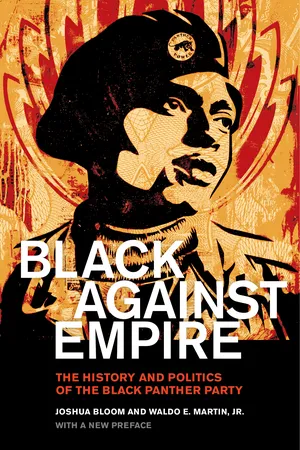 eBook - PDF
Black against Empire
The History and Politics of the Black Panther Party
- Joshua Bloom, Waldo E. Martin Jr.(Authors)
- 2016(Publication Date)
- University of California Press(Publisher)
Edgar Hoover famously declared, “The Black Panther Party, without question, represents the greatest threat to the internal security of the country.” 12 As the Black Panthers drew young blacks to their revolutionary pro-gram, the Party became the strongest link between the domestic Black Liberation Struggle and global opponents of American imperialism. The North Vietnamese — at war with the United States — sent letters home to the families of American prisoners of war (POWs) through the Black Panther Party and discussed releasing POWs in exchange for the release of Panthers from U.S. jails. Cuba offered political asylum to Black Panthers and began developing a military training ground for them. Algeria — then the center of Pan-Africanism and a world hub of anti-imperialism that hosted embassies for most postcolonial govern-ments and independence movements — granted the Panthers national diplomatic status and an embassy building of their own, where the Panthers headquartered their International Section under the leader-ship of Eldridge and Kathleen Cleaver. But by the time of Newton’s trip to China, the Black Panther Party had begun to unravel. In the early 1970s, the Party rapidly declined. By mid-1972, it was basically a local Oakland community organiza-tion once again. An award-winning elementary school and a brief local renaissance in the mid-1970s notwithstanding, the Party suffered a long and painful demise, formally closing its last office in 1982. Not since the Civil War almost a hundred and fifty years ago have so many people taken up arms in revolutionary struggle in the United States. Of course, the number of people who took up arms for the Union and Confederate causes and the number of people killed in the Civil War are orders of magnitude larger than the numbers who have engaged in any armed political struggle in the United States since. eBook - ePub
- Jon-Jamal Turner(Author)
- 2021(Publication Date)
- Hotep Book Publishing(Publisher)
Indeed, this voice offered was given a different posture by Marcus Garvey, a profound force during the Harlem Renaissance. A contemporary of Du Bois, the Jamaican Garvey influenced the hearts and minds of millions of people of African descent. As a quasi-community organizer, Garvey founded the Universal Improvement Association (UNIA).12 His organization had over a million members, but UNIA had no viable and functional community action programs addressing the day-to-day needs of the people. There was no political agenda addressing specific policies that would have a positive effect on the community as a body politic. UNIA was primarily a cultural and economic nationalist organization with the desire to return to Africa all people of African descent. Indeed, according to Garvey in "The Dream of a Negro Empire," it was the purpose of the Universal Negro Improvement Association to have established in Africa the brotherly cooperation that would make the interest of the African native and the American and West Indian Negro one and the same, that is to say, we shall enter a common partnership to build up Africa in the interest of our race. In theory, UNIA's agenda was to better the condition of African people socially, politically, and economically. Moreover, this transformation was to take place in Africa and not permanently in the colonies (inner cities) of America. Unlike the BPP, however, UNIA never applied its philosophy into practical application; the idea remained abstract and was never actualized.The Historical Footprints of the Black Panther Party
Nowhere has the torch been carried with such ferocity than with the BPP. Combining all the heretofore-mentioned elements, the Party would become a major force in the history of the Black Liberation Movement, aimed at actualizing the ancestral dreams for self-liberation, self-empowerment, self-defense, community organizing and the yearnings of freedom for and full citizenship for blacks in a country that they built with the sweat, blood and minds of their ancestors. The Black Panther Party created a major paradigm shift as a model for community organizing and self-defense. It became the first and only political party founded on the principles of a community-based organization with viable community programs and built-in protections for the community. Moreover, the BPP was the community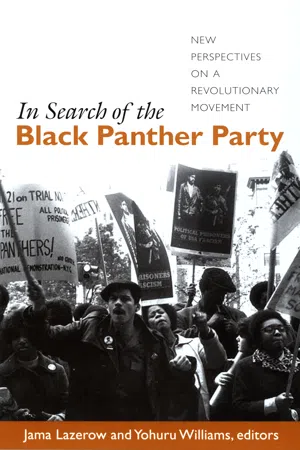 eBook - PDF
In Search of the Black Panther Party
New Perspectives on a Revolutionary Movement
- Jama Lazerow, Yohuru Williams, Jama Lazerow, Yohuru Williams(Authors)
- 2006(Publication Date)
- Duke University Press Books(Publisher)
50 Robert O. Self Party, 1966–1971’’ (Ph.D. diss., Michigan State University, 2003); Robyn Spencer, ‘‘Repression Breeds Resistance: The Rise and Fall of the Black Panther Party in Oak-land, California, 1966–1982’’ (Ph.D. diss., Columbia University, 2001); Craig Peck, ‘‘Educate to Liberate: The Black Panther Party and Political Education’’ (Ph.D. diss., Stanford University, 2001); Tracye Matthews, ‘‘No One Ever Asks What a Man’s Place in the Revolution Is: Gender and Sexual Politics in the Black Panther Party, 1966–1971’’ (Ph.D. diss., University of Michigan, 1998). 2. Among Panther critics, see Hugh Pearson, The Shadow of the Panther: Huey Newton and the Price of Black Power in America (Reading, Mass.: Addison-Wesley, 1994); and Peter Collier and David Horowitz, Destructive Generation: Second Thoughts about the Sixties (New York: Summit, 1989). More sympathetic accounts include Ward Churchill and Jim Vander Wall, Agents of Repression: The fbi ’s Secret War Against the Black Panther Party and the American Indian Movement (Boston: South End Press, 1988); and Judson Je√ries, Huey P. Newton: The Radical Theorist (Jack-son: University Press of Mississippi, 2002). For Panther memoirs, see Huey P. Newton, Revolutionary Suicide (New York: Harcourt Brace, 1973); Bobby Seale, Seize the Time: The Story of the Black Panther Party (New York: Vintage, 1970); David Hilliard and Lewis Cole, This Side of Glory: The Autobiography of David Hil-liard and the Story of the Black Panther Party (Boston: Little, Brown, 1993); Elaine Brown, A Taste of Power: A Black Woman’s Story (New York: Doubleday, 1992); and Earl Anthony, Spitting in the Wind: The True Story Behind the Violent Legacy of the Black Panther Party (Malibu, Calif.: Roundtable, 1990). 3. Nikhil Pal Singh, Black Is a Country: Race and the Unfinished Struggle for Democ-racy (Cambridge, Mass.: Harvard University Press, 2004), 2.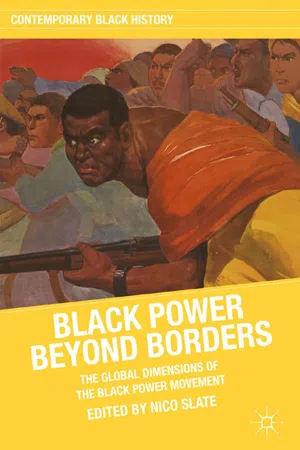 eBook - PDF
Black Power beyond Borders
The Global Dimensions of the Black Power Movement
- N. Slate(Author)
- 2012(Publication Date)
- Palgrave Macmillan(Publisher)
They hoped to create a united front organization that would enable SNCC to move into the urban north and use New York’s dense infrastructure of black nationalist and radical activism to launch a national black party. 3 With its usual caprice, however, history proved more elusive. The Harlem Party lasted little more than a year and, instead, the panther traveled west to the migrant communities of the San Francisco Bay Area. In a pattern inaugurated by the Watts rebellions, the comparatively small and recent black population settle- ments of California, rather than the historic black metropolises of New York or Chicago appeared at the forefront of post-civil rights struggle. A dynamic youth movement coalesced in the expansive network of urban college campuses and universities that crisscrossed the Bay Area with North Oakland’s Merritt College at the center. By April 1966, dissidents from the Afro-American Association, California’s first indigenous black nationalist group, and participants in Merritt Black Studies movement quietly joined RAM and formed the Black Panther Party of Northern California (BPPNC). Within six months, two other Merritt students, Huey Newton and Robert Seale, met at the North Oakland Poverty Center to draft the official platform for the BPPSD. They appended “Self Defense” to their name to distinguish themselves from earlier groups and to highlight their advo- cacy of armed police patrols. This Oakland-based party quickly eclipsed its pre- decessors, and in less than five years blossomed into an international movement with branches in over 61 US cities and 26 states. 4 WHEN THE PANTHER TRAVELS 59 To many past and present, the Oakland BPP incorporated and even personi- fied the major tenets of Black Power politics. Crisp paramilitary uniforms of black leather jackets, berets, and powder blue shirts combined with precision marching and martial display demonstrated racial pride and community accom- plishment. eBook - PDF
- Rick Elgendy, Joshua Daniel(Authors)
- 2015(Publication Date)
- Palgrave Macmillan(Publisher)
Born in 1942, Huey P. Newton was the seventh of seven chil- dren. 13 As a child, his family moved from Louisiana to California, where he was an unhappy student, often fighting with his class- mates. As an adolescent he taught himself to read, and began devouring political books. In 1966, he formed the Black Panther Party with Bobby Seale. The first activity of the Panthers was to organize police patrols: groups of black people who would follow police officers through black neighborhoods in order to witness abuses, and to intimidate police so that abuses would not occur. Newton led the drafting of a ten point list of demands adopted by 160 ● Vincent Lloyd the Panthers, including demands for full employment, for hous- ing, for education, and for an end to economic exploitation and police brutality. The first demand on this list asserts that power is the prerequisite for freedom: “We want freedom. We want power to determine the destiny of our Black Community. We believe that black people will not be free until we are able to determine our destiny.” The tenth demand, demanding a United Nations plebi- scite to determine the future of the “black colony” in America, is notable for quoting, verbatim, the first two paragraphs of the Declaration of Independence in its explication—“When, in the course of human events, it becomes necessary for one people to dissolve the political bonds which have connected them with another, and to assume, among the powers of the earth, the sepa- rate and equal station to which the laws of nature and nature’s God entitle them . . . ”. 14 As the Declaration of Independence cita- tion suggests, the Panthers were particularly, and somewhat para- doxically, concerned with framing their work within the context of an American legal framework. Newton thought it important to be able to cite state laws in confrontations with police.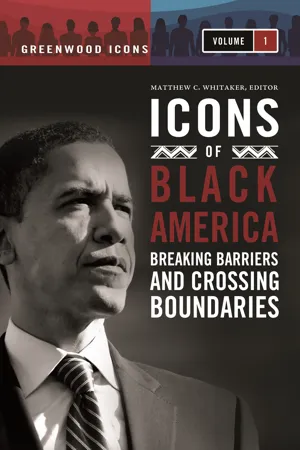 eBook - PDF
Icons of Black America
Breaking Barriers and Crossing Boundaries [3 volumes]
- Matthew Whitaker(Author)
- 2011(Publication Date)
- Greenwood(Publisher)
Huey P. Newton (1942– 1989) and Bobby Seale (1936–) Ted Streshinsky/Corbis Huey P. Newton and Bobby Seale emerged as symbols of ultra-militant black radicalism beginning in October 1966 when they founded the Black Panther Party for Self Defense (BPP). Dedicated initially to organizing blacks to pro- tect themselves and their neighborhoods against police brutality in Oakland, California, the BPP developed as a revolutionary, broad-based self-help, political and social action organization. Its signature “Ten Point Program” (TPP) demanded major reforms to improve the circumstances and conditions of life for blacks and other oppressed peoples in the United States. “We want land, bread, housing, education, clothing, justice, peace and people’s com- munity control of modern technology,” the TPP declared in its final summary point. Spreading nationally, particularly to urban centers with significant black populations, and later internationally, the BPP drew attention dramati- cally with its militancy and deadly clashes with law enforcement. Newton’s and Seale’s public images grew with the BPP to almost legendary dimensions as friends and foes contrived, exaggerated, and fabricated accounts of their actions and intentions. Their images soared, particularly in the late 1960s- counterculture, especially after Federal Bureau of Investigation (FBI) Director J. Edgar Hoover in September 1968 publicly declared the BPP “the greatest threat to the internal security of the country” and virtually ordered FBI agents and assets to harass and destroy the BPP, its members, and supporters (Cleaver and Katsiaficas, 8). Newton and Seale were both southern-born: Seale in Dallas, Texas, and Newton in Monroe, Louisiana. They migrated with their families to Oakland in 1945, part of a rising wave of Southern blacks moving to opportunities World War II created. They met for the first time almost 20 years later as students at California’s northern Alameda County’s Merritt College.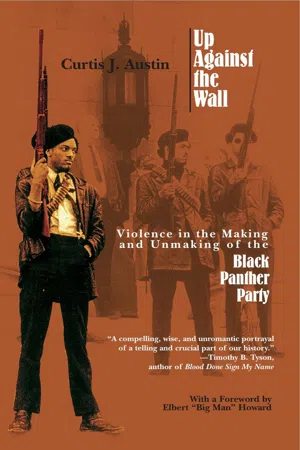 eBook - ePub
Up Against the Wall
Violence in the Making and Unmaking of the Black Panther Party
- Curtis J. Austin, Elbert "Big Man" Howard(Authors)
- 2008(Publication Date)
- University of Arkansas Press(Publisher)
The Black Panther Party for Self-DefenseAFTER ABOUT A MONTH OF GOING IN AND out of their office on Fifty-sixth and Grove in Oakland openly displaying their weapons, the moment of truth finally arrived.1Bobby Seale wrote that by early 1967 “Huey was on a level where he was ready to organize the black brothers for a righteous revolutionary struggle with guns and force.” In addition to its founders, the Black Panther Party’s members at this time included Sherman and Reginald Forte, Bobby Hutton, and Elbert Howard. Hoping for the opportunity to demonstrate to the community that their philosophy and tactics helped advance the cause of black liberation, they held political education classes daily in an attempt to bring ideological uniformity to the group. They also had sessions where they learned how to break down, clean, and reassemble weapons, to fire them, and to handle them safely. Newton wrote, “a number of people who [he] knew had just come from Vietnam, and they helped train [the Panthers] in weaponry.” Oakland resident John Sloane, who had been in the military, gave the group its first lessons on “field stripping and shooting,” according to Seale. (The following chapters further address the Vietnam connection in the following chapters.)One frigid day in early February 1967, several well-armed Panthers were leaving the office when an Oakland police officer cruised by. The officer continued down the street, radioed to headquarters then quickly made a U-turn and drove back toward the Panthers, who were by then getting into their car to leave. Just as they expected, the police officer pulled behind them. Newton instructed everybody in the car to remain silent because, according to Seale, he said “the minute somebody says something, the man is going to try to arrest you for some jive about interfering with an officer carrying out his duty” or “on a traffic ticket.” The people who were “subject to gather around” them would then “think he arrested you because you’ve got the gun. We want to prove to the people that we’ve got the right to carry guns and they’ve got a right to arm themselves and we will exhaust our constitutional right to carry these guns.”2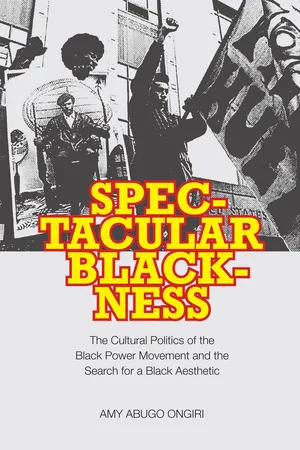 eBook - PDF
Spectacular Blackness
The Cultural Politics of the Black Power Movement and the Search for a Black Aesthetic
- Amy Abugo Ongiri(Author)
- 2009(Publication Date)
- University of Virginia Press(Publisher)
Serving both to provide information and to promote the party, the Black Panther combined graphic images of police brutality and urban black mis- 54 SPECTACULAR BLACKNESS ery with uplifting illustrations and textual analysis of events in American popular and political culture. In the 19 June 1971 issue are found an article on the lack of scientific research on sickle cell anemia; a lengthy analysis of the film Sweet Sweetback’s Baadasssss Song! that includes movie stills along-side illustrations by Douglas; a press statement on the Richmond Five; and an article on and picture of Jo Etha Collier, a young Black woman killed while celebrating her graduation from the white high school in Drew, Mis-sissippi, that she had integrated. The careful mélange of popular and politi-cal culture in the Black Panther suggests how the party would successfully operate within popular culture to create an enduring critique of U.S. cul-ture in general. At the same time, this mix also suggests how the Black Pan-ther Party’s investment in popular culture would leave it open to co-option and appropriation by the same commodity forces driving the popular cul-ture that it critiqued. Material from the early days of the Oakland chapter of the Black Pan-ther Party, now archived in the Dr. Huey P. Newton Foundation Collection held in Palo Alto by Stanford University, suggests the seemingly limitless extent of the creative nature of its engagement with American popular cul-ture. Whereas Panther efforts to imprint the notion of Black Power and an end to police brutality through the newspaper and rallies is widely known, the extent and sophistication of their engagement with popular culture is not. In This Side of Glory, Hilliard makes brief mention of “large contribu-tions” and “remunerative book deals” as important sources of income for the Black Panther Party (154).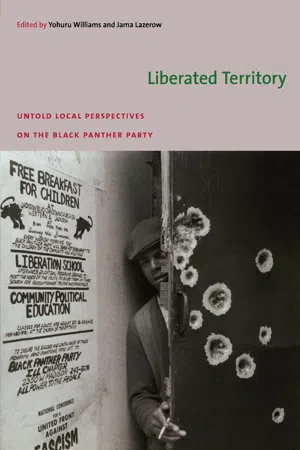 eBook - PDF
Liberated Territory
Untold Local Perspectives on the Black Panther Party
- Yohuru Williams, Jama Lazerow, Yohuru Williams, Jama Lazerow(Authors)
- 2009(Publication Date)
- Duke University Press Books(Publisher)
Newton,’’ reprinted in Mitch-ell Goodman, comp., The Movement Toward a New America: The Beginnings of a Long Revolution (A Collage), a What? (New York: Alfred A. Knopf, 1970), 202. Seale’s book was eventually published under the title Seize the Time: The Story of the Black Panther Party and Huey P. Newton , ed. Art Goldberg (New York: Vintage, 1970). Two years later, activist Julian Bond made a similar case in his preface to the first collection of published Panther writings and speeches: ‘‘So much has been written and spoken about the Black Panthers in the press and over the radio and TV that one might suppose that most people know what the organization really stands for and seeks to achieve. But this is far from the case. Only rarely does the press report what the Panthers are actually saying and doing. . . . The result is most people have obtained their impression of the Panthers from statements issued by those who wish to see them eliminated as a factor in American life’’ (Foner, The Black Panthers Speak , xix). ∞∞ After more than a decade of scholarly overviews, Maurice Isserman and Michael Kazin, America Divided: The Civil War of the 1960s (New York: Oxford University Press, 2000) represented a historiographical watershed. The maturing of the monographic literature was signaled two years earlier by Doug Rossinow’s The Politics of Authenticity: Liberalism, Christianity, and the New Left in America (New York: Columbia University Press, 1998); a foreshadowing of a new day for bringing the Black Panther Party back in ∏≥ the history of the 1960s came several years earlier with David Farber’s collection, The Sixties: From Memory to History (Chapel Hill: University of North Carolina Press, 1994). For a meditation on the state of the field, ca. 2000, see Jama Lazerow, ‘‘1960–1974,’’ in A Companion to 20th Century America , ed. Stephen J. Whitfield, 87–101 (Malden, Mass.: Blackwell, 2004).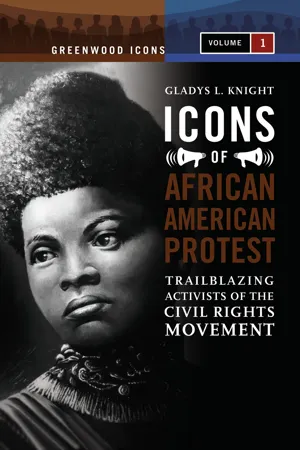 eBook - PDF
Icons of African American Protest
Trailblazing Activists of the Civil Rights Movement [2 volumes]
- Gladys L. Knight(Author)
- 2008(Publication Date)
- Greenwood(Publisher)
Newton Foundation. It serves as a repository for Black Panther Party history and information. See also Elaine Brown; Stokely Carmichael; Angela Davis; W.E.B. Du Bois; Martin Luther King, Jr.; Malcolm X; Al Sharpton; and Robert F. Williams. 440 Icons of African American Protest FURTHER RESOURCES Collier, Peter, and David Horowitz. Destructive Generation: Second Thoughts about the Sixties. New York: Simon & Schuster, 1996. Forbes, Flores A. Will You Die with Me? My Life and the Black Panther Party . New York: Atria Books, 2006. Hilliard, David. Huey: Spirit of the Panther . New York: Thunder’s Mouth Press, 2006. Horowitz, David. Hating Whitey and Other Progressive Causes. Dallas: Spence Publishing Company, 1999. A Huey P. Newton Story . Directed by Spike Lee. 40 Acres & A Mule Filmworks, 2004. ‘‘It’s about Time.’’ Black Panther Party Legacy & Alumni (March 2008). See http:// www.itsabouttimebpp.com/index.html. Newton, Huey P. The Huey P. Newton Reader . New York: Seven Stories Press, 2002. Newton, Huey P. Revolutionary Suicide. New York: Writers & Readers Publishing, 1995. Newton, Huey P. ‘‘War against the Panthers: A Study of Repression in America.’’ Mindfully.Org (March 2008). See http://www.mindfully.org/Reform/War-Against- Panthers-Newton1jun80.htm. Seale, Bobby. Seize the Time: The Story of the Black Panther Party and Huey P. Newton. New York: Random House, 1970. Huey P. Newton 441 This page intentionally left blank
Index pages curate the most relevant extracts from our library of academic textbooks. They’ve been created using an in-house natural language model (NLM), each adding context and meaning to key research topics.

