Politics & International Relations

Pan Africanism
Pan-Africanism is a movement that advocates for the unity and solidarity of African people worldwide. It seeks to promote the political, social, and economic empowerment of African nations and people, and to combat colonialism, racism, and inequality. Pan-Africanism aims to foster a sense of shared identity and purpose among people of African descent, and to advance the interests of the African continent as a whole.
Written by Perlego with AI-assistance
Related key terms
1 of 5

12 Key excerpts on "Pan Africanism"
 eBook - PDF
Nationalism in a Transnational Age
Irrational Fears and the Strategic Abuse of Nationalist Pride
- Frank Jacob, Carsten Schapkow, Frank Jacob, Carsten Schapkow(Authors)
- 2021(Publication Date)
- De Gruyter Oldenbourg(Publisher)
Onigu Otite (Enugu: Fourth Dimension Publishing, 1978), 75. 10 Esedebe, “ The Emergence of Pan African Ideas, ” 75. 5 New Transnational Pan-Africanism and Its Nationalist Limitations 93 of attention since the pre-colonial era when the slave trade and the scramble for Africa troubled the continent. To show the strategic nature of Africa in world politics, great power politics also revolve around the continent as a ma-jority of great powers in history had to focus their foreign policy objectives to-ward Africa. Pan-Africanism is generally regarded as an intervention of African peoples over what they view as a Eurocentric conspiracy targeting blacks and aimed at sustaining the dependence of Africa on the developed world and the continu-ous exploitation of its people by those in the Western world. 11 So, this inter-vention is centered on advocacy for equity in the interest of Africa. According to Ndlovu-Gatsheni, Pan-Africanism, which recognizes the contemporary in-ternational system as a racially hierarchized, partial, imperial, colonial, and capitalist global social order, is a movement that emerged as a result of black racial consciousness and sought to challenge the domination of Africa by a Eurocentric-centered world system. The latter ’ s existence gives little opportu-nity to the less privileged race to actualize their potentials through what is generally perceived as the oppression, abuse, and exploitation of black iden-tity by white racial groups who desire continuous economic, technological, etc. dependences on the West. 12 Bunting states that Pan Africanism is an ideology and an objective informed by the culture values, beliefs and customs of African peoples and their experiences that have developed over the past six centuries of the modern era. eBook - PDF
African Philosophy and Thought Systems
A Search for a Culture and Philosophy of Belonging
- Munyaradzi Mawere, R. Mubaya(Authors)
- 2016(Publication Date)
- Langaa RPCIG(Publisher)
An exposition of Pan-Africanism Pan-Africanism is a recognition that Africans have been divided among themselves, that they constantly compete with each other, are deprived of true ownership of their own resources, and are inundated with paternalistic external actors (Murithi 2007: 2). Modern-day paternalism takes a sophisticated form, manifesting as a kind and gentle helping hand with benign and benevolent intentions. In reality, however, it perpetuates a ‘master-servant’ relationship and resists genuine empowerment of Africans and independence of thought in Africa. The net effect is disempowerment of Africans, so they do not decide for themselves on the best way to deal with problems and issues unique to them. Pan-Africanism recognises that the only way out of this existential socio-political crisis is by promoting greater solidarity amongst Africans (ibid). 114 It is axiomatic to posit that despite the flood of books and articles on Pan- Africanism in recent years the study of the phenomenon is still in its babyhood. Scholars and politicians alike tend to bury its aspirations and dynamics in minutiae of fascinating but largely irrelevant details. Not surprisingly there is still no consensus on what Pan- Africanism is all about. As a concept, the term “Pan-Africanism” is credited to Henry Sylvestre-Williams, and Marcus Garvey, amongst others, renowned for organising the largest Pan-African movement in history (Dieng 2005). The ideal of unity for all peoples of African descent have found resonance globally, attracting intellectuals, writers, artists, leaders of religious and cultural movements, and politicians of varying renown. Pan-Africanism has inspired scholarly traditions that privilege African-centred knowledge production, epistemologies and perspectives that challenge perceived Euro-centric (mis)representations of Africa and people of African descent (Obenga 2001). eBook - ePub
- Matthew Graham(Author)
- 2018(Publication Date)
- Bloomsbury Academic(Publisher)
This chapter will first assess the evolution of Pan-Africanist thought, and the influence this continues to have on political decision making, and the efforts to forge political, economic, and cultural unity through institutions such as the OAU and African Union (AU). It will then track the evolution of Africa’s continental organisations and regional economic communities (RECs) in the search to establish collective political and economic unity, with a specific focus on how peacekeeping has become a major function in fulfilling stability and security. The chapter will then examine Africa’s diaspora and the ways in which it has shaped, influenced, and worked with the continent in its different forms, and the potential these communities might have in the future. The final section will address migration, seeking to move beyond western stereotypes in order to provide a more nuanced picture of population movements, the effects these have across Africa, and the ways in which continental and international institutions have understood and responded to migration pressures.Pan-AfricanismOne of the most enduring yet nebulous ideological concepts in contemporary Africa is Pan-Africanism, an influential theoretical idea that first gained philosophical and political adherents from the early twentieth century. Colin Legum (1965, 14) observed that Pan-Africanism ‘is essentially a movement of ideas and emotions; at times it achieves a synthesis; at times it remains at the level of thesis and antithesis.’ What makes Pan-Africanism difficult to define is that it is a fluid ideology which has evolved and been recast over time in an effort to fulfil the aspirations of African people and their descendants, with different iter-ations emerging in response to changing political circumstances. At its core, Pan-Africanism is centred on recognising the shared experiences of racism, oppression, marginalisation, and (neo)colonialism, which can only be overcome through unity, solidarity, and collective action.The Pan-African movement first originated in the African diaspora of North America and the Caribbean where black intellectuals sought to articulate their experiences, and forge a unified global racial consciousness to achieve dignity and freedom. This vision of solidarity and unity based on a common heritage and history was conceptualised through a continental rather than territorial lens, which ironically accentuated divisions across Africa when new nationalist leaders began to debate how best to practically implement its philosophical tenets. Key leaders in the diaspora that drove the earliest conceptualisations of Pan-Africanism included Trinidadian barrister Henry Sylvester-Williams and the American W.E.B. Du Bois, who convened several Pan-African Conferences, the first of which was held in London in 1900; the delegates demanded an end to racism, criticised colonialism, and asserted the need for black people to gain political rights. The core ideas behind Pan-Africanism gradually developed in the first half of the twentieth century, but it remained very much a diasporic-driven initiative. It was only in 1945, at the Fifth Pan-African Congress held in Manchester, England, that the ideology pivoted towards an African led-approach, which called for continental cooperation and unity to overthrow colonialism and achieve self-determination; this change in focus was prompted by the attendance of young, radical and militant African nationalists including future presidents Hastings Banda (Malawi), Kwame Nkrumah (Ghana), and Jomo Kenyatta (Kenya). eBook - ePub
Back to Black
Retelling Black Radicalism for the 21st Century
- Kehinde Andrews(Author)
- 2018(Publication Date)
- Zed Books(Publisher)
We have one destiny’. 4 Pan-Africanism was seen to represent the revolutionary overthrow of imperialism on the African continent. Pan-Africanism has become synonymous with movements such as Garveyism, which spread across the globe in the early twentieth century aiming to liberate ‘Africa for the Africans’. 5 Pan-Africanism, however, has a far more complicated history than being the revolutionary antidote to global racism. 6 In much of the literature on the topic the consensus is that, rather than representing a clear set of politics, the movement has ‘no founder, or particular set of political tenets’ and so ‘almost defies definition’. 7 So broad is the realm of the Pan-African that it has been defined as including ‘the liberation of Africa; the economic, social and cultural regeneration of Africa; and the promotion of African unity and of African influence in world affairs’. 8 These may all seem like worthwhile goals but Fanon warned that the main problem facing Africa in regard to independence was the lack of a coherent ideology. 9 It is not enough to want to liberate Africa, the question is how we go about doing so. In order to begin to distinguish between the varying forms, Shepperson marked the difference between capital and small ‘p’ Africanism. 10 Pan-Africanism with a capital letter marks the series of conferences and congresses that were started in London in 1900, while pan-Africanism captures the array of political movements that have put the unity of Africa and the Diaspora at their core. We must reject this orthodoxy of seeing Pan-Africanism as a wide range of different viewpoints and competing ideas. One of the most infuriating things about the way Black intellectual and political thought is understood is that we lump everything together as though it were one united history. The differences in how Africa is placed at the heart of Black politics are so diverse and contradictory it is an insult to think of them as being part of a whole eBook - ePub
Contemporary African Social and Political Philosophy
Trends, Debates and Challenges
- Albert Kasanda(Author)
- 2018(Publication Date)
- Routledge(Publisher)
5The pan-African movement
From race-based solidarity to political unity and beyond 1Introduction
Pan-Africanism originated in African diasporas in the late nineteenth century, and it spread to Africa in the middle of the twentieth century. Originally, this movement relied on the idea that black people all over the world constitute a single nation and that they have a common destiny. Therefore, they must unite to fight the discrimination and exploitation that they endure from white people (Outlaw 1996, 88). This thought developed through various theories, and it dominated the debate on black people’s destiny for almost a century. The awareness of new configurations and interdependencies2 taking shape in the world calls for a new consideration of pan-Africanist discourses. This call has become even more urgent due to the emergence of new and proliferating self-representations of black people through movements and theories such as Afropolitanism, cosmopolitanism, postcolonial theories, and globalization theories. Most critiques denounce the institutionalization and the ossification of traditional pan-Africanist discourse, which is viewed by some as disconnected from black people’s reality and aspirations.This chapter argues that pan-Africanism is neither outdated nor incongruous concerning contemporary black people’s realities because its fundamental purpose is not reducible to the defence of black people and black identity as an end in itself. This movement aims at supporting the struggle for human dignity and freedom which was embodied in categories of race and black people’s identity. Both these categories are strongly questioned today, as already mentioned, while the issue of human dignity is more than ever a burning debate that calls for the achievement of global justice and human rights. Therefore, this chapter suggests going beyond all kinds of Afrocentrism to instead define black people’s solidarity as part of the struggle against social inequalities and exclusion affecting human dignity regardless of African emancipation. eBook - PDF
- American Society of African Culture(Author)
- 2023(Publication Date)
- University of California Press(Publisher)
P A N - A F R I C A N I S M O R N A T I O N A L I S M I N A F R I C A * D A V I D E . A F T E R Department of Political Science, University of Chicago, J A M E S S . C O L E M A N Department of Political Science, University of California, Los Angeles I . INTRODUCTION Our plan in this paper is a simple one. In addressing ourselves to the political aspects of Pan-Africanism and of nationalism, we shall first provide some overview of the issues that each presents. We shall then proceed to a more detailed analysis of the politics of Africa in order to illustrate some of the dynamism of both the forces of Pan-African- ism and the forces of nationalism. Because the internal and external political factors that shape and affect these two forces are so closely interrelated, we have decided to write this paper jointly. In this way we will be able to illuminate the relationships between Pan-African- ism, or the building of larger African political unities; nationalism, or the building of effective national polities; and international politics, or the relations both between independent African states and between those states and the world at large. Each of these—Pan-Africanism, nationalism, and international politics—has important implications for the others. These are the implications we hope to clarify. Although both Pan-Africanism and nationalism are manifestations of the same general urge toward independence and freedom, they are by no means the same thing. Indeed, the simultaneous effort to create Pan-African political unity and to build effective national societies in Africa creates political paradoxes which, difficult to resolve, may hold the key to Africa's future. Both have in common the objective of politi- • This paper was presented by Professor Coleman. Professor Apter participated in the discussion. Certain events subsequent to the presentation of this paper should be kept in mind. Independence for the Congo has been threatened by regional separation.
- Toyin Falola, Kwame Essien(Authors)
- 2013(Publication Date)
- Routledge(Publisher)
Pan-Africanism and the demands for a new international order simultaneously seek the renegotiation of African and Western dependencies and a favorable treatment of Africa within the present world system. Therefore, instead of treating every Western ideology as sacred, Africa must set its own economic, political, and international policies and processes that will place it on a power pedestal that at the minimum will make its countries viable and relevant enough to compete effectively with the world powers in the international power game. We contend that this goal can only come to pass when there is a concerted effort by African countries to reawaken the spirit of Pan-Africanism.Notes
- Charles F . Andrain, “The Pan-African Movement: The Search for Organization and Community,” Phylon: The Atlanta University Review of Race and Culture xxiii (Spring 1962): 5.
- Robert July , “Nineteenth-Century Negritude: Edward W. Blyden,” The Journal of African History 5 (1964), 73–74; and Bentley Le Baron, “Negritude: A Pan-African Ideal?”, Ethics 76 (July 1966): 267–276.
- Abiola Irele , The African Experience in Literature and Ideology (Ibadan: Heinemann Educational Books Ltd., 1981), 117.
- See Charles F . Andrain, “The Pan-African Movement: The Search for Organization and Community,” Phylon: The Atlanta University Review of Race and Culture xxiii (Spring 1962): 5.
- Ibid ., 10–11.
- Ibid .
- See Olusegun Oladipo , Third Way in African Philosophy: Essays in Honour of Kwasi Wiredu (Ibadan: Hope Publications, 2002), 78.
- Irele , The African Experience in Literature and Ideology, 102.
- See Lord Hailey , An African Survey, Revised (Oxford: Oxford University Press, 1957), 253.
- See Kwasi Wiredu , “African Philosophy: Anglophone,” in The Routledge Encyclopedia of Philosophy (London: Routledge, 1998).
- Irele , The African Experience in Literature and Ideology, 118–119.
- Ndabaningi Sithole , “African Nationalism after World War II,” in Readings in African Political Thought

- Thierno Thiam, Gilbert Rochon(Authors)
- 2019(Publication Date)
- Palgrave Macmillan(Publisher)
states , African unity became an imperative. The link between unity and independence could not, therefore, be any clearer.3 Conclusion
The essence of Pan -Africanism can be described more as a process toward the building of an identity than as a static and fixed symbol of Africanness . Thus, while the process which initiated the break had to originate in Africa , the process which would start the healing had undoubtedly to originate with the lost sons and daughters of Africa in the Caribbean and North America. After all, the story of Pan-Africanism is indeed the story of pioneers in the African Diaspora who, in their quest to find their own identity, found the Pan-African ideal. Pan-Africanism in this sense is deeply rooted and intrinsically linked to African-American and African-Caribbean identity politics . The story of Africans in Africa, in the same vein, will never be a distinct and separate story from that of Africans in the Western Hemisphere . Like two ends of a broken bone, the movement toward unity is a natural characteristic.It is also important to note that the process has been anything but an easy project. This was to be expected. What might not have been expected, however, is the depth and level of the conflict in conceptualizing unity in Africa between key drivers and intellectual architects of Pan -Africanism . The case of the two most influential theoreticians of African Unity in the Diaspora , notably Du Bois and Garvey, was mirrored by the profound ideological opposition between the two key theoreticians of African Unity in Africa: Nkrumah and Nyerere.Such opposition gave rise to indirect confrontations as well as direct verbal confrontations. Nowhere was this more obvious than during the 1964 Cairo Summit, where Nyerere argued that, beneath the veneer of African unity, Nkrumah was obsessed with how he would be viewed by posterity and that if that meant wrecking any chance of unity he would do it. Such opposition contributed a great deal to the paralysis of the project of continental unification during a time which represented arguably the best opportunity for Africa eBook - ePub
- Reiland Rabaka(Author)
- 2020(Publication Date)
- Routledge(Publisher)
Ohadike, Pan-African Culture of Resistance: A History of Liberation Struggles in Africa and the Diaspora (Binghamton: Global Academic Publishing, 2002); George Padmore, ed., Colonial and Coloured Unity: A Programme of Action—History of the Pan-African Congress (London: Hammersmith, 1963); Thomas E. Smith, Emancipation Without Equality: Pan-African Activism and the Global Color-Line (Amherst: University of Massachusetts Press, 2018); Vincent Bakpetu Thompson, Africa and Unity: The Evolution of Pan-Africanism (London: Longman, 1977); Ronald W. Walters, Pan-Africanism in the African Diaspora: An Analysis of Modern Afrocentric Political Movements (Detroit: Wayne State University Press, 2000); Njoki Nathani Wane and Akena Francis Adyanga, eds., Historical and Contemporary Pan-Africanism and the Quest for African Renaissance (Newcastle upon Tyne, UK: Cambridge Scholars Publishing, 2019); Justin Williams, Pan-Africanism in Ghana: African Socialism, Neoliberalism, and Globalization (Durham: Carolina Academic Press, 2016); Rodney Worrell, Pan-Africanism in Barbados: An Analysis of the Activities of the Major 20th-century Pan-African Formations in Barbados (Washington, D.C.: New Academia Publishing, 2005); Josiah U. Young, Pan-African Theology: Providence and the Legacies of the Ancestors (Trenton: Africa World Press, 1992). 3 Peter Olisanwuche Esedebe, Pan-Africanism: The Idea and Movement, 1776–1991 (Washington, D.C.: Howard University Press, 1994), 7–8. 4 For further discussion of black internationalism, see Charisse Burden-Stelly and Gerald Horne’s brilliant elaborative essay in Part I of this volume. 5 For further discussion of black internationalism, as well as its relationship to Pan-Africanism, see Keisha N eBook - PDF
- Shiraz Durrani, Noosim Naimasiah, Shiraz Durrani, Noosim Naimasiah(Authors)
- 2022(Publication Date)
- Vita Books(Publisher)
It is only the ideology of Pan-africanism which can guide the struggles of the masses against the imperialists and their indigenous lackeys. Oppressed masses of Africa unite! You have nothing to lose but your chains! 60 60 Noosim Naimasiah: Azimio La Elimu (2017) The end of November in 2016 found us huddled around warm talk in a backroom somewhere on the toes of the Ngong Hills. Thoughts on Pan- Africanism, our various political struggles, disenchantment with the university, and redemption songs defined the conversation amidst food and laughter. After a gruesome year, exhausted from fighting the leviathan that is University bureaucracy and living through the death of a dream at the Makerere Institute for Social Research (some of us), we were in urgent need of political solace. And so we had planned with friends and comrades from Ghana, Burundi, Ethiopia, South Africa, Tanzania, Kenya and Uganda to have a meeting in Ngong (Kenya) to think through, as many others have before us, what is to be done? Our planning was located in the debris of our political devastation. We refused to seek donor funding. We refused to make it an academic meeting. We refused to have a structured programme. Instead, we contributed kwa hali na mali (we gave what we had). Our space and talk were intimate. We were workers, technical professionals, academics, artists, political activists, social movement stalwarts. We were also Pan-Africanists, Black, Marxists, Feminists, Queer, Africanists, Socialists, in ways that were cohesive and antagonistic at the same time, deliberating on what we have and what we were. Thinking together on what should be done. We spoke about our personal brutal encounters with the system. Our fatigue with endless critique that did not produce direct action towards emancipatory politics. And even our elitist encounters with alternative politics. eBook - PDF
- Cyrille B. Koné, Matthias Kaufmann(Authors)
- 2021(Publication Date)
- Peter Lang Group(Publisher)
A Pan-African library may be a way to reflect not only on the political and economical drive towards “a more perfect union” but inspire a new the political imagination of the youth and the people that gives a new life to the ideal of sov- ereignty coined by Julius Nyerere as Uhuru. As a matter of fact it is amazing to witness, today, the collapse of this ideal. For instance the dependency of African audience on non African broadcasting or television media in Africa: the way they totally substitute themselves to endogenous strategies of communication. When they duly document the Pan- African heritage we are nonetheless sad to see that it’s not made by African for the African. In terms of archives the challenge of Uhuru as ownership is cru- cial. I received recently on my Whatsapp number a program of the visit of the president of Germany to Guinea in 1962. This is the kind of archives that I am talking about: they are as important for the political imagination of our youth as the pieces of African art. The third dimension of African agency in Pan-Africanism is what we would call today the Pan-African xenology based on a transformation of the public spirit in order to build a Pan African citizenship meaning hospitality and a peaceful social life. Pan-Africanism is somewhat a humanism which affirms that no African is a foreigner in African soil. For instance the social movements or civil society are concerned by the issue of migrants Trying to reach Europe from Lybia. But why and how were the firm roots of hospitality destroyed in the Continent itself? The majority of African migrate within Africa but who documents it and show are they are and were received? The new order of information advocated by late general director of UNESCO Amadou Makhtar Mbow is still an impor- tant objective for a united Africa.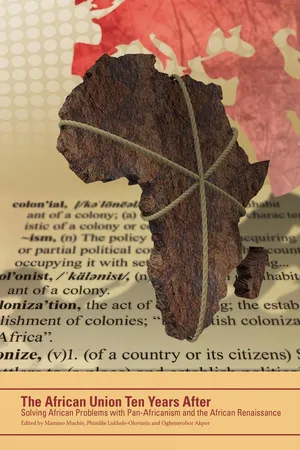 eBook - PDF
Muchie: The African Union Ten Years After
Solving African Problems with Pan-Africanism and the African Renaissance
- Mammo Muchie, Phindil Lukhele-Olorunju, Mammo Muchie, Phindil Lukhele-Olorunju(Authors)
- 2013(Publication Date)
- Africa Institute of South Africa(Publisher)
12 For this to happen, awakening is essential where people will not be lulled into sleep. It is in the post-colonial conundrum where pan-African unity is called; in the absence of full decolonisation. This creates a situation where the post-colonial Africa is reduced into a mere lethargy. 413 RETHINKING PAN-AFRICANISM, UNITY AND POLITICS OF POSSIBILITY The imagination of pan-African unity should be infused with political im-agination which fuels the aspirations of the politics of possibility. Audacity to transform and expand political imagination which is the driver of the quest for liberation should not be a glass ceiling. As such, oppression will be censored in that people during the struggle towards liberation will have one common goal of attaining liberation. Fanon stated that, ‘now it must be said that the masses show themselves totally incapable of appreciating the log way they have come’. 13 For Fanon, it was not only important to fight oppression and advance liberation. It was also important to forge ahead to fight in the post-liberation phase against liberators who might oppress their own people. The pan-Africanist slogans will have no meaning if they are not backed-up by a concrete actionable political project of African unity. As Fanon states, ‘there is no programme, there are no speeches or reso-lutions, and no political trends’. 14 Fanon here calls for political imagination which comes from spontaneity – that is, politics of possibility where there is deepening of a dialectic since pan-African unity is an ongoing process rather than an event. This is the state of making sure that political imagi-nation is such that it thinks beyond the state of liberation. In other words, the state of liberation is not achieved, but rather, it is worked on continu-ously since liberation itself will have its own challenges. The process of building pan-African unity is rooted in the view that an Africa which is thoroughly decolonised is still yet to be born.
Index pages curate the most relevant extracts from our library of academic textbooks. They’ve been created using an in-house natural language model (NLM), each adding context and meaning to key research topics.

