Politics & International Relations

Pan Arabism
Pan-Arabism is a political ideology that promotes the unity and cooperation of Arab countries. It emphasizes the shared language, culture, and history of Arab nations and seeks to create a sense of solidarity and common identity among them. Pan-Arabism has been influential in shaping the political landscape of the Middle East and has been a driving force behind movements for Arab unity and cooperation.
Written by Perlego with AI-assistance
Related key terms
1 of 5
6 Key excerpts on "Pan Arabism"
 eBook - ePub
- Yehoshua Porath(Author)
- 2014(Publication Date)
- Routledge(Publisher)
3 The Rise of Political Pan-ArabismUnlike the ideological sphere, in which pan-Arabism had developed into a rather coherent concept, based upon the assumption that the Arabs constituted one nation and were therefore entitled to establish one state, the concurrent political developments were much more complicated and even twisted. They took place in different countries; they reflected varied and even conflicting interests – dynastical, personal, partisan, etc.; and since they were in close touch with reality they had usually never been too far-reaching in their vision of the future. When ‘Izzat Darwaza, one of the main Palestinian pan-Arab activists, described in private the goals of the 1931 General Arab Congress (see ch. 1 , pp. 14–17) he admitted that when the Congress Preparatory Committee discussed the question of Arab unity, ‘they reached a unanimous view that every [Arab] country should preserve its existence and thus a Federation would come into existence. None of the committee’s members thought of unity’.1 Whatever the exact meaning of that term, pan-Arabism as a political force gained important ground with its advances in Egypt.Pan-Arabism in Egypt2From its beginning the evolution of Egyptian national identity was marked by ambivalence: on the one hand, there was a deep feeling of belonging and devotion to the Nile Valley, and on the other, a supra-Egyptian concept of belonging to a broader community, either religious, such as the Muslim Ottoman Empire, or linguistic, such as the Arab Nation.3 eBook - PDF
- Don Peretz(Author)
- 1994(Publication Date)
- Praeger(Publisher)
Rather, the Arab world seemed to be subdividing into regional organizations such as the six-member Gulf Cooperation Council established in 1981, the five-member Arab Maghreb Union of North African states (1989), and the four-member Arab Cooperation Council. During the 1980s a new form of supra nationalism seemed to sweep through the Middle East in the form of politicized Islam. In nearly every country of the region political movements with an Islamic orientation gained a wide following, increased political strength and influence, and offered keen competition to the secular parties that had dominated the political scene since World War II in Egypt, Syria, Iraq, and Turkey, among the Palestin- ians, and even among the Arabs of Israel. Details of this phenomenon are offered in the individual country studies that follow. The importance of Islam in the Arab national consciousness was emphasized by a Lebanese Christian theoretician, Constantine Zurayk, who observed that the Prophet Muhammad influenced every aspect of our Arab culture, for we cannot today understand our ancient Arab Heritage... except after a deep study of the tenets and laws of the Muslim religion, and after reaching a correct understanding of its spirit and organization.... This is why every Arab, no matter what his sect or community... should attempt to study Islam and understand its reality; he should also sanctify the memory of the great Prophet to whom Islam was revealed. 10 PALESTINIAN NATIONALISM After the 1967 war Palestine became the focus of Arab nationalism; ac- cording to some, the issue of Palestine was the cement which bound it together. Arab defeat sparked interest in the dispute with Israel across the Arab Nationalism 151 whole Arab world, from Morocco to the Gulf. In the aftermath of Israel's attack on Egypt, Syria, and Jordan, mobs rioted as far away as Algiers and Tunis in North Africa. eBook - ePub
- Benjamin MacQueen(Author)
- 2017(Publication Date)
- SAGE Publications Ltd(Publisher)
There are also strong religious, cultural and historical elements underlying Arab identity. This is somewhat more problematic, as the Arab community, whilst majority Muslim, has a great variety of religious communities, both between religions (Islam, Christianity, Judaism, etc.) and within religions (Sunni and Shi`a Islam, Catholic and Orthodox Christianity, etc.). However, the links between Arab and Islamic history make the two almost inseparable in discussions of Arab identity, in particular, the history of Arab-Islamic empires and the articulation of Islam in the Arabic language. These links are important to remember when discussing the emergence of an Arab nationalist ideology in the late 19th and early 20th centuries. As with almost all aspects under review here, this discussion remains a point of historic debate today (Barakat, 1993). The following will focus on the broad tension between the notion of Arab political unity and the consolidation of states that separated the community, from the Atlantic Ocean to the Gulf.The Uniqueness of Arab Nationalism
The central tension in Arab nationalist discourse is the ideal of political unification for the Arabs and the reality of Arab political life divided amongst 22 states. In this regard, the doctrine of Arab nationalism is unique in that it challenges not just the existence of one or two states, but an entire regional state system. The idea of challenging state borders on the basis of ethnicity and nationalist claims is not unique. In this regard, irredentist movements have challenged established state borders across the globe, often through armed conflict.This has most often come in the form of one state making territorial claims on another, such as the conflict over the status of Northern Ireland (Ulster), Taiwan, Kashmir, and many others. In addition, groups have also lobbied for the division of existing states to create new entities, such as the various Kurdish movements in relation to Iraq, Turkey, Iran and Syria, or members of the Pashtun population advocating for an independent state to be carved out of Afghanistan and Pakistan. However, the idea of Arab political unity is unique in two respects. First, the scale of the vision of Arab unity is unprecedented, calling for unity of the people from Morocco to Iraq and Syria to Yemen. A possible comparison is the creation of the European Union. However, this was a move based on claims of political utility rather than nationalism and ethnic unity (Choueiri, 2000).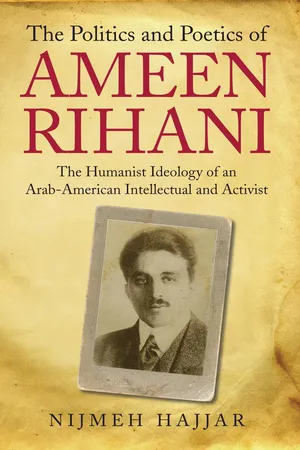 eBook - PDF
The Politics and Poetics of Ameen Rihani
The Humanist Ideology of an Arab-American Intellectual and Activist
- Nijmeh Hajjar(Author)
- 2010(Publication Date)
- I.B. Tauris(Publisher)
84 Arabism, Rihani argued, was not simply an intellectual or a political ideology. It was ‘an all-embracing spirit which induces one to co-operate and unite with one’s brothers/sisters in order to have a strong sovereign country which provides them all with security and happiness’. In its highest meaning and farthest aim, Arabism sought to transcend the small and lost nationalisms, the sectarian and regional nationalisms, in one big nationalism that would subsume and overcome the fragmentation and differentiation between majorities and minorities. In Rihani’s Arabism, ‘the Christian and the Muslim, Druze and Alawite, are one and equal’. 85 ‘Nationalism ( al-qawmiyya ) unites and religion separates’, he said to Imam Yahya. ‘The Christian of Syria is an Arab like the Muslim, and this nationality is destined to firmly unite the two and keep them united … Religion separates the Syrian Christians from you, but the feeling of nationalism will bring them back to you’. 86 Arab Nationalism 229 Pan-Arabism, in Rihani’s vision, extends beyond all the narrow fanaticisms and regional nationalisms because it is based on Arabism, this all-embracing non-religious national solidarity (‘ asabiyya ). This concept of Arab nationalism has two main characteristics: capability to overcome sectarianism in both forms ( al-madhhabiyya and al-ta’ifiyya ); and deep understanding of the delicate problem of religious, ethnic and political minorities in the Arab world. He saw such a ‘secular’ and broad idea of Arab nationalism as the only way to give Christians and other minorities an identity as citizens in a polity that accords equal rights and opportunities to all. And he sincerely believed that this form of nationalism would lead the Arab nation in the battle of civilization and liberation from Western domination, because ‘Arabism is the greatest patriotic power, the unbeatable power which Europeans will respect’. eBook - PDF
International Society and the Middle East
English School Theory at the Regional Level
- B. Buzan, A. Gonzalez-Pelaez, B. Buzan, A. Gonzalez-Pelaez(Authors)
- 2009(Publication Date)
- Palgrave Macmillan(Publisher)
Arab Nationalism(s) in Transformation 155 These internal divisions attained yet another dimension with the emer- gence of the so-called neo-Ba’thists in the mid-1960s stressing socialism more than nationalism. Hence, any unity plan should be preceded by a radical social and political revolution within the Arab societies mak- ing them more alike; in other words, the road to liberation of Jerusalem now went through revolutions in Damascus, Cairo and Amman (Owen, 2000: 70). While Ba’thism was more ideologically stringent, this revolution- ary pan-Arabism found its most vibrant voice in Gamal Abdel Nasser. Notwithstanding his reputation of being Mr pan-Arabism himself, the coup d’état bringing him and his fellow ‘Free Officers’ to power was not informed by any elaborate Arab nationalist ideology. The initial concern was not to promote some larger Arab interest but to safeguard Egypt’s interests and independence from foreign interference (Chalala, 1987: 42; Dawisha, 2003: 138). After focusing in the beginning on internal politi- cal and economic reforms, his attention turned to the wider Arab world when Egypt was risking isolation by the British/US attempt to form an alliance of Middle Eastern states in terms of what in 1955 became the Baghdad Pact. Against this background, Nasser started to develop his ideas about the need for a collective Arab effort to counter what he con- sidered as Western imperialist designs. This Nasserist doctrine took its points of departure in the assumption that the Arab world constituted a ‘pan-system’. Behind a façade of deviant and transient Arab territorial states with permeable and illusory frontiers, the Arabs constituted a sin- gle nation having common interests and security priorities distinct from those of the West (Heikal, 1978: 719; Khalidi, 1978: 695). eBook - PDF
- Kini-Yen Kinni(Author)
- 2015(Publication Date)
- Langaa RPCIG(Publisher)
367 Chapter 7 Radical Pan-Africanism and the Emerging Radical Pan Arabism From North Africa, Abdel Gamal Nasser, the controversial personality and champion of Pan Africanism became an adept supporter of Pan Arabism which was inspired from his experience of Pan Africanism. Actually, the initiator of Pan Arabism was Michel Aflaq of the Ba’ath Socialist Party of Syria and Iraq, who championed in the late 1940s the idea of Arab Liberation from the Ottoman colonization of the ancient Byzantine Civilisation from Turkey. The Byzantine civilization had developed after liberating itself from the Roman Christian Julius Caesarean to the Constantinopolitanian civilization to promote Mohamedan Islam. After the fall of Constantinople to Islam, Istanbul, as Constantinople came to be called, became the political capital of Islam in the Middle East. With the bastardisation of ancient Palestine (see Map) and the creation of puppet Arab states of ancient Arabia by Great Britain and the puppet Lebanon by France in the late 1940s, Abdel Gamal Nasser, because of his Pan African nationalist activism, also embraced Michel Aflack’s theory of Pan Arabism. This ideology of Pan Arabism was boosted more from a linguistic political framework than from and ethnic identity setting. Because originally, the Hittites, the Hurians, the Assyrians and the Babylonians, the Persians the ancient Phoenicians and Palestinians who had embraced Islam and Arabism, were not Arabs. They embraced Arabism because of Islam and some of them thereby came to lose their original languages to embrace Arabic but not their ethnic identities. This can explain the power scuffle for the so-called United Arab Organisation leadership between the true Arabs and the adopted Arabs.
Index pages curate the most relevant extracts from our library of academic textbooks. They’ve been created using an in-house natural language model (NLM), each adding context and meaning to key research topics.

