History

Dennis Banks
Dennis Banks was a Native American activist and co-founder of the American Indian Movement (AIM) in 1968. He was a leading figure in the movement for Native American rights and worked to raise awareness of the injustices faced by Indigenous peoples in the United States. Banks passed away in 2017 at the age of 80.
Written by Perlego with AI-assistance
Related key terms
1 of 5
4 Key excerpts on "Dennis Banks"
 eBook - PDF
- Edward J. Rielly(Author)
- 2011(Publication Date)
- Greenwood(Publisher)
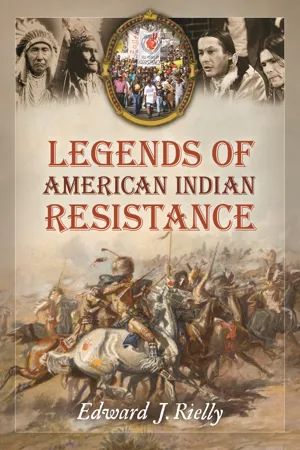
Dennis James Banks (born 1937) Dennis Banks holds aloft a burning paper containing a government offer to allow Indians to leave Wounded Knee during the 1973 occupation. Russell Means looks on approvingly. (AP Photo) Dennis Banks, an Ojibwa from Minnesota, became one of this country’s most influential American Indian leaders of the twentieth century. He co-founded the American Indian Movement (AIM) in 1968 and participated in a wide range of efforts designed to bring to the nation’s attention the injustice and lack of opportunities that constituted the basic condition for a huge percentage of Indians throughout the country. During the 1970s, Banks participated in the occupation of Alcatraz Island, protests at Mount Rushmore and Plymouth Rock, efforts to gain justice for murder victims Raymond Yellow Thunder and Wesley Bad Heart Bull, the Trail of Broken Treaties, and the occupation of Wounded Knee. His actions at Wounded Knee and Custer, South Dakota—the latter concerned with bring- ing the killer of Wesley Bad Heart Bull to justice—led to criminal charges against Banks. In the Custer case, Banks was convicted of assault and incitement to rioting but refused to turn himself in to begin serving his prison term. He remained a fugitive for almost a decade before surrendering in 1985. Upon his release, Banks continued his efforts to improve the quality of life for Indians. He also began acting in films and recording American Indian songs. BEFORE THE AMERICAN INDIAN MOVEMENT Leech Lake Reservation Dennis Banks was born on April 12, 1937, on the Leech Lake Chippewa Reser- vation in central Minnesota, about one-third of the way from the northern bor- der of the state. The area was the site of the last battle between Ojibwas (also known as Chippewas) and the U.S. army, which occurred in 1898. Banks’s birth took place in the home of his maternal grandparents, Jenny and Josh Drum- beater.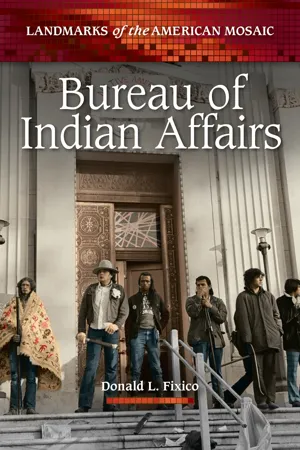 eBook - ePub
- Donald L. Fixico(Author)
- 2012(Publication Date)
- Greenwood(Publisher)
Biographies of Key Figures
Adams, Hank (1943–)
Hank Adams is an Assiniboine-Sioux and was born on the Fort Peck Indian Reservation in Montana at a place called Wolf Point, commonly referred to as Poverty Flats. He resisted being drafted into the army but reluctantly served. Following his service, he became involved in the struggle for Native fishing and treaty rights in the state of Washington during the 1960s. As a political activist, he helped to organize a march on the Washington State capitol in 1964. In 1968 he became the founding director of Survival of American Indians Association to fight for Indian fishing rights. He participated in the Trail of Broken Treaties March to Washington in 1972 where he helped develop the Twenty Points presented to the Richard Nixon administration. Adams also participated in the Wounded Knee takeover in 1973 and participated in the final negotiations that ended the 73-day occupation.Banks, Dennis (1937–)
Born on the Leach Lake Reservation in northern Minnesota, Dennis Banks is an Anishinabee. He attended a boarding school and served in the U.S. Air Force. In 1968 he cofounded the American Indian Movement with Clyde Bellecourt and George Mitchell. As a leader of AIM, he helped to organize the Trail of Broken Treaties March in 1972 and participated in the takeover of the BIA in Washington. He also was instrumental in leading the takeover of Wounded Knee in 1973. He was arrested and tried for his activism in 1974, but all charges were dismissed in 1985. From 1976 to 1983, he earned an associate of arts degree at University of California, Davis, and he served as the first American Indian chancellor at Deganawide Quetzecoatl (DQ) University. Banks believes that running is an important part of Native life for good health and well-being, which led him to organize the Great Jim Thorp Longest Walk, a spiritual run from New York to Los Angeles. eBook - ePub
Race and Ethnicity in America
From Pre-contact to the Present [4 volumes]
- Russell M. Lawson, Benjamin A. Lawson, Russell M. Lawson, Benjamin A. Lawson(Authors)
- 2019(Publication Date)
- Greenwood(Publisher)
The use of the media to draw attention to Native issues played a significant role throughout AIM’s existence. Frequently, AIM’s protest activism—its agenda, its tactics, and its strategies—revolved around drawing media attention to their grievances. Media coverage functioned to air Native grievances, to draw attention to public figures of Indian Affairs, and to transmit information about new forms of protest and contention to other potential protesters. Dennis Banks (Ojibwe) and Clyde Bellecourt (Ojibwe), the organization’s cofounders, as well as a number of other activists that joined later—Russell Means (Lakota), Carter Camp (Ponca), John Trudell (Sioux), and Vernon Bellecourt (Ojibwe), Clyde’s brother—would eventually become the public faces of AIM. Dennis Banks and Russell Means are probably the most photographed Native Americans of the twentieth century. Male AIM members became perhaps most notorious for its imagery of hypermasculine warriors that attracted nationwide news media attention.By the early 1970s, AIM entered the national stage in protest activism. Throughout much of its early years, AIM members were concerned with urban issues within the confines of the Twin Cities. When AIM leaders visited the occupiers of Alcatraz Island, the organization began to become active on the national level. Clearly, the occupation of Alcatraz provided a role model for AIM as it had shown that the takeover of federal property or the occupation of symbolic sites became a way to highlight Native grievances.Throughout its existence, AIM members sought to reconnect to their traditional heritage and bridge the major disconnect that distanced them from their cultural grounding. As AIM members reached out to reservation communities, they began a process of re-traditionalization as they learned about Native languages, songs, dances, customs, and traditions. Often, the cross-cultural alliance with reservation traditionalists directly translated into a political alliance and a deep antagonism toward the IRA-style of tribal governance under the auspices of the BIA. The most prominent example of the deep-seated attitude of AIM toward indirect colonial rule under IRA-style governance came with the occupation of Wounded Knee II.From early 1972 onward, AIM became increasingly involved with reservation concerns. The unfortunate death of Raymond Yellow Thunder (Oglala Lakota) in Gordon, Nebraska, in early 1972 from the hands of white supremacists (and an alleged failure of law enforcement agencies to look into the matter) triggered classic civil rights protests close to the Pine Ridge reservation in San Diego, and eventually led to AIM’s political involvement with reservation matters. The violent death of Wesley Bad Heart Bull (Lakota) in January 1973 at Buffalo Gap, South Dakota, in a bar room fight—a less clear-cut case as Bad Heart Bull had a history of anti-social behavior and allegedly started the fight—sparked another series of protests. At Custer, the seat of the county courthouse, a meeting between local law enforcement officers and AIM activists escalated into a full-scale race riot. Rapid City, South Dakota, also became a place of heightened tensions between Native activists and local police. eBook - PDF
The Politics of Anthropology
From Colonialism and Sexism Toward a View from Below
- Gerrit Huizer, Bruce Mannheim, Gerrit Huizer, Bruce Mannheim(Authors)
- 2011(Publication Date)
- De Gruyter Mouton(Publisher)
Evidence of this new unity is the fact that on the opening day of the trial of the AIM leaders on conspiracy, arising out of the Wounded Knee occupation, sixty-five traditional leaders of the Oglala Sioux Nation appeared in court. Many had never been in a white man's court before, some never off the reservation. Most were women and one was ninety-one years old. Some were survivors of the 1890 Wounded Knee mas-sacre. Their spokesman was Frank Foolscrow, a traditional chief of the Oglala Nation: 2 5 2 STEVE TALBOT To the American public and to Federal Judge Fred Nichol: we are all Oglala people, landowners and traditional people. We have come to a court we don't know, which doesn't know us, to tell everybody who will listen that we stand with our brothers Russell Means and Dennis Banks [AIM leaders]. Together we stand with our traditions, our land, our medicine and our Treaty Rights. We represent not only ourselves but the Oglala band, the Sioux Nation and concerned Indian people everywhere. We called our brothers and AIM to help us because we were being oppressed and terrorized. They answered our call. We now call upon all people to honor our people and to honor our Treaty Rights. If Dennis Banks and Russell Means go to jail for supporting the dignity of the Sioux Nation and the promises made to us, you must be ready to send us all to jail. If we cannot live with our brothers in freedom according to our ways and tradition we are ready to join them in a white man's prison ( People's World 1974). In view of the events described above, it is indeed remarkable that very few anthropologists are studying the current Indian protest movement or the issues raised by the Indian activists (let alone taking ethical positions on these matters) as topics worthy of scientific inquiry.
Index pages curate the most relevant extracts from our library of academic textbooks. They’ve been created using an in-house natural language model (NLM), each adding context and meaning to key research topics.

