Literature

Solomon Northup
Solomon Northup was a free African American man who was kidnapped and sold into slavery in the mid-19th century. His memoir, "Twelve Years a Slave," provides a firsthand account of the brutality and inhumanity of slavery. Northup's narrative is a powerful and important work that sheds light on the horrors of the institution of slavery in the United States.
Written by Perlego with AI-assistance
Related key terms
1 of 5

8 Key excerpts on "Solomon Northup"
 eBook - PDF
Solomon Northup
The Complete Story of the Author of Twelve Years a Slave
- David Fiske, Clifford W. Brown Jr., Rachel Seligman(Authors)
- 2013(Publication Date)
- Praeger(Publisher)
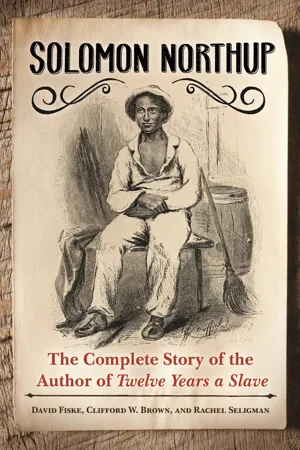
He had no realistic choice. Besides, he could not easily escape from where he was, so perhaps his chances might be better somewhere else. He did what he was told. It was the end of April 1841. He was about to begin an extraordinary journey lasting nearly 12 years. * * * * * * There are numerous slave narratives, including most famously that of Frederick Douglass. There are many scholarly and literary accounts that describe the “peculiar institution.” But the importance of Solomon Northup’s story is that it comes from the perspective of a person who grew up free and therefore had the assumptions and values of a free society before he entered slavery. Northup had also developed many skills in a technologically advanced region of the country. He was the legatee of several cultures, including that of antebellum upstate New York, part of the New England diaspora, with its emphasis on shrewdness, self-sufficiency, innovation, and what Northup calls “industry.” From this perspective Northup confronted each day’s chal- lenges, and his perspective was bound to differ, if only in nuanced ways, from that of someone raised in a culture of subservience. Not only a narrative about slavery and the rural culture of the antebellum South, Northup’s account is a story about survival and the triumph of the human spirit over great adversity: despite all he endured, he never lost his sense of self, his awareness of who he was, the injustice of his situation, and his resolve to escape. Moreover, though he was a shrewd observer of slavery and southern institu- tions, he was also a participant and a victim, and he became emo- tionally attached to other victims, feeling their suffering, sensing what aspirations their circumstances allowed, sharing their hopes and fears. Despite this, he never lost perspective and his ability to observe and evaluate. eBook - PDF
Traveling South
Travel Narratives and the Construction of American Identity
- John Cox(Author)
- 2010(Publication Date)
- University of Georgia Press(Publisher)
Like Frederick Douglass, Solomon Northup, author and narrator of Twelve Years a Slave , has different names when he is free and when he is enslaved. Un-like Douglass, however, Northup begins his life, and his account, as a free man. Kidnapped into slavery during a visit to Washington, D.C., Northup’s name moving slaves 83 is changed to “Platt,” by which he is known during the entire twelve years of his captivity. He quickly learns not to announce that he is legally a citizen of New York named Solomon Northup, for the slave traders who transport him to Louisiana beat him mercilessly after the one time he tries to plead his case to them. He does not try again until he meets Samuel Bass, a sympathetic carpen-ter from Canada who is opposed to slavery; in fact, Bass is the man responsible for bringing Northup’s plight, and slave identity, to the attention of his northern friends. Northup’s struggle for freedom, then, becomes a struggle to be recog-nized legally as Solomon Northup, rather than as Platt. Northup seeks to recover an identity rather than create one. By the end of the narrative, Northup’s legal name has been restored to him, and he is once again in New York with his family and community of friends. Because Douglass’s 1845 autobiography has for many years served as the model of the American slave narrative, critics have traditionally ignored or given scant attention to those narratives that do not chart a similar course from bondage to freedom or illiteracy to authorship. 27 As a result, even those narra-tives that initially sold more copies than did Douglass’s have been ignored in fa-vor of those that trace a comparable route out of servitude. Solomon Northup’s Twelve Years a Slave is a case in point. eBook - ePub
I Was Born a Slave
An Anthology of Classic Slave Narratives
- Yuval Taylor(Author)
- 1999(Publication Date)
- Lawrence Hill Books(Publisher)
Solomon Northup
SOLOMON NORTHUP (1808-63), as the title page of his narrative indicates, was a free black man of New York who was kidnapped, sold, and held as a slave in one of the most remote regions of the South for a period of twelve years. His book, Twelve Years a Slave, is singular in a number of ways: it is perhaps the only slave narrative written from the perspective of a nonslave; it is one of the few to describe the condition of slaves in Louisiana; it combines a mastery of detail with a richness and strength of language rare in the narrative corpus; and it was one of the fastest selling and most popular—the first printing of eight thousand copies was sold within a month of publication, and over thirty thousand copies were sold altogether.1Northup’s tale proved unforgettable to his readers. As one of them, Frederick Douglass, said at the time,It is a strange history; its truth is stranger than fiction. . . . Think of it: For thirty years a man, with all a man’s hopes, fears and aspirations—with a wife and children to call him by the endearing names of husband and father—with a home, humble it may be, but still a home . . . then for twelve years a thing, a chattel personal, classed with mules and horses. . . . Oh! it is horrible. It chills the blood to think that such are.2 eBook - ePub
New York's Grand Emancipation Jubilee
Essays on Slavery, Resistance, Abolition, Teaching, and Historical Memory
- Alan J. Singer(Author)
- 2018(Publication Date)
- SUNY Press(Publisher)
Northup’s book was republished in Philadelphia after the Civil War. In an introduction, the editors explained that his narrative made it possible “to understand the exact status of such a people in all its bearings, we can pursue no better course than to live among them, to become one of them, to fall from a condition of freedom to one of bondage, and the outrage of manacles” (Eakin and Logsdon 1967, xxiii–xxiv).Before discussing the importance of Solomon Northup’s memoir and Northup’s experience as a slave in Louisiana during the 1840s and early 1850s, I want to acknowledge David Fiske, a retired librarian and independent historian specializing in the Capital Region of New York State for carefully reconstructing Northup’s life before and after his kidnapping and enslavement (Fiske, Brown, and Seligman 2013). In the introduction to the 1967 edition of Twelve Years a Slave , Sue Eakin and Joseph Logsdon write, “What finally became of Solomon Northup can only be conjectured” (Northup 1853, xxiii). Thanks to Fiske, that is no longer completely true.Solomon Northup was a free black man and a citizen of New York State. He lived in Saratoga Springs with his wife and three children. Northup was a skilled carpenter and violinist and also worked on the Lake Champlain Canal and on construction of the Troy and Saratoga railroad. In 1841, Solomon Northup was kidnapped by slave traders while on a trip to Washington, D.C., and his freedom papers were stolen. He was transported to Louisiana where he was sold as a slave. In Louisiana, Northup worked on cotton and sugar plantations until he was able to smuggle a letter to his wife and friends in New York. Using a New York State law designed to protect free black citizens from being sold into slavery, they secured his freedom through the courts.Northup was finally rescued after being enslaved for twelve years. When he returned to New York, abolitionists helped him publish his memoirs as part of their campaign to abolish slavery. Solomon Northup’s account is especially important as a historical document because he was able to describe slavery from the point of view of a free man and a skilled worker. It is also unique because Northup was enslaved on plantations in the Deep South. eBook - PDF
Discovering the American Past
A Look at the Evidence, Volume I: To 1877
- William Bruce Wheeler, Lorri Glover(Authors)
- 2016(Publication Date)
- Cengage Learning EMEA(Publisher)
Throughout her story, Jacobs used fictitious names and places to protect those who helped her and to conceal the escape route she used. Jacobs was self-educated, she wrote her own book, and she was widely read in the nineteenth century. Her narra-tive continues to be a popular teaching text today. John Thompson represents a very different kind of slave narrative. He did not become famous, like Jacobs, and little is known about his life aside from the information contained in his narrative. After he escaped to Phila-delphia, Thompson feared he might be returned to slavery, so he took to the seas. He worked for several years in the whaling industry, traveling the world before contributing his story to an abolitionist press in Massachusetts in 1856. Solomon Northup—like some of the St. Louis litigants—was a free black man. In 1841, he went to Washington, DC, where slavery was legal, and was kidnapped and sold into slavery in the South. Northup wrote his harrowing account after finally making his way home to New Copyright 201 Cengage Learning. All Rights Reserved. May not be copied, scanned, or duplicated, in whole or in part. Due to electronic rights, some third party content may be suppressed from the eBook and/or eChapter(s). Editorial review has deemed that any suppressed content does not materially affect the overall learning experience. Cengage Learning reserves the right to remove additional content at any time if subsequent rights restrictions require it. ✦ CHAPTER 9 The “Peculiar Institution”: Slaves Tell Their Own Stories [ 244 ] with women than men and agreed to hear their cases more often. What is clear is that the Missouri law enabling all these lawsuits was designed not to encourage challenges to slavery but rather to prevent legally free blacks from being kidnapped into slavery— individuals like Solomon Northup. But increasingly in the 1830s and 1840s, enslaved African Americans used the law to their own ends. eBook - ePub
Voices of Freedom
Four Classic Slave Narratives
- Solomon Northup, Frederick Douglass, Harriet Jacobs, Sojourner Truth(Authors)
- 2017(Publication Date)
- Open Road Media(Publisher)
It was Solomon’s fortune, during his captivity, to be owned by several masters. The treatment he received while at the “Pine Woods” shows that among slaveholders there are men of humanity as well of cruelty. Some of them are spoken of with emotions of gratitude—others in a spirit of bitterness. It is believed that the following account of his experience on Bayou Boeuf presents a correct picture of Slavery in all its lights, and shadows, as it now exists in that locality. Unbiased, as he conceives, by any prepossessions or prejudices, the only object of the editor has been to give a faithful history of Solomon Northup’s life, as he received it from his lips.In the accomplishment of that object, he trusts he has succeeded, notwithstanding the numerous faults of style and of expression it may be found to contain. DAVID WILSON.WHITEHALL, N. Y., May, 1853. Passage contains an image
CHAPTER I
Introductory—Ancestry—The Northup Family—Birth and Parentage—Mintus Northup—Marriage with Anne Hampton—Good Resolutions—Champlain Canal—Rafting Excursion to Canada—Farming—The Violin—Cooking—Removal to Saratoga—Parker and Perry—Slaves and Slavery—The Children—The Beginning of SorrowHAVING BEEN BORN A freeman, and for more than thirty years enjoyed the blessings of liberty in a free State-and having at the end of that time been kidnapped and sold into Slavery, where I remained, until happily rescued in the month of January, 1853, after a bondage of twelve years—it has been suggested that an account of my life and fortunes would not be uninteresting to the public.Since my return to liberty, I have not failed to perceive the increasing interest throughout the Northern States, in regard to the subject of Slavery. Works of fiction, professing to portray its features in their more pleasing as well as more repugnant aspects, have been circulated to an extent unprecedented, and, as I understand, have created a fruitful topic of comment and discussion.I can speak of Slavery only so far as it came under my own observation—only so far as I have known and experienced it in my own person. My object is, to give a candid and truthful statement of facts: to repeat the story of my life, without exaggeration, leaving it for others to determine, whether even the pages of fiction present a picture of more cruel wrong or a severer bondage.As far back as I have been able to ascertain, my ancestors on the paternal side were slaves in Rhode Island. They belonged to a family by the name of Northup, one of whom, removing to the State of New York, settled at Hoosic, in Rensselaer county. He brought with him Mintus Northup, my father. On the death of this gentleman, which must have occurred some fifty years ago, my father became free, having been emancipated by a direction in his will. eBook - ePub
Twelve Years a Slave
The Black History Classic
- Solomon Northup, Tom Butler-Bowdon(Authors)
- 2021(Publication Date)
- Capstone(Publisher)
PART I NARRATIVE OF Solomon Northup Passage contains an image
I
Introductory—Ancestry—The Northup Family—Birth and Parentage—Mintus Northup—Marriage With Anne Hampton—Good Resolutions—Champlain Canal—Rafting Excursion to Canada—Farming—The Violin—Cooking—Removal to Saratoga—Parker and Perry—Slaves and Slavery—The Children—The Beginning of SorrowHAVING BEEN born a freeman, and for more than thirty years enjoyed the blessings of liberty in a free State – and having at the end of that time been kidnapped and sold into Slavery, where I remained, until happily rescued in the month of January, 1853, after a bondage of twelve years – it has been suggested that an account of my life and fortunes would not be uninteresting to the public.Since my return to liberty, I have not failed to perceive the increasing interest throughout the Northern States, in regard to the subject of Slavery. Works of fiction, professing to portray its features in their more pleasing as well as more repugnant aspects, have been circulated to an extent unprecedented, and, as I understand, have created a fruitful topic of comment and discussion.I can speak of Slavery only so far as it came under my own observation – only so far as I have known and experienced it in my own person. My object is, to give a candid and truthful statement of facts: to repeat the story of my life, without exaggeration, leaving it for others to determine, whether even the pages of fiction present a picture of more cruel wrong or a severer bondage.As far back as I have been able to ascertain, my ancestors on the paternal side were slaves in Rhode Island. They belonged to a family by the name of Northup, one of whom, removing to the State of New-York, settled at Hoosic, in Rensselaer county. He brought with him Mintus Northup, my father. On the death of this gentleman, which must have occurred some fifty years ago, my father became free, having been emancipated by a direction in his will.Henry B. Northup, Esq., of Sandy Hill, a distinguished counselor at law, and the man to whom, under Providence, I am indebted for my present liberty, and my return to the society of my wife and children, is a relative of the family in which my forefathers were thus held to service, and from which they took the name I bear. To this fact may be attributed the persevering interest he has taken in my behalf. eBook - ePub
Bad Feminist
Essays
- Roxane Gay(Author)
- 2014(Publication Date)
- Harper Perennial(Publisher)
12 Years a Slave is how the suffering of women is used to further a man’s narrative. There is, for example, a rape scene that carries little narrative relevance. Patsey lies, inert, beneath Epps. It’s a repulsive scene, so in that regard, McQueen has done his job, but it doesn’t seem essential to the movie because the primary story is not Patsey’s. It’s a gratuitous, unnecessary reminder that yes, women were raped during the slave era.Ultimately, Solomon Northup is freed because he has finally gotten word to his family in New York that he is alive. The moment, like much of the movie, is strangely muted. We’re clearly supposed to feel something, but it’s hard to know quite what to do with that emotion. Before Solomon leaves the Epps plantation, Patsey runs into his arms, and they embrace. We know nothing of what happens to Patsey, beyond what we might imagine, because she has already done the necessary work of staying on the sidelines while Solomon is dispatched unto freedom once more.My reaction to 12 Years a Slave is born, largely, of exhaustion. I am worn out by slavery and struggle narratives. I am worn out by broken black bodies and the broken black spirit somehow persevering in the face of overwhelming and impossible circumstance. There seems to be so little room at the Hollywood table for black movies that to earn a seat, black movies have to fit a very specific narrative. Movies like Love & Basketball or The Best Man and The Best Man Holiday are perhaps not Oscar material, but they are certainly movies that also capture the black experience, and somehow, they are often overlooked in conversations about serious movies. Filmmakers take note and keep giving Hollywood exactly what it wants. Hollywood showers these struggle narratives with the highly coveted critical acclaim. It’s a vicious cycle.There is no one way to tell the story of slavery or to chronicle the black experience. It is not that slavery and struggle narratives shouldn’t be shared but that but these narratives are not enough anymore. Audiences are ready for more from black film—more narrative complexity, more black experiences being represented in contemporary film, more artistic experimentation, more black screenwriters and directors allowed to use their creative talents beyond the struggle narrative. We’re ready for more of everything but the same, singular stories we’ve seen for so long.
Index pages curate the most relevant extracts from our library of academic textbooks. They’ve been created using an in-house natural language model (NLM), each adding context and meaning to key research topics.

