Literature

Twelve Years a Slave
"Twelve Years a Slave" is a memoir by Solomon Northup, a free African American man who was kidnapped and sold into slavery in the 19th century. The book recounts his harrowing experiences as a slave in Louisiana, detailing the brutality and inhumanity he endured. Northup's powerful narrative sheds light on the horrors of slavery and serves as a poignant testament to the resilience of the human spirit.
Written by Perlego with AI-assistance
Related key terms
1 of 5

9 Key excerpts on "Twelve Years a Slave"
 eBook - ePub
- Caron Knauer(Author)
- 2023(Publication Date)
- ABC-CLIO(Publisher)
Twelve Years a Slave as a Neo Slave Narrative.” American History Review 26, no. 2 (Summer): 326–31.Littlefield, Daniel C. 1997. “Review of Freedom at Risk: The Kidnapping of Free Blacks in America 1780–1865.” American Historical Review 102, no. 3 (June): 890.Livesay, Andrea. 2014. “A Life More Terrible: The Women of 12 Years a Slave.” SBS News, November 1, 2014.Maltin, Leonard. 2013. “Before There Was ‘12 Years a Slave’ There Was ‘Solomon Northup’s Odyssey.’” October 17, 2013. https://www.imdb.com/news/ni56313357 .Masur, Kate. 2022. Until Justice Be Done: America’s First Civil Rights Movement, from the Revolution. New York: W. W. Norton.McQueen, Steve, dir. 2013. 12 Years a Slave. Performances by Chiwetel Ejiofor, Lupita Nyong’o, Michael Fassbender, and Brad Pitt. Searchlight Pictures.Northup, Solomon. (1853) 2014. Twelve Years a Slave. Quebec: Magdalene Press.Parks, Gordon. 2005. A Hungry Heart. New York: Atria.Ray, Sadie. 2016. “‘Roll, Jordan, Roll’: A Critique of Slavery and a Story of Hope.” https://core152eray.wordpress.com/2016/04/30/roll-jordan-roll-a-critique-of-slavery-and-a-story-of-hope/ .Sehgal, Purhal. 2019. “White Women Were Avid Slaveowners, a New Book Shows.” New York Times, February 26, 2019.Silkenat, D. 2014. “‘A Typical Negro’: Gordon, Peter, Vincent Colyer, and the Story behind Slavery’s Most Famous Photograph.” American Nineteenth Century History 15 (2): 169–86. https://doi.org/10.1080/14664658.2014.939807 .“Slavery and the Making of America.” n.d. Accessed August 28, 2022. https://www.thirteen.org/wnet/slavery/experience/gender/history2.html .Smith, Valerie. 2014. “12 Years a Slave: Black Life in the Balance.” American Literary History 26 (Summer): 362–66.Snyder, Terri L. 2010. “Suicide, Slavery, and Memory in North America.” Journal of American History 97, no. 1 (June): 39–62. Oxford University Press on behalf of Organization of American Historians. https://www.jstor.org/stable/40662817 .Sorlin, Pierre. 1980. The Film in History: Restaging the Past eBook - ePub
Fugitive Testimony
On the Visual Logic of Slave Narratives
- Janet Neary(Author)
- 2016(Publication Date)
- Fordham University Press(Publisher)
4“The Shadow of the Cloud”: Racial Speculation and Cultural Vision in Solomon Northup’s Twelve Years a SlaveThe boast of evidence . . . is that it limits and constrains the promiscuity of the imagination, weds imagination to a liturgy of facts, records, documented events. If to know is always, in part, to imagine, then evidence demands that imagination bind itself to the empirically demonstrable.—IAN BAUCOM, SPECTERS OF THE ATLANTICPublished in 1853 and written by Solomon Northup with white lawyer and writer David Wilson, Twelve Years a Slave: Narrative of Solomon Northup, A Citizen of New-York, Kidnapped in Washington City in 1841, and Rescued in 1853, From a Cotton Plantation Near the Red River, in Louisiana , has long been at the margins of slave narrative criticism.1 Although it has received renewed attention with Steve McQueen’s 2013 adaptation of it into a feature-length film, 12 Years a Slave , the narrative has been in the somewhat unusual position of having been acknowledged and referenced by virtually all of the early literary criticism of the genre, but rarely treated as the primary subject of these works. One reason for this, as in the case with The Narrative of the Life of Henry Box Brown discussed in the next chapter, is because of Northup’s reliance on an amanuensis, and in this case, Wilson, who was not affiliated with the anti-slavery movement. The difficulty of separating the narrative goals of Wilson and Northup has cast lingering suspicion on the usefulness of the text within literary studies. Sam Worley, one of the early critics to write on the importance of Northup’s philosophical perspective in Twelve Years a Slave , asserts that the narrative’s “value has been seen as one of fact or historical record and not, as in the case of the so-called classic narratives, a matter of imposing meaningful, interpretive form on its subject matter.”2 However, the notion that self-writing is “a matter of imposing meaningful, interpretive form on . . . subject matter” is borrowed from the European tradition of autobiography, a tradition I argue ex-slave narrators actively write against.3 eBook - ePub
- Soyica Diggs Colbert, Robert J. Patterson, Aida Levy-Hussen(Authors)
- 2016(Publication Date)
- Rutgers University Press(Publisher)
1 12 Years a What?Slavery, Representation, and Black Cultural Politics in 12 Years a SlaveROBERT J. PATTERSONWe tend to privilege experience itself, as if black life is lived experience outside of representation. We have only, as it were, to express what we already know we are. Instead, it is only through the way in which we represent and imagine ourselves that we come to know how we are constituted and who we are. There is no escape from the politics of representation.1—Stuart HallThe concept of American chattel slavery primarily animates Steve McQueen’s Oscar-winning film 12 Years a Slave (2013). Or, does it? Adapted from Solomon Northup’s emancipatory narrative Twelve Years a Slave: Narrative of Solomon Northup, a Citizen of New-York, Kidnapped in Washington City in 1841, and Rescued in 1853, from a Cotton Plantation near the Red River in Louisiana (1853), the film has been acclaimed as one of the best filmic representations of slavery. Admirers note that it depicts the peculiar institution unflinchingly, accentuating how black life existed in a matrix of violence, evil, and immorality.2 But in the extant criticism and reviews, the term best neither offers an aesthetic judgment nor assesses the accuracy of the adaptation. Rather, it draws attention to how the film, as an adaptation, engenders expectations about truth and accuracy that are central to the film’s reception and that fit within a range of critical discourses about black cultural products and production. While directors and producers have the prerogative to choose the degree to which their representations will converge with an original narrative (which is also only a representation), the meaning of those choices cohere within, and always are informed by, a broader discursive context.3Critical examinations of the film thus must ask a variety of questions that engage the complexities of these convergences and diverges. What does it mean, for example, to represent the violence of slavery on the big screen? Is the purpose to shock, inspire, or incapacitate? How do representational strategies compel or foreclose a range of affective responses, such as shock, inspiration, guilt, or terror? How might racialized audiences identify with or against the history of slavery? And how do representations of slavery mediate messages about the nature of antiblack oppression and the modes of agency and resistance that African Americans exercised? In thinking through these questions, I propose two interrelated arguments. First, by demonstrating how behaviorist discourses also inform McQueen’s representation of Northup’s life and chattel slavery, I contend that the movie’s representation of black inequality privileges behavioral explanations over structural ones. Whereas structural examinations of black inequality examine how institutions are set up in explicit and implicit ways that thwart black thriving, behaviorist explanations contrastingly consider black people’s (in)action as the cause and effect of their unequal access to and outcomes within America’s institutions. Second, I question the degree to which representation—which is an important cultural force for catalyzing political action and engagement and memorializing history—can achieve our cultural and political desires. eBook - PDF
- Britta Viebrock(Author)
- 2016(Publication Date)
- Narr Francke Attempto Verlag(Publisher)
USA A History of Violence: Productive and Creative Methodology in Teaching 12 Years a Slave Jan-Erik Leonhardt 12 Years a Slave (2013) tells the story of Solomon Northup, a free black man who has been abducted and sold into slavery. This chapter will explore the film for its representation of slavery in the U.S. within its socio-historical context and reflect on the suitability of the film for the English language classroom. After a concise synopsis and some contextual information, considerations on the teaching potential of the film will follow. Possible pre-and while-viewing exercises will be suggested for a first approach to 12 Years a Slave . An in-depth anaylsis will then focus on two central topics: the role of women and the use of violence, again including methodological suggestions and material for classroom use. In the end, post-viewing tasks will be discussed. 1 The film: context and synopsis Over two-and-a-half centuries, large parts of the United States’ economy have been sustained by an enslaved workforce. Especially, “[t]he six decades between the turn of the nineteenth century and the death of slavery during the American Civil War witnessed the entrenchment of slavery in the Deep South […]“ (Morgan 2005: 12). Even after the slave trade ban of 1807, Afro-Americans throughout the country were hauled into slavery. And still, “[d]iscrimination against free blacks continued for nearly a century afterwards, with segregation, lynching, the rise of the Ku Klux Klan and Jim Crow legislation“ (ibid.: 17). The slave trade has become a legacy still present today. Social inequality is protested against and police violence towards Afro-Americans has been one of the top news stories in 2014 and 2015. The stories of slavery have been processed by the arts in writing, painting, and, more recently, TV and film, as, for example, in Steve McQueen’s Academy Award winning feature film 12 Years a Slave (2013) . eBook - ePub
- Solomon Northup(Author)
- 2022(Publication Date)
- coolaij(Publisher)
Title: Twelve Years a Slave Narrative of Solomon Northup, a Citizen of New-York, Kidnapped in Washington City in 1841, and Rescued in 1853, from a Cotton Plantation near the Red River in Louisiana Author: Solomon Northup Language: English © Copyright 1853 Solomon Northup - All rights reservedTranscriber's NoteEvery effort has been made to replicate this text as faithfully as possible, including obsolete and variant spellings and other inconsistencies. Text that has been changed is noted at the end of this ebook.FIFTH THOUSAND.Twelve Years a Slave.
NARRATIVE OF SOLOMON NORTHUP, A CITIZEN OF NEW-YORK, KIDNAPPED IN WASHINGTON CITY IN 1841, AND RESCUED IN 1853,FROM A COTTON PLANTATION NEAR THE RED RIVER, IN LOUISIANA.AUBURN: DERBY AND MILLER.BUFFALO: DERBY, ORTON AND MULLIGAN.LONDON: SAMPSON LOW, SON & COMPANY, 47 LUDGATE HILL.1853.Entered according to Act of Congress, in the year one thousand eight hundred and fifty-three, by Derby and Miller , In the Clerk's Office of the District Court of the Northern District of New-York.Entered in London at Stationers' Hall.TO HARRIET BEECHER STOWE: WHOSE NAME, THROUGHOUT THE WORLD, IS IDENTIFIED WITH THE GREAT REFORM: THIS NARRATIVE, AFFORDING ANOTHER Key to Uncle Tom's Cabin, IS RESPECTFULLY DEDICATED"Such dupes are men to custom, and so prone To reverence what is ancient, and can plead A course of long observance for its use, That even servitude, the worst of ills, Because delivered down from sire to son, Is kept and guarded as a sacred thing. eBook - PDF
Cinematic Social Studies
A Resource for Teaching and Learning Social Studies With Film
- William B. Russell III, Ph. D., Stewart Waters, William B. Russell III, Stewart Waters(Authors)
- 2016(Publication Date)
- Information Age Publishing(Publisher)
It was also the inspiration for many Americans, from all ethnicities, to trace their own family histories (Archive of American Television, 2013; Wilson, 2007; Zurawik, 1992). The second movie that we selected, 12 Years a Slave, is an Oscar-winning film based on another bestseller: the 1853 autobiography of Solomon Nor- thup. Northup was a freed person of color from New York who was kid- napped and sold into slavery for 12 years. As with the film Roots, 12 Years a Slave brought a realistic and heartbreaking depiction of the horrors of slav- ery to viewers all over the world. As it was based on a true story, many of the scenes in the film came directly from what Northup had written about his experience (Berlatsky, 2013; Cieply, 2013; Mason; 2014; Wickman, 2013). Although there are, not surprisingly, some questions raised about the au- thenticity of some of the scenes in the film, scholars praise it. For example, Emily West, a historian, suggests that she had “never seen a film represent slavery so accurately” (Mason, 2014). A Roots Lesson Plan The idea for the lesson plan about Roots began with three of Scott’s el- ementary social studies methods’ students Josh Barnhart, Doug Droski, and Hollywood or History? 265 Jamie Vincent. In a class session geared toward lesson plan development, preservice teachers in the course were required to select at least two stan- dards and one NCSS theme. One standard had to be from the states’ so- cial studies standards and one from the Common Core Standards. Follow- ing their wide interest in the topic of slavery, the students chose the social studies standards from a 5th-grade curriculum strand that dealt with the transatlantic slave trade and the life of enslaved Africans in North America. The students were also able to integrate two standards from the 5th-grade literacy Common Core Standards and several NCSS themes in developing this lesson (see Appendix A).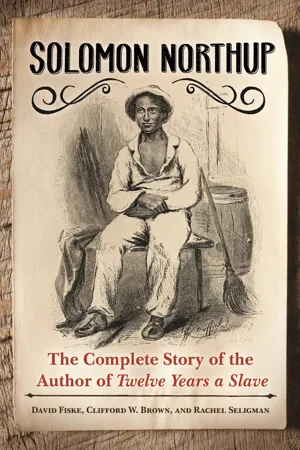 eBook - PDF
Solomon Northup
The Complete Story of the Author of Twelve Years a Slave
- David Fiske, Clifford W. Brown Jr., Rachel Seligman(Authors)
- 2013(Publication Date)
- Praeger(Publisher)
1 Twelve Years a Slave: An Overview He awoke in darkness and in chains. The severe headache of last night had subsided, but wasn’t completely gone, and he still felt faint and weak. Uncomprehending, dazed, he tried to collect his thoughts and survey his surroundings in the gloom from the rough bench on which he was now sit- ting up. Where was he? Why was he here? Was this still part of his night- mare or was it real, some colossal misunderstanding, some terrible mistake? What was happening? He was handcuffed and his ankles fettered. He was attached to a ring in the floor. His money and papers were gone from his pockets. Someone had taken his coat and hat. He yelled, but the sound of his own voice seemed strange. Aside from this, the only noise was the clink of his chains. 1 Where were Brown and Hamilton? Why had they let this happen to him? They must not know that he was there. Surely they were looking for him. They would get him out. They understood the city and its ways. They would rescue him. His thoughts began to focus. He was clearly in a cell. He had committed no crime. There was no reason to hold him. But someone had put him there. Why? There must be a reason. What were the possibilities? Slowly, awareness began to emerge from incomprehension. Slowly, the rec- ollections and the uneasiness and the vague doubts began to materialize and focus. Could he have been kidnapped? He had been warned. He knew about the practice. He even knew that it was not uncommon. Free blacks, American citizens like him, would fetch a good price on the open market if they could be abducted, cowed, chained, and transported to the slave states—as much as a thousand dollars. This was done fairly frequently, especially in southern Pennsylvania, or along the Ohio River, regions close to slave territory. There were vigilante societies in the major cities of the north to warn and protect free blacks subject to such depredation, but he was from Saratoga, far from slave territory. eBook - PDF
Histories on Screen
The Past and Present in Anglo-American Cinema and Television
- Sam Edwards, Faye Sayer, Michael Dolski, Sam Edwards, Faye Sayer, Michael Dolski(Authors)
- 2018(Publication Date)
- Bloomsbury Academic(Publisher)
By the time the film was released on DVD in 2011, it had been renamed Sally Hemings: An American Love Story , reflecting an ongoing shift in public perception. 65 It seems that in the era of a black president, people were now willing to accept a founding father’s sexual relationship with a slave as long as it was based on love. Historians, of course, do not know whether the relationship was based on love or on coercion. 66 Director Steve McQueen explains that he was looking for a story about slavery that would translate to film: ‘I had an idea of a free man – a free African American who gets kidnapped into slavery, and that’s where I got stuck.’ 67 He found the answer in Solomon Northup’s 1853 book, Twelve Years a Slave . 68 Like Debbie Allen’s discovery of the story of the rebellion on the Amistad, McQueen was amazed that ‘no one I knew knew this book’. 69 The resulting film, 12 Years a Slave , starred Chiwetel Ejiofor in the leading role and was incredibly successful: it went on to win three Oscars, including Best Picture, and was hailed by a number of commen-tators for its authentic depiction of slavery. 70 However, McQueen was very clear that he intended 12 Years a Slave to speak directly to contem-porary issues. ‘The whole movie in a way is a call to arms. There’s so much that we can do and should do’, he told Henry Louis Gates at The Root . 71 Similarly, to Nelson George of the New York Times , he explained that ‘You see the evidence of slavery as you walk down the street … the prison population, mental illness, poverty, education … I hope it could be a starting point for [people] to delve into the history and somehow reflect on the position where they are now.’ 72 Northup’s kidnapping, for McQueen, was evidence of the precarious nature of freedom.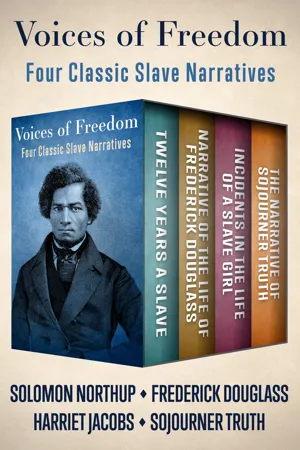 eBook - ePub
Voices of Freedom
Four Classic Slave Narratives
- Solomon Northup, Frederick Douglass, Harriet Jacobs, Sojourner Truth(Authors)
- 2017(Publication Date)
- Open Road Media(Publisher)
Twelve Years a Slave
Solomon Northup
 Passage contains an image
Entered according to act of Congress, in the year one thousand eight hundred
and fifty-three, by
DERBY AND MILLER,
in the Clerk’s Office of the District Court of the Northern District of New-York.
ENTERED IN LONDON AT STATIONERS’ HALL.
Passage contains an image
TO
HARRIET BEECHER STOWE:
WHOSE NAME,
THROUGHOUT THE WORLD, IS IDENTIFIED WITH THE
GREAT REFORM:
THIS NARRATIVE, AFFORDING ANOTHER
Key to Uncle Tom’s Cabin,IS RESPECTFULLY DEDICATED Passage contains an image
“Such dupes are men to custom, and so prone
To reverence what is ancient, and can plead
A course of long observance for its use,
That even servitude, the worst of ills,
Because delivered down from sire to son,
Is kept and guarded as a sacred thing.
But is it fit or can it bear the shock
Of rational discussion, that a man
Compounded and made up, like other men,
Of elements tumultuous, in whom lust
And folly in as ample measure meet,
As in the bosom of the slave he rules,
Should be a despot absolute, and boast
Himself the only freeman of his land?”
Cowper.
Passage contains an image
Passage contains an image
Passage contains an image
Entered according to act of Congress, in the year one thousand eight hundred
and fifty-three, by
DERBY AND MILLER,
in the Clerk’s Office of the District Court of the Northern District of New-York.
ENTERED IN LONDON AT STATIONERS’ HALL.
Passage contains an image
TO
HARRIET BEECHER STOWE:
WHOSE NAME,
THROUGHOUT THE WORLD, IS IDENTIFIED WITH THE
GREAT REFORM:
THIS NARRATIVE, AFFORDING ANOTHER
Key to Uncle Tom’s Cabin,IS RESPECTFULLY DEDICATED Passage contains an image
“Such dupes are men to custom, and so prone
To reverence what is ancient, and can plead
A course of long observance for its use,
That even servitude, the worst of ills,
Because delivered down from sire to son,
Is kept and guarded as a sacred thing.
But is it fit or can it bear the shock
Of rational discussion, that a man
Compounded and made up, like other men,
Of elements tumultuous, in whom lust
And folly in as ample measure meet,
As in the bosom of the slave he rules,
Should be a despot absolute, and boast
Himself the only freeman of his land?”
Cowper.
Passage contains an image
Contents
EDITOR’S PREFACE CHAPTER I CHAPTER II CHAPTER III CHAPTER IV CHAPTER V CHAPTER VI CHAPTER VII CHAPTER VIII CHAPTER IX CHAPTER X CHAPTER XI CHAPTER XII CHAPTER XIII CHAPTER XIV CHAPTER XV CHAPTER XVI CHAPTER XVII CHAPTER XVIII CHAPTER XIX CHAPTER XX CHAPTER XXI CHAPTER XXII APPENDIX Passage contains an image
Editor’s Preface
When the editor commenced the preparation of the following narrative, he did not suppose it would reach the size of this volume. In order, however, to present all the facts which have been communicated to him, it has seemed necessary to extend it to its present length.Many of the statements contained in the following pages are corroborated by abundant evidence—others rest entirely upon Solomon’s assertion. That he has adhered strictly to the truth the editor, at least, who has had an opportunity of detecting any contradiction or discrepancy in his statements, is well satisfied. He has invariably repeated the same story without deviating in the slightest particular, and has also carefully perused the manuscript, dictating an alteration wherever the most trivial inaccuracy has appealed.
Index pages curate the most relevant extracts from our library of academic textbooks. They’ve been created using an in-house natural language model (NLM), each adding context and meaning to key research topics.

