History

Napoleon
Napoleon Bonaparte was a French military and political leader who rose to prominence during the French Revolution. He became the Emperor of the French and expanded the French Empire, making significant contributions to the modernization of Europe through his military conquests and administrative reforms. His impact on history is profound, shaping the political landscape of Europe during the early 19th century.
Written by Perlego with AI-assistance
Related key terms
1 of 5
10 Key excerpts on "Napoleon"
- M. Broers, P. Hicks, A. Guimera, M. Broers, P. Hicks, A. Guimera(Authors)
- 2012(Publication Date)
- Palgrave Macmillan(Publisher)
1 Introduction: Napoleon, His Empire, Our Europe and the ‘New Napoleonic History’ Michael Broers Napoleon was a breaker of worlds. He made and remade most of the European continent almost at will, for well over a decade. Much of our world was forged as a consequence of his actions. Ever since we have taken our revenge—whether as scholars, novelists, politicians or private citizens— by making, unmaking and remaking him. Annie Jourdan, a distinguished contributor to this volume, is perhaps the most recent practitioner of this most necessary historical service. Napoleon: assassin or saviour of the Revolution? Hero or charlatan? Manager or despot? Warmonger or pacifist? These are the questions French and foreign historians have tried to answer over the last two centuries. 1 With great candour, she declares that these questions are her ‘red thread’. The great Dutch historian, Pieter Geyl, put it starkly, for the stark times he wrote in at the end of the Second World War: Napoleon, for or against? 2 The life and deeds are both glittering and black as sin, to return to Annie Jourdan’s challenge to every historian of the period. Behind the man and the life, however, is the legacy of his work. Indeed, the challenge of setting Napoleon in his proper context has become the ‘cause’ of a whole generation of historians. There is, arguably, the need to push the man if not away, then at least a little aside. The wars swept over Europe and ended in 1814, their diplomatic work undone, and most of their economic ravages were soon repaired. The impact of Napoleon’s civil reforms, however subordinate to wars and diplomacy, left more lasting imprints than either, and if there is such a thing as a ‘new Napoleonic history’, it turns on the examination of these reforms, of what endured, rather than what proved transient. eBook - PDF
- Susan P. Conner(Author)
- 2004(Publication Date)
- Greenwood(Publisher)
3 Further sources can be found in the bibliography at the end of this volume. What does all of this mean? Certainly there is no scarcity of inter- est in Napoleon even today, and judgments about history, even those that we believe to be firmly grounded in facts, bear different interpretations and conclusions. Facts do not speak for themselves. They are found in a variety of sources, for example, government documents, correspon- dence, memoirs and recollections, plans and maps, places and place names, ephemera and artifacts. They provide the basis for history and its visions and revisions. They allow us to consider this period again. So it is, from thousands of documents and later interpretations, that Napo- leon has been described as a modern tyrant, a dictator like Hitler, a new Alexander the Great, a caesar, a romantic tempered by Realpolitik, an heir of the Revolution, the reincarnation of an eighteenth-century enlightened despot, a masterful opportunist, or a genius who blundered into glory. 4 As historian Alan Schom reminded us in his recent book on Napo- leon, "Being neutral about Napoleon has never been easy." 5 While Schom was speaking about Europeans who remain extremely divided about their interpretations of the Napoleonic era, the same could be said for most writers about the period. What Napoleonic historians have tried to do is to lay out the evidence for comparison, search the facts and sources for internal inconsistencies and biases, and then come to con- clusions about the man who so dominated Europe. What we do know, when all is said and done, is that a period of nearly two decades of his- tory was named the Age of Napoleon and the title remains the same today. Very Little Time to Be a Child Five years before Napoleon Bonaparte was born on the island of Corsica, the famous English essayist James Boswell traveled there. eBook - PDF
- Arden Bucholz(Author)
- 2017(Publication Date)
- Red Globe Press(Publisher)
1 N APOLEON ’ S L EGACY AND THE P RUSSIAN I NVENTION Napoleonic Transformations Modern war begins with Napoleon’s Italian campaign of 1796, re-inforced by his wars against Austria, Prussia, England and Russia in the next decade. Three aspects of Napoleonic war tell us it begins moder-nity. First there is terminology: the names used to describe it. For exam-ple ‘avant-garde’ was originally a French Revolutionary term meaning something that invades unknown territory, exposes itself to the dangers of sudden, shocking encounters, conquers as yet unoccupied land. 1 With this phrase we are no longer in the safe world of eighteenth-century lim-ited warfare, where armies under siege went home, soldiers did not fight in bad weather or at night, wars did not threaten the existence of states, and campaigns went on for years with only a few battles. Napoleonic war brings a new time consciousness. Napoleon was the first commander to issue time-specific orders. Later with standardiza-tion of time and electricity, time becomes altered, reduced, conquered. Industrial mass war brings mobility and acceleration. Some have sug-gested that the idea of speed built into military strategy at this time helped define modern Western power. 2 The new time consciousness enters philosophy with Henri Bergson’s fluid reality: attention came to be focused on the historical process rather than on the eternally valid, unchanging order of things. Interest was transferred from ‘being’ to ‘becoming’. 3 Time became a positive and useful element, the stage for action of military élan vital. 4 There was a Yin/Yang quality to it: an unending, boundaryless continuum. With Napoleon comes an increasing reliance on future expectations. Whereas previously small professional armies were often sent home 12 between wars and spent hardly any time at all getting ready for war, modern armies spend nearly all their time preparing, not fighting. eBook - ePub
The Perfect Officer
Lessons in Leadership
- Henrik Bering(Author)
- 2022(Publication Date)
- Academica Press(Publisher)
Chapter IIThe Three 19th Century Idols: Napoleon, Nelson, And Wellington. And The Officer Who Turned It All Into Philosophy:ClausewitzNapoleon
The Napoleonic Wars – considered the first modern wars, and indeed the World War I – furnished the three men who became the great role models of the 19th century: Napoleon, Nelson, and Wellington. Of these, Napoleon was long regarded in a class all by himself. Though despising the man’s politics, Clausewitz calls him “the God of War,” and “the most determined general the world has ever seen.” The spell cast by the Frenchman is borne out by the numerous later photos that feature would- be Napoleons, McClellan foremost among them, with one hand tucked inside their uniform jacket in imitation of their hero, who himself had borrowed the gesture from the ancient Romans.Napoleon was not only a brilliant soldier, he was also a brilliant PR man, a self-promoter of the first rank: Throughout his career, he carefully fashioned the image of himself as the ultimate romantic hero and man of action, an image that was reinforced by the memoirs of his closest associates. And after his body was brought back to France from St. Helena on the oddly named warship La Belle Poule in 1840 and re-interred in brooding majesty at Les Invalides, a regular Bonaparte cult developed among artists and intellectuals, both in France and abroad, the effects of which are felt to this day. As a result, his triumphs are remembered and celebrated, his failures excused or discreetly forgotten.Just consider his Egyptian adventure, in which he landed in Alexandria in 1798 with a force of 30,000 soldiers and led them to the Pyramids, where “forty centuries were looking down upon them,” as he put it in his order of the day. What we recall today from this expedition are the artistic and scientific contributions of the scientists, archaeologists, and artists he brought along, echoes of which crop up everywhere in the empire style in the form of obelisks, pyramids, and sphinxes. And there is Antoine Jean Gros’s great painting showing the fearless Napoleon visiting his troops in the plague hospital in Jaffa, a kind of Martial Messiah among the lepers.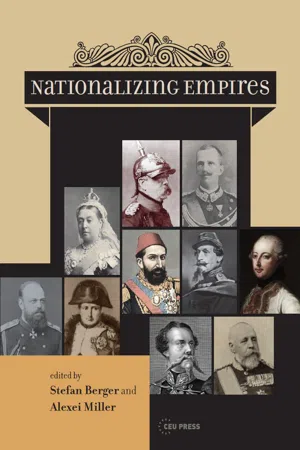 eBook - PDF
- Stefan Berger, Alexei Miller, Stefan Berger, Alexei Miller(Authors)
- 2015(Publication Date)
- Central European University Press(Publisher)
The First Napoleonic Empire, 1799–1815 Michael Broers apoleonic history was once seen only in terms of the “great man” and his deeds, and those deeds were, almost entirely, military and diplomatic. His shadow, whether for good or ill, sweep across Europe—“the trail of the comet” was a recurring met-aphor for the Napoleonic period—and that was that. The legacy of the years 1799– 1814 was centered on the man and his legend. When historians ventured into this pe-riod on any other errand than the military, biographical, or diplomatic, it was either in the spirit of French nationalism writ large, or with something close to a sense of shame. The former attitude is encapsulated in the very title of Jacques Godechot’s clas-sic study of expansion under the Directory, La Grande Nation , which almost says it all. 1 Historians of the non-French parts of the Empire too often equated the period of Napoleonic hegemony with collaboration and national defeat. Most of these scholars were too professional to identify their interpretations directly with the Nazi occupa-tions of the 1940s, but their sensitivities were obviously influenced by the climate of their times. Something of this tradition survives in more sophisticated form. For those who interpreted the empire in a purely nationalist context, the former assessment is still a powerful current in military and diplomatic history, as in Paul W. Schroeder’s The Transformation of European Politics , and has, perhaps, found a postmodernist ex-ponent in David Bell’s The First Total War . Both are powerful works, rooted in diplo-matic and military concerns, which see the essence of the Napoleonic experience as a negative dynamic. 2 Nevertheless, the winds of change have blown through Napoleonic history, with considerable force. 1 J. Godechot, La Grande Nation , 2 vols. (Paris: Aubier Montaigne, 1956). 2 P. W. Schroeder, The Transformation of European Politics, 1763–1848 (Oxford: Oxford University Press, 1994); D.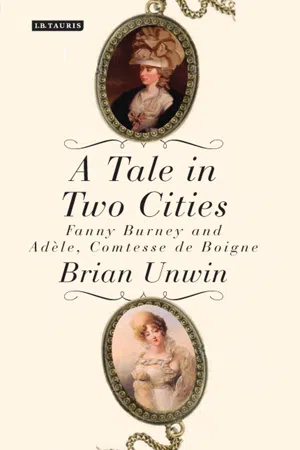 eBook - PDF
A Tale in Two Cities
Fanny Burney and Adèle, Comtesse de Boigne
- Brian Unwin(Author)
- 2014(Publication Date)
- I.B. Tauris(Publisher)
THREE Napoleon T he dominant European figure during the lifetimes of Fanny and Adèle was Napoleon Bonaparte. Although he did not start the French Revolution, he took it over, tamed it and turned the republican wars into more than a decade of imperial aggression and expansion, which overwhelmed the rest of Europe. Large tracts of western Russia were laid to waste, with huge loss of life; Britain was under continual threat of invasion; and the map of Europe was drawn and redrawn at Napoleon’s whim as he nominated his brothers, sisters and favourite marshals as sovereigns of newly conquered or assimilated territories. To the English, ‘Boney’ was a nightmarish figure with a huge army waiting at Boulogne to cross the Channel, seize them in their beds and take control of their country. In her delightful memoirs of Napoleon’s initial stay for a few weeks at her father’s house, the Briars, on St Helena in October and November 1815, 1 the 15-year-old Betsy Balcombe told how she had been taught as a child to believe that he was a ‘huge ogre or giant, with one large flaming red eye in the middle A Tale in Two Cities 72 of his forehead, and long teeth protruding from his mouth, with which he tore to pieces and devoured naughty little girls, especially those who did not know their lessons’. After living, going for walks and playing children’s games with him, she soon learned that he was not so terrible after all, but this image of the tyrant that had been built up in the British press was no doubt why crowds in little boats flocked to catch a real-life glimpse of him when he arrived as a captive at Plymouth and Torbay in July 1815 on His Majesty’s ship of the line Bellerophon .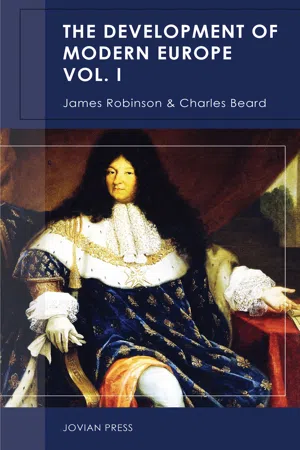 eBook - ePub
- James Robinson, Charles Beard(Authors)
- 2017(Publication Date)
- Jovian Press(Publisher)
Napoleon BONAPARTE
~ BONAPARTE’S FIRST ITALIAN CAMPAIGNThe French army had undergone a complete transformation during the Revolution. The rules of the ancien régime had required all officers to be nobles, and many of these had left France after the fall of the Bastille. Others, like Lafayette and Dumouriez, who had at first favored the Revolution, deserted soon after the opening of the war. Still others, like Custine and Beauharnais (the Empress Josephine’s first husband), were executed because the “deputies on mission” believed that they were responsible for the defeats that the armies of the French republic had suffered.The former rigid discipline disappeared, and the hundreds of thousands of volunteers who pressed forward to defend and extend the boundaries of the Republic found new leaders, who rose from the ranks, and who hit upon novel and quite unconventional ways of beating the enemy. Any one might now become a general if he could prove his ability to lead troops to victory. Moreau was a lawyer from Brittany, Murat had been a waiter, Jourdan before the Revolution had been selling cloth in Limoges. In short, the army, like the State, had become democratic.Among the commanders who by means of their talents rose to take the places of the “aristocrats” was one who was to dominate the history of Europe as no man before him had ever done. For fifteen years his biography and the political history of Europe are so nearly synonymous that the period we are now entering upon may properly be called after him, the Napoleonic Period.Napoleon Bonaparte was hardly a Frenchman by birth. It is true that the island of Corsica where he was born, August 15, 1769, had at that time belonged to France for a year, but Napoleon’s native language was Italian, and he was descended from Italian ancestors who had come to the island in the sixteenth century. His father, Carlo Buonaparte, although he claimed to be of noble extraction, busied himself with the profession of the law in the town of Ajaccio where Napoleon was probably born. He was poor and found it hard to support his eight boys and girls, all of whom were one day to become kings and queens, or at worst, princes and princesses. Accordingly he took his two elder sons, Joseph and Napoleon, to France, where Joseph was to be educated for the priesthood and Napoleon, who was but ten years old, after learning a little French was to prepare for the army in the military academy at Brienne. eBook - ePub
- Franklin L. Ford(Author)
- 2014(Publication Date)
- Routledge(Publisher)
9 Napoleon and EuropeThe fifteen-year segment of European history we call the ‘Napoleonic era’ possessed, like the career of its central figure, a structure at once epic and theatrical. Its story is one of tremendous French victories turning at last to over-extension and crushing defeat. The same story features several pauses or breathing spells in the tumultuous narrative, points at which one is tempted to ask: Why did Napoleon not stop here, consolidate his gains and ask no more of Europe? Whether or not there ever was a real chance of his drawing rein, the times when he appears, in retrospect, to have had that opportunity – 1802, 1807, 1810–11 – punctuate the drama of the age, dividing it almost as intermissions divide a stage production.The present chapter will review the military and diplomatic events that constituted each of these ‘acts’. While doing so, we should bear in mind that save for a single year one nation, Great Britain, was continuously at war with Bonaparte’s France. The stubborn conflict between these enemies facing one another across the Channel might upset the division into subperiods justified by events on the Continent. Even in the Anglo-French struggle, however, the sequence of European crises and relative lulls revealed itself clearly enough to justify our taking up the account as a whole in chronological segments.It would not be enough merely to chart the wars and temporary pacifications between 1800 and the peace of 1815. We need also to follow the principal internal developments within various European states during successive periods, admitting the while that to keep all the nations constantly in view would be impossible. Our goals will be, first, to observe the widening impact of the Napoleonic offensive on an entire civilization and, second, to distinguish the variety of responses, country by country, which in due course will help to explain the new map, the new Europe of 1815. eBook - PDF
- D. Jordan(Author)
- 2012(Publication Date)
- Palgrave Macmillan(Publisher)
Such is the inevitable lot of men of action, and the higher they stand in the social hierarchy the less free they are. It is the base, writes Isaiah Berlin, ‘which consists of those ordinary men and women whose lives are the actual stuff of history’ that mat- ters. Tolstoy’s passion was to penetrate to first causes, ‘to understand how and why things happen as they do and not otherwise’. He found the usual explanations of why Napoleon invaded Russia to be worth- less, irrelevant, and pompous. He mocks the presumption that the will of a single man, even, or especially, if that man be Napoleon, can move the huge wheels of history. His Napoleon is brash, loud, volatile, vain, aggressive, and a bully. He is both the incarnation of the French Revolution and its destroyer, the instrument of the fateful clash between the Revolution and Russia. He is the Revolution on horseback, denied genius and sardonically stripped of the ability to change history. He was lured into Russia by a most complex interplay of intrigues, aims, and wishes, among those who took part in the war and had no perception whatever of the inevitable, or of the one way of saving Russia. Everything came about fortuitously. At Borodino Napoleon is a man in a fog. From his command post he received riders all of whose reports were false. It was impossible in the heat of battle to know what was happening at any given moment in any particular part of the battlefield, let alone to know how the battle was going. Those who carried reports to Napoleon had not seen the action for themselves. They were told what to report to the Emperor by their superiors, who also had not seen what was going on. This information, already second and third hand, was even more worthless by the time the rider reached Napoleon. The fighting had continued as he rode and everything had changed. eBook - ePub
Military Strategy
The Politics and Technique of War
- John Stone(Author)
- 2013(Publication Date)
- Bloomsbury Academic(Publisher)
This was not the portrait of a man who would permit himself to be captured and constrained by the political orthodoxies of his day. Thus although he ultimately consented to marry Archduchess Marie-Louise, the daughter of Francis I of Austria, it was with his boot on her father’s neck in the wake of war. Indeed, the scale of Napoleon’s personal project – his quest for a unified Europe under his own control – meant that war was the only instrument available to him, as none of the monarchs standing in his way would acquiesce in his will without bitter resistance. Thus when he practised politics it was to enter into militarily advantageous alliances of a temporary nature; if he proved magnanimous in victory it was because he recognized the difficulties associated with bringing vast new territories and populations under direct control. A defeated monarch might therefore retain his throne if he proved willing to subordinate his own policies and resources to Napoleon’s grand project. A self-declared adversary of feudalism, the new emperor was perfectly willing to adopt the practice when it suited his own purposes.Reducing monarchs to the humble status of vassals demanded as a preliminary that their means of resistance – their armies – be destroyed. This in turn mandated a continuation of the battle-seeking strategy that had emerged in the wake of the Revolution, with all the associated manpower implications that this involved. By skilfully linking his personal ambitions to the fortunes of the French nation, Napoleon was able to continue the process of mass conscription that had been pioneered in the Republic. And as his empire grew so he was able to call on his subject states to augment the French army’s ranks, although the local discontent this engendered sometimes placed limits on this particular policy.As has already been noted, Napoleon’s superior military technique enabled him to employ his forces to dramatic effect, time and again bringing his enemies to battle under circumstances that permitted him to inflict crippling defeat on them. A complete list of these battles would make for tedious reading, but it is worthwhile highlighting a selection of those victories that brought him to the summit of his imperial power. In 1805 he defeated Austrian and Russian armies at Ulm and Austerlitz, forcing Francis I to seek peace on highly unfavourable terms. Austria was required to cede important territories in Italy and Germany, and to pay a substantial indemnity. The following year Prussia was soundly defeated at the twin battles of Jena and Auerstädt (in the process providing a young Clausewitz with his formative military experience). The resulting peace terms reduced the state to a shade of her former power by stripping her of half her territory and imposing a swingeing indemnity. Throughout all this Russia fought on, but finally met with serious defeat at Friedland in 1807, leaving Napoleon master of continental Europe.
Index pages curate the most relevant extracts from our library of academic textbooks. They’ve been created using an in-house natural language model (NLM), each adding context and meaning to key research topics.

