History

First French Empire
The First French Empire was established by Napoleon Bonaparte in 1804 and lasted until 1814. It was characterized by extensive military conquests, administrative centralization, and the spread of revolutionary ideals. The empire's influence extended across much of continental Europe, and it significantly shaped the political landscape of the time.
Written by Perlego with AI-assistance
Related key terms
1 of 5
11 Key excerpts on "First French Empire"
 eBook - PDF
- Stefan Berger, Alexei Miller, Stefan Berger, Alexei Miller(Authors)
- 2015(Publication Date)
- Central European University Press(Publisher)
The First Napoleonic Empire, 1799–1815 Michael Broers apoleonic history was once seen only in terms of the “great man” and his deeds, and those deeds were, almost entirely, military and diplomatic. His shadow, whether for good or ill, sweep across Europe—“the trail of the comet” was a recurring met-aphor for the Napoleonic period—and that was that. The legacy of the years 1799– 1814 was centered on the man and his legend. When historians ventured into this pe-riod on any other errand than the military, biographical, or diplomatic, it was either in the spirit of French nationalism writ large, or with something close to a sense of shame. The former attitude is encapsulated in the very title of Jacques Godechot’s clas-sic study of expansion under the Directory, La Grande Nation , which almost says it all. 1 Historians of the non-French parts of the Empire too often equated the period of Napoleonic hegemony with collaboration and national defeat. Most of these scholars were too professional to identify their interpretations directly with the Nazi occupa-tions of the 1940s, but their sensitivities were obviously influenced by the climate of their times. Something of this tradition survives in more sophisticated form. For those who interpreted the empire in a purely nationalist context, the former assessment is still a powerful current in military and diplomatic history, as in Paul W. Schroeder’s The Transformation of European Politics , and has, perhaps, found a postmodernist ex-ponent in David Bell’s The First Total War . Both are powerful works, rooted in diplo-matic and military concerns, which see the essence of the Napoleonic experience as a negative dynamic. 2 Nevertheless, the winds of change have blown through Napoleonic history, with considerable force. 1 J. Godechot, La Grande Nation , 2 vols. (Paris: Aubier Montaigne, 1956). 2 P. W. Schroeder, The Transformation of European Politics, 1763–1848 (Oxford: Oxford University Press, 1994); D. eBook - ePub
- Alexander Grab(Author)
- 2017(Publication Date)
- Bloomsbury Academic(Publisher)
The Napoleonic Empire, which constituted the most remarkable French hegemony in Europe, reached the height of its territorial expansion at the end of 1810. Napoleon’s victories cannot be explained, however, solely by his ambitions and military and diplomatic talents. As Martyn Lyons points out, “They reflected the powerful energies released by the French Revolution, and they were made possible by France’s superior resources, both of manpower and agricultural wealth.” 2 He inherited from the Revolution a conscription system that he improved and that was instrumental in building the Grande Armée, his principal tool for gaining control over a good part of Europe. The territories that comprised the Napoleonic “Grand Empire” were divided into three groups: pays réunis (annexed lands), pays conquis (conquered countries), and pays alliés (allied countries). 3 The first group consisted of territories that were annexed to France and were directly ruled by Napoleon. Those lands constituted the “formal French Empire.” The second category included satellite states that were entrusted to French rulers. Finally, the pays alliés constituted allied countries whose territory was expanded by Napoleon in some cases, and which continued to be governed by their native rulers eBook - PDF
- Michael F. Leruth(Author)
- 2022(Publication Date)
- ABC-CLIO(Publisher)
See also: Chapter 2: Timeline; de Gaulle (Charles), World War II, and the Fifth Repub- lic; Sarkozy (Nicolas) and the Hyper Presidency. Chapter 3: European Union; Left; Presidency and Executive Branch. Chapter 12: Contemporary Architecture; Ministry of Culture. Chapter 13: Fête de la Musique. Further Reading Bell (2005); Friend (1998); Maclean (1998); Short (2014). Napoleon Bonaparte (Napoleon I) and the First Empire Napoleon Bonaparte (1769–1821) was a French military commander of Corsican ori- gin who rose rapidly through the ranks of the French army during the wars of the French Revolution, seized political power in France in a 1799 coup that made him the dominant member of the new ruling Consulate, founded the First French Empire in 1804, and went on to conquer or otherwise control most of Europe during the Napo- leonic Wars (1803–1815) before being twice defeated by European coalition forces— definitively so at the Battle of Waterloo in 1815. As a political leader, Napoleon effectively ended the French Revolution. He preserved key elements of republican cul- ture and social reforms (e.g., a minimal degree of civil equality written into law, largely secular government, reliance on the patriotic sentiment of the French people) while leading an authoritarian and conservative government capable of maintaining order. He modernized and centralized France’s government and public administra- tion (e.g., state-appointed prefects in each department), instituted key economic and educational reforms (e.g., Bank of France, French Franc, Imperial University, lycée system), and struck a deal with the Holy See in Rome (Concordat, 1801) that restored 74 | Modern France some of the Catholic Church’s former privileges and influence in France while also formally recognizing other faiths (e.g., Protestantism, Judaism). eBook - PDF
Napoleon's Empire
European Politics in Global Perspective
- Ute Planert(Author)
- 2016(Publication Date)
- Palgrave Macmillan(Publisher)
21 The remarks quoted below, admittedly composed on Saint Helena, are none- theless at least partly true, as is confirmed by the expedition to the Orient of 1798 and by the secret missions of 1810 to Egypt, Syria and Jerusalem. 1 Egypt, he said, should have been our Saint-Domingue and our American colonies, reconciling freedom for the blacks with prosperity for our trade, etc. This new colony would have ruined the English in America, in the Mediterranean, and all the way to the banks of the Ganges. They make clear at the outset the extra-European dimension of Napoleonic ambitions and achievements. This dimension forms the subject of the present essay, which focuses primarily on the Western historiography of the Imperial period in a global perspective. What is immediately striking is the extent to which this historiography has changed since its beginnings. 2 We start therefore by outlining the main themes of the early historiography, then consider the shift in research over recent decades, and finally broaden the focus to global history. The result, it is hoped, will contribute to a better understanding of the Napoleonic period in both Europe and the Atlantic world. From Napoleon’s death to the 1980s and 1990s, the history of the First Empire was primarily a matter of contention. 3 In France, it set uncondi- tional admirers against implacable opponents, that is, Bonapartists of all persuasions against republicans, liberals and royalists. 4 More importantly for our discussion, the historiography of the First Empire was Francocentric, in that French historians concentrated their attention on Napoleonic France itself, not on Europe, an entity inconceivable in the era of triumphant 2 France, Western Europe and the Atlantic World. Napoleon’s Empire: European Politics in a Global Perspective Annie Jourdan 22 Annie Jourdan nationalism and for this reason scarcely visible to them.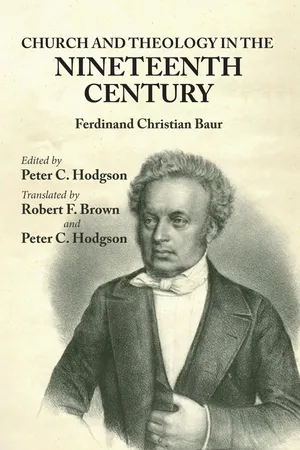 eBook - ePub
- Ferdinand Christian Baur, Peter C. Hodgson, Robert F. Brown(Authors)
- 2018(Publication Date)
- Cascade Books(Publisher)
Part OneFrom the Beginning of the Nineteenth Century to 1815
 Passage contains an image
1
Passage contains an image
1
Introduction
Survey of Political Events
The beginning of Part One takes us back to the turbulent times during which the French Revolution completed its course. Since from its beginning it was a world-shattering event, it was the center of gravity of all political movements of the European states. The torrent, which had powerfully and perilously swollen the stream of revolutionary sentiment, had begun to recede, and more fixed points in the newly forming order of things already had begun to emerge amid the widespread destruction and confusion of the previously existing order. By the first days of the new century, a man stood at the pinnacle of power in France. This was a man who managed to forge the chaotically confused elements in France together and to amplify the power delivered into his hands from the revolution, which he would use to determine the fate of Europe for years to come. After he became the First Consul of the French Republic, in 1799, Napoleon Bonaparte (1769–1821) demonstrated the great organizing talent that set him apart. Because of him France became a newly organized state, rejuvenated with powers nourished by the revolution. Thus he now exerted the greatest influence on the whole of a Europe crumbling as the result of the revolution, and he effected the most important changes in political affairs and all related matters. The entire period of Napoleonic domination involves a series of events that, to an ever greater extent, caused everything to be torn loose from its old footings and the foundations of a new structure to be laid on the wreckage of the old.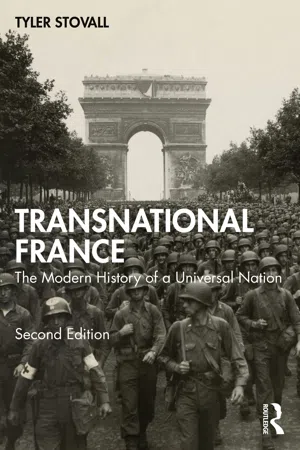 eBook - ePub
Transnational France
The Modern History of a Universal Nation
- Tyler Stovall(Author)
- 2022(Publication Date)
- Routledge(Publisher)
Napoleon III Frees Abd-el-Kadir , 1852. Source: The History Collection / Alamy Stock PhotoFrance’s relationship to the wider world preoccupied the Second Empire, as it did the first, but with significant differences. Bonapartism retained its paradoxical heritage of support for liberty abroad and commitments to preserve the status quo, and the contradictions between the two positions loomed even larger than they had half a century earlier. Increasingly, France under Napoleon III loomed as an obstacle to the new forces of national unification shaking central and southern Europe. At the same time, the Second Empire, much more so than the First, extended the search for imperial glory well beyond the borders of Europe. Both with his successful ventures in Africa, Southeast Asia, and the Pacific, and with his disastrous Mexican campaign, Napoleon III redefined the meaning of empire to focus on overseas expansion. Finally, France’s long rivalry with Germany essentially began under the Second Empire, as the French emperor faced the brilliant Prussian chancellor Otto von Bismarck, bent on making a united Germany dominant in Europe. Unlike the Restoration and July monarchies, the Second Empire collapsed as a result of foreign military defeat, a theme that would resurface more than once during the twentieth century.During the reign of Napoleon III the French became more conscious of their identity as a nation, a process that would continue and accelerate under the Third Republic to follow. This process owed much to the economic advances of the era, notably the rise of a national market facilitated by transportation and communications improvements. The growth of mass-based nationalism abroad also contributed to this new sense of identity; increasingly surrounded by other unified nations, France could not but become more conscious of its own national character. The regime’s end with the signing of German unification at Versailles, on French territory, dramatically underscored the links between French and foreign nationalisms. The idea of French republicanism as a universal value did not disappear, but was instead complemented by a growing sense of French distinction. Both the decline of provincial economic and cultural autonomy, and increased national awareness elsewhere in Europe, fostered a new sense of the singularity of France. Yet, paradoxically, this awareness rested more than ever before on the heritage of the French Revolution, so that modern views of French identity both challenged and reinforced the idea of France as a universal nation. eBook - PDF
- G. Mortimer(Author)
- 2004(Publication Date)
- Palgrave Macmillan(Publisher)
196 11 The French Revolutionary and Napoleonic Wars Alan Forrest If the years from 1740 had seen repeated trials of strength between the armies of the European powers, these were dwarfed by the Wars of the French Revolution and Empire. Between 1792 and 1815 France was almost constantly in a state of war with coalitions of European states, and from 1803 – after the collapse of the truce signed at Amiens – there was no peace across the greater part of the conti- nent until Napoleon’s final defeat at Waterloo. Napoleon himself moved rest- lessly from one campaign to another, fighting some sixty battles in all and winning the great majority of them (Gates, 1997, p. 5). Indeed, the sheer scale of warfare made it difficult for contemporaries to regard the Revolutionary and Napoleonic Wars as simply the continuation of the traditional struggles between states that had characterized the eighteenth century. They distorted trade pat- terns and consumed an unprecedented proportion of the country’s economic wealth. And French objectives were not limited to the customary aims of tradi- tional European wars, be they the acquisition of granaries, of neighbouring terri- tories or of overseas colonies, dynastic successions, or (as with Louis XIV) dreams of attaining natural frontiers. France, it appeared, now thought on an altogether more ambitious scale, attempting to impose its new polity on much of continen- tal Europe during the revolutionary years, before aspiring to create a new Carolingian empire under Napoleon. French troops fanned out across Europe as far as the Peninsula and Russia, they crossed the Mediterranean to Egypt and North Africa, and in a moment of misguided over-ambition they attempted to overturn the new black government in Haiti. They did not hesitate to open up several fronts at once or to take on powerful coalitions of states.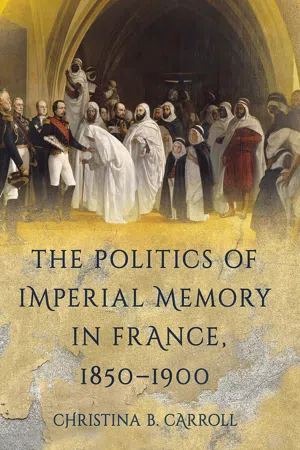
- Christina B. Carroll(Author)
- 2022(Publication Date)
- Cornell University Press(Publisher)
The term could also invoke the memory of the monarchy’s expansion into North America or the Bonapartist expansion across the continent—as well as the specter of German unification or British overseas conquest. 5 The nature of the empire’s relationship to republicanism, Bonapartism, French national identity, and colonial expansion was thus both shifting and fraught. The multiple valences of empire during this period, moreover, had both political and intellectual consequences: they played an important role in shaping the ways that intellectuals, writers, and politicians articulated their ideas about France’s political organization, its national identity, and its colonial ambitions. The memory of both Napoleonic empires lay at the center of these tangled understandings of “empire” in the early Third Republic. The vividness of these memories owed much to Napoleon III, who, throughout his reign, sought to provide substance to his imperial regime by associating himself with his uncle and by popularizing sometimes contradictory “theories of empire.” In the early years of his rule, Napoleon III usually described empire as an internal form of political organization that drew on the legacy of the French Revolution but tempered that legacy with “order” and “security.” 6 He thus treated “the French Empire” as functionally equivalent to “the French nation.” But in the 1860s Napoleon III began to focus more on France’s overseas territories. He extended France’s investment in Indochina, tried to expand France’s foothold in North America by creating an allied “Latin” empire in Mexico, and sought to reimagine Algeria as a royaume arabe, or Arab kingdom. In Mexico and in Algeria especially, Napoleon III paired this renewed overseas investment with a more comprehensive vision of empire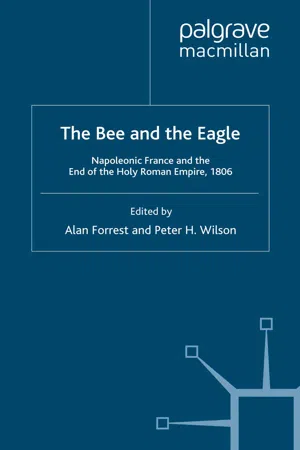 eBook - PDF
The Bee and the Eagle
Napoleonic France and the End of the Holy Roman Empire, 1806
- Alan Forrest, Peter H. Wilson(Authors)
- 2008(Publication Date)
- Palgrave Macmillan(Publisher)
Michael Broers 67 polities, to satellite kingdoms, to French departments under the Emperor’s direct rule. Yet this was far from the whole story. Empire-building is quite dis- tinct from state-building, something Napoleon and his collaborators knew very well. How Napoleon and his family chose to try to rule the domains they purloined matters greatly to the future of Europe. Stuart Woolf’s enduring contribution to the historiography of the Napoleonic period is to have placed this at its heart. The administrative and legal order Napoleon introduced across western Europe – even if ruthlessly imposed, even if violently opposed at the time – laid the foundations for the public sphere of the next two centuries. These foundations were all too often occluded by two world wars, the European civil war that threatened to destroy an entire civilisation, its state structures included. 7 Yet they survived, and this aspect of the Napoleonic legacy must outweigh the ebb and flow of a time of war; the vacillations of the warlord ought not to negate the consistency of the reform of the civil order he attempted. It is too often forgotten that continental Europe was at peace between 1801 and 1805 – one-third of the period of Napoleonic hegemony – and that Napoleon used these years to estab- lish the prefectoral system, the Université, and to pacify his domains – including the annexed territories in northern Italy, western Germany and the Low Countries – as well as bringing the Civil Code to fruition. There was a considerable pause in military hostilities, if not in the distant war with Britain, and it was put to considerable use outside the military sphere. 8 There were those in the ranks of his most devoted contemporary disciples who saw this enterprise not as the work of one man, however much they adored him, but as the achievement of a generation of Frenchmen whose vision he shared.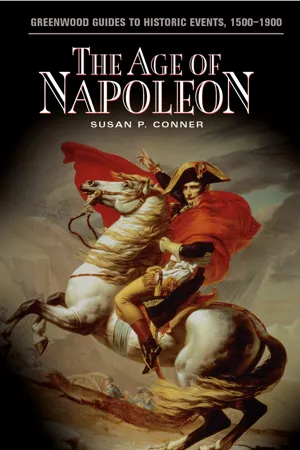 eBook - PDF
- Susan P. Conner(Author)
- 2004(Publication Date)
- Greenwood(Publisher)
His armies had spanned Europe from Portugal on the west to Russia on the east. His satellite kingdoms had stretched from Holland on the north to Italy on the south. He had once fancied a worldwide empire, and he had looked to the east: the Levant and the Orient. He had looked also to the west 2 THE AGE OF NAPOLEON and sent his troops to Saint Domingue (Haiti). He had visualized a polit- ical and economic community in Europe (albeit with French hege- mony)—a common coinage, common laws, and unified diplomacy and trade—long before the European Economic Community of post-World War II Europe was created or the Treaty of Maastricht was ever contem- plated. When Napoleon looked back on that period of history with his companions at St. Helena, he took pleasure in laying the groundwork for its interpretation. He said, in his confident way, "Posterity will judge only by the facts." 2 And facts for this period abound. Among the primary sources of the Napoleonic era are 32 volumes of Napoleon's correspon- dence, 28 of which average 700 pages each and in total contain some 22,067 letters and documents. There are hundreds of volumes of decrees and legislation that provide an official chronicle of the French govern- ment, and articles and essays from the contemporary press are available as well. Cartons of other Napoleonic records fill archives throughout France and Europe. Regardless of what Napoleon said—that the facts would pronounce all judgments on his period—even he knew that more than simple facts, dates, narratives, and names would be necessary to create a portrait of the age and of himself. Time and history's abiding fascination with the small, slightly dark- complexioned Corsican have left a legacy that is sometimes compli- mentary to the point of hagiography and sometimes thoroughly damning, but the bibliography is massive. eBook - PDF
- Jeremy Black(Author)
- 2014(Publication Date)
- Bloomsbury Academic(Publisher)
5 The World of the European Empires, 1800–1950 The nineteenth and twentieth centuries defy ready organization. They are at once the age of imperialism and of world wars, of civil conflict on an unprecedented scale and of revolutions. Any one approach risks being misleading. Conventionally, the period is divided at 1914, with a nineteenth century that had begun with Napoleon’s defeat at Waterloo in 1815 brought to an end with the outbreak of the First World War. A further division occurs in 1945, to mark the end of the Second World War and the beginning of the Cold War, and another in 1989–91 to mark the end of the Cold War. This approach has value, and echoes of it will be found in this book, but the emphasis, instead, is on a different perspective on the World Question, the issue of primacy in the world. Here the stress is on Western territorial imperialism. This imperialism neither began in 1800 nor ended in 1950, but that period comprehended the apogee of Western territorial control, and indeed much of its history. In 1799 the British defeated and killed Tipu, Sultan of Mysore, their leading opponent in southern India, when they stormed his capital, Seringapatam, while British naval victories in 1798 (Battle of the Nile) and 1805 (Trafalgar) put paid to any challenge that the French navy might mount to Britain’s security and imperial position. After 1950 the Portuguese and French empires continued, while Britain was still a major imperial power east of Suez and in the West Indies, but, by then, the Dutch, French and British had already lost much of WA R : A S H O RT H I S TO RY 108 the empires they had held or regained control over at the end of the Second World War. A decade later, 1960 saw independence for most of France’s possessions in Africa as well as for the Belgian Congo and the British colony of Nigeria.
Index pages curate the most relevant extracts from our library of academic textbooks. They’ve been created using an in-house natural language model (NLM), each adding context and meaning to key research topics.

