History

Haitian Revolution Causes
The Haitian Revolution was fueled by a combination of social, economic, and political factors. Slavery and the harsh treatment of enslaved people, as well as the influence of the French Revolution and the desire for freedom and independence, were key causes. Additionally, the leadership of Toussaint Louverture and other revolutionary figures played a significant role in sparking and sustaining the revolution.
Written by Perlego with AI-assistance
Related key terms
1 of 5
11 Key excerpts on "Haitian Revolution Causes"
 eBook - PDF
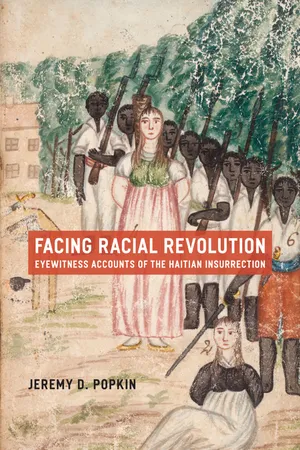
Facing Racial Revolution
Eyewitness Accounts of the Haitian Insurrection
- Jeremy D. Popkin(Author)
- 2010(Publication Date)
- University of Chicago Press(Publisher)
I N T R O D U C T I O N From Saint-Domingue to Haiti: Eyewitness Narratives of the Haitian Revolution The uprising in the French colony of Saint-Domingue that led to the cre-ation of the independent black Caribbean republic of Haiti in 1804 was one of the major events that defined our modern world. Unlike the Ameri-can Revolution of 1776 and the French Revolution of 1789, the Haitian in-surrection directly challenged the system of racial hierarchy that had pre-vailed throughout the Atlantic world since the beginning of the colonial era. The American revolutionaries had consolidated slavery in the South-ern states, and the French legislators evaded a confrontation with the sub-ject until the insurrection in their major colony made action unavoidable. Only the Haitian movement proclaimed that liberty was incompatible with chattel slavery and that equality had to include people of all races. Our un-derstanding of the revolutionary era is not complete unless it takes account of this upheaval, the only successful slave revolt in history and one that led to the creation of the first postcolonial republic to be established by people of color. The French colony of Saint-Domingue had been the source of half the world’s sugar and co≠ee; the revolution there shook the foundations of the system of trade routes, plantations, and investments that had tied the Atlantic world together for three centuries. The saga of the black insurrec-tion and of its legendary leader, Toussaint Louverture, has inspired resis-tance movements in the African Diaspora and the non-Western world ever since. More somberly, in Europe and the United States, the reaction to the Haitian Revolution helped strengthen the racial prejudices that haunt the globe even today. The importance of the Haitian Revolution in the shaping of modern history explains the interest of the eyewitness accounts of its events that eBook - ePub
The Roots and Consequences of Independence Wars
Conflicts That Changed World History
- Spencer C. Tucker(Author)
- 2018(Publication Date)
- ABC-CLIO(Publisher)
Haitian Revolution and Wars of Independence (1791–1804) CausesThe Republic of Haiti is a sovereign state on the island of Hispaniola in the Greater Antilles archipelago of the Caribbean just to the east of Cuba. Haiti shares the island with the Dominican Republic; Haiti comprises the western three-eighths of the island, while the Dominican Republic comprises the rest. Europeans first arrived in 1492 when Christopher Columbus, sailing for the Spanish Crown, stopped at the island that December, believing he had found Asia.Spain claimed possession of the island, which remained under Spanish control until the 17th century. The French established settlements in the western part of Hispaniola and on the island of Tortuga by 1659, and in the Treaty of Ryswick of 1697 that ended the War of the League of Augsburg (Nine Years’ War), Spain formally ceded to France control both of Tortuga and the western third of Hispaniola, now named Saint-Domingue.Saint-Domingue had a plantation economy based on slaves brought to the island from Africa. The island’s plantations produced coffee, cocoa, and indigo, but the main cash crop was sugarcane. The production of sugar made Saint-Domingue the most prosperous of France’s colonies and the wealthiest of all European colonies in the Caribbean. In 1789 it produced some 60 percent of the world’s coffee and 40 percent of the sugar imported by France and Britain. Under the French mercantilist system, Saint-Domingue was not permitted to develop its own industries and was forced to purchase finished goods from France, with all trade carried in French ships. Although many planters became fabulously wealthy, they also harbored resentment against the French government strictures.Haitian Revolution and Wars of Independence (1791–1804)Estimated Total Deaths, Haitian Revolution and Wars of Independence (1791–1804)*Black HaitiansFrench and British SoldiersWhite Colonists200,000 100,000 25,000 *Deaths from all causes. Scholars suspect that the majority of deaths were due to yellow fever.  eBook - PDF
- R. Bessel, N. Guyatt, J. Rendall, R. Bessel, N. Guyatt, J. Rendall(Authors)
- 2010(Publication Date)
- Palgrave Macmillan(Publisher)
10 The Haitian Revolution, in other words, was not only about the compli- cated relationship between developments in France and the Caribbean, but was as much—as John Thornton has argued 11 —a conflict quite literally The Revolutionary Abolitionists of Haiti 57 constituted politically and intellectually by a triangle connecting Africa, the Americas and Europe. It was not just that the imperial conflicts driven by European rivalries shaped the pace and geography of the African slave trade, which they certainly did. The conflicts within Africa—shaped by local forces, rooted in long histories that stretched back before the emer- gence of the Atlantic slave trade, but also shaped by the transformations set in motion by that trade—became part of the age of Atlantic revolution through the choices, actions and perspectives of the masses of African par- ticipants in the Haitian Revolution itself. This perspective can help us better understand one aspect of the political culture of the Haitian Revolution that has long preoccupied historians—the intermingling of republican and royalist symbolism and discourse among the insurgents during the early 1790s. In presenting themselves and articulating their demands, insurgents sometimes made reference to the dis- courses of republicanism, particularly the Declaration of the Rights of Man, but more often they made use of royalist symbols. Yet rather than signifying a fragmented or contradictory set of political ideologies, the cohabitation of these forms provides us with a useful insight into the particularities of the Caribbean political culture embodied in the slave revolution of 1791–93. Indeed, to analyse the political culture of the insurgents in terms of dichoto- mies defined according to the specific European political context of the time is to obscure the complex realities of the Caribbean political context.
- L. Coppolaro, F. McKenzie, L. Coppolaro, F. McKenzie(Authors)
- 2013(Publication Date)
- Palgrave Macmillan(Publisher)
3 An Explosion of Violence: How the Haitian Revolution Rearranged the Trade Patterns of the Western Hemisphere Steven TopikHistorians in recent years have finally begun to give the Haitian Revolution of 1791–1804 the attention that it deserved as one of the first wars of national liberation and as a momentous blow against Atlantic slavery.1 That struggle demonstrated that the ideals that so marked the French Revolution, ‘liberté, égalité, fraternité’, had very different meanings – and consequences – in an overseas French colony overwhelmingly inhabited by slaves, many of whom were born in Africa. This chapter will consider that world historic event from an unusual perspective by addressing its consequences for international trade in the early nineteenth century. Was the destruction of the Haitian ‘Pearl of the Antilles’ constructive and, if so, who enjoyed the benefits? It will be argued that the colonial bloodbath that severely impacted the most precious European colony in the Caribbean had the ironic effect of diffusing and expanding tropical exports in the Americas – but not in Haiti – and amplifying mass consumption in the United States and Western Europe – but not in the Caribbean. This violent transnational war and social upheaval served as a vehicle for commercial globalization.The historiography of the Haitian RevolutionThe 13-year-long revolution that broke out in the rich French colony known as Saint Domingue, until recently had been largely ignored or treated as an aberration.2 It is not even included in R. R. Palmer’s Age of the Democratic Revolution , perhaps because of its ominous social implications and because the rebels were as much inspired by African traditions as by European ones. Latin America’s first independent country and first republic arose from a successful slave revolution – the first in the Americas – that broke out in 1791 in Saint Domingue, later known as Haiti. Perhaps because of its uniqueness, Samuel Huntington in his widely cited Clash of Civilizations? dismisses events in Haiti as marginal to the history of Western civilization because it was a ‘lone country’ that lacked ‘cultural commonality with other societies’.3 eBook - ePub
The Haitian Revolution
Capitalism, Slavery and Counter-Modernity
- Eduardo Grüner, Ramsey McGlazer(Authors)
- 2019(Publication Date)
- Polity(Publisher)
The great revolution fought by the slaves of Saint-Domingue/Haiti was the culmination, as well as the most conscious example, of this effort, this displacement of one set of objectives by another. Of course, this process was, like any such social and political process, marked by all kinds of nuances, hesitations, and contradictions, including ideological contradictions. In order to attempt to understand these, we need to ask what the situation in Haiti was like before – and just after, on the sidelines of – the world-historical event that was the Haitian Revolution. Many rebellions began as acts of desperation, more or less spontaneous expressions of resistance to the unspeakable conditions of exploitation, starvation, sadism, racism, and veritable dehumanization under which slaves lived. Others, like the marooned slaves or quilomberos who occasionally organized “guerrilla” groups that undertook to find provisions or punish their old masters for their abuses, sought to withdraw from the society of slaveholders and to “restore” an archaic order that they imagined would be perceived as quintessentially “African.” Instead, however, these fugitives’ communities were in fact new creations, fully African American, with an emphasis on the “American.” From a strict anthropological and cultural point of view, they attested to the creation of a new culture in the so-called “New World.” Again, these movements differed according to region and location, to be sure. Slaves in the Southern United States had a history that was very different from the history of slaves in the Caribbean or in Brazil, for example. In “the great country in the North,” the largest expansion of the slave regime, territorially, economically, and demographically, happened only after the international slave trade itself had come to an end (at least in theory). This system relied, in other words, on a process of “self-reproduction” that was almost exclusively local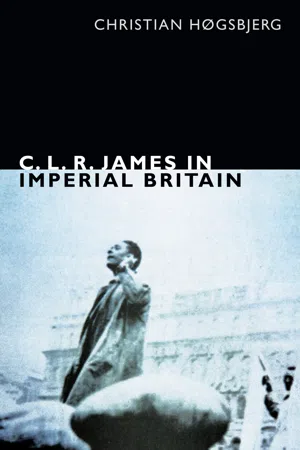 eBook - PDF
- Christian Høgsbjerg(Author)
- 2014(Publication Date)
- Duke University Press Books(Publisher)
Overall, as the Haitian scholar Michel-Rolph Trouillot once noted, the Haitian Revolution “entered history with the peculiar characteristic of being unthinkable even as it happened. . . . The general silence that West-ern historiography has produced around the Haitian Revolution originally stemmed from the incapacity to express the unthinkable.”169 For British imperial historians such as Coupland, for example, while there was some sense that “the rebels in St Domingo were preaching Jacobinism through-out the Caribbean,” the Haitian Revolution was dismissed as a tragic side-show, taking place off stage somewhere, in a place “perilously isolated from the civilized world, shut in upon itself by the encircling sea.”170 In a glorious fusion of classical scholarship on the Great French Revolution and Marxist scholarship on the revolutionary process in general, James’s The Black Jaco-bins instead painted a vivid panorama of the Haitian Revolution, stressing that it was not simply the greatest event in the history of the Caribbean, 198 | Chapter 5 but took its place alongside the English Civil War, the American War of In-dependence, and the French Revolution as one of the great revolutions in world history in its own right. Whereas the greatest victory of the Haitian Revolution was perhaps the revolution itself, and the transformation of consciousness and confidence among the great mass of people who made it, it would also forever transform the world and lay the foundation for the continuing struggle for universal human rights.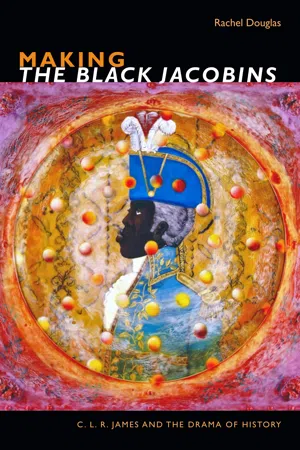 eBook - PDF
Making The Black Jacobins
C. L. R. James and the Drama of History
- Rachel Douglas(Author)
- 2019(Publication Date)
- Duke University Press Books(Publisher)
71 Her work has uncovered how these early Haitian authors prevented the Haitian past from being silenced, rewriting the Haitian Revo-lution in their turn. Like Vastey and Boisrond-Tonnerre, James combats negative representations of Haiti and its revolution in accounts from Europe and the United States. After James, several historians have pointed to the Haitian Revolution as the most radical statement of the overlapping ages of revolution and enlight-enment, arguing that it should rightfully be seen at the center of both ages, and not silenced on their margins, as has often been the case. 72 During the Haitian Revolution, as James shows at length in his history and especially in his plays, former slaves reworked for themselves the banner words of the Introduction | 21 Enlightenment/French Revolution idiom—words like freedom, equality, fraternity, and independence—reinterpreting such ideals within the frame-work of their own situation. Even the most enlightened of the Enlightenment thinkers advocated only a gradualist approach where slaves would gradually be prepared for abolition, with freedom something to be earned by deserving slaves, but also, most importantly, something to be granted benevolently by the colonial power of white abolitionists. 73 Instead, the Haitian Revolution is presented as a revolution of the slaves’ own making; a self-emancipation. This is not, in other words, abolition as scripted by Europeans or Enlighten-ment thinkers. Rather, the radical antislavery of the Haitian Revolution is a story of major historical transformation of world importance where slaves vindicate themselves as active actors and as subjects of history in their own right; a vehement rejection of their condition as slaves—things, objects, and even “pieces of furniture” according to the Code Noir .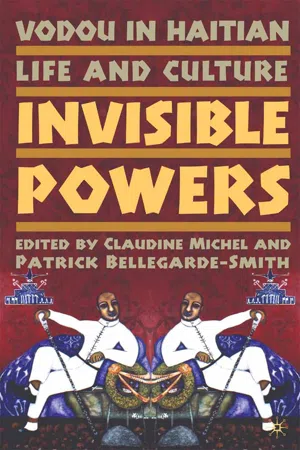 eBook - PDF
Vodou in Haitian Life and Culture
Invisible Powers
- C. Michel, P. Bellegarde-Smith, C. Michel, P. Bellegarde-Smith(Authors)
- 2006(Publication Date)
- Palgrave Macmillan(Publisher)
Chapter 7 Resisting Freedom: Cultural Factors in Democracy—The Case for Haiti Patrick Bellegarde-Smith The trees fall from time to time, but the voice of the forest never loses its power. Life begins. —Jacques Alexis, Les Arbres Musiciens (Paris, 1957) Haitian societal development seems to be filled with paradoxes, contradictions, and enigmas. The process begun with the “encounter” of 1492 was profoundly corrupt- ing in terms of cultural deflections to both the Old World and the New World and to established patterns of interaction everywhere between the powerful and the weak that are still evident today. Haitian history has been marked by struggle and by con- tinuous acts of rebellion that, in more quiescent times, have become passive resistance known by the Haitian label, marronage. The Haitian Revolution of 1791, the most complete social revolution in the hemisphere until Mexico in 1910 and Cuba in 1959, was formed by two major dis- tinct movements that coalesced in an unsteady alliance but never fully merged. The first movement, that of the enslaved, was the heir to all earlier slave rebellions, and was consistent with slaves’ opposition to slavery and all forms of oppression. The sec- ond movement was that of the plantocracy of color. Using a combination of tactics and approaches such as warfare, guerrilla activities, and poisonings, this group terrorized the plantocracy. The leaders were often Vodou priests. Boukman Dutty and a female priest are said to have officiated at a Vodou ceremony at Bois Caïman— doubtless one of many such ceremonies—inaugurating the insurrection of 1791. Makandal, an African-born Muslim with a reputation of being a bòkò, led the 1757 revolt. 1 Pierre Dominique Toussaint Louverture, who later ruled, was also thought to be a bòkò. Makandal’s sacred mission, like that of Zumbi of Palmares, was to rid the colony of its white inhabitants and to create an African kingdom in Saint- Domingue.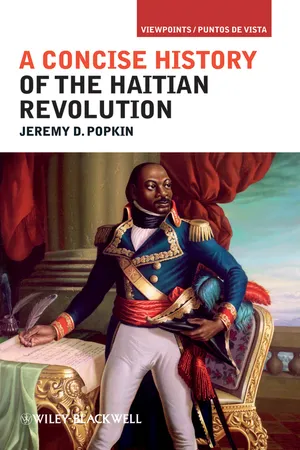 eBook - ePub
- Jeremy D. Popkin(Author)
- 2011(Publication Date)
- Wiley-Blackwell(Publisher)
bossales must have become blurred as they all participated together in the fighting and suffered together at the hands of the French. Dessalines’s insistence, in his 1805 constitution, that all Haitians, regardless of origin or skin color, now formed a single group reflected a certain reality: the revolution had forged a new national community, although not one as united as Dessalines had hoped.Despite the profound significance of the events of 1804 and 1805, not just for the people of the newly proclaimed nation of Haiti but for the entire western world, it would be a mistake to think that the story of the Haitian Revolution ended with the victory over the French and the establishment of new “imagined community” of Haitian citizens.2 Not until the middle of the nineteenth century was it clear what the lasting characteristics of Haitian society and politics would look like. Conflict over the country’s future direction soon became so violent that Dessalines, the determined general who had defeated the French, was assassinated. For fourteen years, from the beginning of 1807 to 1820, Haiti split apart, as the divisions between blacks and free men of color and between the northern and southern regions reasserted themselves in a simmering civil war. Instead of becoming one independent state, Haiti might well have developed into two rival countries.Internal divisions were not the only threat to the future of the experiment launched in 1804. Despite the conclusiveness of the French defeat, few whites at the time believed that a society governed by people of African ancestry could endure; most assumed that it was just a matter of time before some outside power succeeded in reasserting control over the island. France, Haiti’s former colonial overlord, refused to recognize the new country’s independence, and former colonists and government officials there continued to discuss plans to reoccupy the territory for several decades after the independence declaration of 1804. In the meantime, the Spanish and Portuguese colonies in central and South America followed Haiti’s lead in demanding their own independence, but, like the United States, they refused to recognize the black-ruled island as an equal partner in the new world of independent states that now made up the Americas. Disadvantaged by structural changes in the world economy that doomed any hope of recovering the prosperity of the colonial past, and marginalized by the rising tide of racialist prejudice that characterized the nineteenth century, Haiti found itself condemned to a precarious existence from which, many would argue, it has never really been able to escape.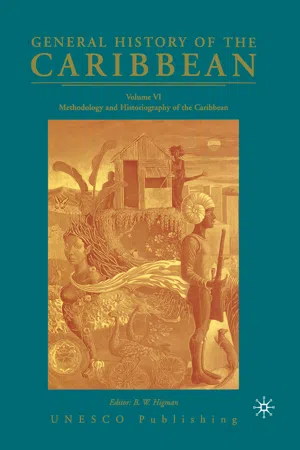 eBook - PDF
General History of the Caribbean UNESCO Volume 6
Methodology and Historiography of the Caribbean
- NA NA(Author)
- 2019(Publication Date)
- Palgrave Macmillan(Publisher)
As witnesses to this occupation, they felt they had to explain, however reluctantly, what had gone wrong. For this, they turned to nineteenth-century post-independence history and most especially to the elites' failed attempts to establish a working democracy. Neither the attention shown the nineteenth century at large nor the emphasis on its many aborted and trivial 'revolutions' was new. Earlier histor- ians had pondered on political upheavals, notably the 'revolution' of 1843. In 1843 a number of young and idealist members of the elites, mostly but not exclusively mulatres, had successfully challenged the despotic republic of Jean-Pierre Boyer, only to establish an equally despicable dictatorship that 463 General History of the Caribbean lasted merely a year. This mockery of a revolution set up the pattern for both the establishment and removal of Haiti's autocratic regimes. Even before 1915 it had been hard to reconcile such events and the glory of the 'real' Revolution. 32 The difference for the members of the Societe and their contemporaries was the widespread feeling that the verdict of a societal failure, a debatable diagnostic in the nineteenth-century, could not be questioned any more after 1915. In that context, post-independence history acquired new meaning, its analysis new relevance. Here again Sannon was a clear leader in establishing both the context and the purpose of historiography. His Essai historique sur la revolution haf- tienne de 1843 (Historical essay on the Haitian revolution of 1843) (905) is a work of historical sociology that draws on newspapers and other publica- tions of the time to explain the dismal failure of the most spontaneous effort to establish parliamentary democracy in Haiti. Sannon blames this failure on what some theorists would call today 'the political culture' of the Haitian elites. eBook - PDF
Empires of the Imagination
Transatlantic Histories of the Louisiana Purchase
- Peter J. Kastor, François Weil, Peter J. Kastor, François Weil(Authors)
- 2009(Publication Date)
- University of Virginia Press(Publisher)
By refusing Bonaparte’s plan to reenslave them, the people who made up this movement — most of them former slaves — “drastically limited Napoleon’s capacity to fulfill his western design and to project power in the Americas.” They therefore rendered French designs on Louisiana irrelevant and paved the way for its cession to the United States.2 94 laur ent dubois The connection between the Louisiana Purchase and the Haitian Rev-olution is rich with irony: it was the courage of men and women fighting to preserve their liberty, and the leadership of the one-time slave Jean-Jacques Dessalines, that made possible one of Thomas Jefferson’s signal political achievements, one of whose major results was the expansion of slavery in the United States. But remembering the centrality of Haiti in the transfer of Louisiana also calls for us to think differently about the broader place and significance of this event: as Richard White notes in his essay in this volume, what is often remembered as a remarkably “peaceful” transfer of land was in fact predicated on events of enormous violence that took place in the Caribbean. The war for liberty and independence that created Haiti was an extremely brutal one in which upward of fifty thou-sand French troops, and probably twice as many men and women from Saint-Domingue, lost their lives. The victory in Haiti was the result of the commitment and sacrifice of its revolutionaries. But the French defeat on the battlefield was the result of another kind of defeat that preceded it, which I explore in detail in this essay: the inability of Bonaparte’s government to accept the reconfigura-tion of empire being offered up to them by the Caribbean of the late 1790s. What ultimately doomed Bonaparte’s plans for the region was a fatal com-bination of ambition and blindness.
Index pages curate the most relevant extracts from our library of academic textbooks. They’ve been created using an in-house natural language model (NLM), each adding context and meaning to key research topics.

