Geography

Hydropower in Nepal
Hydropower in Nepal refers to the use of water resources to generate electricity. Nepal has abundant water resources due to its mountainous terrain and rivers, making hydropower a significant source of energy in the country. The development of hydropower has the potential to improve access to electricity and contribute to economic growth in Nepal.
Written by Perlego with AI-assistance
Related key terms
1 of 5

11 Key excerpts on "Hydropower in Nepal"
 eBook - PDF
- Basel I. Ismail(Author)
- 2017(Publication Date)
- IntechOpen(Publisher)
In this context, Asia has estimated the largest remaining unutilized potential of hydropower at 7195 TWh/year, making it the likely leading market for future development [69] and support to reduce global GHG emission in the near future. The hydropower potential in Nepal depends on the 6000 or more rivers flowing from moun-tains to hills and plains, although Nepal is divided into five geographic regions namely Terai plain, Siwalik Hills, Middle Mountains, High Mountains, and the High Himalayas. The world’s water coverage of 97% seawater and 3% fresh water, Nepal constitutes nearly 5000 lakes; 1380 reservoirs; and 5183 village ponds including 3808 glaciers with a total area of 4212 km 2 , and 1466 glacial lakes with an area of 64.75 km 2 . Among these glacial lakes, 20 lakes were identified as a potential risk of glacial lake outburst floods [70]. Despite the natural beauty of Nepal with its unique topography, ecological regions, geography, and enormous source of water potential, Nepal is the poorest countries in the world wherever electricity infrastructure is heavily reliant for hydroelectricity power generation. Despite the high potential of hydropower potential, Nepal’s low economy and slow GDP growth rate in combination with environmental and socioeconomic constraints, effective implementation of existing policy and political stability may support to reach the sustainable development goals of the county. Nepal however ratified the UNFCCC, the Convention to Combat Desertification (UNCCD), and the Convention on Biodiversity (UNCBD), the most critical impacts of climate change consisting water resources and hydropower generation, stemming from glacier retreat, expansion of glacial lakes, and changes in seasonality and intensity of precipitation through the grid and off grid system. The projected climate change scenarios for Nepal average mean temperature will increase by 1.2 and 3°C as projected by 2050 and 2100.
- Monika Mandal(Author)
- 2016(Publication Date)
- KW Publishers(Publisher)
Both Nepal and India have several reasons to cooperate with each other on hydropower. On the part of Nepal, the perennial nature of its rivers and the steep gradient of its topography provide the ideal conditions for the development of some of the world’s largest hydroelectric projects in that country. But as stated at the outset, though Nepal has rich hydrological reserves of 43,000 MW of hydropower, it has been able to develop only 650 MW of hydropower. More than 98% of the feasible generation has thus not been realised yet. Besides, the multipurpose, secondary and tertiary benefits have not been realized from the development of its rivers. Nepal’s electricity generation is dominated by hydropower, though in the entire scenario of the energy use of the country, electricity is a tiny fraction; only 1% of the energy need is fulfilled by electricity. The bulk of the energy need is dominated by fuel wood (68%), agricultural waste (15%), animal dung (8%) and imported fossil fuel (8%). In addition, only about 40% of Nepal’s population has access to electricity.In view of this dismal utilisation of its vast hydropower potentials, it is important for Nepal to increase its energy dependency on electricity with hydropower development. This will help to reduce deforestation, the import of fossil fuel and Green-House-Gas (GHG) emissions. Besides, it will also help Nepal to achieve the millennium development goals while conserving the environment, increasing literacy and improving the health of children and women with a better source of energy. Nepal’s overall development thus depends on the optimum utilisation of its water resources.India, on the other hands, ranks sixth in the world in total energy consumption and needs to accelerate the energy production to meet its demands of development. This entails a comprehensive and balanced growth of the energy sub-sectors such as coal, hydropower, oil and gas, renewable and nuclear, etc. Although India is rich in coal and abundantly endowed with renewable energy in the form of solar, wind, hydroelectricity and bio-energy, its hydrocarbon reserve is really small (0.4 per cent of the world’s reserves). India is a net importer of energy with more than 25 per cent of the primary energy needs being met through imports. The country also imports near about 70% of the oil it consumes. India’s developmental aspiration of 9% per annum coupled with a rapidly changing lifestyle is likely to increase the energy demand exponentially. eBook - ePub
Water Issues in Himalayan South Asia
Internal Challenges, Disputes and Transboundary Tensions
- Amit Ranjan(Author)
- 2019(Publication Date)
- Palgrave Macmillan(Publisher)
© The Author(s) 2020Begin AbstractA. Ranjan (ed.)Water Issues in Himalayan South Asia https://doi.org/10.1007/978-981-32-9614-5_6Multi-stakeholder Hydropower Disputes and Its Resolutions in Nepal
End AbstractSanju Koirala1,Prakash Bhattarai1andSarita Barma1(1) Center for Social Change, Kathmandu, NepalSanju Koirala (Corresponding author)Prakash BhattaraiSarita BarmaIntroduction
Nepal is rich in water resources and has a huge hydropower potential. Nepal has more than 6000 rivers and rivulets with a total length of about 45,000 kilometres and has 2.27% of world’s water resources.1 , 2 The perennial type of river run-off flowing through the steep gradient in many parts of the country makes ideal conditions for the generation of hydropower . Nepal has the theoretical potential to generate 83,000 MW of hydropower, of which 43,000 MW is estimated to be economically feasible for production.3 While hydropower is the dominant source of electricity production, it only accounts for about 2% of the total energy usage in Nepal.4 The dominant form of energy used in Nepal is still biomass with 88% of population consuming it. By the end of 2016, Nepal was only producing 802.4 MW of hydropower .5 The latest data on the population with access to electricity is not available however, until 2010 only 40% of the Nepali population had access to electricity.6 For a long period of time even those who had access to electricity services suffered from 14 to 18 hours of power cut in a day during dry season. Nepal has been ranked as 137 out of 147 countries in terms of quality of electricity supply.7In order to solve the problem of severe power shortage, the Government of Nepal (GoN), particularly after 2006’s political changes,8 has given a high priority to the development of hydropower projects. For this, the government has also encouraged private sector and international investors to invest in hydropower production in Nepal. The present government led by Nepal Communist Party has set a target to produce 10,000 MW of electricity in the next 10 years i.e. until 2028 for domestic consumption and foreign export. To meet this target, the government so far has given license to 172 companies to construct hydropower plants. Likewise, 36 hydropower projects have completed the feasibility study mandated by the government and applied for the license to construct projects.9 Although the government has announced its ambitious plan for large-scale hydropower production, it is equally challenging to materialize not only because of technical reasons, but also due to political factors, divergent interests, and different perceptions among stakeholders regarding the construction of hydropower projects.10 As a result, they attempt to influence the implementation process which many times foster hostile situations between the stakeholders and creates unfavourable environment for the successful implementation of the project. In some cases, such projects are trapped in a long gestation period and in some the construction works are delayed for months or years.11 In this regard, it is pivotal to understand the factors behind arising disputes among different hydropower
- Emily T. Yeh(Author)
- 2018(Publication Date)
- Routledge(Publisher)
Despite decades of interventions by a pageant of different actors and institutions, hydropower development in Nepal has been frustrated by an array of geographic, bureaucratic, and geopolitical obstacles (Dixit and Gyawali 2010; Gyawali 2003). Today, as Kathmandu reels under up to sixteen hours of blackouts during the dry winter months, both the material shortage of electricity supply and fears of an escalating energy crisis endow hydro-imaginaries with a moral and social authority to bring about an improved future for Nepal (Lord 2014). In this context, and after decades of undelivered development promises in the wake of the failed Arun-3 Hydropower Project, one frustrated local man from the Arun Valley spoke for thousands of his compatriots, suggesting that “some foreign country should get Nepal and develop it” (Rest 2012, 113).Within the vacuum of local governance that persists across Nepal, hydropower companies are commonly perceived and engaged as development actors, filling voids left open by the Government of Nepal. Vectors of a “spatializing state” (Ferguson and Gupta 2002), these entities not only influence local authorities but have also become key providers of numerous social and structural services. In Rasuwa and other northern districts, the hydropower complex has proved more durable than local officialdom and more effective in “bringing bikas,” providing the roads, jobs, health posts, educational improvements, and other services that the government has failed to deliver (Lord 2016). This allows citizens of Nepal, historically marginalized and on the social and geographical margins of the state, to directly engage with the “gift of development” in ways that pragmatically include and exclude the Nepalese state as an intermediary. As a result of local citizens’ “shares” in hydropower revenues and across a range of multi-scalar projects, experiences with capital, mobility, and other new capacities continue to add velocity to the processes through which hydropower creates new and active kinds of development subjects in Nepal. Articulations of bikas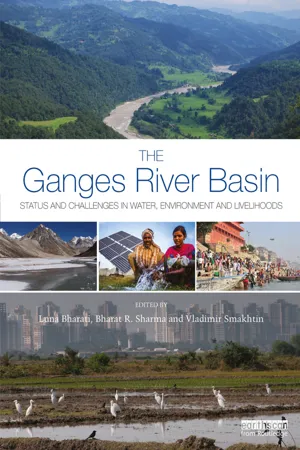 eBook - ePub
The Ganges River Basin
Status and Challenges in Water, Environment and Livelihoods
- Luna Bharati, Bharat R. Sharma, Vladimir Smakhtin, Luna Bharati, Bharat R. Sharma, Vladimir Smakhtin(Authors)
- 2016(Publication Date)
- Routledge(Publisher)
The April 2015 earthquake (7.8 magnitude) caused loss of over 8,600 lives and the destruction of 800,000 houses in Nepal besides serious damage to hydropower plants both in operation and under construction. This earthquake is an eye-opener for hydropower development in Nepal’s seismically active zones. According to the Ministry of Energy’s Post Disaster Needs Assessment Report, while 115 MW of various operating hydropower plants have been ‘severely damaged’, 60 MW have been ‘partially damaged’. The total cost of physical damage from the earthquake to the energy sector has been assessed at around US$180 million. About 1,000 MW of projects under construction have been partially damaged, thus pushing back their commissioning dates.Despite a century-old hydropower history, despite a huge hydropower potential and despite a huge market across the border, Nepal has not been able to develop its hydropower potential. As hydropower development is capital-intensive, with a long gestation period, Nepal’s hydropower can move ahead only when its hydra-headed politics stabilizes and comes to a minimum national consensus on the way forward. For this, institutions like the National Water Resources Development Council, now in a coma, must play the role of catalyst, whether hydropower is for domestic or transboundary uses.India
Hydropower in the context of basin development
Hydropower in the Indian part of the Ganga Basin sits at the crossroads between developmental aspirations, environmental conservation and sharing of the river across political borders. Development of hydropower is, therefore, determined by a complex set of factors. The basin, traversing through mountainous ranges, fertile plains and ecologically rich delta regions, is densely populated with inadequate levels of socio-economic development and huge energy deficits. It has therefore been the focus for technological interventions to build irrigation capacity and generate electricity. Central to this is the requirement to meet the basic needs of the population in terms of energy access, food security, access to drinking water and the aspiration towards double digit economic growth. eBook - ePub
Ethnographies of Power
A Political Anthropology of Energy
- Tristan Loloum, Simone Abram, Nathalie Ortar, Tristan Loloum, Simone Abram, Nathalie Ortar(Authors)
- 2021(Publication Date)
- Berghahn Books(Publisher)
Nepal is a small nation often referred to as ‘a yam between two boulders’ or ‘a mouse between two elephants’, which shares its rivers with China and India. The government is particularly keen to lay claim to water resources flowing within its borders and to export electricity to markets in nearby India and Bangladesh. To make this dream a reality, Nepali citizens are being called on to invest in hydropower development, which is presented as a national initiative towards energy security, socioeconomic development, and geopolitical self-determination. As the government, the hydropower sector, development agencies, foreign diplomats and the media reiterate the value of Nepal’s hydropower resources, Nepal’s water volumes are popularly imagined as an untapped reservoir for future wealth.In recent years, scholars have shown a growing interest in moving beyond two-dimensional representations of sovereignty and to define territorial ambitions in terms of volumes. As Elden (2017) recently stated: ‘Often focused on state borders, territory more properly extends through the fabric of the state and can only be grasped as volume.’ Critical studies of ‘waterscapes’ have long argued that territorial contestations over volumes are particularly pertinent in the context of water, and analysed the shifting relations between water, technology and the nation-state (Baviskar 2007; Menga and Swyngedouw 2018). For South Asia, colleagues have discussed nationalist framing of water management (Gyawali 2003; Klingensmith 2007; Rademacher 2011) and highlighted the reasons why water is a particularly challenging volume to control (Anand 2017; Björkman 2015; D’Souza 2006). Most recently, scholars have turned their attention to contestations over ‘volumetric sovereignty’, which can generate new forms of turbulence as different flows interact (Lord 2019; Billé 2019, 2020). Nationalist ambitions and volumetric uncertainty are both particularly intense in Nepal, given the relative economic scale of Nepal’s hydropower resources and the intense uncertainty of Himalayan hydrology. eBook - PDF
- Slariya, Mohinder Kumar(Authors)
- 2021(Publication Date)
- Biotech(Publisher)
Chapter 20 Generation of Hydro-electricity: A Case Study of Himachal Pradesh Sujit Surroch and Anita Surroch Mankind has identified couples of renewable and non- renewable sources of energy. Hydro (water) is one of the main and globally harnessed renewable sources. It is a flexible source of electricity since plants can be ramped up and down very quickly to adapt to changing energy demands. However, damming interrupts the flow of rivers and can harm local ecosystems, and building large dams and reservoirs often involves displacing people and wildlife and requires significant amounts of carbon-intensive cement. Once a hydro-electric complex is constructed, the project produces no direct waste, and has a considerably lower output level of the gas carbon dioxide, fossil fuel and generated through the use of the gravitational force of falling or flowing water is known as hydro-electricity. Hydro-electricity: A Global Phenomenon Hydro-electricity is the most widely used form of renewable energy, accounting for 16 percent of global electricity consumption, and 3,427 terawatt-hours of electricity production as in 2010. It is produced in 150 countries, with the Asia-Pacific region generating 32 percent of global hydropower. China is the largest hydro-electricity producer, with 721 terawatt-hours of production in 2010, representing around 17 percent of domestic electricity use. Each of three Gorges Dam in China, Itaipu Dam in Brazil, and Guri Dam in Venezuela generate more than 10 GWs hydro-electricity. The cost of hydro-electricity is relatively low, making it a competitive source of renewable electricity. India has a potential of 150,000 This ebook is exclusively for this university only. Cannot be resold/distributed. MW of which less than one fifth is being tapped. Process of Generating Hydro-electricity Most hydro-electric power comes from the potential energy of dammed water driving a water turbine and generator. eBook - ePub
Renewable Energy and Sustainability
Prospects in the Developing Economies
- Imran Khan(Author)
- 2022(Publication Date)
- Elsevier(Publisher)
Chapter 5Hydropower––Basics and its role in achieving energy sustainability for the developing economies
Arun Kumar Department of Hydro and Renewable Energy, Indian Institute of Technology Roorkee, Uttarakhand, India5.1 Introduction
Hydropower is the energy generated from water flowing from higher to lower levels. Hydropower technology has the best conversion efficiencies (about 90% efficiency) and the highest energy payback ratio of all known energy sources. Though a relatively high initial investment is required for hydropower projects, such projects have a long life with quite low operation and maintenance costs.Hydropower plants are not water consumptive for running the turbine. The water, after generating power, is available for various other uses. Hydropower serves both large and small, centralized, or isolated electric grids. It supports both solar and wind energy by providing the backup that variable technologies need. In addition, it provides grid flexibility services, such as frequency response, black start capability, and spinning reserves. Many hydropower projects (HPP) are multipurpose providing energy and water supply services such as irrigation, drinking water supply, drought and flood management, navigation, and recreation along with socio-economic benefits. For constructing a hydropower project, in addition to the environmental, social, physical, and economic considerations, legal considerations are equally important as in most of the countries the necessary permissions are required from the respective government (Kumar et al., 2011 ).Hydropower is one of the cleanest sources of electricity, emitting lesser greenhouse gases than other kinds of energy sources. Globally, hydropower is the largest source of renewable electricity (15.9%) out of a total of 27.3%, generating more electricity than all other renewables combined (11.4%). However, in the era of the energy transition with the aim of limiting the global temperature rise to no more than 2°C, the development of sustainable hydropower construction is needed to increase significantly. The International Energy Agency's (IEA) flagship Net Zero by 2050 report (IEA, 2021 eBook - ePub
International Watercourses Law for the 21st Century
The Case of the River Ganges Basin
- Surya P.Subedi(Author)
- 2016(Publication Date)
- Routledge(Publisher)
There are 33 rivers, whose drainage area exceeds 1,000km 2. The total average annual runoff into Nepal’s rivers is estimated to be 200,000 million m 3 originating from areas within the country; the catchments area from Nepal alone make up about 45 per cent of the long-term average annual flow of the Ganges basin and contributes over 70 per cent of the Ganges flow during the driest months. 1 Numerous studies suggest that Nepal theoretically has 83,000MW of hydropower potential, more than the combined total produced by the United States, Canada and Mexico, of which about 43,000MW is presently considered economically viable to harness. 2 Despite the abundance of water resources, only about one third of the population has got access to safe water, and only 42 per cent of the net calculated land has been irrigated so far. 3 11.3 Potential for Nepalese Watercourses Nepal is endowed with immense water resources potential, which, if utilised properly would be a boon both for itself and for countries further downstream. The benefits could be applied to several spheres, including hydropower, irrigation, and particularly navigation, which is crucial for the landlocked countries of Nepal and Bhutan and the north-eastern Indian states which could access the sea via Bangladesh. Moreover, benefits from flood control, and industrial, recreational and other areas are possible. 4 Due to the nature of these rivers and the geography of the area, the optimum site for a barrage might be in one state (e.g. Nepal), but the benefits could be accrued in other states, (e.g eBook - PDF
Hydropower
Practice and Application
- Hossein Samadi-Boroujeni(Author)
- 2012(Publication Date)
- IntechOpen(Publisher)
This key region for hydropower development features, despite its present political splitting into different states, geographically a similar natural as well as cultural characteristic. It can even be regarded as one cultural landscape. Following is given a short introduction of that region. 3.1.1 Environmental diversity The Tibetan Plateau in general and its south-eastern extension (incl. its adjacent mountain ranges) in particular play as part of the ‘Asian water tower’ a crucial role. Some of the world’s largest rivers with their tributaries flow through the region (e.g. Yarlung Tsangpo/Brahmaputra; Jinsha/Yangtze; Lancang/Mekong; Nu/Salween, and Irrawaddy). In that region the rivers change their topography (hydraulic gradient) from plateau via a long transition area with often deep gorge topography or rain-drenched Himalayan slopes to that of lowland topography and landlocked alluvial plains. Combined with its wide range of climatic setting is the region one of the global core areas for hydropower development, both that of larger scale as well as of smaller scale. The area is a product of the collision and subduction of the Indian subcontinent with Eurasia, resulting in an impressive geodiversity but also in a fragile geological base and active seismic-tectonic instability. This unique physiogeographic setting includes with the Damming China’s and India’s Periphery: An Overview over the Region’s Rapid Hydropower Development 305 Eastern Himalaya and the Hengduan Mountains some of the highest mountain ranges in the world. But it includes also diverse Karst landscapes and huge plateaus and basins. The territory’s geodiversity, combined with a climatic setting that ranges from tropical to temperate, has led to a unique diversity of ecosystems: from tropical rainforests in the south to shrub and grasslands in the mountainous north. This small region is part of three of the world’s major biodiversity ‘hotspots’ and several important ecoregions (WWF 2001). eBook - PDF
Climate, Energy and Water
Managing Trade-offs, Seizing Opportunities
- Jamie Pittock, Karen Hussey, Stephen Dovers(Authors)
- 2015(Publication Date)
- Cambridge University Press(Publisher)
Hydropower and its role in global energy Hydropower is power extracted from falling or moving water. In this chapter, we use hydropower synonymously with hydroelectric power, which is electricity generated by the gravitational force of water moving through turbines. The most common forms of hydro- power require constructing a dam across a river. The dam maintains water at a certain elevation (the head), from which water is directed through pipes or channels to turbines that generate electricity. A dam allows water to be stored over time periods ranging from hours to years, reducing the variability of flows that otherwise can vary dramatically within a year, such as between a wet season and a dry season, and allowing a more consistent flow of water through the turbines (Figure 6.1). Large reservoirs are capable of storing water across years and can thus reduce variability between wet years and dry years. Storage reservoirs give hydropower managers the ability to release water into the turbines when energy is most needed or valuable, such as summer when the demand for energy is greater. Within a day, hydropower managers can release water into turbines to respond to rising demand, a mode of operation known as ‘load following’ or ‘peaking’ (Kumar 2011). Hydropower dams can generally be classified into either ‘storage’ dams – those that impound water for use during other times of the year – and ‘run-of-river’ dams, in which 80 Hydropower within the climate, energy and water nexus reservoir storage is held constant and outflow equals inflow (Kumar 2011). Run-of-river dams are generally considered to have a lower impact on rivers systems because they don’t alter the overall flow pattern, but the actual operation associated with the term ‘run-of- river’ can differ by region, resulting in very different impacts. In some regions, run-of-river balances instantaneous outflow and inflows from dams.
Index pages curate the most relevant extracts from our library of academic textbooks. They’ve been created using an in-house natural language model (NLM), each adding context and meaning to key research topics.

