Geography

Market Gardening
Market gardening refers to the small-scale production of fruits, vegetables, and flowers for sale in local markets. It typically involves intensive cultivation on relatively small plots of land, often using sustainable and organic farming practices. Market gardening plays a significant role in providing fresh, locally grown produce to communities and supporting the local economy.
Written by Perlego with AI-assistance
Related key terms
1 of 5

4 Key excerpts on "Market Gardening"
 eBook - PDF
- Tina Marie Waliczek, Jayne M. Zajicek(Authors)
- 2016(Publication Date)
- CRC Press(Publisher)
This is compared to over 60% of the general prison population in California (O’Connor 2014). C OMMUNITY G ARDENS Simply put, a community garden is a plot of land set aside for growing vegetables that is managed by the gardeners themselves. They come in many shapes and sizes, are located in rural, suburban, or inner city settings, and may serve many different functions including sustenance gardens, food pantries, job training, therapeutic gar-dens, school gardens, or market gardens (McKelvey 2009) (Figure 9.3). The community garden or allotment as it is known in the United Kingdom, had its origins in the United Kingdom but was quickly established in the U.S. urban environment as early as 1893. Community gardens have flourished at times of hard-ship in the United States, including the Great Depression, WWI and WWII, and in the 1970s as one solution toward addressing blighted urban areas (McKelvey 2009). Recent interest in local food has created a renewed interest in community gardens. The American Community Garden Association estimates there are 18,000 commu-nity gardens in the United States and Canada as of 2015 (American Community Garden Association 2015). F ORAGERS Forager is a new term meant to encompass the role of connecting local producers with local businesses. Whole Foods Market employs regional foragers to find unique, local, high-quality food products, as do some high-end restaurants. Other foragers are FIGURE 9.3 Festival beach community garden, Austin, Texas. (Photo by James Buratti.) 282 Urban Horticulture freelancers, working for a number of small, local restaurants, and grocers. The for-ager helps ease the burden of working with a number of small producers that can take more time than simply buying from a regional wholesaler or distributor. Producers also save time selling to one forager instead of a number of individual establishments. U RBAN F ARMING Urban farms can be found in many urban areas throughout the United States.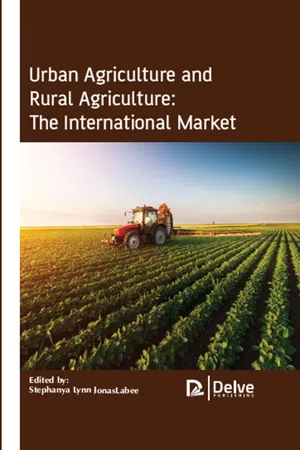 eBook - PDF
Urban Agriculture and Rural Agriculture
The International Market
- Stephanya Lynn JonasLabee(Author)
- 2019(Publication Date)
- Delve Publishing(Publisher)
1.2.4. Prevailing Economic Activities In the system of urban agriculture, there are many agricultural production activities as well as marketing processes, processing methods; various kinds of services delivery and inputs like compost. Service delivery methods include like veterinary services, specialized small companies related to agricultural sector or NGOs. Two facts enable better production and marketing in urban agriculture as compared to rural agriculture, and they are fast resources flow and the greater geographical proximity. 1.2.5. Market Orientation Market orientation is the nature of the product in which the product is to be sold. It also implies the final destination of the product. What happens in most of the developing countries is that the urban agriculture meets the required demand, and the surplus is then traded. However, one must not underestimate the value of the urban agriculture’s market in terms of its economic value and its volume. The type of market places where products of urban agriculture are sold as follows: • Local shops; • Farmer markets; • Selling by cart; • Intermediaries; • Supermarkets. Introduction to Urban Agriculture 11 In the Urban markets, usually the fresh products are sold, but some are also processed for future use. The products are also processed and packaged for selling to the markets mentioned above. 1.2.6. Technology of Production and the Scale of Production In the cities, agriculture is practiced at varied scales. Here is the list of levels at which urban agriculture is done in cities: • Single or individual farm. • Family farm. • Commercial agricultural companies. • Small farms. • Medium sized farms. • Large scale agricultural companies. Although, urban agriculture is widely prevalent in the cities in the developing countries, the level of technology deployed for agricultural purposes is very low although the cities in these nations try to use technologically advanced methods in everything (Figure 1.9). eBook - PDF
- Patrícia Alexandra Batista Branco(Author)
- 2019(Publication Date)
- Delve Publishing(Publisher)
Due to various constraints, such as population pressure on land and the continuous need to produce cash-crops, it has been realized that hectarage expansion as a strategy for increased food crop output is only a short-term solution to food shortages in most countries. Increased food crop output, in the long run, will be realized only through higher yields within the small-farm sector. Given suitable arable land, the latter requires an increased acceptance of recommended agricultural innovations. The adoption rate of recommended innovations by smallholder farmers has so far been rather minimal contributing to the low yields obtained. In cases where hybrid seed has been planted, yields do not compare favorably with those recorded in experimental stations from identical seeds due to inferior husbandry methods (Dorosh & Rashid, 2013). Most of the geographical research has invariably been centered on the diffusion of particular innovations on a temporal and spatial context. Particular emphasis should be given to: • Environmental attributes • Farmer characteristics • Socioeconomic variables determining one’s accessibility to agricultural information and services Food crop harvested by smallholder farmers can be either consumed on the farm or offered for sale. In the latter case, one or both the formal and informal marketing systems can be utilized. Food Production and Agriculture 5 1.4 THE ROLE OF COMMUNITY GARDENING IN FOOD PRODUCTION A report from the National Gardening Association shows that food gardening, especially in the United States, is increasing. Moreover, millions of households are growing their own vegetables and fruits. More Americans are starting to understand the benefits of growing their own produce whether in their own home gardens or in the community gardens. While everyone recognizes the importance of growing their own produce, the greatest challenge becomes the issue of not having a space to grow, most especially to the urban dwellers. eBook - PDF
Chinese Market Gardening in Australia and New Zealand
Gardens of Prosperity
- Joanna Boileau(Author)
- 2017(Publication Date)
- Palgrave Macmillan(Publisher)
There were a number of reasons for their predominance in Market Gardening. Chinese gardeners followed general population movements and markets, and were adept at identifying niche markets, particularly in the growing cities. Europeans recognised the horticultural skills of Chinese immigrants, which were valued in the Australian and New Zealand economies. In addition, Market Gardening was regarded as a labour-intensive, low-status occupation which most Europeans were not keen to enter, reducing direct competition between Europeans and Chinese in the industry. The evidence presented in these chapters also counters the stereotype of Chinese immigrants as sojourners. If market gardeners were to conduct a successful commercial enterprise they needed to make a longer-term CONCLUSION 151 commitment to living in their adopted country and establish links to the land. Market Gardening was therefore a crucial economic foundation for the transition of Chinese immigrants from sojourners to settlers. Australia and New Zealand were leading the world in per capita incomes for most of the period from 1860 to 1914. The rapid urbanisation of the populations of Australia and New Zealand and the high standards of living they enjoyed underpinned the growth of Market Gardening. Developments in technology, transport, communications and industry, which flowed from population growth and urban expansion, also supported the growth of Market Gardening. The complementary industries associated with early Market Gardening included tanneries, boiling down works, pig- geries and dairies. These factors are explored in the following chapter. NOTES 1. New South Wales Legislative Assembly, Royal Commission of Inquiry as to Food Supplies and Prices 1913, Sectional Report on the Supply of Fruit and Vegetables, Sydney, 1914, Sydney, 1914, p. 1. 2. Weston Bate, A History of Brighton, Melbourne, 1983, p. 166; and Randwick Municipal Council, Randwick: A Social History, Sydney, 1985, p.
Index pages curate the most relevant extracts from our library of academic textbooks. They’ve been created using an in-house natural language model (NLM), each adding context and meaning to key research topics.
