Geography

Olympic Park Case Study
The Olympic Park Case Study refers to the redevelopment of the Lower Lea Valley in London to create a sustainable and multi-functional space for the 2012 Olympic Games. It involved the transformation of a previously industrial area into a parkland with sports facilities, residential housing, and commercial spaces. The project aimed to regenerate the area, improve infrastructure, and leave a lasting legacy for the local community.
Written by Perlego with AI-assistance
Related key terms
1 of 5
5 Key excerpts on "Olympic Park Case Study"
 eBook - ePub
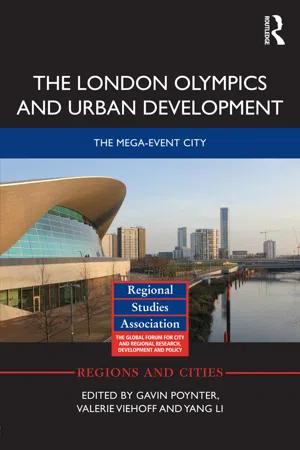
The London Olympics and Urban Development
The Mega-Event City
- Gavin Poynter, Valerie Viehoff, Yang Li, Gavin Poynter, Valerie Viehoff, Yang Li(Authors)
- 2015(Publication Date)
- Routledge(Publisher)
et al. , 2002; Essex and Chalkley, 2003; Kissoudi, 2008; Gold and Gold, 2011). Since these host cities are typically large in size and have sophisticated governance structures, their local planning institutions are accustomed to working through these kinds of development issues, albeit with outcomes expressed as a function of their particular political, economic and cultural contexts. Much of this literature has been developed in Australia and the UK during the run-up to Sydney 2000 and to London 2012. This work is generally imbued with a capacious definition of urban development impacts, and its contributions lie along the trajectories of urban theories as they intersect with economic, social and environmental concerns. Themes include the economic analyses and the impact on regional economic indicators, political analyses such as the formation and effectiveness of protest movements, sociological studies that investigate changes in the culture of sports and participation, and so forth. More planning-oriented research examines the relocation of existing populations or the use of eminent domain or other regulatory strategies to make land available for Games-related development. Importantly for this chapter, the extant literature is less concerned with expressly physical and spatial outcomes, often providing little analysis beyond description.This current thinking on urban development outcomes misses some important nuances that mark the increasing influence of Olympics Games – and other mega sports events – in host cities. A closer examination reveals that host city plans have evolved beyond their original function as a mechanism for delivering the broader benefits of the Games, to a more elevated and far-reaching role as a locus of urban aspirations. Several factors explain the heightened import of planning that takes its cues from the needs of the Olympics. On a practical level, prospective host cities must have a mega-event strategy in place to be able to respond to the increasing scale and complexity of planning for the Games, to the longer timeframe of the host city selection process and to the reality that multiple bid cycles may be necessary to win the designation, which in turn requires demonstrating experience with other mega-events. There is very little research that evaluates the role of mega-events in city planning processes.The IOC has also played an important role in strengthening its influence in the planning process in host cities. Its host city selection process requires applicant cities to lay out their plans for delivering a positive legacy after the Games. The origins in the IOC’s legacy policy lay primarily in serving its own interests while secondarily serving those of its host cities. The IOC is motivated to facilitate positive experiences for its host cities to ensure a strong pool of candidate cities, since competition among candidates increases the extent of its political and economic influence. The financial debacle that followed in the wake of ambitious building plans in Montreal 1976 had the effect of dampening demand for prospective hosts for years after. Thus, the legacy policy was targeted to both managing the urban aspirations of host cities, so as to reduce financial risk and to literally cement a positive impression of the Games among residents of the host city and the rest of the world. eBook - ePub
- Italo Pardo, Giuliana B. Prato, Italo Pardo, Giuliana B. Prato(Authors)
- 2017(Publication Date)
- Palgrave Macmillan(Publisher)
2012 ).The 2012 Olympic delivery followed an easy-to-understand narrative of reclamation. The head of the Olympic Park Legacy Company, Andrew Altman, argued that the East London’s pre-Olympic landscape was a ‘gash’ that required ‘Olympic healing’, which perhaps best exemplified the underlying logic of regene ra ti on (Armstrong et al. 2011 ). It was expected that the post-Games period would subject the less affluent and the minority multiethnic communities that bordered the space of the Olympic Park to increased regulation, surveillance, policing techniques and displacement in order to ensure that the area would become suitable for the habitation of n ew peopl e (Gibbons and Wolff 2012 ; Paton et al. 2014 ).It was difficult to argue against the fact that Newham required regeneration and greater safety for its people. Figures commonly quoted at the time showed that each year approximately 30% of the borough inhabitants would move internally or externally,4 which translated into a hugely ‘rootless’ population that saw the borough as a place of transit and transience, little more than a stop on a journey elsewhere. If, as some argue, place-related identities, relations and histories are formed and asserted through uniform it y (Korpela 1989 ; Gregory et al. 1994 ), the absence of such identity-affirming uniformity leads to the consideration that it would be pertinent to apply to N ewham Auge’s (1995 ) conceptualization of the ‘non-place’. Auge argued that if a ‘place’ can be defined as relational, historical and concerned with identity, then a space that cannot be defined as such must be a ‘non-place’ (1995 eBook - ePub
Hosting the Olympic Games
Uncertainty, Debates and Controversy
- Marie Delaplace, Pierre-Olaf Schut, Marie Delaplace, Pierre-Olaf Schut(Authors)
- 2019(Publication Date)
- Routledge(Publisher)
The following analysis of the bids, both successful and unsuccessful, will identify the effects of the campaigns and examine the outcome of the projects planned for the hosting of the Olympics. For this study, Paris is the selected example. Although the analysis of one city only will limit the scope of our conclusions, it does present interesting factors: Paris has presented three bids for the Games since the beginning of the 2000s. The outcome in 2008 was unfavourable; Beijing received without a doubt the majority of votes. While Paris had a very good chance of gaining the bid in 2012, the project presented by London obtained the majority of the IOC votes. The margin was very close and was visible in the conviction that Paris would succeed in this second campaign right up to the announcement of the results. At last, the bid for the 2024 Olympic and Paralympic Games was a complete success. Albeit a relative one due to the withdrawal of all the other candidates except for Los Angeles, also selected as part of a dual attribution.To support our demonstration, we will give a detailed account of the development plan described by each candidacy. The information is stored at the Olympic Studies Institute in Lausanne. Each proposal will be compared with the real changes in the Metropolis. An analysis of press coverage identifying the political commitments in support of or against the projects in particular will be a major factor in this study. Beyond words, we will also follow-up concrete achievements by including the analysis of aerial photography from the National Geographical Institute, which will reveal the progress of the actual groundwork.Our unique focus will concentrate on infrastructures. We shall analyse successively the provision of sports amenities and the Olympic village. These two approaches address different rationales in the development plan: the Olympic village creates accommodation while the specialized amenities remain dedicated to sport and especially high performance sport.The uncertain future of sports amenities
The Olympic project
Infrastructures really put sports amenities at the heart of an Olympic project. They are where sports events attracting media attention take place. The hosting of the Olympics is often synonymous with the creation of large-scale sports amenities, and stadiums are at the forefront. This was the case in 1936 to celebrate Olympism (Bolz, 2008), or in 1976 in Montreal at the expense of tax paying Quebecers (Roult & Lefebvre, 2010). This last example is a mark of failure to reuse the over-sized infrastructures of the Games and is not unique. Abandoned ‘white elephants’ (Alm, Solberg, Storm & Jakobsen, 2016) punctuate Olympic cities. If the memory of sport retains the achievements that took place there, people also remember the wastage of abandoned buildings.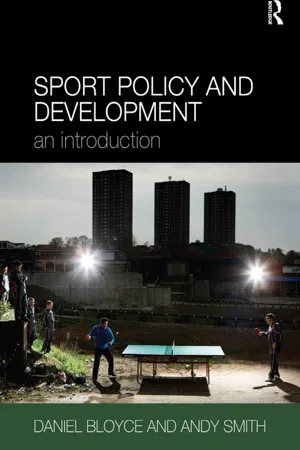 eBook - ePub
Sport Policy and Development
An Introduction
- Daniel Bloyce, Andy Smith(Authors)
- 2009(Publication Date)
- Routledge(Publisher)
This would, it was claimed, ‘enable residents of the Lower Lea Valley to have a stake in the economic growth of their region and begin to break the cycle of deprivation in the area’ (London 2012, 2004b: 25). It was claimed that local residents would gain not only from the creation of new jobs, but also from the new ‘sustainable’ sporting, housing and transport infrastructure that was being proposed. In this regard, it was claimed that the Olympic Park will create a high quality environment for the neighbouring mixed-use communities. It will enhance the amount and quality of greenspace, promote sustainable travel, conserve local biodiversity and wetlands, and improve air, soil and water quality. Its design will take account of the potential impacts of climate change and will set new standards for sustainable production, consumption and recycling of natural resources. (London 2012, 2004b: 23) A further alleged benefit thought to be an important legacy of the Olympics would be the promotion of greater social inclusion (Chapter 4). The Candidate File ambitiously set out to use the Olympic Park as ‘a hub for east London, bringing communities together and acting as a catalyst for profound social and economic change’ (London 2012, 2004b: 19). In this respect, it was proposed that the Olympic Park area ‘will become a model of social inclusion, opening up opportunities for education, cultural and skills development and jobs for people across the UK and London, but especially in the Lea Valley and surrounding areas’ (London 2012, 2004b: 19). In the process, it was proposed that since the new facilities would be available for use by the broader community, as well as elite athletes, ‘this will create a more inclusive, more active community, leading to a fitter society and reducing health inequalities’ (London 2012, 2004b: 19) eBook - ePub
- Catherine Palmer, Author(Authors)
- 2012(Publication Date)
- SAGE Publications Ltd(Publisher)
Building on some of the key policy developments identified in this timeline, some of the prospective issues for forthcoming mega-events are worth summarizing. Clearly, environmental concerns have shifted beyond simply ‘nature’, and the implications of urban development, the built environment, social dislocation and unregulated industry in BRIC and developing nations are part of the wider discourse of environmentalism within which the planning of mega-events is now situated. Moreover, there has been a move from an ‘adaptive’ mode of policy-making, in which Organizing Committees of Olympic Games (OCOGs) implemented a series of steps that they would take in order to ensure compliance with both IOC and stakeholder expectations during the staging of the Games (i.e. energy renewal, waste management and pollution reduction schemes), to an ‘incremental’ approach, in which OCOGs were more proactive, e.g. by proposing ‘Games-time’ adherence to environmental standards (i.e. Torino agreeing to build games structures in accordance with national laws and regulations that had been co-signed by the IOC) (Paquette, Stevens & Mallen, 2011: 361).One of the ‘legacy promises’ of the London 2012 Olympics was to ‘make the Olympic Park a blueprint for sustainable living’ (DCMS, 2007). It remains to be seen how realistic this promise was, yet the anticipatory redevelopment agenda that surrounds the Games brought together several key themes for mega-events and the environment.Many of the Games venues were built in the East End of London, on land that was earmarked for remediation and redevelopment. This forms the core of the 2012 regeneration strategy that linked economic growth with long-term sustainability, one of the key reforms of the Olympic Movement’s Agenda 21. The strategy was, in the words of Robert Harding, the Olympic Project Officer at the United Kingdom’s Environmental Agency, a regeneration for the whole area up to and beyond the Games:The London 2012 Games have been a catalyst for major investment in that part of east London and to regenerate the whole area up to and beyond the Games. ... The Olympic project has brought that land back into long-term use. Lots of money has been invested in the cleanup to enable the London 2012 Olympic Delivery Authority to create something to behold for the future. (Olympic.org
Index pages curate the most relevant extracts from our library of academic textbooks. They’ve been created using an in-house natural language model (NLM), each adding context and meaning to key research topics.

