Geography

Origins of Agriculture
The origins of agriculture refer to the transition from hunting and gathering to the cultivation of crops and domestication of animals. This pivotal shift occurred independently in various regions around the world, leading to the development of settled communities and the rise of complex societies. The adoption of agriculture had profound impacts on human societies, economies, and the environment.
Written by Perlego with AI-assistance
Related key terms
1 of 5

10 Key excerpts on "Origins of Agriculture"
 eBook - PDF
World Prehistory and Archaeology
Pathways Through Time
- Michael Chazan(Author)
- 2021(Publication Date)
- Routledge(Publisher)
Other regions where there was limited independent domestication of plants include eastern North America and New Guinea. Because agriculture developed independently in at least six regions, archaeologists can explore whether there were regularities in its unfolding. Archaeologists make a distinction between areas where agriculture devel-oped independently and areas into which agriculture spread.The spread of agri-culture is increasingly recognized as a process that is as complex and worthy of study as the original domestication of plants and animals.The origin of agricul-ture is a complex topic that involves both empirical and theoretical components. The essential theoretical issue that faces archaeologists is how to approach the Origins of Agriculture as a process. How and why did societies across the globe shift from a hunter-gatherer way of life to living in settled farming communities? One approach to this question has been to look for an external trigger that played a role in the shift to agriculture. An obvious candidate for such a trigger is climate change. Another factor that might have triggered the shift to agriculture Marshall Sahlins An anthropolo-gist who described hunter-gatherers as the “original affluent society.” PART III: PERSPECTIVES ON AGRICULTURE 188 is an increase in population. Research by Ester Boserup suggests that popu-lation growth might actually be an underlying cause, rather than an effect, of agriculture. Boserup’s (1965) studies suggest that subsistence systems—the ways people get their food—tend to be the result of population pressures. A major breakthrough in the study of agricultural origins has been the recognition that it is unlikely that searching for a single external trigger will produce a satisfying explanation. Following an approach based on systems the-ory, archaeologists have shifted to developing models of how the interaction between a number of factors might have led to the adoption of agriculture (Bender 1975). eBook - PDF
Human Geography
People, Place, and Culture
- Erin H. Fouberg, Alexander B. Nash, Alexander B. Murphy, Harm J. de Blij(Authors)
- 2015(Publication Date)
- Wiley(Publisher)
What is the contemporary global pattern of agriculture and agribusiness? 4. How has agriculture influenced settlement patterns and the cultural landscape? 9.1 What Is Agriculture, and Where Did It Begin? Where does our food come from? When we walk up and down the aisles in the grocery store, we see that some produce is grown in Canada, and some comes from faraway places. We hear about the “100 Mile Diet”—the challenge to eat only produce grown within 100 miles of where we live—while at the same time we can buy tender fruit from Chile or apples from New Zealand. Agriculture, then, can sometimes be very local and sometimes global in terms of both production and consumption. Bound up in these considerations is our spatial perspective—location, region, landscape, place, and movement—because where our food is grown, and how it moves from where it is produced to where it is consumed, are central to geographers’ questions about agriculture. Agriculture has long been a key topic of study for human geographers across Canada and around the world. It is one area of human activity that clearly illustrates the important but tenuous symbiotic relationship existing between humans and the natural environment. In fact, agriculture makes up one of the most significant human uses of land in the world, with pasture lands and croplands alone taking up more than one-third of the Earth’s land area at the turn of the 21st cen- tury. Also, more than two-thirds of global water consumption by humans is for agricultural purposes. Thus, geographical variations in the availability and quality of agricultural lands, along with the availability of water, are among the central matters of concern to agricultural geographers and other human geographers. Unfortunately, many of the agriculture-related issues ex- amined by geographers today are related to the negative envi- ronmental and social consequences of contemporary farming practices. eBook - PDF
- Hazem Shawky Fouda(Author)
- 2019(Publication Date)
- Delve Publishing(Publisher)
However, cultivation may comprise a wide range of practices. These practices will then tend to select for the morphological domestication in the seed crops. Agriculture can be defined in terms of: • Scale of cultivation • Its importance in the local landscapes • Its contribution in the human diet Introduction to Agriculture: A Global Perspective 5 In this way, agriculture is defined as the form of land use, which actually signifies a change or modification in the landscape, as farmers cultivate, grows, and focus more on the domestic plants as well as animals, on a regular basis. Agricultural practices develop fields for large-scale production of livestock and crops. Though, small-scale cultivation may comprise just a small number of plants, agriculture comprises the formation of extensive fields of propagated vegetation on a practical scale that it must be identifiable in the regional datasets of palaeovegetation, recoverable from palaesols and a conspicuous part of the indirect source of archaeological plant remains. According to the factors of specific cultural and geographical contexts, how a person distinguishes small-scale cultivation from agriculture differs. Systems of irrigation are an important and widespread method by which different landscapes of the agriculture have been formed. Water control can be concentrated on its drainage or removal, or by adding water to dry areas so as to allow effective cultivation process, in those regions where rainfall is not enough to improve the productivity. In case of riverine agriculture, similar to that correlated with the ancient Egypt and Mesopotamia, this took the form of basins and canals that eventually helped in the conservation of floodwater and distributed this water more widely. In some of the mountain environments, like, canal systems and the Andes generally closely linked to the cultivated terraces, were developed to carry steep slopes into the agricultural practices, also. eBook - PDF
Soils, Land and Food
Managing the Land during the Twenty-First Century
- Alan Wild(Author)
- 2003(Publication Date)
- Cambridge University Press(Publisher)
This chapter describes the development of agriculture, and partic-ularly of techniques of land management, up to the middle of the nine-teenth century. The empirical knowledge and skills of farmers, artisans and others provided the base from which later scientific applications could be developed. Much fuller information on the development of 24 3 Development of agriculture and systems of land management agriculture can be found in Slicher van Bath (1963), Grigg (1974, 1987), Redman (1978), Rindos (1984), Barker (1985), Simmons (1987) and Cowan and Watson (1992). 3.2 Origins of Agriculture Hunter-gatherers were often transhumant, moving to and from hunt-ing grounds according to the season and with a principal place with permanent water where the old and very young could be based and food could be stored. The foods they collected depended on the biome in which they lived. Lakes, rivers and the sea provided fish, shellfish and molluscs; the land provided animals and birds, seeds in savanna and desert regions, and fruits, tubers and roots from forests. Archaeological evidence is that hunting and gathering are as old as the human species itself, although the techniques became more ef-ficient with the development of tools. Only a few societies now depend wholly on these means of acquiring food; more usually they are sup-plements for people who rely primarily on agriculture. Comprehensive accounts of hunter-gatherer societies have been given by Lee and Daly (1999). Domestication of plants and animals Although the term ‘agriculture’ has been defined in different ways, probably the most useful definition is that of Harris (1996 and earlier papers): ‘a mode of deliberate biological production based largely or ex-clusively on the cultivation of domesticated plants and on the raising of domesticated animals’. eBook - PDF
- Steven Polgar(Author)
- 2011(Publication Date)
- De Gruyter Mouton(Publisher)
However, to account for all of these several origins by assuming that the concept of agriculture spread from one or a few hearths is not supportable in terms of known patterns of diffusion: the indigenous crops occur earlier than the imports Population Pressure and the Origins of Agriculture 83 in too many regions. Hence, we can assume that there were at least several independent discoveries of agriculture. Moreover, our knowledge of the ecology of hunter-gatherer groups suggests that the independent discovery of the concept of domestication by several of these groups is not only possible, it is highly probable, and I maintain that lack of insight into the process of domestication would rarely have offered an obstacle to the progress of any group. The techniques of agriculture are self-evident to any hunter-gatherer group. We know, for example, that even nonhuman primates regularly accumulate around their home-ranges gardens of their favorite produce grown from seeds or vegetative parts dropped in the course of eating or in feces (Jolly 1972: 59). We know that human hunter-gatherers also tend to collect gardens of their favorite foods near their houses quite independent of any attempts at domestica-tion (Schwanitz 1966: 12). And we know that these people often uninten-tionally propagate their food plants by accidentally re-sowing parts of their crops in the process of harvesting (Schwanitz 1966: 12). We know that pre-agricultural man created new open habitats for plants in the form of dumps, pathways, and recently burned areas (Anderson 1969: 144) and that many of man's cultivated plants originated as species which enjoyed these disturbed habitats (Anderson 1969: 144; Sauer 1952: 71). We know that most hunting and gathering groups have a very thorough knowledge of the characteristics and ecological needs of the species of their preferred food and that they even know how to assist them in their survival (Stewart 1956: 120).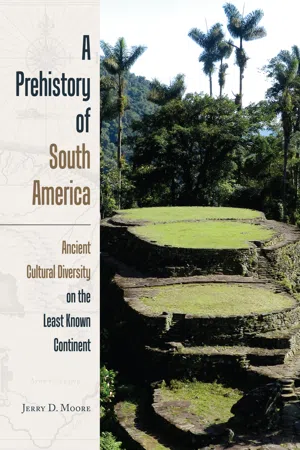 eBook - ePub
Prehistory of South America
Ancient Cultural Diversity on the Least Known Continent
- Jerry D. Moore(Author)
- 2014(Publication Date)
- University Press of Colorado(Publisher)
Douglas Price and Ofer Bar-Yosef recently wrote: “The simple fact is that we do not yet have a good grasp on the causes for the Origins of Agriculture. The how and the why of the Neolithic transition remain among the more intriguing questions in human prehistory. There is as yet no single accepted theory for the Origins of Agriculture—rather, there is a series of ideas and suggestions that do not quite resolve the question.” 51 Therefore, while we can assume that the practices of cultivation and, eventually, domestication were the result of human decisions and interactions, the specific pathways to agriculture may be as divergent as the different plants and animals that became the foundations of agriculture in ancient South America. Divergent Agrosystems The diverse sets of cultigens and domesticates were incorporated into an array of agrosystems tailored to fit the varied environments and social settings of prehispanic South America. 52 Many of these agrosystems are still used by modern traditional farmers, and this ethnographic knowledge illuminates archaeological studies of ancient agriculture. We understand that agricultural systems are not simple reflections of the natural environment but rather are active human creations. The cultural geographer William Denevan has noted: “There are no environmental limitations to the development of agriculture, only cultural limitations. ‘Agricultural potential’ is a cultural phenomenon; it is not something inherent in nature that can be measured, that exists independent of culture. Today, with available technology, agriculture can be carried out anywhere on earth eBook - PDF
Visualizing Human Geography
At Home in a Diverse World
- Alyson L. Greiner(Author)
- 2017(Publication Date)
- Wiley(Publisher)
Agriculture involves the ongoing process of domestication—selecting plants or animals for specific characteristics and influencing their reproduction. Domestica- tion not only makes plants and animals visibly or behaviorally dis- tinct from their wild ancestors, it also increases the interdepen- dence between people and the domesticate. Domestication re- flects human agency. Until very recently, agriculture employed the high- est percentage of people worldwide. Since the 1990s, the percentage of the world’s workforce employed in agri- culture has fallen from 45% to 31%. This decline in the share of agricultural employment is a testament to the ongoing urbanization of our world as well as the mecha- nization and industrialization of agriculture. Even so, employment in the agricultural sector differs vastly from one region and country to another. Although women have been involved in agriculture since it began, certain trends increasingly point to a new feminization of agri- culture (Figure 9.1). Origins of Agriculture Hunting and gathering is the oldest method of obtain- ing food, and historically all people obtained their food this way. Most hunters and gath- erers moved frequently in pursuit of game and seasonally available plants, although some groups that relied heavily on fishing might settle permanently in one location. Strictly speaking, however, hunters and gather- ers are not classified as agriculturalists because they use wild rather than domesticated plants and animals. A geography of employment in agriculture • Figure 9.1 Agricultural employment varies by region and gender. Finbarr O’Reilly/REUTERS agriculture Activi- ties centered on cul- tivating domesticated crops and livestock in order to procure food and fiber for human use or consumption. hunting and gathering Hunting wild animals, fishing, and gathering wild plants for food. eBook - PDF
- David L. Browman(Author)
- 2011(Publication Date)
- De Gruyter Mouton(Publisher)
There are a number of lines of evidence which refute this assumption and suggest in fact that the concept of agriculture was probably readily available to evolving human populations. First, it is becoming increasingly apparent that agriculture was in fact discovered independently a number of times. A recent review of agricultural origins by Harlan (1971) indicated that the origins of our major domesticates must be traced over an extremely broad area of the New and Old Worlds and that defined centers of domestication are recognizable only in certain cases. He pointed out in addition that there are a large number of genera of plants in which two or more species were domesticated at different times and in different places. The evidence of interregional contacts of great anti-quity is sufficient to suggest that many of these regions learned the idea from others. However, to account for all of these several origins by assuming that the concept of agriculture spread from one or a few hearths is not supportable in terms of known patterns of diffusion: the indigenous crops occur earlier than the imports in too many regions. Hence, we can assume that there were at least several independent discoveries of agriculture. Moreover, our knowledge of the ecology of hunter-gatherer groups suggests that the independent Population Pressure and the Origins of Agriculture 95 discovery of the concept of domestication by several of these groups is not only possible, it is high probable, and I maintain that lack of insight into the process of domestication would rarely have offered an obstacle to the progress of any group. The techniques of agriculture are self-evident to any hunter-gatherer group. We know, for example, that even non-human primates regularly accumulate around their home-ranges gardens of their favorite produce grown from seeds or vegetative parts dropped in the course of eating or in feces (Jolly 1972: 59). eBook - PDF
First Farmers
The Origins of Agricultural Societies
- Peter Bellwood(Author)
- 2022(Publication Date)
- Wiley-Blackwell(Publisher)
First Farmers: The Origins of Agricultural Societies, Second Edition. Peter Bellwood. © 2023 John Wiley & Sons Ltd. Published 2023 by John Wiley & Sons Ltd. Matters of Definition The main themes behind the writing of this book revolve around the genesis and large-scale dispersals of the agricultural systems, associated communities, and language families that can be detected in the world’s linguistic and archaeological databases. Such dispersals, it is held, would have occurred most readily and coherently if those communities involved in the process already depended on food production (including animal husbandry) for the greater part of their subsistence needs, and if they had the technology and skills to establish their food production systems in new environments, especially those already occupied by indigenous populations. Such is the rationale for the early farming dispersal hypothesis. The transition from foraging to food production was often long and complex, with intermediate stages that some populations entered sometimes rapidly, sometimes slowly, and sometimes not at all. To understand the significance of those intermediate stages we must first consider a few definitions. The term food production is used in this book to refer to human economies that rely primarily on deliberate propagation of domesticated plants and animals (on the concept of domestication, see Purugganan 2022). Terms such as agriculture, implying a focus upon plants, and pastoralism, implying a focus on animals, refer to variants within the overarching concept of food production. Arboriculture (tree crop production) and hor- ticulture (multicrop gardening) are further varieties of food production. The terms farmer and farming are less specific in meaning, although I use them from time to time in general discussion. eBook - PDF
- R. Knowles, J. Wareing(Authors)
- 2014(Publication Date)
- Made Simple(Publisher)
PART ONE: THE STUDY OF ECONOMIC AND SOCIAL GEOGRAPHY CHAPTER ONE MAN AND ENVIRONMENT Geography is currently going through an exciting period in its development as new problems are identified and new methods of analysis are formulated. It is not easy to say precisely what geography is about because geographers often hold different views of the subject, and these views change from time to time, but this is not surprising since geographers are interested in a very wide range of problems and rapid advances are being made in the subject, as they are in all branches of knowledge. Because geography involves such a wide range of knowledge, the subject has been divided into two major areas of study. The first of these is physical geography, which is concerned with the physical environment of landforms, weather and climate, soils, and plants and animals (see Physical Geography Made Simple). The second is human geography, which is concerned with man's activities over the surface of the earth. In many ways this is a false distinction since the activities of man take place within the physical environment, and the physical environment is considerably affected by these activities, but the divi-sion is a useful one and in this book the physical environment will only be considered in relation to man. Human geography can be studied in two principal ways. First, the earth's surface can be studied part by part. This is the approach of regional geography, which seeks to understand the unique character of an area as produced by the interaction of human activity and the physical environment. Secondly, human activity over the earth's surface can be studied part by part. This is the approach of systematic geography, which isolates particular elements such as agriculture, industry or transport, and seeks to understand their spatial patterns and the processes which have produced them.
Index pages curate the most relevant extracts from our library of academic textbooks. They’ve been created using an in-house natural language model (NLM), each adding context and meaning to key research topics.

