Geography

Types of Economies
Types of economies refer to the different ways in which societies organize and distribute resources. The main types include traditional, command, market, and mixed economies. Traditional economies rely on customs and traditions, while command economies are centrally planned. Market economies are driven by supply and demand, and mixed economies combine elements of both market and command systems.
Written by Perlego with AI-assistance
Related key terms
1 of 5

7 Key excerpts on "Types of Economies"
 eBook - ePub
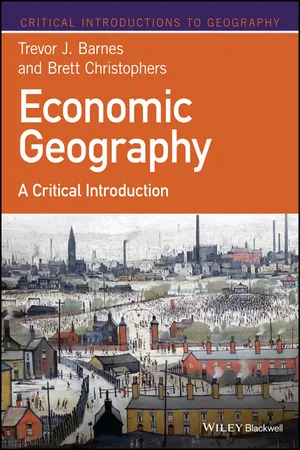
Economic Geography
A Critical Introduction
- Trevor J. Barnes, Brett Christophers, Trevor J. Barnes(Authors)
- 2017(Publication Date)
- Wiley-Blackwell(Publisher)
In “Geographical Economics,” models, and the quantitative relations they express, are deemed to explain. For other types of economic geography, quantitative findings generally can do no more than describe, with explanation requiring qualitative analysis. Second, “Geographical Economics” and its models rely on assumptions that other types of economic geography refute. To be sure, some of the wider assumptions ordinarily invoked in mainstream economics, such as perfect competition and constant returns to scale, have been relaxed by the “new economic geographers.” Yet more deep‐seated assumptions – not least regarding the possibility and analytical power of general equilibrium and the derivation of aggregate behavior from individual maximization – remain. These set “Geographical Economics” definitively apart in the wider terrain of economic geography. 2.5.4 Alternative Economic Geographies The contemporary economic geographic scholarship we want to highlight under this fourth and final heading offers a very different answer to the “what is” question. Indeed, difference is arguably its central narrative property. Although those practicing such economic geography would likely recoil from the very idea of definition, if they were pushed they might begin by saying that economic geography needs to be defined in tension to the three approaches already discussed. “Alternative Economic Geographies” is what those three are not, or, better, what they are not only. If the three previous approaches are the “dominant” or “leading” narratives, there needs also to be a type of economic geography to challenge or at least unsettle them and to achieve something different. But it would be a very limited reading to leave things there. If the work we have in mind here is certainly “alternative” by being different, it is also alternative in another, more identifiable sense: it is alternative in terms of being explicitly non‐ mainstream in approach and subject matter eBook - ePub
Economic Geography
Places, Networks and Flows
- Andrew Wood, Susan Roberts(Authors)
- 2012(Publication Date)
- Routledge(Publisher)
PART I
TRADITIONAL ECONOMIC GEOGRAPHIES
Economic geography is a broad and diverse field. Today, a significant number of economic geographers, regional scientists, planners and economists continue to work with and refine concepts drawn from what we are labeling ‘traditional economic geography.’ Traditional economic geography not only has deep roots but continues to develop and evolve. However, it should be pointed out that many economic geographers (and other social scientists too) deliberately ignore traditional economic geography on the grounds that they are not motivated by the same sorts of questions traditional economic geography asks, they do not use the same sorts of methods it favors, and they have different understandings of the broader social and political roles of economic geography.So, what are the hallmarks of traditional economic geography? First, there is an abiding commitment to rationalism. By this we mean that traditional economic geography is based on assumptions that the world can be known through observation and that it is fundamentally an ordered word. That is, that there are regularities and patterns that need to be identified and explained by the economic geographer. Further, the world's orderliness, including its spatial patterning, is itself the outcome of orderly economic processes, treated in many accounts as laws of economic activity. Orderly economic patterns and processes, in traditional economic geography, are seen as the outcome of rational decisions made by economic actors; typically individuals and firms. These rationalist underpinnings have come in for considerable skepticism and criticism, as Trevor Barnes has detailed in his writings on the history of ideas in economic geography (1996, 2000). However, the powerful discipline of economics is very much based on these foundations, as is much so-called common-sense understanding of the market or the economy, so it is not surprising that the approaches of traditional economic geography continue to attract many and, as Paul Plummer indicates, they most definitely have not been ‘consigned to the dustbin of intellectual history’ (Plummer 2000: 28). Indeed, it could be argued that through the attention given to geographical questions by such prominent economists as Paul Krugman, traditional economic geography approaches have been reinvigorated in the past decade or so. Certainly, a major methodological goal of traditional economic geography and of economics, ‘being able to produce tightly specified models’ (Krugman 2000: 59), continues to exercise many. eBook - ePub
- Yuko Aoyama, James T Murphy, Susan Hanson(Authors)
- 2010(Publication Date)
- SAGE Publications Ltd(Publisher)
Section 4Global Economic Geographies
How do economic geographers conceptualize economic processes at the global scale? In Section 4 the focus shifts from the local and regional to key concepts that are essential to analyzing Global Economic Geographies.How do economic geographers engage in globalization debates? As economic geographers are concerned with generalizable theory as well as specific contexts, the approach is necessarily multi-faceted. The chapter on Core–Periphery draws heavily on Marxist ideas, especially dependency theory and world-system theories, to explain how uneven economic development at the global scale is sustained in part by political-economic relationships between wealthy (i.e. core), emerging (i.e. semi-peripheral) and poor (i.e. peripheral) countries. Core economies, through colonization and imperialism and, more recently, neo-liberal and information-driven capitalism, have created uneven structural relationships with those in peripheral and semi-peripheral countries. These relationships enable the core to extract surplus value and maintain global economic dominance, while making it difficult for those in the periphery and semi-periphery to improve their economic and geopolitical position in the world system.The chapter on Globalization focuses on three aspects of economic globalization. The first is the role of MNCs in driving various forms (e.g. offshoring, outsourcing), which in turn result in a new International Division of Labour. We then discuss how globalization’s interconnecting and homogenizing tendencies are limited by factors such as localized, place-specific knowledge, state actors, and cultural preferences and traditions. Finally, we explore the concept of scale under globalization, noting that traditional perspectives on scale (i.e. local, regional, national and global) are losing their usefulness for analyzing both local development and global economic change. eBook - ePub
Society and Its Environment
An Introduction
- Egbert Tellegen, Maarten Wolsink(Authors)
- 2014(Publication Date)
- Routledge(Publisher)
In this chapter we will return to these three main causes of environmental problems. But we start from another perspective: the well-known division of the world into a first, second and third world. Although these terms are becoming outdated, the division is still a good base from which to approach the geographical variety of environmental problems in different parts of the world. In this chapter our aim is to offer some insight into the environmental effects of basic differences between socio-economic systems. The difference between developed market economies (first world), (former) planned economies transforming into market economies (second world) and developing countries with marginally developed market and state regulation (third world) will still be crucial for the understanding of both the existence of environmental problems and the possibilities of environmental problem-solving in different parts of the world over many years.3.2.1 Market economies
Our characterization of market economies refers in particular to the comparatively rich countries which are united in the Organisation of Economic Cooperation and Development (OECD). To this organisation belong many, mainly western, European countries, the USA, Canada, Mexico, Australia, New Zealand, Japan and South-Korea. Recently the Czech Republic, Hungary and Poland have become members of OECD.In market economies demand and supply of goods and services are dependent of prices. According to the logic of the market-mechanism, growing scarcity of environmental goods would have to lead to an increase in prices and reduction of scarcity of these goods. In reality however, scarcity of environmental goods is often not expressed in prices (see section 5.2). Several scarce environmental goods like clean air and water, silence and scenic beauty are not at all protected by the market mechanism because they are not priced. In section 1.3.1. the exhaustion of non-renewable and renewable resources was discussed. Predictions about the moment of exhaustion of non-renewable resources are risky. However, it is likely that the massive use of all sorts of materials and fuels will lead to exhaustion or strongly reduced availability of these environmental goods within one or a few centuries. Nevertheless, this scarcity is not expressed by the current prices. Populations of plants and animals can be reduced or disappear as a result of human behaviour both in a direct and an indirect way. In a direct way by excessive harvesting or hunting, in an indirect way because the living conditions of animals and plants are destroyed. In this case the market mechanism does not prevent environmental destruction either. eBook - PDF
- Andrew Leyshon, Roger Lee, Linda McDowell, Peter Sunley, Andrew Leyshon, Roger Lee, Linda McDowell, Peter Sunley, SAGE Publications Ltd(Authors)
- 2011(Publication Date)
- SAGE Publications Ltd(Publisher)
This will certainly involve social struggle, not least over meanings, of the resultant social geographies of evaluation and understanding through which the social bases of value may be established. One of the most significant of such struggles arises over the distribution of value through society. Traditionally, the struggle between workers and employers is one of the most significant of such struggles but the global financial crisis which began in 2007 generalized such struggles to that between individuals, com-munities and nations and the capitalist finan-cial system rightly perceived to be the cause of the crisis. THE SAGE HANDBOOK OF ECONOMIC GEOGRAPHY 376 necessities of economic reproduction (e.g. the wage relation, property rights, exchange relations, etc.), together with time- and place-specific pat-terns of economic behaviour, constitute a multiple set of non-universal determinants of economic activity. 7 Thus economic geographies are the recur-sive effects of interactions and socially-ar-ticulated struggles between causal tendencies (including, in particular, those surrounding the material practices of circuits of value such as the formative power of finance capi-tal) and counter tendencies (including alter-native practices and criteria of evaluation of circuits of value such as proposals for the reform of finance). As a result, economic geographies which, to repeat, are circuits of value – that is, socially directed circuits of production, exchange and consumption – are neither singular nor an easily definable or containable sets of processes and practices. Certainly it is unlikely that they are capable of comprehension by abstract and abstracted economic models. This is because such models assume both a separation of the eco-nomic from the social and, within the eco-nomic, they assume rational behaviour on the part of economic actors. eBook - ePub
Economy
Critical Essays in Human Geography
- Ron Martin(Author)
- 2017(Publication Date)
- Routledge(Publisher)
Reflecting on these debates, I identify six axioms that are central to conceptualizing economic geographies. I then go on to consider issues of culture and the economy and the relationships between them. The paper explores the links between political-economic and cultural-economic approaches, suggesting that they are most productively seen as complementary both/and approaches rather than as competitive either/or ones. Key words: economic geographies, circuits, flows, spaces, capitalism, political economy, cultural economy I Introduction The last decade or so has been one of ongoing, at times heated, debate in economic geography as to how best to conceptualize and theorize economies and their geographies, and, relatedly, how best to practise and carry out research on such economic geographies. This debate is reflected in a number of edited volumes that seek to define the current state-of-the-art and (re)define the conceptual boundaries of economic geography (for example, see Amin and Thrift, 2004b; Clark et al, 2000; Lee and Wills, 1997; Sheppard and Barnes, 2000). During the 1970s and 1980s, in the wake of the critique of spatial science and views of the space economy that drew heavily on the orthodoxies of neoclassical economics, strands of heterodox political-economic approaches in general and Marxian political economy in particular rose to prominence. These were important in introducing concerns with issues of evolution, institutions and the state, alongside those of agency and structure, in seeking to develop more powerful and nuanced understandings of economies and their geographies. Much of the subsequent debate in the 1990s has been informed by poststructural critiques of such political-economic approaches, especially those that were seen (rightly or wrongly) to rely upon an overly deterministic and structural reading of the economy and its geographies (Hudson, 2001)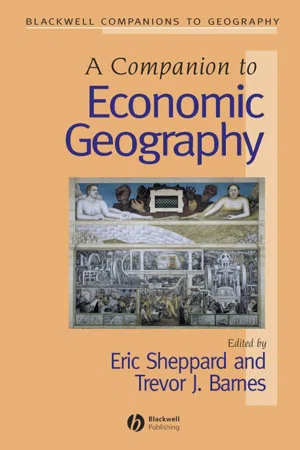 eBook - PDF
- Eric Sheppard, Trevor J. Barnes, Trevor J. Barnes, Trevor J. Barnes(Authors)
- 2008(Publication Date)
- Wiley-Blackwell(Publisher)
As a result of complex spatial divisions of labor (Massey, 1984), commodities are traded between regions, both from firms to consumers and from one firm to another. A unique economic sector also exists ± transportation ± which produces the necessary com-modity of transportation services, so that commodities can be shipped from one place to another. Economic geographers examining the functioning of a spatially extensive capital-ist economy have concluded that incorporating space into our thinking poses further challenges to economic theory. First, the complexities of space mean that the decisions individual capitalists make, about where to locate, how to set prices, what to produce in which quantities, which technology to use, and who to trade with, may well have unintended consequences that undermine the functioning of competitive markets. Even when firms make decisions that seem to be economic-ally beneficial in the short run, once the ramifications of these decisions have concatenated through the geographical economy, the result may be geographies of production that are less profitable than before, not more profitable. Marx referred to the tendency of the rate of profit to fall, even as capitalists work to increase it, as one of the forces undermining capitalist production. Such tendencies seem to be enhanced by the economy having a spatial dimension (Sheppard and Barnes, 1990). 176 ERIC SHEPPARD Second, geographically uneven development is not only consistent with but frequently facilitates capital accumulation. When there is uneven development, workers in wealthy regions may find that their interests correspond more with those of local capitalists than with those of workers in poorer regions. This has long been recognized at the international scale.
Index pages curate the most relevant extracts from our library of academic textbooks. They’ve been created using an in-house natural language model (NLM), each adding context and meaning to key research topics.

