History

Algonquin
The Algonquin people are a group of Native American tribes who historically inhabited the northeastern woodlands of North America, including areas of present-day Canada and the northeastern United States. They are known for their rich cultural heritage, including their language, traditions, and artistic expressions. The Algonquin were skilled hunters, gatherers, and traders, and their influence on the region's history and culture is significant.
Written by Perlego with AI-assistance
Related key terms
1 of 5
5 Key excerpts on "Algonquin"
 eBook - PDF
Encyclopedia of American Indian History
[4 volumes]
- Bruce E. Johansen, Barry M. Pritzker, Bruce E. Johansen, Barry M. Pritzker(Authors)
- 2007(Publication Date)
- ABC-CLIO(Publisher)
1237 Algonquin northeastern group of bands that also gave its name to an important language family. The original self- designation was Anishinabeg, or “true men.” Princi- pal Algonquin bands included the Weskarinis (the Algonquins proper), Abitibis, and Temiskamings. In the early seventeenth century, Algonquins lived in the Ottawa Valley of Quebec and Ontario, particu- larly along the northern tributary rivers. Algonquins spoke an Algonquin language. The people believed in a great creator spirit and a host of lesser spirits, both good and evil. Both shamans and hunters sought guardian spirits to help them with their work, which included interpreting dreams and healing the sick. Small bands were com- posed of one or more clans with local chiefs. People smoked tobacco silently before council meetings. Algonquins entertained visitors with the annual Feast of the Dead, a dance with a war theme. When entertaining guests, the host did not eat. Clan descent as well as the inheritance of hunting territo- ries may have been patrilineal. Bands tended to come together in the summer and disperse in the winter. People lived in cone-shaped, teepee-like dwellings. They also built rectangular birchbark hunting shelters. Men fished in both the summer and winter (through holes cut in the ice). They hunted game such as moose, deer, caribou, and beaver. Agricul- tural crops played a small role in their diet. Impor- tant material items included birchbark containers sewn with spruce roots, basswood bags and mats, wooden cradle boards, bows and arrows, and double-headed drums. Algonquins imported fish nets and cornmeal from the Hurons and traded extensively with Iroquoian tribes. They traded animal pelts and porcupine quills to nearby groups in exchange for corn, tobacco, fishing gear, and wampum. Men made birchbark canoes, snowshoes, and toboggans. Dress varied according to location. Most clothing was made of buckskin or moose skin.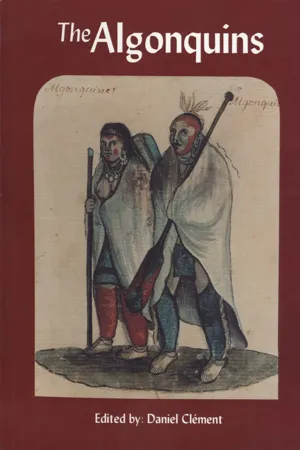 eBook - PDF
- Daniel Clément(Author)
- 1996(Publication Date)
- University of Ottawa Press(Publisher)
LOCATTON OF THE AlgonquinS FROM 1534 TO 1650 Maurice Ratelle Direction des Affaires autochtones Ministère de l'Énergie et des Ressources Translated by Michael J. Ustick A clear grasp of the history of the aboriginal peoples of North America is not possible without taking into account the fact that the ethnic and demographic profile of many major regions has been transformed, sometimes radically, by population migrations. This is a fundamental reality in the history of the indigenous peoples of Quebec. Entire populations emigrated or sometimes even disappeared within very short periods of time. Evidence of this may be found in this country's earliest historical sources. In 1534, 1535 and 1541 Jacques Cartier encountered Iroquoian populations frequenting Gaspé and Tadoussac and occupying the Québec and Montréal regions. Some 60 years later, Samuel de Champlain met with Algonquian nomads (Montagnais, Etchemins and Algonquins) travelling on the St. Lawrence River in summer. If sedentary groups could vanish from so large an area in a short span of time, leaving few traces, what of the nomadic groups who were more flexible in their visits to the territory? The Algonquins present themselves to us as a subject of study which is wholly appropriate to the issue of the ethnic upheavals subsequent to contact with the Europeans. Situated on each side of the Ottawa River, they faced threats which together serve to explain the disappearance of other Amerindian groups : 42 epidemics, the Iroquois wars, and assimilation following upon the scattered flights which those wars provoked. After the disintegration of their former tribes, the Algonquins managed to preserve sufficient strength to organize and define themselves as a new homogeneous nation. 1 THE 16TH CENTURY EVIDENCE T he disappearance of the Iroquoian groups which had settled in the St. Lawrence valley in the 16th century can chiefly be explained as a result of climate, epidemics and war. eBook - ePub
The Dawn of Canadian History
A Chronicle of Aboriginal Canada
- Stephen Leacock, George McKinnon Wrong, H. H. (Hugh Hornby) Langton, (Authors)
- 2003(Publication Date)
- Perlego(Publisher)
Living on the mainland, next to the red men of Newfoundland lay the great race of the Algonquins, spread over a huge tract of country, from the Atlantic coast to the head of the Great Lakes, and even farther west. The Algonquins were divided into a great many tribes, some of whose names are still familiar among the Indians of to-day. The Micmacs of Nova Scotia, the Malecite of New Brunswick, the Naskapi of Quebec, the Chippewa of Ontario, and the Crees of the prairie, are of this stock. It is even held that the Algonquins are to be considered typical specimens of the American race. They were of fine stature, and in strength and muscular development were quite on a par with the races of the Old World. Their skin was copper-coloured, their lips and noses were thin, and their hair in nearly all cases was straight and black. When the Europeans first saw the Algonquins they had already made some advance towards industrial civilization. They built huts of woven boughs, and for defence sometimes surrounded a group of huts with a palisade of stakes set up on end. They had no agriculture in the true sense, but they cultivated Indian corn and pumpkins in the openings of the forests, and also the tobacco plant, with the virtues of which they were well acquainted. They made for themselves heavy and clumsy pottery and utensils of wood, they wove mats out of rushes for their houses, and they made clothes from the skin of the deer, and head-dresses from the bright feathers of birds. Of the metals they knew, at the time of the discovery of America, hardly anything. They made some use of copper, which they chipped and hammered into rude tools and weapons. But they knew nothing of melting the metals, and their arrow-heads and spear-points were made, for the most part, not of metals, but of stone. Like other Indians, they showed great ingenuity in fashioning bark canoes of wonderful lightness.We must remember, however, that with nearly all the aborigines of America, at least north of Mexico, the attempt to utilize the materials and forces supplied by nature had made only slight and painful progress. We are apt to think that it was the mere laziness of the Indians which prevented more rapid advance. It may be that we do not realize their difficulties. When the white men first came these rude peoples were so backward and so little trained in using their faculties that any advance towards art and industry was inevitably slow and difficult. This was also true, no doubt, of the peoples who, long centuries before, had been in the same degree of development in Europe, and had begun the intricate tasks which a growth towards civilization involved. The historian Robertson describes in a vivid passage the backward state of the savage tribes of America. 'The most simple operation,' he says, 'was to them an undertaking of immense difficulty and labour. To fell a tree with no other implements than hatchets of stone was employment for a month. ...Their operations in agriculture were equally slow and defective. In a country covered with woods of the hardest timber, the clearing of a small field destined for culture required the united efforts of a tribe, and was a work of much time and great toil.' eBook - ePub
- Harry Johnston(Author)
- 2004(Publication Date)
- Perlego(Publisher)
[3] the claws or spines of crustaceans, flints, and suchlike substances—in short, they were leading the same life and using almost exactly the same tools as the long-since-vanished hunter races of Europe of five thousand to one hundred thousand years ago—the people who pursued the mammoth, the bison, the Irish "elk", and the other great beasts of prehistoric Europe. Indeed, North America represented to some extent, as late as a hundred years ago, what Europe must have looked like in the days of palæolithic Man.The AMERINDIANS of the Canadian Dominion (when the country first became known to Europeans) belonged to the following groups and tribes. The order of enumeration begins in the east and proceeds westwards. I have already mentioned the peculiar Beothiks of Newfoundland.[4] In Nova Scotia, Prince Edward Island, New Brunswick, and the Gaspé Peninsula there were the Mikmak Indians belonging to the widespread ALGONKIN family or stock. West and south of the Mikmaks, in New Brunswick and along the borders of New England, were other tribes of the Algonkin group: the Etchemins, Abenakis, Tarratines, Penobscots, Mohikans, and Adirondacks. North of these, in the eastern part of the Quebec province, on either side of the Gulf of St. Lawrence, were the Montagnais. This name, though it looks like a French word meaning "mountaineers", was also spellt Montagnet, and in various other ways, showing that it was originally a native name, pronounced Montanyé. The Montagnais in various clans extended northwards across Labrador until they touched the Eskimo, with whom they constantly fought. The interior of Labrador was inhabited by another Algonkin tribe, the Naskwapi, living in a state of rude savagery. The Algonkins proper, whose tribe gave their name to the whole stock because the French first became acquainted with them as a type, dwelt in the vicinity of Montreal, Lake Ontario, and the valley of the St. Lawrence. In upper Canada, about the great lakes and the St. Lawrence valley, were the Chippeways, or Ojibwés, and the Ottawas. West and north of Lake Michigan were the Miamis, the Potawátomis, and the Fox Indians (the Saks or Sawkis). Between Lake Winnipeg and Lake Superior were the Cheyennes (Shians); between North and South Saskatchewan, the Blackfeet or Siksika Indians (sections of which were also called Bloods, Paigans, Piegans, &c). North of Lake Winnipeg, as far as Lake Athabaska, and almost from the Rocky Mountains to the shores of Hudson's Bay, were the widespread tribe of the Kris, or Knistino.[5] The Gros Ventres or Big Bellies—properly called Atsina
- R. G. (Robert Gordon) Latham(Author)
- 2010(Publication Date)
- Perlego(Publisher)
Sheshatapúsh of Labrador are branches.2. The Ojibways;[73] falling into—a. The Ojibways Proper, of which the Sauteurs are a section.[229]b. The Ottawas of the River Ottawa.c. The original Indians of Lake Nipissing; important because it is believed that the form of speech called Algonkin, a term since extended to the whole class, was their particular dialect. They are now either extinct or amalgamated with other tribes.d. The Messisaugis, to the north of Lake Ontario.3. The Micmacs of New Brunswick, Gaspé, Nova Scotia, Cape Breton, and part of Newfoundland; closely allied to the—4. Abnaki of Mayne, and the British frontier; represented at present by the St. John's Indians.5. The Bethuck—the aborigines of Newfoundland.6. The Blackfoots, consisting of the—a. Satsikaa, or Blackfoots Proper.b. The Kena, or Blood Indians.c. The Piegan.To these must be added numerous extinct tribes.The Iroquois.—The single and important exception to the Algonkin population of the Canadas is made by the existence of certain members of the great Iroquois class on the New York frontier; a class falling into two divisions. The northern Iroquois belong to New York and Pennsylvania, the southern to the Carolinas.[230]The former of these two falls into two great confederations, and into several unconfederate tribes.The chief of the unconfederate tribes are the now extinct Mynkasar and Cochnowagoes—extinct, unless either or both be represented by a small remnant mentioned by Schoolcraft, in his great work on the Indian tribes, now in the course of publication, under the sanction of Congress, as the St. Regis Indians.Of the second confederation the leading members were the Wyandots, or Hurons, of the parts between Lakes Simcoe, Huron, and Erie.The first was that of the famous and formidable Mohawks. To these add the Senekas, the Onondagos, the Cayugas, and the Oneidas, and you have the Five Nations. Then add, as a later accession, from the southern Iroquois, the Tuskaroras, and the Six
Index pages curate the most relevant extracts from our library of academic textbooks. They’ve been created using an in-house natural language model (NLM), each adding context and meaning to key research topics.

