History

Cherokee
The Cherokee are a Native American tribe indigenous to the Southeastern United States. They have a rich history and culture, including their own language and traditional practices. The Cherokee Nation has faced significant challenges throughout history, including forced relocation along the Trail of Tears in the 1830s, but they have persevered and continue to contribute to American society.
Written by Perlego with AI-assistance
Related key terms
1 of 5
9 Key excerpts on "Cherokee"
 eBook - PDF
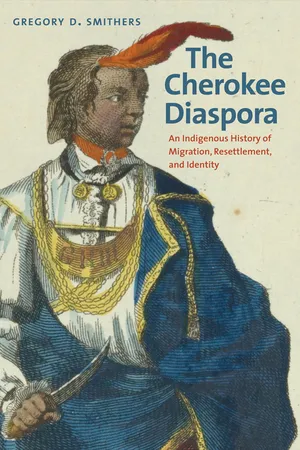
The Cherokee Diaspora
An Indigenous History of Migration, Resettlement, and Identity
- Gregory D. Smithers(Author)
- 2015(Publication Date)
- Yale University Press(Publisher)
For the Cherokee, as for other Indigenous peoples in the American South, the latter half of the eighteenth century was both a traumatic and a transformative epoch in their collective histories. Whether they chose to relocate in different parts of Cherokee Country, rebuilding their towns or clearing land for farmsteads, or trekked beyond the Mississippi and to Missouri, Arkansas, Texas, or colonial Mexico, Cherokees continued to nurture kinship relations. Holding on to old memories and remem-bering kinship ties was no easy task during a time of colonial warfare, shifting settler frontiers and borderlands, and an increasingly mobile, migratory existence for many hundreds (and ultimately thousands) of Cherokee people. The cumulative impact of colonial encounters with Spanish, French, and British settlers, traders, and colonial officials there-fore opened a new chapter in Cherokee history. In a sense, the Chero-kee both became victims of aggressively expansive settler societies, and became Indigenous agents of settlement and re-settlement themselves. This unnerving epoch magnified the significance of intratribal rivalries, led to political and military conflicts with other Indian tribal leaders and warriors, and placed the regenerative qualities of Cherokee social structures and cultural beliefs under intense pressure. 3 In the decades between the French and Indian War (1754 –1763) and the Treaty of Washington in 1819, when Eastern Cherokee leaders declared their determination to resist further cessions of land and re-main in the Southeast, the Cherokee diaspora was born. During these tumultuous decades Cherokee chiefs ceded 58,555,280 acres of land in Virginia, Georgia, Tennessee, Alabama, and North Carolina either to British colonial governments in North America or to the federal gov-ernment of the United States. eBook - PDF
- R. Rivera-Servera, H. Young, R. Rivera-Servera, H. Young(Authors)
- 2010(Publication Date)
- Palgrave Macmillan(Publisher)
The frequent appearance of the suffering of the Cherokees within historical accounts of, and academic investigations into, the Trail of Tears can give the misleading impression that the Cherokees were the only indigenous people dispossessed and relocated, by force, within the United States. “Only about 10 percent of the eastern Indians who traveled trails of tears to the place now called Oklahoma were Cherokees, however, and each of the dozens of relocated tribes has its own unique and important history,” write historians Thelma Perdue and Michael Green. 2 They add, “The history of the removal of the Cherokees can never substitute for the histories of the others, but it can exemplify a larger history that no one should forget.” 3 The Chickasaws, Choctaws, Creeks, and Seminoles traveled many of the same routes and, today, frequently partner with each other and the Cherokees to organize and host events to remember and memorialize the experience of eviction and movement across borders. 4 Why are the Cherokees centralized within our cul- tural and historical imaginings of Native American suffering? Their plight was documented within Northeastern and Cherokee newspapers, transcriptions of congressional speeches debating the morality of the actions being undertaken in Georgia, and the decisions of judicial bodies, including the Supreme Court, on the legality of Cherokee dispossession. The preservation of this paper trail within public and private collections makes the relocation of the Cherokee Nation, or, at least, the politics leading up to the removal of Cherokees from Georgia, easier to reconstruct within historical narratives than the experiences of other groups or nations who were not given as large a place within official governmental archives. eBook - PDF
- William Barney(Author)
- 2008(Publication Date)
- Wiley-Blackwell(Publisher)
McLoughlin regarded the rise of Cherokee nationalism as imitative, in some respects, of a similar process in the United States, but he also placed that development firmly in the context of cultural revitalization, an analytical model normally applied to cultural persistence rather than change. The Cherokee elite, McLoughlin argued, adopted Anglo-American political forms in order to save their society, which threat-ened to disintegrate with the decline of an eighteenth-century economy based on hunting and a political system that grew out of almost constant warfare. These new political forms, along with the skills and values learned from US agents and mission-aries, enabled the Cherokees to survive as a people and mount a credible, though unsuccessful, defense of their homeland. Most scholars have been reluctant to offer an explanation for the Cherokees' apparent exceptionalism, but sociologist Duane Champagne suggested a plausible theory for the Cherokees' unique political developments in Social Order and Political Change (1992). Choctaws, Chickasaws, and Creeks viewed their social and political organizations as interwoven and interpreted governance in religious terms. Political office derived in large part from one's place in the tribe's social organization, in particular, clan affiliation. Furthermore, government represented the social units of clan and town, a feature that made other forms of political apportionment and the delegation of power unthinkable. Additionally, religion and politics were considered inseparable. Because Cherokee social organization played a far more limited role in their political system, and Cherokees did not see governance as religious behavior, they were able to change their government structure without challenging more deeply embedded cultural practices.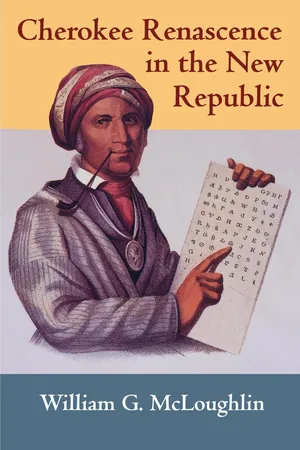 eBook - PDF
- William G. McLoughlin(Author)
- 2018(Publication Date)
- Princeton University Press(Publisher)
336 C L A S S , G E N D E R , A N D R A C E w i t h sufficient wealth to quarrel over what they had. Apparently clans and town councils still functioned at a different level of jurisdiction, pro- viding traditional answers to traditional questions for those who pre- ferred to live by the old norms and relationships. Little is known of the actions of these town councils except that they set the times of local fes- tivals and dances, tried to resolve local quarrels, took stands on tribal is- sues, and presided over marriages. But it was an oral and ritual system. Older people and those in remote areas probably found all the regulation they needed among their local headmen, doctor/priests, and town coun- cils. Still, they were uneasy about the implications of the many regula- tions established by the National Council and the new law courts. Defining what it meant to be a Cherokee had become very difficult, just as it was now difficult to define who was a Cherokee. The removal crisis had settled the fact that a true Cherokee remained loyal to tribal owner- ship of the ancestral land and resided on it. But there were more subtle forms of definition with which the Council continued to wrestle. For ex- ample, the Cherokee Nation, like the United States, was multiracial. There were different kinds of Indians living among them—Catawba, Creek, Uchee, Osage; various Europeans—British, Spanish, French, American; and there was a growing body of Africans (some freedmen, some slaves). Prior to 1819 these variations were of minor importance. Thereafter, as the Cherokees sought to measure themselves by white standards, they began to make distinctions. Concerning the white man, the problem was essentially to distinguish between the good and the bad. This could be done by laws defining be- havior and by distinguishing friendly whites (usually from the east and north) from unfriendly whites (usually from the frontier around them). eBook - ePub
Divided Sovereignties
Race, Nationhood, and Citizenship in Nineteenth-Century America
- Rochelle Raineri Zuck(Author)
- 2016(Publication Date)
- University of Georgia Press(Publisher)
The exigencies of Removal prompted Cherokee leaders to reconsider the relationship between land, nationhood, and people and to think through a particular kind of virtuality in which political and social potential was not linked to any particular territory but could survive the trauma of forced dispossession. Through their written constitutions and other documents, Cherokee leaders attempted to shift the terms of the debate to one of multiple affiliations rather than internal divisions in order to assert their political and territorial sovereignty and remind the United States of its treaty obligations. As I show in the next two chapters, the terms of this debate were reimagined as part of discussions of a threatening black imperium and African Americans’ assertions that they were a nation affiliated with the United States in a web of individual and collective allegiance. eBook - ePub
Twenty-First Century Perspectives on Indigenous Studies
Native North America in (Trans)Motion
- Birgit Däwes, Karsten Fitz, Sabine N. Meyer, Birgit Däwes, Karsten Fitz, Sabine N. Meyer(Authors)
- 2015(Publication Date)
- Routledge(Publisher)
Kimberly Blaeser explicates the significance of stories in a lucid fashion: “Just like the weaving mode of a Cherokee basket never runs straight on, native stories are seldom about separate existences, but instead are about intricately linked relationships, about intersections” (557). Survival demands a meaning or meanings. While the removal march wounds personal identity, family unity, and tribal integration, the premise for survival is to reconstruct the interconnection, that is, the linked relationship, which has been destroyed by the colonial infliction of violence. In a historical note appended to his book, Bruchac relates how the alien strangers were once tolerated by the indigenes and how their mutual understanding and connection were built on Native trust in the strangers and yet were destroyed in less than two decades due to the colonists’ avaricious desire. In 1817, President James Monroe made a promise to the Cherokees, the largest tribe east of the Mississippi River: “As long as water flows,” Monroe said, “or grass grows upon the earth, or the sun rises to show your pathway, or you kindle your camp fires, [you will] never again [be] removed from your present habitations” (177). This promise was broken as the Cherokees were forced to march a thousand miles away from their original home-base to a reservation in “Indian Territory” or Oklahoma during the brutal winter between 1838 and 1839. As a result, four thousand Cherokees died, who account for one quarter of their nation (184). 5 Today, the Trail of Tears is regarded as more than just an exclusively Cherokee experience. Rather, it becomes a collective cultural metaphor, which bespeaks a past that has been erased by authoritative History. In writing about the Trail of Tears, Bruchac forges a connection between this traumatic memory and Native American spirits eBook - PDF
Discovering the American Past
A Look at the Evidence, Volume I: To 1877
- William Bruce Wheeler, Lorri Glover(Authors)
- 2016(Publication Date)
- Cengage Learning EMEA(Publisher)
Calhoun (Columbia, SC: Univ. of Copyright 201 Cengage Learning. All Rights Reserved. May not be copied, scanned, or duplicated, in whole or in part. Due to electronic rights, some third party content may be suppressed from the eBook and/or eChapter(s). Editorial review has deemed that any suppressed content does not materially affect the overall learning experience. Cengage Learning reserves the right to remove additional content at any time if subsequent rights restrictions require it. ✦ CHAPTER 7 Land, Growth, and Justice: The Removal of the Cherokees [ 170 ] on a particular decision (to fire on Fort Sumter, for instance, or to sup-port the Civil Rights Movement of the twentieth century) as inevitable. Most contemporaries, however, did not see it that way. As a historian, you should avoid the concept of “inevitability” as well. ✦ Background Sometime before their regular con-tact with Europeans, the Cherokees became sedentary. Women performed most of the farm duties, raising corn and beans, whereas men hunted deer and turkey and caught fish to complete their diet. The Cherokees built towns organized around extended families. Society was matrilineal, meaning that property and position passed from generation to generation through the mother’s side of the family. Each town theoretically was autonomous, and there were no leaders (or chiefs, in European parlance) who ruled over all the towns. Local leaders led by persuasion and example, and all adults, including women, could speak in town councils. Indeed, Cherokee governing practices were considerably more democratic and consensual than the Europeans’ hierarchical ways. Initial contacts with Europeans were devastating. Europeans brought with them measles and smallpox, against which Native Americans were not immune. Also, Cherokees were attracted to European goods, such as fabrics, metal hoes and hatchets, fire-arms, and (tragically) alcohol. To ac-quire these goods, Cherokees traded deerskins for them. eBook - PDF
World Christianity and Indigenous Experience
A Global History, 1500–2000
- David Lindenfeld(Author)
- 2021(Publication Date)
- Cambridge University Press(Publisher)
The Cherokees had a well-deserved reputation for ferocity in war, perpetuated by their belief in clan retribution, which was based on the notion that natural balance required the taking of a life for a life. At the same time, their diplomatic skills were equally well- developed, as witnessed by the 22 separate treaties they signed with the Anglo-Americans between 1721 and 1835. 78 The most conspicuous feature of Cherokee-Christian interactions during the colonial period is their almost total absence, a state of affairs for which both Natives and colonists were responsible. 79 Cherokee spir- ituality was characterized by a certain conservative pragmatism, focused 66 Native North America on maintaining harmony and order through a cycle of six annual rituals and being markedly averse to individual expressions of religious fervor. The Cherokee of course had their religious specialists, known as adonisgi (conjurers), who presided over knowledge of cures and cast spells to help or harm individuals as the need arose. But generally, wise elders were favored over charismatic prophets. 80 The dignified bearing and rhetoric of the leading chiefs seemed to satisfy the white stereotype of the noble savage, and the 19-year-old Thomas Jefferson was highly impressed by one such speech that he heard, even though he could not understand a word of it. 81 Reinforcing this image was the popular European notion that the Indians were descendents of the Lost Tribes of Israel. One visitor to the Cherokees, James Adair, devoted a 230-page book in 1775 to arguing for this proposition. 82 More surprising is the lack of initiative from the British side, especially in the light of the founding of the Anglican Society for the Promotion of the Gospel in Foreign Parts (SPG) by royal charter in 1701, an organiza- tion specifically aimed at the American colonies. It was not for want of trying: the SPG sent a number of missionaries to South Carolina. eBook - ePub
African Americans and Native Americans in the Cherokee and Creek Nations, 1830s-1920s
Collision and Collusion
- Katja May(Author)
- 2016(Publication Date)
- Routledge(Publisher)
3 Cherokee Nation, 1830s-1900s Two major issues have dominated Cherokee and most Native American history: freedom and land tenure. These terms generated much controversy among the Cherokee people, as they interpreted them in various ways. "Removal" had deprived the Cherokees of their ancestral homeland, but they had gained another land and with it, presumably, freedom from intrusion. Freedom did not come to those enslaved tribal members, however. There was one reported slave revolt in the Cherokee Nation in the 1840s. The intratribal controversy over the Removal Treaty ultimately created clan warfare throughout the post-Removal years. The issue of freedom and tribal sovereignty began to separate Native American and African American interests in the Cherokee Nation. Indian land held an uncertain promise for African Americans' freedom from enslavement and white domination. Yet the Cherokee tribe was merely a "domestic dependent nation," in the United States Supreme Court's opinion. The Cherokee populace was stratified and a great number of Cherokees felt little inclined to defend the freedom of African Americans. Some were pro-slavery, others only felt that African American freedom somehow jeopardized Native American land ownership. In the 1860s an area called the Canadian District was set aside for the explicit settlement of former slaves and their former masters. This was the beginning of the unsuccessful attempt to segregate African American and Native American concerns in the Cherokee Nation. At the turn of the century, the struggle over allotment brought the clashing views over the role of African Americans and the direction of the Cherokees as a tribe out en force. A Cherokee traditionalist movement known as the Keetoowahs opposed African American freedom, because it seemed to translate into loss of political sovereignty and loss of Cherokee land
Index pages curate the most relevant extracts from our library of academic textbooks. They’ve been created using an in-house natural language model (NLM), each adding context and meaning to key research topics.

