History

Hopi Tribe
The Hopi Tribe is a Native American tribe located in northeastern Arizona. They are known for their rich cultural heritage, particularly their intricate artwork, traditional dances, and unique agricultural practices. The Hopi are also recognized for their strong spiritual beliefs, which are deeply rooted in their connection to the land and their reverence for nature.
Written by Perlego with AI-assistance
Related key terms
1 of 5
8 Key excerpts on "Hopi Tribe"
 No longer available |Learn more
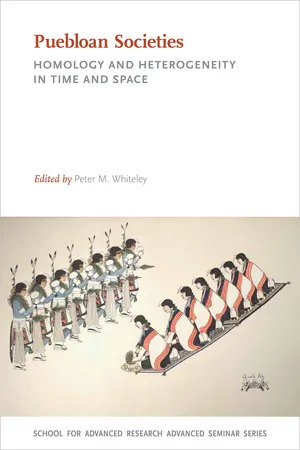
Puebloan Societies
Homology and Heterogeneity in Time and Space
- Peter M. Whiteley(Author)
- 2018(Publication Date)
157 CHAPTER SEVEN Archaeological Expressions of Ancestral Hopi Social Organization KELLEY HAYS-GILPIN AND DENNIS GILPIN Introduction Hopi oral histories describe diverse geographic, linguistic, and cultural ori-gins for the people who came together over millennia to settle the Hopi Mesas and create the diverse settlements and ritual practices we see today as Hopi and Hopi-Tewa communities. Archaeological evidence strongly supports this account. Archaeologists conventionally organize data in a time-space matrix that classifies sites and artifacts into distinct time periods and geographic locali-ties of varying scales. In contrast, oral traditions concern relationships among past and present groups of people and emphasize place over time. The use of traditional histories in archaeological research is complicated and problematic for many reasons (Vansina 1985). Archaeological and oral lines of evidence sel-dom coincide neatly and indeed are often contradictory. Yet their juxtaposition provides some interesting synergies—food for thought for both scientists and indigenous historians. Ancestral Hopi architecture and ritual paraphernalia illustrate the diverse origins of Hopi communities and their elaborate ritual calendar, and Hopi kinship and social organization clearly are structured to facilitate incorporation of outsiders. Hopi Views Hopis explain that “Hopi” is an amalgamation of clans that took different routes to the Hopi Mesas and contributed diverse social institutions to Hopi culture and society. For example, some clans owned ceremonies that brought rain; others were warriors who turned their skills to defense of their new communities. Because warrior societies, medicine societies, dances, kiva activities, elaborate eBook - ePub
- Walter Hough(Author)
- 2018(Publication Date)
- Perlego(Publisher)
THE HOPI INDIANS
By WALTER HOUGH Curator Division of Ethnology, United States National Museum, Washington, D. C.Publisher's device CEDAR RAPIDS, IOWA THE TORCH PRESS, 1915Copyright 1915 By The Torch Press AprilLITTLE HISTORIES OF NORTH AMERICAN INDIANS ———— Number FourIN THE SAME SERIESTHE NAVAHO By Oscar H. Lipps Supervisor in Charge, U. S. Indian School, Carlisle, Penn. With map and illustration in three colorsTHE IOWA By William Harvey Miner With map and illustrations in halftoneTHE INDIANS OF GREATER NEW YORK By Alanson Skinner Assistant Curator of Anthropology, American Museum of Natural History, New York With a map of the regionEach Volume 12mo, $1.00 net Delivery extraA Hopi woman and child sit in a doorwayTo My WifePhoto by P. G. GatesA MADONNA AMONG THE MOKI Passage contains an image
 CONTENTS
The Country, Towns, and Peoples 13 Social Life 28 Food and Rearing 49 The Workers 69 Amusements 102 Birth, Marriage, and Death 114 Religious Life 132 Myths 179 Traditions and History 201 Brief Biographies 218 The Ancient People 250 Index 263 Passage contains an image MESA FOLK OF HOPILANDPREFACE
Whoever visits the Hopi falls perforce under the magic influence of their life and personality. If anyone entertains the belief that “a good Indian is a dead Indian,” let him travel to the heart of the Southwest and dispel his illusions in the presence of the sturdy, self-supporting, self-respecting citizens of the pueblos. Many sojourns in a region whose fascinations are second to no other, experiences that were happy and associations with a people who interest all coming in contact with them combined to indite the following pages. If the writer may seem biased in favor of the “Quaker Indians,” as Lummis calls them, be it known that he is moved by affection not less than by respect for the Hopi and moreover believes that his commendations are worthily bestowed. eBook - PDF
- René Provost(Author)
- 2017(Publication Date)
- Cambridge University Press(Publisher)
29 Costas Douzinas, supra note 25 at 28. on perpetuity 161 6.2 Hopi Tribal Court: Arguing with Tradition Approximately 6,600 Hopi tribal members reside on the Hopi reserva- tion, 30 which occupies 1.5 million acres of aboriginal Hopi lands in northeastern Arizona. These residents occupy twelve villages located on or around three mesas which before the 1930s operated under autono- mous village leadership. 31 In 1936, and pursuant to the Indian Reorgan- ization Act, 32 these autonomous villages federated into a Hopi Tribe to be governed by a representative Tribal Council. The Hopi Constitution also includes an explicit reservation of power to village leadership, giving them regulatory and adjudicatory power over intravillage matters, including addressing family and property disputes. Tribal governance was elaborated again in 1972 with the creation of the Hopi Judiciary, one that is largely Anglo-Adversarial in its processes and procedures. At the same time, tribal legislation and case law require the Hopi court to give a preferential place to Hopi customs, traditions, and culture. In Resolution H-12–76, the Hopi Tribal Council mandated that “in deciding matters of both substance and procedure,” the Tribal Court give more “weight as precedent to the . . . customs, traditions and culture of the Hopi Tribe” than to U.S. state and federal law. 33 These customs, traditions, and cultures are largely understood by Hopi as pointing to and enacting the norms, practices, and institutions related, either directly or indirectly, to the clan traditions and ceremonies that animate ritual life in the several Hopi villages. Both before and after 1936, the idealized image that Hopis have of village organization sees them as constituted of several matrilineal, matrifocal, exogamous groups they call ngyam or clans. eBook - ePub
- Scott Rushforth, Steadman Upham(Authors)
- 2014(Publication Date)
- University of Texas Press(Publisher)
katchinas themselves) may have had some effect on Hopi religious ideology not reflected in the historical or ethnographic literature. Further, we see no reason to suggest that the Hopi ceremonial cycle was fundamentally altered in the years under consideration. Hopi religious societies probably continued to perform both public and private rituals based on mythologically expressed beliefs about the universe, with the intention of increasing community well-being and agricultural plenty. This sacred/secular dichotomy was the primary point of contention between Spanish priests and Hopi political leaders, who were priests themselves. The Pueblo Revolt of 1682 and the destruction of Awatovi during the fall of 1700 or winter of 1701 were largely about this issue. As indicated earlier, part of the Hopi motivation for participation in the Revolt was the proven ineffectiveness of Catholicism for bringing rain and ensuring plentiful crops.On the other hand, we see no reason to assume that relationships between Hopi descent groups, ceremonies, religious societies, and political leadership were invariant during this period. We would be surprised if this were the case. Again, we see flexibility and resilience in the structural and organizational arrangements involving the above institutions and activities. We first discussed Hopi resilience when considering prehistoric Western Pueblo abandonments. We now return to this subject.Flexibility in historic Hopi sociocultural arrangements is illustrated in many ways (see Parsons 1933:21ff.; Titiev 1944; Eggan 1950; Nagata 1970; Whiteley 1988a, 1988b). The specific clans and the number of clans represented in the different Hopi villages, for example, vary. Different clans (or clan segments) control different ceremonies and occupy different leadership positions in the various Hopi pueblos. The control by one descent group of a particular ceremony might be switched to another descent group if the first becomes too small or dies out. Ceremonies might be lost entirely under similar circumstances. Village leadership might be shared or rotated among the heads of various descent groups, or change from the head of one group to the chief of another group under similar demographic conditions.11 A woman might even become kikmongwi eBook - PDF
- Austin Sarat(Author)
- 2019(Publication Date)
- Emerald Publishing Limited(Publisher)
University of Michigan Journal of Law Reform , 46 , 417. 82 JUSTIN B. RICHLAND Rushforth, S., & Upham, S. (1992). A Hopi social history: Anthropological perspectives on sociocul-tural persistence and change . Austin, TX: University of Texas Press. Sekaquaptewa, E. (1972). Preserving the good things in Hopi life. In E. Spicer & R. Thompson (Eds.), Plural society in the southwest (pp. 239 260). New York, NY: Weatherhead Foundation. Sahlins, M. (2011). What kinship is – And is not . Chicago, IL: University of Chicago Press. Shaul, D. L. (2002). Hopi traditional literature . Albuquerque, NM: University of New Mexico Press. Simpson, A. (2015). Mohawk interruptus: Political life across the borders of settler states . Durham, NC: Duke University Press. Strathern, M. (2004). Commons and borderlands. Working Papers on interdisciplinarity, accountabil-ity and the fl ow of knowledge. Oxford: Sean Kingston Publishing. Taylor, C., & Dreyfus, H. (2015). Retrieving realism . Cambridge, MA: Harvard University Press. Whiteley, P. (1988). Deliberate acts. Changing Hopi culture through the Oraibi split . Tucson, AZ: University of Arizona Press. Whiteley, P. (1998). Rethinking Hopi ethnography . Washington, DC: Smithsonian Institution Press. Whiteley, P. (2004). Bartering Pahos with the president. Ethnohistory , 51 (2), 359 414. Whorf, B. L. (1956). Language, thought, reality. Selected writings . In J. B. Carroll (Ed.). New York, NY: MIT Press. Wilkins, D. E., & Lomawaima, T. K. (2001). Uneven ground: American Indian sovereignty and federal law . Tucson, AZ: University of Arizona Press. Wilkinson, C. F. (1987). American Indians, time and the law . New Haven, CT: Yale University Press. Wittgenstein, L. (1953). Philosophical investigations . G.E.M. Anscombe, Trans. Section 115. London: Basil Blackwell Press. Wolfe, P. (1998). Settler colonialism and the transformation of anthropology .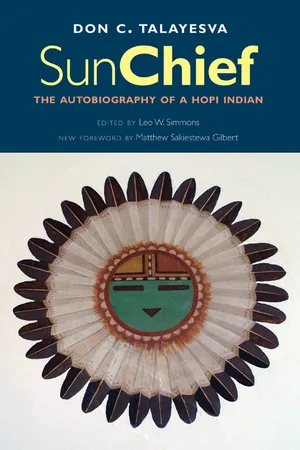 eBook - PDF
Sun Chief
The Autobiography of a Hopi Indian, Second Edition
- Don C. Talayesva, Matthew Sakiestewa Gilbert, Robert V. Hine, Leo W. Simmons(Authors)
- 2013(Publication Date)
- Yale University Press(Publisher)
Hawks and eagles are kept in captivity part of the year and their feathers employed for making the sacred prayer sticks, called pahos, and for sacrifice to the gods. They are never eaten. Long and arduous journeys, with elaborate ritual and ceremony, were formerly made to procure salt. Clay and various materials for 12 Introduction native dyes are borne long distances for the making of pots and other utensils. Twigs from small bushes are stripped of their bark, dried, dyed, and woven into plaques and baskets for domestic use. The native fare is predominantly vegetarian. Every herb is care- fully studied for its food values and medicinal properties. Cultivated plants like maize, beans, squash, watermelons, and sunflowers are staples. They are carefully planted in the sand drifts and gullies, closely guarded from worms, insects, and windstorms, and cultivated through floods and droughts with the utmost diligence and patience. Corn is truly the “staff of life.” Centuries of selection have produced a type of corn and cotton that can germinate and mature within a very short time. The Spanish priests—first known to the Hopi in 1540—built a chapel and residence at Oraibi in the early part of the seventeenth century but were all massacred in a general uprising in 1680, and the Catholic church never reopened its mission. While the Hopi rejected the religion of the Spanish priests, they kept their peaches and apri- cots and adopted their sheep, burros, and horses, which produced fundamental changes in their system of maintenance. But in spite of these and more recent improvements under the supervision of the United States Government, life is still very hard at Oraibi. An indi- vidual born there of Hopi parents in 1890 was destined to live a life in very close contact with a raw, harsh, and difficult environment. The organization and division of labor include practically every person in Oraibi with the exception of very young children and ex- tremely incapacitated adults. eBook - PDF
Global Ancestors
Understanding the Shared Humanity of our Ancestors
- Rebecca Redfern, Jelena Bekvalac, Heather Bonney, Margaret Clegg, Rebecca Redfern, Jelena Bekvalac, Heather Bonney, Margaret Clegg(Authors)
- 2013(Publication Date)
- Oxbow Books(Publisher)
Iowa City: University of Iowa Press, 1–19. Hopi Dictionary Project. 1998. Hopìikwa Lavàytutuveni: A Hopi-English Dictionary of the Third Mesa Dialect . Tucson: University of Arizona Press. Hough, W. 1903 Archaeological Field Work in Northeastern Arizona. The Museum-Gates Expedition of 1901. Report of the US National Museum for 1901. Government Printing Office: Washington, DC, 279–358. Indian Claims Commission, 1970a. Findings of Fact. The Hopi Tribe, an Indian Reorganization Act Corporation, suing on its own behalf and as a representative of the Hopi Indians and the villages of First Mesa Consolidated Villages of Walpi, Shichumovi and Tewa, Mishongnovi, Sipaulovi, Oraibi, Kyakotsmovi, Bakabi, Hotevilla and Moenkopi, Plaintiff, Docket 196; The Navajo Tribe of Indians, Plaintiff, Docket 229; v. The United States of America, Defendant. Ind. Cl. Comm. 277. [Also published in Hopi Indians , 1974, New York: Garland Publishing, 401–424.] Indian Claims Commission, 1970b. Opinion on Title. The Hopi Tribe, an Indian Reorganization Act Corporation, suing on its own behalf and as a representative of the Hopi Indians and the villages of First Mesa Consolidated Villages of Walpi, Shitchumovi and Tewa, Mishongnovi, Sipaulovi, Oraibi, Kyakotsmovi, Bakabi, Hotevilla and Moenkopi, Plaintiff, Docket 196; The Navajo Tribe of Indians, Plaintiff, Docket 229; v. The United States of America, Defendant. Ind. Cl. Comm. 277. [Also published in Hopi Indians , 1974, New York: Garland Publishing, 389–401.] Jernigan, W. and Wieden, K. B. 1982. The White Mound-Kiatuthlanna-Red Mesa Stylistic Tradition. In J. J. Reid (ed.) Cholla Project Archaeology , vol. 5. University of Arizona: Archaeological Series No. 161. Cultural Resources Management Division: Arizona State Museum, 39–428. Kent, K. P. 1957. The Cultivation and Weaving of Cotton in the Prehistoric Southwestern United States . Philadelphia: Transactions of the American Philosophical Society, vol.
- Margaret Cecile Nelson, Colleen A Strawhacker, Margaret C. Nelson, Colleen A. Strawhacker(Authors)
- 2011(Publication Date)
- University Press of Colorado(Publisher)
Hopi consultants emphasize that the conflict between ancestral groups at this time was ritual in nature rather than physical, as people struggled to reconcile different ideologies (Leigh Kuwanwisiwma, personal communi-cation, 2006). After AD 1350, sites on the Hopi Mesas no longer exhibit defensive posi-tioning or layouts, indicating resolution of high-level tensions (Bernardini 1998). Social Impact of Immigration What was the social impact of immigration, and to what extent can we read the existing organization of Hopi society as a partial response to the challenges immigra-tion once presented? Here, traditional knowledge and ethnography combine to answer these questions. A common theme in Hopi migration accounts is the ranking of clan status accord-ing to order of arrival at a village. As Eggan noted: [A]t the head of the prestige hierarchy is the Bear Clan, the members of which arrived first in the Hopi region and made a compact with Masu’u, the god of life and death, in which he gave the Hopi land and crops in exchange for carrying out the proper rituals. Late-comers received portions of this estate in exchange for the perfor-mance of ceremonies for rain for the crops, but the “last” arrivals often possessed no rituals and offered their services as guards. Their position was marginal, and usually they were not assigned clan lands. (1966:124–125) Although the Bear Clan is almost always listed as the first arrival at Hopi, in fact the Motisinom were the original occupants of the Colorado Plateau. The Motisinom clans were cautious, however, and ceded the responsibility (and prestige) of organizing subse-quent immigrants to the Bear Clan (Leigh Kuwanwisiwma, personal communication, 2007). Thus despite the Motisinom clans’ primacy of place, the original mother villages were Nùutungkwisinom villages. The Nùutungkwisinom did not simply settle at Hopi freely, however.
Index pages curate the most relevant extracts from our library of academic textbooks. They’ve been created using an in-house natural language model (NLM), each adding context and meaning to key research topics.

