History

Trail of Tears
The Trail of Tears refers to the forced relocation of Native American tribes, including the Cherokee, from their ancestral lands in the southeastern United States to designated Indian Territory in present-day Oklahoma. This tragic event, which took place in the 1830s, resulted in the deaths of thousands of Native Americans due to exposure, disease, and starvation during the arduous journey.
Written by Perlego with AI-assistance
Related key terms
1 of 5
11 Key excerpts on "Trail of Tears"
 No longer available |Learn more
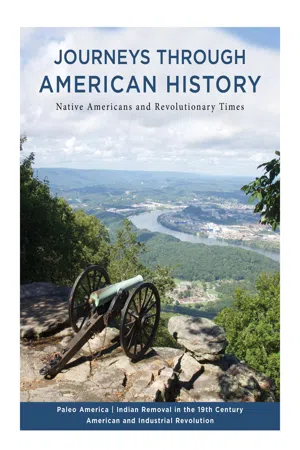
A Road Trip Through American History: Volume I
Native Americans and Revolutionary Times
- James T Parks(Author)
- 2020(Publication Date)
- European Creative Communication Inc(Publisher)
INDIAN REMOVAL IN THE 19TH CENTURY:As Europeans continued flooding into America in the 19th century, our federal government began displacing Native Americans from their homelands by moving them to reservations west of the Mississippi River. This section retraces the paths followed by one of those tribes, the Cherokee, along what came to be known as The Trail of Tears, because of the resulting deaths and hardships. Passage contains an image
THE CHEROKEE Trail of Tears
Missionary Daniel Butrick kept a journal of his travels with the Cherokee People as they were force-marched to Indian Territory during the winter of 1838-39. It is one of the saddest episodes in American history, with the depths of despair grippingly described by him in this entry: “… the government might more mercifully have put to death everyone under a year or over sixty; rather it had chosen a more expensive and painful way of exterminating these poor people. ”BREAKING AWAY FROM THE BELTWAYIn pre-Columbian times, the Cherokee People’s land stretched from the Ohio River to present-day Kentucky, Tennessee, North Carolina, South Carolina, Georgia, and Alabama. But by the early 1800s, various treaties had reduced Cherokee land to a fraction of their former size. At the same time, European diseases devastated much of the Cherokee Nation. Those who survived adopted many aspects of European culture and enterprise, including farming, a written language, a court system, a printed newspaper, and even Christianity. Cherokee settlements looked and functioned much the same as white settlements of the day. However, in 1828, gold was discovered on Cherokee land in North Georgia, and white settlers began ignoring legal Cherokee boundaries. By 1830, the Cherokee had lost any legal claim to their lands. That year, Congress passed the Indian Removal Act, and President Andrew Jackson signed it into law; he had long advocated Indian removal to lands west of the Mississippi River.
Passage contains an image
THE CHEROKEE Trail of Tears
Missionary Daniel Butrick kept a journal of his travels with the Cherokee People as they were force-marched to Indian Territory during the winter of 1838-39. It is one of the saddest episodes in American history, with the depths of despair grippingly described by him in this entry: “… the government might more mercifully have put to death everyone under a year or over sixty; rather it had chosen a more expensive and painful way of exterminating these poor people. ”BREAKING AWAY FROM THE BELTWAYIn pre-Columbian times, the Cherokee People’s land stretched from the Ohio River to present-day Kentucky, Tennessee, North Carolina, South Carolina, Georgia, and Alabama. But by the early 1800s, various treaties had reduced Cherokee land to a fraction of their former size. At the same time, European diseases devastated much of the Cherokee Nation. Those who survived adopted many aspects of European culture and enterprise, including farming, a written language, a court system, a printed newspaper, and even Christianity. Cherokee settlements looked and functioned much the same as white settlements of the day. However, in 1828, gold was discovered on Cherokee land in North Georgia, and white settlers began ignoring legal Cherokee boundaries. By 1830, the Cherokee had lost any legal claim to their lands. That year, Congress passed the Indian Removal Act, and President Andrew Jackson signed it into law; he had long advocated Indian removal to lands west of the Mississippi River. eBook - PDF
Through a Lens Darkly
Films of Genocide and Ethnic Cleansing
- John J. Michalczyk, SJ Raymond G. Helmick(Authors)
- 2012(Publication Date)
The federal government’s failure to act on the court’s ruling against Georgia, in addition to the language of the Indian Removal Act, were the first concretized steps of organization and preparation for eliminating the Indian presence from the land. Perhaps the most iconic scene in the history of American Indian oppres- sion is the forced removal of the Cherokee. In the words of James Mooney, an American ethnographer who lived with the Cherokee, the Trail of Tears, as the removal came to be known, “may well exceed in weight of grief and “Making His Paths Straight” 5 pathos any other passage in American history.” 8 Under increasing pressure from encroaching settlers and government agents, the Cherokee had become polarized within themselves. With the Treaty of New Echota, a treaty signed surreptitiously by a significant but small dissident party of pro-removal Cherokees and ratified by just one vote in the Senate, the US moved swiftly to take advantage of the division and force the Cherokees off their land, despite the fervent appeals of the recognized Cherokee leadership and their followers. Both Cherokee factions had legitimate reasons for their stance: the dissident party believed that white expansion was inevitable and saw westward migration as a chance for a new beginning; those against removal were fighting to preserve their ancestral home and sovereignty. Again, the US government capitalized on the situation under the veneer of “legal” mechanisms. After being forced off their land at bayonet point, often with nothing but the clothes on their backs, the Cherokee were transported and concentrated in various forts and internment camps. Many remained in these camps for months without any of their belongings, which had been burned and looted, before beginning the treacherous journey. The migration trail itself then became the path to extermination. Over several years and thou- sands of miles, it claimed at least one-fourth of the Cherokee Nation. eBook - ePub
History of American Indians
Exploring Diverse Roots
- Robert R. McCoy, Steven M. Fountain(Authors)
- 2017(Publication Date)
- Greenwood(Publisher)
Removal and Reservations, 1820s–1860s
Many tribes went through a process of removal from their homelands. Some peoples fled their homelands under the pressure of increased colonization and conflict and others faced forced removal by federal troops. The Cherokee Trail of Tears in 1831 may be the most well-known aspect of Indian Removal, but a similar process uprooted others from the American South, the Old Northwest, and from across the West. New, often radically different geographies awaited removed tribes. In many cases, the newcomers crowded alongside other relocated tribes in other people’s homelands. As Indian Country shrank, competition for limited resources increased as Plains Indians found ever more tribes arriving to government-designated reservations.Removal was far from being a simple or uniform process. Each people and each relocated village or family experienced their own hardships of being torn from their homeland. Some were quite effective in their abilities to negotiate around removal and remain in their lands. Most were less fortunate and the rampant disease and starvation, violence and cruelty, and loss continue to affect Native Americans today. The ability to overcome the horrors of this era and persevere as a people is a testament to the resilience of indigenous culture.Many removed peoples found themselves in the new Indian Territory of Oklahoma. Other reservations extended northward in a swath through Kansas, Nebraska, and into the Dakotas. These lands were largely beyond white settlement in the 1820s and 1830s in an area thought to be unfit for an agrarian nation such as the United States. Associating soil fertility with trees, Americans had made the mistake of seeing the Great Plains as a “Great American Desert,” unfit for farming. However, Caddos, Osages, Poncas, Pawnees and others provided evidence that Native Americans could not only live, but also thrive in those same lands. eBook - PDF
Discovering the American Past
A Look at the Evidence, Volume I: To 1877
- William Bruce Wheeler, Lorri Glover(Authors)
- 2016(Publication Date)
- Cengage Learning EMEA(Publisher)
With some traveling by boat while others journeyed overland, a total of approximately thirteen thou-sand Cherokees participated in what became known as the Trail of Tears. 2. See John G. Burnett, “The Cherokee Re-moval Through the Eyes of a Private Sol-dier,” Journal of Cherokee Studies 3 (1978): 180–185. ✦ C H A P T E R 7 Copyright 201 Cengage Learning. All Rights Reserved. May not be copied, scanned, or duplicated, in whole or in part. Due to electronic rights, some third party content may be suppressed from the eBook and/or eChapter(s). Editorial review has deemed that any suppressed content does not materially affect the overall learning experience. Cengage Learning reserves the right to remove additional content at any time if subsequent rights restrictions require it. ✦ CHAPTER 7 Land, Growth, and Justice: The Removal of the Cherokees [ 168 ] advocates of removal (including lead-ers Major Ridge, John Ridge, Elias Boudinot, and Thomas Watie) were murdered. 4 The forced removal of the Cherokees marked the end of a debate that was older than the United States itself. As white populations mushroomed and settlements moved ever westward, the question of how to deal with Native Americans came up again and again, especially when Native American peo-ples refused to sell or give their lands to whites by treaty. In 1829, Andrew Jackson became president. For at least ten years, it was (See Map 1.) It has been estimated that over four thousand died in the squalid stockades or along the way. 3 But re-cent research has determined that the figure may have been higher than that, in part because of shoddy record keeping and in part because numerous Cherokees died in an epidemic almost immediately upon reaching their des-tination. In addition, conflict broke out between new arrivals and those Cher-okees (around six thousand) who had earlier moved. And, once in the West, those who opposed removal took out their vengeance on the leaders of the Cherokee removal faction. eBook - ePub
Apartheid in Indian Country
Seeing Red Over Black Disenfranchisement
- Hannibal B. Johnson, Kim Williams, Janis Williams(Authors)
- 2020(Publication Date)
- Eakin Press(Publisher)
35The Cherokees suffered a particularly tragic fate upon removal. As former Cherokee Nation Principal Chief Wilma Mankiller observed: “[W]e [must] never forget what happened to our people on the Trail of Tears. It was indeed our holocaust.”36The federal government extricated the Cherokees from their homes, herded them into internment camps, and forcibly evicted them to a foreign land along Nunna daul Tsunyi , “the trail where we cried.”37 Removal proved all the more bitter and ironic for the Cherokees, who had largely succeeded at Eurocentric assimilation.The word “Cherokee” is the anglicized version of Tsalagi , meaning “cave people,” a word that has been spelled a variety of ways throughout history.38 Traditionally, the Cherokees, woodlands people, lived in villages in the southern Appalachians, in present day Virginia, West Virginia, Kentucky, Tennessee, western North Carolina, South Carolina, northern Georgia, and northeastern Alabama. The Cherokees availed themselves of the diverse topography in the region to create a culture rife with farming, hunting, and fishing.The Cherokees constructed European-style homes and farmsteads. They laid out European-style fields and farms. They developed a written language based on the syllabary created by Sequoyah. They established a newspaper, the Cherokee Phoenix. They wrote a constitution. Some of them, a relative few, undertook human bondage; they embraced slavery.Cherokee assimilation, however successful, failed to stave off white land-lust. Neither did it guarantee the Cherokees equal protection under the law.Beginning in 1791, a series of treaties between the United States and the Cherokees explicitly recognized the Cherokee Nation as a separate sovereign. Despite this official recognition, however, subsequent treaties and agreements gradually whittled away at the Cherokee land base. eBook - PDF
Native America
A History
- Michael Leroy Oberg(Author)
- 2015(Publication Date)
- Wiley-Blackwell(Publisher)
Ridge and Boudinot did not believe that their people could ever find justice in their homelands, or protect their property from land-hungry frontiersmen who already were overrunning and dispossessing them. They knew about racism. Both had married white women when they attended a boarding school in Connecticut as young men. Their white neighbors threatened to destroy the school and burned effigies of Boudinot and Ridge on the town green. Having lost their faith in the republic, they did what they felt was best. The “Trail of Tears” in 1838, the forced migration of the Cherokees that killed thousands of men, women, and children, resulted. At least 4,000 died on the jour- ney west, perhaps many more. The conditions were brutal, but so were the soldiers who herded them into stockades and then forced them westward at gunpoint. Those who signed the New Echota Treaty were not spared the suffering. John Ridge, Elias Boudinot, and a handful of others had betrayed their nation, their enemies claimed, and violated Cherokee laws that made it a capital crime to cede the nation’s lands. They truly believed that they had no alternative, and that to remain in Georgia meant subjection to a racial order that offered them no rights and no protections. Still, they had broken the nation’s laws, and they would pay for their crimes. The Cherokees, of course, were not the only nation to suffer Indian removal. After the War of 1812 and the destruction of the Shawnee prophet’s resistance campaign, the Potawatomis recognized that they no longer could militarily resist American expansion. With the British eliminated as a threat in the Great Lakes 190 RELOCATIONS AND REMOVES region, Americans no longer felt the need to placate the peoples of the Great Lakes, and in the eight years after the end of the war the Americans built a number of new fortified posts near the Potawatomis. eBook - PDF
How the Indians Lost Their Land
Law and Power on the Frontier
- Stuart Banner, Stuart BANNER(Authors)
- 2009(Publication Date)
- Belknap Press(Publisher)
Y 6 Removal The word removal conventionally denotes a distinct era in the history of United States Indian policy, from the late 1820s through the early 1840s. As the story is usually told, during that period the federal government, at the urging of President Andrew Jackson, forced most of the remaining eastern Indians to migrate west of the Mississippi River. Between 1828 and 1838, more than eighty thousand Indians were removed from the east to the west. The enduring image of the period is the Trail of Tears —the U.S. Army’s internment and forced relocation of approximately sixteen thousand Cherokees in the fall and winter of 1838–1839, under circumstances so dire that four thousand are said to have died along the route between Georgia and what is now Oklahoma. 1 Removal has accordingly taken on sinister connotations, sinister be-cause of the mismatch between the word’s surface blandness and the cruelty of some of the events it was used to describe. After a century in which Orwellian terms like ethnic cleansing and the final solution became commonplace, the very word removal sounds chilling today. It evokes the idea of a newly aggressive federal government opening a new chap-ter in its Indian relations by forcibly pushing American Indians west of the Mississippi in order to seize their land and parcel it out to white set-tlers. In light of the story thus far, however, removal looks much more like a continuation of earlier Indian land policy than a departure from it. Re-moval, just like the acquisition of Indian land for the previous two hun-dred years, was structured as a series of voluntary transactions. The fed-eral government went to considerable trouble to obtain the signatures of Indians on treaties in which the tribes ostensibly consented to be re-moved. eBook - ePub
- Carolyn Ross Johnston(Author)
- 2013(Publication Date)
- Blair(Publisher)
A small group of twenty-two Cherokees signed the Treaty of New Echota in 1835. The Senate passed it by one vote in 1836, and the government ordered forcible removal of the Cherokees within two years. Although the members of the Treaty Party did not have authority to sign for the tribe, and although nearly sixteen thousand Cherokees formally protested the treaty, the tribe was forced to cede all its lands in the Southeast for land in Indian Territory. It was promised five million dollars to be disbursed on a per capita basis and an additional half a million for education. The treaty also promised compensation to individuals for their buildings and fixtures and pledged to pay the cost of relocation. The United States promised to honor the title of the Cherokee Nation’s new land, respect its political autonomy, and protect the tribe from trespassers. As late as 1907, the Cherokees were still trying to recover much of the promised money.Federal troops arrived in 1838 and forced three detachments of a thousand Cherokees each westward that summer. So many deaths occurred that John Ross persuaded the government to allow the Cherokees to remove themselves. Ross put his brother Lewis in charge of the provisioning. Thirteen detachments left for Indian Territory in the winter of 1838–39.The Trail of Tears claimed the lives of at least four thousand Cherokees, a fourth of the tribe. Women faced more hardships than men on the journey because many of them were pregnant. They bore children while in the stockades and on the road. At least sixty-nine newborns arrived in the West, but many infants died on the way. Women’s experiences also differed from men’s because they were vulnerable to rape. Along with the elderly and the very young, women were especially susceptible to disease and death.1The following selections record the protests of Cherokee women against removal and the personal testimonies of those who went on the Trail of Tears or whose parents made the long journey.ENDNOTES1 “Emigration Detachments,” Journal of Cherokee Studies 3 (1978), 186–81. Theda Perdue, “Women and the Trail of Tears,” Journal of Women’s History, vol.1, no. 1 (Spring 1989), 14–30. Around one thousand Cherokees in North Carolina escaped into the mountains. Their descendants are members of the Eastern Band of Cherokee Indians. Descendants of the Cherokees who went on the Trail of Tears eventually established the Cherokee Nation of Oklahoma. Passage contains an image
Cherokee women tried repeatedly to defend and preserve their land. In an attempt to encourage a peaceful resolution of existing land disputes, Nancy Ward, the Beloved Woman (or War Woman) of Chota, addressed the treaty conference at Hopewell, South Carolina, in 1785. That conference was the last occasion when women played an official role. Subsequently, the Cherokees lost large areas of land south of the Cumberland River in Tennessee and Kentucky and west of the Blue Ridge Mountains in North Carolina. Cherokee women unofficially continued to oppose further cession of lands. eBook - ePub
- Julia Coates(Author)
- 2014(Publication Date)
- Greenwood(Publisher)
In those 10 years, there had been ample time for Cherokee citizens to reflect on the conditions of their lives and society and to make decisions about their own actions and reactions. Some had decided to emigrate from their homelands and start fresh in western areas. But many more had determined to stay, to endure the harassment directed at them, and refuse to capitulate in the face of injustice. As with Reverend Foreman, it was a decision made consciously by individual Cherokees across their nation. “Ethnic cleansing” has been defined as “the planned deliberate removal from a specific territory, persons of a particular ethnic group, by force or intimidation, in order to render that area ethnically homogenous.” 2 Another definition states more simply, “The systematic elimination of an ethnic group or groups from a region or society, as by deportation, forced emigration, or genocide.” 3 Although some deny that Indian removals met the standard to be called “ethnic cleansing,” the federal Indian removal policy was similar enough that it has inspired debates among contemporary scholars and the public, many of whom feel it is valid to apply the term. How do a people react to removal, possibly identified as ethnic cleansing? For those who have not actually experienced such an atrocity, imagination may lead to images of horror and terror on the part of those subjected to it. Fictional or dramatic representations of the Trail of Tears often offer traumatized, screaming victims at the hands of brutal oppressors. But the enactment of ethnic cleansing is often a relatively subdued affair, and those who are subjected to it frequently display a dignity that inspires pride in the human spirit, even as the deed also elicits shame in human actions. In theory, the Cherokees had had years to accept that they would be removed, by force if necessary, from their lands and homes No longer available |Learn more
Failures of the Presidents
From the Whiskey Rebellion and War of 1812 to the Bay of Pigs and War in Iraq
- Thomas J. Craughwell, M. William Phelps(Authors)
- 2008(Publication Date)
- Fair Winds Press(Publisher)
They brought with them dysentery, measles, whooping cough, and other contagious diseases that had begun in the wretched, overcrowded conditions of the forts. Malnutrition, physical exhaustion, and exposure to the elements made even healthy adults susceptible. A man from Maine who encountered one detachment of Cherokee on what has become known as the Trail of Tears recorded, “A great many go on horseback and multitudes on foot—even aged females, apparently nearly ready to drop into the grave.”Sadly, the government’s originally generous provision for the removal of the Cherokee did not play out as planned. Often, expected deliveries of food and other supplies were stolen by middlemen who sold the goods for profit. The number of wagons, which General Scott had thought unnecessary, now proved to be insufficient to carry the sick and the weak as well as the fodder needed for the horses. Adding to the Indians’ troubles, all along the route they were routinely overcharged by settlers who managed toll bridges or operated ferries. Not all whites were pitiless, however. Some religious congregations opened their churches and schoolhouses to shelter Indians for the night. In some towns, doctors did what they could for the sick and the dying, and farmers and other landowners gave the Cherokee permission to forage for firewood and hunt game on their property. Passage contains an image
SAD LEGACY
How many died? The number is uncertain. Dr. Elizur Butler, a Protestant minister who accompanied the Cherokee, estimated that 4,000 perished along the trail, and this figure is the one cited most often in history and reference books. Chief Ross believed 424 died, while a government official in the Indian Territory (Oklahoma) set the death toll at 1,645. Because many deaths in the forts as well as the deaths of newborns and infants less than six months old may have gone unrecorded, it is impossible to give an accurate number.It is an indelible stain on the reputation of Jackson that he would compel more than 13,000 men, women, and children—from newborns to dying old men and women of a tribe that had been an ally of the United States against the Creek War only a generation before—to leave their homes and all their personal belongings and walk (in most cases) nearly 1,000 miles to begin new lives in a strange and comparatively desolate country. Jackson’s action cost the lives of hundreds, possibly thousands, and caused unimaginable pain and hardship to every Cherokee forced to make the journey. In one respect Jackson was correct. In Oklahoma, the Cherokee did survive as a nation. But given how smoothly the Cherokee had earlier adopted mainstream American culture, it is likely that they could have survived quite well if they had been left alone to live in their ancestral homelands. eBook - PDF
- Craig Thompson Friend, Lorri Glover(Authors)
- 2014(Publication Date)
- Cambridge University Press(Publisher)
28 “Historical Data-Trail of Tears Commission, Inc.”; Program, Park Dedication, May 14, 1988, in scrapbook, Kentucky Chapter, Trail of Tears Association; Beverly Baker to Wendell Ford, August 12, 1987; Beverly Baker to Robert E. Thompson, July 5, 1988, both in Beverly Baker Collection; Press Release, 1992, Beverly Baker Collection; Kentucky New Era, September 16 and 26 and October 8, 1987; May 3, 1988; September 20, 1989; “Video Tour – Trail of Tears Park and Museum,” n.d., Trail of Tears Commemorative Park. When completed, the museum included both the Cherokee-themed exhibit and a “western room” featuring art and craft items from a variety of other tribal communities. This room was meant to represent the variety of Native Americans who participated in the annual powwow. Reframing the Indian Dead 265 children and their teachers. More than five hundred middle-school stu- dents wrote letters to Congress in support of the national trail proposal as part of special history lessons on the Cherokees and the Trail of Tears. Baker and the other adults, meanwhile, cultivated the local media and convinced Kentucky Senator Wendell Ford to introduce the bill adding the Trail of Tears to the national historic trail system. When that bill became law in late 1987, Hopkinsville was one of four specific locations identified as sites related to Cherokee removal. 29 Most likely, Congress would have eventually approved the national trail, with or without the Kentuckians’ efforts. The NPS had recommended designation of the Trail of Tears in its feasibility studies, and there were other constituencies supporting the idea. But Baker and her allies provided the immediate stimulus for the inclusion of the removal route in the trail system. In doing so, they ensured that Hopkinsville would figure prominently in the national effort to remember Cherokee removal. 30 figure 8. Statues of White Path and Fly Smith, Trail of Tears Commemorative Park.
Index pages curate the most relevant extracts from our library of academic textbooks. They’ve been created using an in-house natural language model (NLM), each adding context and meaning to key research topics.

