History

Alien and Sedition Act
The Alien and Sedition Acts were a series of four laws passed by the United States Congress in 1798. The acts were aimed at limiting the political power of immigrants and restricting freedom of speech and the press. They were controversial and seen as a violation of the First Amendment, leading to debates about the balance between national security and civil liberties.
Written by Perlego with AI-assistance
Related key terms
1 of 5
10 Key excerpts on "Alien and Sedition Act"
 eBook - PDF
Civil Liberties and the State
A Documentary and Reference Guide
- Christopher Peter Latimer(Author)
- 2010(Publication Date)
- Greenwood(Publisher)
In 1798 the United States was on the brink of war with France. The Federalists believed that Democratic-Republican criticism of Federalist policies was disloyal and feared that aliens living in the United States would sympathize with the French dur- ing a war. As a result, a Federalist-controlled Congress passed four laws, known col- lectively as the Alien and Sedition Acts. In particular, the Sedition Act made it a high misdemeanor, punishable by fine, imprisonment, or both, for citizens or aliens (1) to oppose the execution of federal laws; (2) to prevent a federal officer from performing his or her duties; (3) to aid any insurrection, riot, unlawful assembly, or combination; or (4) to make any defamatory statement about the federal govern- ment or the president. The laws were directed against Democratic-Republicans, the party typically favored by new citizens, and the only journalists prosecuted under the Sedition Act were editors of Democratic-Republican newspapers. Approximately 25 individuals were arrested under the Sedition Act. Fifteen were indicted; 10 cases went to trial and all 10 resulted in convictions. For many years, English and American courts had prosecuted individuals for this kind of seditious libel using the common law—a collection of court precedents and traditions—rather than acts of a legislature. Some doubted that the federal courts had jurisdiction over common law crimes, so the Sedition Act provided the statutory authority for federal prosecution of seditious libel. Although early drafts included drastic penalties for even general criticisms of the government, the act incorporated recent liberalizations in American and English practice, such as permitting the truth as a defense and allowing juries to determine whether the law properly applied to the case. eBook - ePub
The Safety of the Kingdom
Government Responses to Subversive Threats
- J. Michael Martinez(Author)
- 2015(Publication Date)
- Carrel Books(Publisher)
Chapter 1 THE Alien and Sedition ActS I have sworn upon the altar of God eternal hostility against every form of tyranny over the mind of man. —THOMAS JEFFERSON,LETTER TO DR . BENJAMIN RUSH , SEPTEMBER 23, 18001A mericans who look back through the dark pages of history often are perplexed by the behavior of forebears who championed measures clearly at odds with the prevailing myth of the republic as a proverbial shining city on a hill. Yet the 1790s, the first full decade that the United States existed under the new US Constitution, teemed with danger and intrigue. The nation was less than a generation removed from the American Revolution, and its perpetual existence was hardly assured. For citizens fearful of an avaricious European power asserting its dominance over the American landscape, measures to lessen or avoid foreign subversion appeared prudent and necessary to the national interest. Concerns over alien, corrosive elements led to the first major backlash against subversion in the country’s history: passage of the Alien and Sedition Acts.2BackgroundThe laws were the result of a long train of events. Tensions, especially with Great Britain, reached a crisis early in the 1790s. The British still occupied forts in the Great Lakes region and continually impressed Americans into service as British sailors a decade after the Treaty of Paris had ended the war between Britain and her former colonies. By repeatedly encouraging Native American attacks against settlers in the western territories and interfering with trade in the West Indies, the English also threatened the well-being of citizens eking out a living on the frontier. The first US president, George Washington, was not a man to back away from a fight, but he recognized that a bellicose attitude toward the British could lead to disastrous consequences. Ill-prepared for war and mindful of the necessity of resolving ongoing disputes, his administration, propelled by a prominent Anglophile, Alexander Hamilton, negotiated a treaty that ensured at least a temporary rapprochement with Great Britain. Formally titled the Treaty of Amity, Commerce, and Navigation, Between His Britannic Majesty and the United States of America, the agreement, hammered out by a well-known lawyer and statesman, John Jay, solved one set of problems while triggering others.3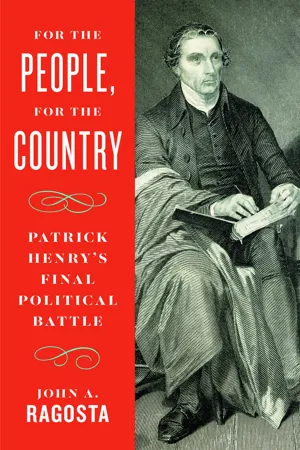 eBook - ePub
For the People, For the Country
Patrick Henry's Final Political Battle
- John A. Ragosta(Author)
- 2023(Publication Date)
- University of Virginia Press(Publisher)
10In the summer of 1798, the Federalist-dominated Congress passed several laws intended to respond to the danger from possible foreign agents operating in the United States, the Naturalization and Alien Acts (called the Alien Acts). These laws made it more difficult for immigrants to become citizens (increasing the residency period from five to fourteen years, for example) and gave the president unilateral power to expel any alien, without benefit of trial, whom he believed was dangerous.While the Alien Acts were roundly denounced by Democratic-Republicans, gauging their impact is more complex. No one was actually deported under the acts. But over a score of prosecutions/deportations were contemplated, especially of aliens working on Democratic-Republican newspapers; several deportations orders were signed by Timothy Pickering, Adams’s secretary of state, although not executed. The laws certainly had an in terrorem effect, and a large number of Frenchmen—fifteen boatloads by one account—voluntarily left the country after the laws’ adoption.11Even more portentously, Congress adopted the Sedition Act of 1798, making it a crime to publish or speak anything “false, scandalous or malicious” against the president or Congress or to “unlawfully combine or conspire together, with the intent to oppose any measure or measures of the government.” In essence, the Sedition Act made it a crime to criticize the president or Congress (but, tellingly, not the vice president, now Thomas Jefferson). While the law made truth a defense against a claim of sedition, the “truth” of most political criticism simply was not readily subject to proof; opinions could be prosecuted. Those in opposition could literally be silenced with fines and incarceration.12 eBook - PDF
Deportation Nation
Outsiders in American History
- Daniel Kanstroom(Author)
- 2010(Publication Date)
- Harvard University Press(Publisher)
As an unprecedented extension “of the au-thority of the federal government into the lives of American citizens,” however, the critique of the Sedition Act had powerful contempora-neous support, and ultimately undergirded the progressive expansion of free speech protections by the Supreme Court in the twentieth cen-tury. 242 The path of the law regarding noncitizens’ rights, notwith- Antecedents 63 standing similar rhetorical flourishes by the critics of the Alien Friends Act, has been much less clear. A welter of different concerns, in the crucible of an incendiary time, had been forged into extreme laws that ultimately heralded the end of Federalist power. The historically victorious Republican critique of the Alien and Sedition Acts was itself contradictory, however. It provided an unstable base for future opponents of later-enacted deportation laws. Jeffersonian concerns about highly centralized, discretionary federal power, which may resonate powerfully for contemporary civil libertar-ians, were linked to states’-rights positions that supported slavery. As-sertions of aliens’ rights were often motivated more by electoral pragma-tism than by human or constitutional rights concerns. Still, if the powerful rhetoric of the Republican critics of the Federal-ists’ “Aliens laws” resonates today more than that of the laws’ sup-porters, it is for reasons that should be respected: it speaks to our best constitutional traditions, our highest aspirations, our proudest heritage, and the most expansive egalitarian vision of the nation of immigrants ideal. It reminds us of the transitory nature of fear and of the responsi-bility of a mature constitutional legal system to transcend fear and to balance it against more long-lasting concerns. Part 3: Indian Removal, Fugitive Slave Laws, and “Colonization” Indian Removal Conquest gives a title which the courts of the conqueror cannot deny. —Johnson v. M’Intosh (1823) A significant part of the U.S. eBook - PDF
- Susan F. Martin(Author)
- 2021(Publication Date)
- Cambridge University Press(Publisher)
When seen in combination with the Sedition Act passed a few weeks later, the ideological import of its provisions is better understood. The Sedition Act made it illegal to write, print, utter, or publish, or to cause or procure to be written, printed, uttered, or published, or to knowingly and willingly assist or aid in writing, printing, uttering, or publishing any false, scandalous, and malicious writing or writings against the government of the United States, the Congress, or the president of the United States, with intent to defame them, bring them into contempt or disrepute, or excite the hatred of the people against them. If convicted, the person would be subject to a fine of up to two thousand dollars ($42,263 in today’s money) and by a term of imprisonment not exceeding two years. In attempting to implement the law, mostly unsuccessfully, the Adams administration focused its prosecutions under the Aliens Act on persons who had, they argued, also violated the Sedition Act. Two particular cases stand out: In the first of these, John D. Burk had fled Ireland with a sedition charge hanging over him. In the United States, he was the co-editor of the New York daily newspaper The Time Piece and a leader of the United Irishmen, both known to be supporters of the Republican Party. Burk made a plea bargain to leave the country in exchange for the administration’s waiving prosecution on the sedition charges. Before his deportation could be arranged, however, he Immigration and the Security of the New Republic 85 went into hiding until after the Alien Act expired. In the second case, William Duane was the editor of the Aurora, the most vocal opponent of the Federalists. Although Duane claimed to have been born in the United States, Attorney General Pickering argued that he had left as a child, spent the Revolution outside the country, and reentered only a few years before the passage of the legislation.
- De Alva Stanwood Alexander(Author)
- 2007(Publication Date)
- Perlego(Publisher)
[87] Under the Alien Act persons not citizens of the United States could be summarily banished at the sole discretion of the President, without guilt or even accusation, thus jeopardising the liberty and business of the most peaceable and well-disposed foreigner. Under the Act of Sedition a citizen could be dragged from his bed at night and taken hundreds of miles from home to be tried for circulating a petition asking that these laws be repealed. The intended effect was to weed out the foreign-born and crush political opponents, and, the better to accomplish this purpose, the Alien Act set aside trial by jury, and the Sedition Act transferred prosecutions from state courts to federal tribunals.Governor Jay approved these extreme measures because of alleged secret combinations in the interest of the French; and, although no proof of their existence appeared except in the unsupported statements of the press, he submitted to the Legislature, in January, 1799, several amendments to the Federal Constitution, proposed by Massachusetts, increasing the disability of foreigners, and otherwise limiting their rights to citizenship. The Legislature, still strongly Federal in both its branches, did not take kindly to the amendments, and the Assembly rejected them by the surprising vote of sixty-two to thirty-eight. Then came up the famous Kentucky and Virginia resolutions. The Virginia resolves, drafted by Madison and passed by the Virginia Legislature, pronounced the Alien and Sedition laws "palpable and alarming infractions of the Constitution;" the Kentucky resolutions, drafted by Jefferson, declared each act to be "not law, but altogether void and of no force." This was nullification, and the States north of the Potomac hastened to disavow any such doctrine, although the vote in the New York Assembly came perilously near indorsing it.The discussion of these measures gave opportunity for the public opening of a great career in New York legislation—a career that was to continue into the years made memorable by Martin Van Buren and William L. Marcy. The record of New York party politics for forty years is a record of long and brilliant contests in which Erastus Root, if not a recognised party chieftain, was one of the ablest lieutenants that marshalled on the field of combat. He was a man of gigantic frame, scholarly and much given to letters, and, although somewhat uncouth in manner and rough in speech, his forceful logic, coupled with keen wit and biting sarcasm, made him a dreaded opponent and a welcomed ally. He resembled Hamilton in his independence, relying less upon organisation and more upon the strength of his personality, yet shrewdly holding close relations with those whose careful management and adroit manipulation of the spoils kept men in line whatever the policy it seemed expedient to adopt. For eleven years he served in the Assembly, and thrice became speaker; for eight years he served in the Senate, and twice became its president; for twelve years he served in the lower house of Congress, and once became lieutenant-governor. Wherever he served, he was recognised as a master, not always consistent, but always earnest, eloquent, and popular, fighting relentlessly and tirelessly, and compelling respect even when unsuccessful. eBook - PDF
The Huddled Masses Myth
Immigration And Civil Rights
- Kevin Johnson(Author)
- 2008(Publication Date)
- Temple University Press(Publisher)
3 Exclusion and Deportation of Political Undesirables rom its early days, the United States sought to limit the num-ber of politically undesirable persons coming to this country from foreign lands. The infamous Alien and Sedition Acts of the 1790s represent one of the first examples of these efforts. 1 Over the next two centuries, Congress passed laws that pe-nalized “alien” anarchists, communists, and other politically unpopular persons. During the twentieth century, the fed-eral government enforced these laws with vigor in times of crisis. The hunt for political dissidents took on new meaning and urgency after September 11, 2001. The highest levels of the federal government have engaged in a concerted effort to uncover political dissent among Arab and Muslim noncit-izens and to question, detain, and remove them from the country. 2 The efforts to exclude or deport political undesirables have almost invariably been linked to domestic tensions. In-deed, ideological exclusions in the immigration laws “mask their true purpose: protection of particular social and eco-nomic values that are promoted by the American political system.” 3 For example, through the Alien and Sedition Acts, the Federalists sought not only to cut off the burgeoning po-litical support that immigrants offered to the Republicans but also to respond to tensions with the new radical French 55 F government and fear of the spread of radicalism in the United States. 4 In later turbulent times, the primary concern was that “foreigners” might infect the domestic populace with the disease of subversion, thereby causing labor turmoil and possibly even a radical takeover. 5 In that vein, the U.S. government has traditionally employed the im-migration laws, particularly the provisions that pertain to the exclusion and deportation of noncitizens, to attack perceived threats to the social order. eBook - PDF
Discourses of Freedom of Speech
From the Enactment of the Bill of Rights to the Sedition Act of 1918
- J. Rudanko(Author)
- 2012(Publication Date)
- Palgrave Macmillan(Publisher)
72 1 Introduction The previous chapter showed how two contrasting approaches to the concept of freedom of speech had emerged in the new Republic by 1794. On the one hand, Republicans had a broad notion of freedom of speech, permitting the free expression of opinions, unhindered by Federal legislation. On the other, Federalists wanted to secure what was termed “genuine” freedom of speech, which was to be achieved by the imposition of limits on freedom of discussion, particularly on the extent to which the government and rulers could be criticized with impunity. The precise nature of the limits on freedom of speech that Federalists had in mind did not emerge in the debates in November 1794, and the attempt to censure Democratic societies was eventually voted down in the House of Representatives. As regards the practice of political journalism during this period, vigorous political debates continued to flourish with impunity in the press, for instance in the summer of 1795 in critical reaction to the Jay Treaty (see Stewart 1969, 196–206). However, only a short time later Federalists were back with a vengeance. In the summer of 1798 the Federalist majority in Congress approved four acts that subsequently came to be known as the Alien and Sedition Acts. When discussing these acts, historians sympathetic to Federalists sometimes concentrate on the Alien Acts, as if these had more significance than the Sedition Act. However, the Alien Acts had little practical or conceptual impact. It is the Sedition Act that merits attention because of its content and the philosophical and conceptual underpinning of that content. In brief, the Sedition Act probably constituted the most serious actual and conceptual threat to freedom of speech that has materialized to 5 Freedom of Speech under Threat: The Sedition Act of 1798 The Sedition Act of 1798 73 this day. It is therefore important to any investigation dealing with the emergence of the American conception of freedom of speech.
- E. P. Hutchinson(Author)
- 2016(Publication Date)
A committee was set up to receive the petitions, which previously had been considered by the House sitting as Committee of the Whole. 16 The committee reported back on February 21, 1799, defending the con-stitutionality of the legislation, and offered three resolutions asserting the inexpediency of repealing the laws in question. 17 Several days later Con-gress took up the committee's lengthy report and passed a resolution that it was inexpedient to repeal the Act concerning aliens. Passage of the resolution was by the narrow margin of 52 to 48. 18 6th Congress (1799-1801) The Federalists, who had pushed through the antialien legislation in the 5th Congress, continued to hold a House majority in the 6th Congress and were even more firmly in control of the Senate, but signs of declining Federalist strength began to appear. The important states of New York and Pennsylvania sent Republican and antiadministration delegations to the new Congress, and Federalist support was also waning in other states. The Alien and Sedition Acts had proved to be very unpopular, and although President Adams had been reluctant to enforce the acts, Con-gress received sundry petitions and remonstrances asking for repeal of the offending legislation. 19 A committee was appointed to receive the petitions, but no further action was taken. The Alien and Sedition Acts were about to expire, and some Federalist effort was made at extension, but they were finally allowed to lapse. Motions were introduced in the House to consider amendment of the Naturalization Act, but without further action being taken; and the Alien Enemy Act remained undis-turbed. '«Ibid., 9:2884. Ibid., p. 3002. 17 Ibid., p. 2955. Ibid., 10:257. First Legislation 17 yth Congress (1801-1803) During the years of the 7th Congress external affairs did little to reduce apprehensions of foreign influence. eBook - PDF
Free Speech, The People's Darling Privilege
Struggles for Freedom of Expression in American History
- Michael Kent Curtis, Neal Devins, Mark A. Graber, Neal Devins, Mark A. Graber(Authors)
- 2000(Publication Date)
- Duke University Press Books(Publisher)
In short, the case of the Sedition Act brilliantly illuminates the essen-tially antidemocratic nature of the e ff ort to protect the institution of slavery from criticism. It does the same, of course, for the e ff ort to silence critics of the government’s policy during the Civil War. The Sedition Act is central to the free speech struggles recounted in this book in still another way. The attack on the act emphasized two themes—freedom of speech and protection of states’ rights. Many crit-ics of the act appealed to states’ rights in an e ff ort to protect free speech, much as today consumer advocate Ralph Nader appeals to states’ rights against federal laws that restrict state common law or statutory rights to sue makers of defective products. As slavery became the main political the debate over the sedition act [ 55 ] issue agitating the nation, the tension between the idea of free speech as (potentially, at least) merely a limit on the national government and the idea that free speech was essential to representative government became increasingly clear. Both the Sedition Act and the battle for free speech about slavery are chapters in the growth of the idea that democratic gov-ernment for the United States required national constitutional protec-tion for free speech: a protection that limited the states as well as the na-tional government and that allowed broad protection for discussion of public a ff airs. For all these reasons, the Sedition Act, to which I now turn, is an im-portant part of our free speech story. This chapter discusses the legisla-tive struggles over the framing of the act and the public debate the act engendered. Chapter will explore the act’s enforcement and theories of free speech that followed it. From the Revolution to the Bill of Rights In the Sedition Act debate, in the debate over antislavery speech, and in the debate over antiwar speech, ideas of popular sovereignty were cru-cial.
Index pages curate the most relevant extracts from our library of academic textbooks. They’ve been created using an in-house natural language model (NLM), each adding context and meaning to key research topics.

