History

Barter System
The barter system is a method of exchange where goods and services are traded directly for other goods and services without using money. It was commonly used in ancient societies before the advent of currency. In a barter system, individuals would negotiate and agree upon the value of the items being exchanged.
Written by Perlego with AI-assistance
Related key terms
1 of 5

8 Key excerpts on "Barter System"
 eBook - ePub
- Glyn Davies, Duncan Connors(Authors)
- 2016(Publication Date)
- University of Wales Press(Publisher)
Perhaps the most valuable step forward in the Barter System was made when established markets were set up at convenient locations. Very often such markets had been established long before the advent of money but were, of course, strengthened and confirmed as money came into greater use – money which in many cases had long come into existence for reasons other than trading. In process of time money was seen to offer considerable advantages over barter and very gradually took over a larger and larger role while the use of barter correspondingly diminished until eventually barter simply re-emerged in special circumstances, usually when the money system, which was less robust than barter, broke down. Such circumstances continue to show themselves from time to time and persist to this day. In some few instances communities appear to have gone straight from barter to modern money. However, in most instances the logical sequence (barter, barter plus primitive money, primitive money, primitive plus modern money, then modern money almost exclusively) has also been the actual path followed, but with occasional reversions to previous systems. 3 Persistence of gift exchange One of the more interesting forms of early barter was gift exchange, which within the family partook more of gift than exchange but beyond that, as for example between different tribes was much more in the nature of exchange than of gift. Silent or dumb barter took place where direct and possibly dangerous contact was deliberately avoided by the participants. An amount of a particular commodity would be left in a convenient spot frequented by the other party to the exchange, who would take the goods proffered and leave what they considered a fair equivalent in exchange. If, however, after obvious examination, these were not considered sufficient they would remain untaken until the amount originally offered had been increased eBook - ePub
The Articulated Peasant
Household Economies In The Andes
- Enrique Mayer(Author)
- 2018(Publication Date)
- Routledge(Publisher)
I agree with Humphrey and Hugh-Jones that barter is separable from other types of exchange—gift exchange, credit, formalized trade, and monetized commodity exchange—even though they may shade into each other at the boundaries. Still, barter is a distinct and irreducible form. It is ubiquitous and has moved material objects between humans for a long time. Formally conceived, pure barter is so unstable that only when institutionalized in what Humphreys and Hugh-Jones (1992: 8) call “Barter Systems” can it be viable and interesting for ethnographic study.Barter Systems exist when goods tend to be repeatedly exchanged with known people at particular times and places. Thus there is an in-built tendency to act fairly, so that the opportunity to repeat the exchange is not spoiled. Barter is also a very direct and uncomplicated affair in contrast with the complexities involved in, say, gift giving, where the viscosity between object and person enriches reciprocal relationships (as discussed in Chapter 4 ). Pure barter is therefore a myth or a conceptual construct that, in its very features, exhibits the mark of instability (“tit for tat and goodbye”). But exchanges exist in a social context, and people labor to ensure that this context is established. In the examples that I describe below, one can think of barter as an electrical wire that connects traders to each other: The wire energizes the movement of goods between people from time to time, but it is insulated by a coating of sociability, such as hospitality, which, although it adds to the transaction costs, nevertheless permits the transaction to continue to take place.One complexity, however, revolves around the issue of value between the objects, which may be so dissimilar as to be noncomparable. Humphrey and Hugh-Jones (1992: 9) put it this way: “… [I]t would be a mistake to think that the consumption or use values of the objects are measurable by some common abstract standard held in the heads of the two parties.” In institutionalized Barter Systems, known and quotable equivalencies are often established between commonly bartered objects; but these are not proxies to measures of economic value, nor are they some kind of price. Equivalencies serve as reference points for bargaining to take place, but it is not possible to aggregate equivalencies in a manner that reconciles all objects against each other. In established Barter Systems a given range of objects can substitute for each other, and people often categorize them with a descriptive term such that commonly demanded objects fall within a particular category. For example, Antoinette Fioravanti Molinié (1982: 220–221) describes barter in the Urubamba Valley of Cusco. In each climatic zone one primary crop serves as the main crop against which other equivalencies can be stated—maize in the valley, potatoes in the next level up. Coca, which comes from the tropical lowlands, is more ubiquitous throughout. There are equivalencies of other items against maize or potatoes or coca in each of the weekly markets in different climatic zones, where women can barter them against each other. These equivalencies set up the common ground that starts the bargaining process, and often the bargaining is about quantity rather than equivalency. eBook - ePub
- Shahzavar Karimzadi(Author)
- 2012(Publication Date)
- Routledge(Publisher)
For that reason under commercial and economic circumstances where a generally accepted medium of exchange is absent the economic agents tend to exchange their goods with other goods directly without any medium of exchange. In economics parlance this state of affairs is known as barter exchange. This distinction does not exist in reality. It is impossible to draw a sharp demarcation line between barter as a moneyless economy and a money-using economy. The fallacy arises from assuming the origin of money to be one and the same as the origin of a generally accepted medium of exchange. A distinct difference is that the formation of a generally accepted medium of exchange is a later stage of development in the chronological order of the history of money.The pre-money era corresponds with the pre-barter era and not the barter era. The barter era reaches its full circle with the presence of a generally accepted medium of exchange. The exchange in kind is a comparatively more rudimentary exchange system to the exchange system run by using a medium of exchange. Being designated a more rudimentary stage is not a definite proof for the absence of money. It simply means there is not a medium of exchange. This then cannot and must not be taken to imply that the rise of a medium of exchange is the origin of money. It is a fruitless endeavour, therefore, to press for an answer out of barter exchange for the origin of money. A lack of a generally accepted medium of exchange, by no means proves the complete omission of money.At its core the theory of barter exchange is the exchange of one commodity (C) for another commodity (C). It is alleged that to be a non-monetary exchange economy, the two commodities (C–C) are exchanged against one another without the intermediation of money. The barter exchange economy is argued to be fundamentally different from a money-using economy in one overriding respect. That is in a money-using economy a commodity (C) is first exchanged with money (M) and then money is exchanged with another commodity (C). The money economy can be expressed as C–M–C. The key element that transforms the economy from a moneyless economy to a money-using economy is said to be the difficulties inherent in the barter exchange economy. eBook - ePub
No Cash? No Problem!
How to Get What You Want in Business and Life, Without Using Cash
- Dave Wagenvoord, Ali Pervez(Authors)
- 2013(Publication Date)
- Morgan James Publishing(Publisher)
A barter deal is identical to a cash deal. The only difference is that you don’t pay with cash!We are now about to let you into another secret that most amateurs who get into barter trade forget. And that is:If you can sell what you have for cash, you don’t need barter trade. But if you cannot sell what you have for cash, barter provides an ideal medium to sell it for trade.INSIDE SECRET #13
Barter is not designed to replace any cash transactions that you are currently doing; it is meant to supplement them—i.e., add to them.INSIDE SECRET #14
Barter trade is simply a tool to use to provide you with leverage—i.e., maximum impact with minimal effort.With all the benefits that barter trade has, it always makes sense to seek barter opportunities whenever possible. We both would rather barter than pay cash for goods and services, because barter yields immense benefits, which you are about to learn. But we do live in a “cash world,” and not everyone understands the benefits of barter. Hence we wrote this book.However, when people have products or services that they cannot sell for cash or that are approaching midnight (i.e., about to expire), they will be very interested in trading with you.WHAT IS BARTER?
Barter, by definition, is the legal exchange of goods and services in a mutually beneficial manner. You trade something that you have for something you usually need and want, and both parties benefit in the process. It is a “cashless” process. No cash changes hands.INSIDE SECRET #15
In true orthodox barter trade, it would be illegal to exchange cash!Barter is also used by nations, and this practice is called “counter trade,” an accepted way to make trading more convenient for nations that have difficulty with currency conversion, as well as for nations with fewer financial resources but sufficient commodities. For example, a country that produces plenty of rice may exchange it with another nation to acquire another type of grain, or fruits and vegetables. On the other hand, one country might trade foodstuffs for textiles or oil.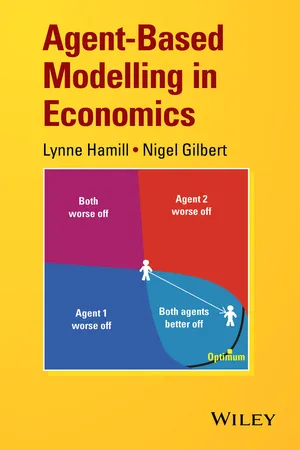 eBook - ePub
- Lynne Hamill, Nigel Gilbert(Authors)
- 2015(Publication Date)
- Wiley(Publisher)
Wealth of Nations (1776). However, Graeber (2011) reported that anthropologists have apparently never found such economies. For example, Diamond (2012, pp.61–75) described how trade was conducted in societies that did not use money, where trade was as much a social as an economic activity, merging with gift-giving. However, these are not the simple barter worlds described by Smith and those economists who followed him. Nevertheless, there was some truth in the barter model. Sturt (1912, Chapters II, VIII and IX) described the self-reliance of Surrey villagers and the change that came about when the loss of the open common meant that labourers who had been largely self-sufficient had instead to buy from shops:So the once self-supporting cottager turned into a spender of money…; and, of course, needing to spend money, he needed first to get it…To a greater or lesser extent, most were already wage-earners, though not regularly.(Sturt, 1912, Chapter IX)Graeber argued that pure barter economies are only found where people have been accustomed to using money, but money was not available to them. That is certainly true of Tom Sawyer and Huck Finn in nineteenth-century America!However, rather than looking at ticks and teeth, this chapter is based on what has become known as ‘the Red Cross parcel problem’ and is based broadly on Radford’s (1945) description of what happened in a prisoner-of-war camp in the Second World War. The parcels were ‘usually sent at the rate of one per man per week’ and contained tins of tea, sugar, milk and meat and other basics. They also included a bar of chocolate and 50 cigarettes (Red Cross, 2015). Thus, everyone received ‘a roughly equal share of essentials’ and most traded so that their ‘individual preferences are given expression and comfort increased’ (Radford, 1945). Radford continued,
- Patrick Spread(Author)
- 2022(Publication Date)
- Routledge(Publisher)
The idea of support-bargaining and money-bargaining suggests, like mainstream economics, that money probably emerged from a process of barter, though the dynamic of money-bargaining is different. The standard presentations of barter, including those of Mill and Samuelson, suggest that a person having something to sell and wanting something else must find the exact counterpart person who wants the something and has for sale the something else. A tailor having a coat for sale and wanting bread must find a baker who has bread for sale and wants a coat. But a person trying to exchange, say, a surplus bag of grain, will enhance his bargaining position if he is willing to accept not just, say, a cooking pot, in exchange, but a variety of products. He may then be able to choose whether he accepts a cooking pot, a block of salt, a leg of mutton, a dozen fish or a wooden box. Caroline Humphrey sees barter as an innovative, accommodating process of this kind, involving negotiations:The word barter as I use it implies an open-ended, potentially innovative, negotiable, transaction, in which need not only answers need but can also create a new demand: ‘If you don’t want these potatoes, perhaps you would like this pair of scissors.’5A ‘package’ of various commodities might be acceptable to establish parity of exchange value. Flexibility regarding the commodity or commodities to be received in exchange increases options and potentially improves the return. The ‘double coincidence of wants,’ suggested by Newlyn as the condition for barter, is more easily achieved if the ‘wants’ are varied.6 It might then be that a few commodities become popular in such exchanges. Traders would not want to build up large stocks of products that other people wanted to get rid of. But if they found that stocks of a particular product were useful because others found them acceptable in barter transactions, then they would continue to accept them in barter deals, and be happy to maintain a stock of them. If ‘standard cooking pots’ were reasonably dependable as items accepted in barter exchanges, they would perform the function of money. They would become a bargaining counter accepted in a community for purposes of exchange. The choice of commodity for bargaining counter would be affected by considerations of durability, portability, appropriate supply and perhaps divisibility. The great variety of commodities that has been used as money is consistent with the selection of a favoured commodity in different communities for the practical purpose of getting round the inconveniences of barter. Glyn Davies lists twenty-five commodities that have been used as money, but notes that he lists only a ‘minute proportion’ of the commodities that have been used as money.7 Paul Einzig identifies a great variety of commodities that have been used as money.8 eBook - PDF
Money, Trust, and Banking
An Integrated Approach to Monetary Theory and Banking Theory
- G. Schaefer(Author)
- 2005(Publication Date)
- Palgrave Macmillan(Publisher)
Barter with Intermediate Exchange of Goods This chapter prepares the ground for the analysis of advanced transaction tech- nologies by developing a barter model with intermediate exchange of goods. If there exists a lack of double coincidence of needs and wants, barter implies that at least some traders have to acquire goods temporarily which they do not actually desire. Accepting goods in exchange which an agent does not actually desire for trading them against the desired goods is called intermediate exchange of goods. 7 Another major purpose of the model presented in this chapter is to analyze the shopper's paradise model introduced in the preceding chapter in full formal detail. The friction considered in the barter case is relatively simple such that the shop- per's paradise model can be studied without much interference from more sophis- ticated transaction technologies. Barter transactions make up only a minor share of total transactions in a modern economy. This is not to say that barter cannot become an important transaction technology if due to a major crisis other transactions technologies collapse. After wars or other major disruptions of economic activity economies may fall back on barter to conduct economic transactions for a certain period of time. But the goal of this chapter is not to explain real world barter transactions in the first place or to conduct a historically accurate study of the development of transaction tech- nologies. The goal is rather to establish a basic theoretical benchmark. Because of its basic character barter is a useful point of departure to start monetary analysis. In later chapters the search for more efficient transaction technologies can be motivated by relating the benefits of those technologies to this benchmark. Barter also provides an interesting starting point for the development of an inte- grated theory of money and banking based upon the problem of trust in exchange. eBook - PDF
- Michael Veseth(Author)
- 2014(Publication Date)
- Academic Press(Publisher)
In a Barter System, this means that you know all the exchange rates of all available goods. This can get very complicated. In a 2-good society, exchange rates are easy to remember. The smart trader must know the price of fruit in terms of fish and the price of fish in terms of fruit. This is easy to figure out. But add a third good—milk. Now the intelligent trader has to know the price of fish in terms of fruit and milk, the price of fruit in terms of fish and milk, and the price of milk in terms of fruit and fish. For 3 goods you must know a total of 6 separate exchange rates. The problem gets even worse when we add more goods. With 4 goods, a total of 12 exchange rates must be mastered. For 5 goods, the total is 20 exchange rates. And for a relatively simple economy with just 1000 goods a wise trader would need to know and keep track of almost a million different exchange rates! It's no wonder that barter societies never get very large. Anyone who spends the time necessary to master all the exchange rates would have no time left to actually produce anything to trade. Exchange is a beneficial phenomenon, but the mechanics of exchange can get very cumbersome. The solution to this problem is money. Money is anything that people accept in exchange for goods and services and in payment of debt. It can be rocks, beads, shells, gold coins, paper currency, or bank accounts. Money facilitates exchange in several ways. First it does away with the problem of coincidence of wants. Since everyone wants money, a producer need only be concerned about getting money, not the goods that someone else might want to trade. Second, money simplifies exchange by reducing the amount of information that an intelligent trader needs. Instead of knowing hundreds of thousands of exchange rates, the trader only needs to know the price of each good in terms of money—the amount of money it takes to buy each item. If there are a thousand goods, then, the consumer need know just a thousand prices.
Index pages curate the most relevant extracts from our library of academic textbooks. They’ve been created using an in-house natural language model (NLM), each adding context and meaning to key research topics.

