History

Colonial Militia
Colonial militia refers to a military force composed of ordinary citizens who were trained to defend their communities during the colonial period in America. These militias played a crucial role in protecting the colonies from external threats and were often called upon to support regular troops during times of conflict. The colonial militia system laid the groundwork for the development of the American military tradition.
Written by Perlego with AI-assistance
Related key terms
1 of 5
12 Key excerpts on "Colonial Militia"
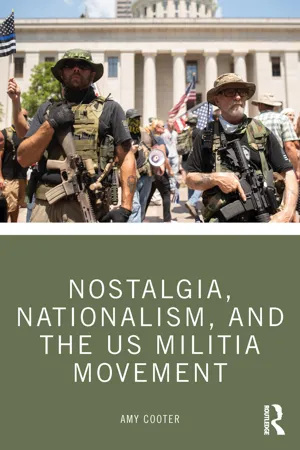
- Amy Cooter(Author)
- 2024(Publication Date)
- Routledge(Publisher)
Historian John Mahon emphasizes this complexity, saying that in the lead-up to the war, “there were at least 13 different militia systems” (1983, p. 31) (emphasis added), meaning that each colony at best had its own, distinct organizational structure, while some colonies relied on local organization that may have differed even across neighboring towns. Historian Darren Mulloy suggests that it is easiest in this context to think of militias as being “adjuncts” to the Continental Army’s efforts for most of the war effort, helping to supplement more official and organized forces (2008, p. 62). In some places, militias were also responsible for finding men to effectively be drafted into the official Continental Army. But they did not draw soldiers from their own ranks, preferring to leave those men behind to protect their local communities. Militia towns would instead pool resources to pay other men, usually the most severely economically marginalized ones, to be conscripted in militia members’ place. Most colonial soldiers did not serve in the war because of a sense of duty or loyalty to an emerging national ideal, but rather “because they were the ones least able to resist a crass economic appeal” (Shy, 1990, p. 128). Many Revolutionary War soldiers were effectively mercenaries, men whose loyalty was to a paycheck rather than to a higher calling or to their community, a notion that belies our usual storytelling of these soldiers’ character. Shy even goes so far as to say that while pre-war militias were focused on ideas of defense and territorial acquisition, Revolutionary militias were “a police force and an instrument of political surveillance” (ibid., p. 176) against other colonists that forced men to publicly take a side regarding the conflict during conscription efforts eBook - ePub
- C. Edward Skeen(Author)
- 2021(Publication Date)
- The University Press of Kentucky(Publisher)
Chapter 1The Militia before the War of 1812
Two of England’s legacies for the American colonists were a fear of standing armies and a reliance upon citizen soldiers, or militiamen, for defense. The British generally left the local defense to the colonies, and they in turn placed responsibility for local defense on the colonial towns and the towns’ militia. By regarding every man as a trained, armed soldier prepared to respond to any emergency, the colonists sustained a belief that there was no need for a professional, standing army. Consequently, there was no organized interColonial Militia system, no central command, and no permanent commissariat.1During the Revolutionary War numerous problems arose in the use of militia. Short enlistments limited their availability; they lacked discipline and training; and they were poorly armed and led. Early in the war General George Washington confessed that he felt a “want of confidence, in the generality of the Troops.” His experience confirmed him in his opinion, and his famous statement regarding the militiamen was often repeated: “[They] come in, you cannot tell how; go, you cannot tell when, and act, you cannot tell where, consume your provisions, exhaust your stores, and leave you at last in a critical moment.” So many problems arose that the Continental Congress moved cautiously to create a regular army, which played an important role in winning independence. Nevertheless, of the 395,858 men who served during the American Revolution, 164,087 were militiamen.2After the war, Washington and other military leaders recommended maintaining a small national force as well as proposing plans to improve and perfect the state militia forces to create, essentially, a national militia. A common feature of all these proposals by Washington, Baron Friedrich von Steuben, Henry Knox, and Alexander Hamilton was to make the state militia systems uniform and interchangeable when they were called into duty by the national government. In order to achieve the goal of uniformity and interchangeability, the training had to be carried out under the auspices of the national government, and militiamen were to be classed by age, with the youngest given more training and kept in a higher state of readiness; not all men were to be trained. These proposals, however, were met by two major objections: the cost of the training elicited criticism, and there were fears that such training would create an elite militia force equivalent to a standing army. State leaders opposed the plans, and nothing was done.3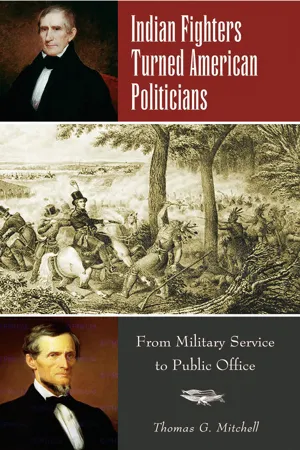 eBook - PDF
Indian Fighters Turned American Politicians
From Military Service to Public Office
- Thomas G. Mitchell(Author)
- 2003(Publication Date)
- Praeger(Publisher)
1 The Militia and Indian Wars INTRODUCTION One of the first institutions founded in the New World by the English colonists—whether in religious colonies as in Massachusetts or Pennsylvania or in royal colonies like Virginia—was the militia. The militia has a long history in Europe in general and England in particular. As relations with the native population deteriorated, the militia grew in importance. Later the interjection of European imperial rivalries into North America increased the need even more as the French began actively aiding the Indians against the British settlers. During the eighteenth century, as the colonists became more established, they began to exert their independence; and the legislatures of the colonies became training schools for American politicians and statesmen. As the cen- tury went on there arose a power struggle in nearly every colony between the royal executive in the form of the governor and the "democratic" legisla- tures. The colonists saw themselves as Englishmen, with all the rights of Englishmen won in the English Civil War and the Glorious Revolution. As taxes were levied after the French and Indian War in an attempt to make the Americans pay a greater share of their own defense, the cry of "no taxation without representation" was taken up. Eventually the militia and the legislature came together as the Second Continental Congress began to organize the militias for revolution. Throughout the American Revolution, the militias played a crucial part in providing both a basic manpower pool from which to recruit for the 2 Indian Fighters Turned American Politicians Continental army and an emergency backing for the army in local battles. They also provided the Patriot generals of the Revolution, men like black- smith Nathaniel Greene, bookseller Henry Knox, tavern keeper Israel Putnam, Benedict Arnold, Benjamin Lincoln, and Daniel Morgan. eBook - ePub
- Peter Karsten(Author)
- 2013(Publication Date)
- Routledge(Publisher)
A New Look at Colonial MilitiaJohn W. Shy*T HE subject of the militia has produced some passionate writing by American publicists, soldiers, and historians. Defenders of the militia—those who believe that a universal military obligation is the proper way to defend a society—are fond of stressing that only when free men must themselves fight to protect their liberty are they likely to remain free. The Colonial Militia, in particular, represents the happy uniqueness of America, where Englishmen in the seventeenth century revived this military relic of the middle ages just as in Europe it was sinking beneath the superiority of the politically dangerous mercenary army on the battlefield. Critics of the militia—many of them professional soldiers—point a different moral, one that rests on the apparent inefficiency of militia in combat, and on the way that the myth of defense by militia led again and again to tragic unpreparedness for war.There is one point, however, where critics and defenders appear to agree: it is on the assumption that the militia, especially the Colonial Militia, is a fairly static institution; once its simple theory of organization has been described, there seems little need to watch it as closely for signs of deviation and change as one would watch, say, political institutions. Historians have tended to go along with this assumption, as they have generally accepted the major tenets of both defenders and critics; in short, the militia is usually regarded as both politically healthy and militarily inefficient, but in any case relatively uncomplicated.1 eBook - ePub
- Peter M. Karsten(Author)
- 1986(Publication Date)
- Free Press(Publisher)
The Colonial Era Passage contains an image
1A New Look at Colonial Militia JOHN W. SHYSome have argued that military systems are major forces, shaping the political and social order; others see them as essentially reflective of the societies they serve. The history of the several compulsory and voluntary militia and expeditionary military organizations of the colonial era provide evidence relevant to these questions.* John Shy’s “new look at Colonial Militia,” a comparison of the military systems of different colonies throughout the seventeenth and eighteenth centuries, certainly suggests a diversity of experience, reflecting differing colonial social and economic settings and political purposes.THE SUBJECT OF THE MILITIA has produced some passionate writing by American publicists, soldiers, and historians. Defenders of the militia—those who believe that a universal military obligation is the proper way to defend a society—are fond of stressing that only when free men must themselves fight to protect their liberty are they likely to remain free. The Colonial Militia, in particular, represents the happy uniqueness of America, where Englishmen in the seventeenth century revived this military relic of the middle ages just as in Europe it was sinking beneath the superiority of the politically dangerous mercenary army on the battlefield. Critics of the militia—many of them professional soldiers—point a different moral, one that rests on the apparent inefficiency of militia in combat, and on the way that the myth of defense by militia led again and again to tragic unpreparedness for war.SOURCE : John W. Shy. “A New Look at Colonial Militia,” William and Mary Quarterly , 20 (April 1963): 175-185. Copyright 1963 by John W. Shy. Reprinted by permission.EDITOR’S NOTE
Passage contains an image
1A New Look at Colonial Militia JOHN W. SHYSome have argued that military systems are major forces, shaping the political and social order; others see them as essentially reflective of the societies they serve. The history of the several compulsory and voluntary militia and expeditionary military organizations of the colonial era provide evidence relevant to these questions.* John Shy’s “new look at Colonial Militia,” a comparison of the military systems of different colonies throughout the seventeenth and eighteenth centuries, certainly suggests a diversity of experience, reflecting differing colonial social and economic settings and political purposes.THE SUBJECT OF THE MILITIA has produced some passionate writing by American publicists, soldiers, and historians. Defenders of the militia—those who believe that a universal military obligation is the proper way to defend a society—are fond of stressing that only when free men must themselves fight to protect their liberty are they likely to remain free. The Colonial Militia, in particular, represents the happy uniqueness of America, where Englishmen in the seventeenth century revived this military relic of the middle ages just as in Europe it was sinking beneath the superiority of the politically dangerous mercenary army on the battlefield. Critics of the militia—many of them professional soldiers—point a different moral, one that rests on the apparent inefficiency of militia in combat, and on the way that the myth of defense by militia led again and again to tragic unpreparedness for war.SOURCE : John W. Shy. “A New Look at Colonial Militia,” William and Mary Quarterly , 20 (April 1963): 175-185. Copyright 1963 by John W. Shy. Reprinted by permission.EDITOR’S NOTE eBook - PDF
The Military in the Early Modern World
A Comparative Approach
- Markus Meumann, Andrea Pühringer, Markus Meumann, Andrea Pühringer(Authors)
- 2020(Publication Date)
- V&R Unipress(Publisher)
During the reign of Elizabeth I, the English militia had essentially become a “small select group of able-bodied, middle class men” who were organized around local units, called trainbands. Rarely, however, did these trainbands actually meet for drills. If so, as E. Wayne Carp emphasized, the meetings resembled social gatherings rather than actual training. Militarily, these militia units were essentially use- less. 58 In North America, however, faced with the near-constant threat of Indian attack, Colonial Militias used “universal compulsory service for all free adult white males” to establish their forces. In some cases, the draft even extended to men on the margins of society. Everybody had to train and serve if needed. 59 Nevertheless, militia units in the New World, just like in England, were pri- marily defensive-oriented military institutions. In many ways, moreover, militia organization and function changed significantly over time and varied greatly 54 Quoted ibid. 55 Lois G. Schwoerer, “No Standing Armies!” The Antiarmy Ideology in Seventeenth-Century England, Baltimore 1974. 56 Lawrence Delbert Cress, Citizens in Arms: The Army and the Militia in American Society to the War of 1812, Chapel Hill 1982. 57 Charles Royster, A Revolutionary People at War: The Continental Army and American Character, 1775–1783, Chapel Hill 1979. 58 Carp, Early American Military History (cf. note 4), p. 268. 59 Ibid., p. 269. Daniel Krebs 294 © 2020, Vandenhoeck & Ruprecht GmbH & Co. KG, Göttingen ISBN Print: 9783847110132 – ISBN E-Book: 9783847010135 from colony to colony. John Shy detailed some of those variations in a 1963 essay. He highlighted the great differences in structure and personnel between New England and Virginia militias. 60 More recently, Harold Selesky stressed not only that militia organization and social composition varied from North to South, but even within New England. eBook - ePub
Armed America
The Remarkable Story of How and Why Guns Became as American as Apple Pie
- Clayton E. Cramer(Author)
- 2009(Publication Date)
- Thomas Nelson(Publisher)
108Seventeenth and eighteenth century Whigs argued that militias were intrinsically virtuous instruments of government power because they reflected the concerns and interests of a broad, landed gentry. While these theories had been largely accepted in Colonial America, they were more abstract than heartfelt. Americans believed in the militia system because it was flexible enough to handle attacks by naval forces, Indians, or slaves, without the expense of a standing army, either raised locally, or sent from Britain. As Parliament sought to assert its authority after the French &Indian War ended in 1763, those who would later style themselves as Patriots based their arguments against standing armies in Whig terms. The role of British regulars in the Boston Massacre, and enforcing Parliament's laws punishing Massachusetts in the 1770s, both confirmed the theory, and inflamed public sentiment against standing armies.109 These sentiments dominated American military policy into the nineteenth century.It is easy to pick particular examples from the period 1607–1775 to demonstrate almost any level of militia competence. Colonial Militia competence reflected the varying levels of recent military experience of the men involved, how necessary the citizens regarded the existence of that militia, and the extent to which colonists saw a direct connection between their own interests and military service. Passage contains an image
Threatening Shadows: Guns in the Hands of the Other2While Colonial governments trusted most people with guns—indeed, required gun ownership of many—this trust was not universal. Governments sometimes disarmed individuals as punishment for criminal behavior. More often, governments distrusted particular groups. Unsurprisingly, Colonial governments rarely trusted enslaved blacks and Indians with guns—but some masters trusted some slaves with guns—enough so that legislatures passed laws to either prohibit or closely regulate this practice. (Especially in the seventeenth century, Indian prisoners of war were often enslaved. South Carolina's slave population in 1708 was one-third Indian.)1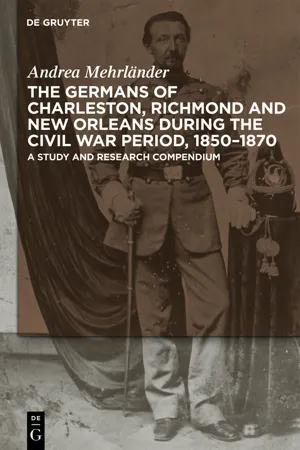 eBook - PDF
The Germans of Charleston, Richmond and New Orleans during the Civil War Period, 1850-1870
A Study and Research Compendium
- Andrea Mehrländer(Author)
- 2011(Publication Date)
- De Gruyter(Publisher)
IV. The Antebellum Militias of South Carolina and Virginia up to December 1860: Organization and Significance IV. The Antebellum Militias of South Carolina and Virginia up to December 1860: The legal basis for the establishment and organization of the militia system in the United States was the Constitution, 1 as extended by the “Uniform Militia Act” of 1792. This law stipulated that every fit white man between the ages of eighteen and forty-five was obligated to serve in the militia. Colored men, whether free or not free, were forbidden to carry weapons. Free colored men were obligated to serve in the militia, but could serve only in pioneer units, the labor corps, or the music corps. 2 As was customary throughout the United States, the militia armies of the states of Louisiana, South Carolina, and Virginia evolved organizationally from a hybrid status that was established in the 1850’s 3 and was followed until the outbreak of the Civil War: line militia companies (regular militia men) served along with volunteer militia companies, 4 but the latter were integrated administratively into the regular troop units. After serving for an uninterrupted period of seven years, of which at least two years had to be in the same company, members of volunteer companies had satisfied their militia service requirements and were no longer called up for exercising and training practice. 5 A militia company, not counting the officers, was composed of at least thirty (later fifty) and at the most sixty-four men. The most apparent characteristic of the dual militia, as opposed to the standing army, was the lack of permanent territorial formations, since the soldiers were organized only for training purposes and usually as companies and not as regiments. eBook - ePub
A Short, Offhand, Killing Affair
Soldiers and Social Conflict during the Mexican-American War
- Paul Foos(Author)
- 2003(Publication Date)
- The University of North Carolina Press(Publisher)
Thus it was the persistence of the militia ethic rather than its demise that is striking. The actual usefulness of militias as keepers of order or as defenders against invasion proved to be marginal. Working people rebelled against militia service when it became an instrument of compulsion, with rules and leadership imposed by state government. The opponents of universal militia service objected to appointed officers, and exemptions for the well-to-do, but military service was not necessarily objectionable to them when they could choose their own group affiliations and their own leaders —even if those leaders were from an elite economic or political background.In the 1820s and 1830s poor and middling folk in Philadelphia, New York, Albany, New Haven, and other cities showed blatant contempt for compulsory militia service. The notorious Colonel Pluck was a half-witted stable hand elevated to leadership of a Philadelphia militia battalion. Militia conscripts paraded him through the streets ridiculously mounted and uniformed, followed by militiamen likewise out of uniform and carrying cornstalks and broomsticks. This was a deliberate affront to the system of appointed officers and preferences granted to wealthy members of volunteer companies.In the 1820s and 1830s Pennsylvania allowed paid deferments for those who could afford it, while laborers, mechanics, and artisans gave up their time and supplied their own weapons and uniforms. Those who could afford to, formed volunteer militia companies composed of their social equals, and it was out of the ranks of the latter that the smartly caparisoned regimental officers were chosen. Workingmen criticized the officers and the volunteer companies as unrepublican in their finery and because of the preferential political connections through which they obtained their commissions.23But at the local, or company, level the social and political function of the militia had a strong appeal and the voluntarist impulse was alive and well, manifesting itself in political clubs and volunteer fire companies. Volunteer organization was not only for the elite; it allowed people at all social levels to assert group identity.24 Fire companies became even more popular than militias in the 1830s and 1840s as egalitarian expressions of small-group democracy, combining solidarity and an exemplary heroism. Like the militias, fire companies were often socioeconomically mixed, encompassing merchants, industrialists, tradesmen, and artisans. But they manifested strongly egalitarian ideas and practices: a manly solidarity in the face of danger and arduous labor; social cohesion within a small group; and a willingness to use violence against groups they perceived as a danger to the community, such as immigrants or lawbreakers. Also, like the independent militias, the volunteer fire company was swept away by large-scale politics and economic rationalism in the decades before the Civil War.25 eBook - PDF
- Corinna Jentzsch(Author)
- 2022(Publication Date)
- Cambridge University Press(Publisher)
Vigilantism is therefore “an exercise in power” (Bateson 2020, 1) and is closely linked to how elites or communities attempt to shape political order. During war, militias are involved in counterinsurgency and the protection of communities. While the majority of militias operate in peacetime, they are very common in civil wars. Carey Mitchell, and Lowe (2013, 255) find that 43 percent of all pro-government militias are active when the country experi- ences a civil war, and in 81 percent of country-years during which the country experiences a civil war, there is militia activity. In contemporary civil wars, militias have been cost-effective force multiplicators and help the state deny accountability for violence, as they can outsource such violence to militias (Carey, Mitchell, and Lowe 2013). But also in the past, during the antic- olonial wars, for example, occupying forces frequently created and collabor- ated with local forces who knew the terrain well and were able to collect crucial intelligence (Coelho 2002; Branch 2009; Bennett 2013). Militias have always been important tools for state repression. States have delegated mass violence against civilians to militias throughout history (Ahram 2014; Üngör 2020). In addition, communities themselves often form militias to protect themselves, such as during the long and violent civil wars in Colombia, Guatemala, and Peru. These groups were encouraged or co-opted by the state or formed in cooperation with social and political elites (Mazzei 2009; Romero 2003; Remijnse 2001; Starn 1995). Usually, community-initiated militias recruit residents for nightly patrols, collecting intelligence, and warning the population of imminent attacks. In many cases, such militias professionalize and militarize over time, at times collaborating with the government or even substituting the army. In this emerging research agenda on domestic third actors, many issues remain unexplored.
- H. Richard Uviller, William G. Merkel, Neal Devins, Mark A. Graber, Neal Devins, Mark A. Graber(Authors)
- 2003(Publication Date)
- Duke University Press Books(Publisher)
This doctrine, in substance, had like to have lost us our indepen-dence. It cost millions to the United States that might have been saved. The facts which from our own experience forbid a reliance of this kind are too recent to permit us to be the dupes of such a suggestion. The steady operations of war against a regular and disciplined army can only be successfully conducted by a force of the same kind . . . . The American militia, in the course of the late war, have, by their valor on numerous occasions, erected eternal monuments to their fame; but the bravest of them feel and know that the liberty of their country could not have been established by their efforts alone, however great and valuable they were. War, like most other things, is a science to be acquired and perfected by diligence, by perseverance, by time, and by practice. 179 As Hamilton hinted, the militia was not quite so consistently use-less as Washington had suggested. In the action at Bunker Hill, for instance, volunteer companies formed in anticipation of hostilities acquitted themselves very well. But they were defending fixed posi-tions. What Washington realized from the start of the war was that no American amateurs, not even elite volunteer units who had de-voted long hours to training, could successfully engage mainline British Regulars in pitched battle on open fields. 180 Washington did not have sufficient confidence in his Continentals—even after the institution of systematic European-style drill under Inspector Gen-eral Steuben—to challenge British strength directly with the best of American regular forces. 181 American success depended on surprise, maneuver, an excellent artillery arm, and taking outnumbered British 66 the militia and the right to arms eBook - PDF
- Peter Karsten(Author)
- 2005(Publication Date)
- SAGE Publications, Inc(Publisher)
PERMIT ME TO CALL your attention to the subject of the Militia of the Commonwealth. —A well regulated militia “held in an exact subordination to the civil author-ity and governed by it,” is the most safe defence of a Republic. —In our Declaration of Rights, which expresses the sentiments of the people, the people have a right to keep and bear arms for the common defence. The more generally therefore they are called out to be disciplined, the stronger is our security. No man I should think, who possesses a true republican spirit, would decline to rank with his fellow-citizens, on the fancied idea of a superiority in circumstances: This might tend to introduce fatal distinctions in our country. We can all remember the time when our militia, far from being disci-plined, as they are at present, kept a well appointed hos-tile army for a considerable time confined to the capital; and when they ventured out, indeed they took possession of the ground they aimed at, yet they ventured to their cost, and never forgot the battle of Bunker Hill. The same undisciplined militia under the command and good conduct of General Washington, continued that army confined in or near the capital, until they thought proper to change their position and retreated with haste to Halifax. —If the Militia of the Commonwealth can be made still more effective, I am confident that you will not delay a measure of so great magnitude. I beg leave to refer you to the seventeenth article in our Declaration of Rights, which respects the danger of standing armies in time of peace. I hope we shall ever have virtue enough to guard against their introduction.
Index pages curate the most relevant extracts from our library of academic textbooks. They’ve been created using an in-house natural language model (NLM), each adding context and meaning to key research topics.

