History

Depression of the 1890s
The Depression of the 1890s was a severe economic downturn that affected the United States and other industrialized nations. It was characterized by widespread unemployment, bank failures, and a sharp decline in agricultural and industrial production. The depression led to social unrest and political movements advocating for economic reforms, and it ultimately set the stage for the progressive era in American history.
Written by Perlego with AI-assistance
Related key terms
1 of 5

10 Key excerpts on "Depression of the 1890s"
 eBook - PDF
Democracy in Desperation
The Depression of 1893
- Douglas Steeples, David O. Whitten(Authors)
- 1998(Publication Date)
- Praeger(Publisher)
Commercial conditions thus fostered a spirit of imperialism that impelled the United States to extend into “a virtually new world which ripped up the assumptions of the previous century and forced the American people to face the inexorable consequences of a lost security and a forfeited freedom of action.” 30 Carl N. Degler’s sprightly Age of the Economic Revolution, 1876–1900 is the sole example of a general survey of latenineteenthcentury America that sets the Depression of the 1890s at the center of events. Although granting the course of the business crisis but brief mention, Degler showed how the disease of depression that followed the financial panic of 1893 ignited an unprecedented wave of labor strikes, pushed class antagonism to new heights, and provoked a major realignment in politics. The Populist rebellion climaxed and subsided, but the Republican Party capitalized on depressioninspired discontent to forge a new majority. The country, meanwhile, turned to adventurism overseas. A home market insufficient to restore prosperity fueled an expansionist drive for foreign markets that eventuated in war with Spain and the annexation of Hawaii in 1898. 31 Clearly, then, a growing fund of annals, statistical indices, and literature has attested that the Depression of the 1890s was a profound influence on national life. The depression served as a setting for a transformation creating an urban and industrial society, posed grave economic and social problems demanding prompt solution, sharply tested the resourcefulness of the country’s leaders and people, helped reshape popular attitudes and thought, altered the political equilibrium, and changed the direction of foreign policy. It remains, however, for these disparate matters to be treated together in detail, and for one study to trace and interpret the economic history of the business contraction in the context of national development. eBook - PDF
English Farming : Past and Present
New (sixth) Edition
- Rowland E. Prothero(Author)
- 2019(Publication Date)
- Routledge(Publisher)
CHAPTER XVIII THE GREAT DEPRESSION AND RECOVERY, 1874-1914 S i n c e 1862 the tide of agricultural prosperity had ceased to flow; after 1874 it turned, and rapidly ebbed. A period of depression began which, with some fluctuations in severity, continued through-out the rest of the reign of Queen Victoria, and beyond. Depression is a word which is often loosely used. It is generally understood to mean a reduction, in some cases an absence, of profit, accompanied by a consequent diminution of employment. To some extent the condition has probably become chronic. A decline of interest on capital lent or invested, a rise in wages of labour, an increased competition for the earnings of management, caused by the spread of education and resulting in the reduction or stationary character of those earnings, are permanent not temporary tendencies of civilisation. So far as these symptoms indicate a more general distribution of wealth, they are not disquieting. But, from time to time, circumstances combine to produce acute conditions of industrial collapse which may be accurately called depression. Such a crisis occurred in agriculture from 1875 to 1884, and again from 1891 to 1899. Industrial undertakings are so inextricably interlaced that agri-cultural depression cannot be entirely dissevered from commercial depression. Exceptional periods of commercial difficulty had for the last seventy years recurred with such regularity as to give support to a theory of decennial cycles.1 In previous years, each recurring period had resulted in a genuine panic, due as much to defective information as to any real scarcity of loanable capital. The historic failure of Overend and Gurney in 1866 and the famous “ Black Friday ” afford the last example of this acute form of crisis. Better means of obtaining accurate intelligence, more l £.g. 1825-6, 1836-7, 1847, 1857, 1866, 1877-8. eBook - ePub
- Philip R. Yannella(Author)
- 2010(Publication Date)
- Wiley-Blackwell(Publisher)
1 The Depression and the Early 1940s The ContextFrom the Civil War through the 1920s, there was a great deal of poverty in the United States. Decades of protest, political agitation, and unionization efforts were not successful in altering basic economic conditions and the near-revolutionary agitation of the years between 1916 and 1919 ended in total loss for reformers, unionists, socialists, and other dissidents. The prosperity of the 1920s helped some people in some regions and economic sectors of the country. But all ships were not raised on the tide of prosperity; some economic sectors, including the large agricultural sector, continued to suffer.The long-term problems of farmers were exacerbated during the 1930s by severe drops in the price of farm products and drops in consumer demand. Farming became an even more tenuous occupation than it had been, farm profits thinner, farm families less stable. Parts of the country were also struck by a multiyear drought. The hardest hit was the so-called Dust Bowl, a large area that included western Kansas, the southern edge of Nebraska, southeastern Colorado, the northwestern corner of Oklahoma, northwestern Texas, and the northeastern edge of New Mexico. Wind storms across the Dust Bowl carried away topsoil made vulnerable to erosion by poor farming practices, crops failed year after year, great numbers of farms went into foreclosure, and local economies were devastated.Popular representations of 1930s farmland conditions sometimes make it seem that all except very wealthy farmers failed and left the land. In actuality, according to the occupational summaries of the 1930 and 1940 Censuses, the numbers of farmers and tenant farmers grew during the decade, from 5.0 million in 1930 to 5.1 million in 1940. The number of farm laborers, people who worked for wages on farms, however, declined from 4.4 to 3.0 million. eBook - ePub
The Climax of Capitalism
The U.S. Economy in the Twentieth Century
- Tom Kemp(Author)
- 2014(Publication Date)
- Routledge(Publisher)
A decade of crisis: 1929—1939By its unexpectedness, its scale and its duration, the Great Depression of the 1930s had a traumatic effect on all sections of American society. Coming as a sequel to several years of prosperity which had led business spokesmen and leading economists to forecast a new era of crisis-proof expansion, it proved to be the longest and deepest in history.For three and a half years following the Wall Street crash, the economy continued on a downward plunge, ruining millions of small businessmen and farmers, condemning one quarter of the labour force to unemployment and almost destroying the banking system. In what Americans proudly assumed was the richest country in the world, the living standards of many unemployed workers and poor soil farmers fell to 'third world' levels. The blow to the 'American dream' was so sudden and severe that the reaction of many was one of disbelief and passivity rather than of anger. There was no sharp turn to the left by a segmented working class, no mass middle-class support for a far-right saviour - though both tendencies were later to appear.The explanation of the Great Depression poses many problems for economists and it is not surprising that no consensus should exist. Many were, and still are, reluctant to attribute it to some organic weakness of capitalism, looking rather to extraneous circumstances, mistakes in government policy or wrong decisions by the monetary authorities.The Greatest Depression
Most accounts of the Depression begin with the Wall Street crash, so that the beginning of the Depression can be exactly dated to 24 October 1929. It is unlikely that the crash would have been followed by such devastating consequences had there not been about this time the coming together of various factors making for a slump. The crash, while particularly severe, was a financial panic of a classic type familiar in the financial history of European countries as well as the United States. Its form was a rush into liquidity by those holding shares, and later, other types of paper - bonds, securities, bills of exchange bringing prices crashing down. In the previous months share prices had been rising at an extraordinary rate, the result of excessive speculation in which large numbers of people, including many newcomers to stock-market transactions, had been participating. In such speculative manias, a time comes when confidence in the continued upward movement of stock-market prices begins to break. Some feel the urge to sell before the fall begins, or become overcommitted and have to sell to settle payments elsewhere. Once selling generates a fall there is a good chance that the movement will spread until it becomes an avalanche. Weaknesses and frauds are exposed, and it becomes virtually impossible to reverse the trend. eBook - PDF
From Versailles to Pearl Harbor
The Origins of the Second World War in Europe and Asia
- Margaret Lamb, Nicholas Tarling(Authors)
- 2017(Publication Date)
- Bloomsbury Academic(Publisher)
Chapter 4 The Depression While the Wall Street crash of October 1929 has been seen as signalling the onset of the Great Depression, it is acknowledged that its causes were more long-standing and complex. There had been no major reconstruction of the whole international economy following its dislocation by the war, only piecemeal attempts to return to pre-war conditions. Many problems, whose origins lay in the pre-war period, were not recognised. In Britain, for instance, the need for the modernisation of its old staple industries, particularly shipbuilding and mining, was ignored. Several years before 1929 there was an overproduction of primary products with a consequent decline in prices. The rural parts of Germany, many of the east European states and the mainly primary producing British Dominions, as well as rural America, were already experiencing the adverse effects of this situation when the financial crash occurred. Much of the European economic recov-ery in the 1920s had been dependent on American loans, usually short-term ones. Germany had had something approaching $4 billion and Austria $3 billion. Prior to the 1929 crash, this flow of American capital abroad had been shrinking as investors were tempted by the boom in their own country, but after the crash, the flow became a mere trickle. Markets contracted, businesses failed, banks collapsed and millions faced unemployment throughout Europe. The Depression was clearly a turning-point in economic history: it brought a setback in a long period of expansion, hitherto interrupted only by smaller cycles of recession. It affected the industrial countries, the USA, the UK and other European countries, and Japan; and it affected the countries outside Europe that produced food and raw materials for the industrial world – the Australasian dominions, Argentina, Indonesia, Burma and Malaya. It prompted governments to reappraise their economic policies. eBook - ePub
- Phillip Cottrell(Author)
- 2019(Publication Date)
- Routledge(Publisher)
The Depression, 1866 to 1869The financial depression after the crisis of 1866 was both long and severe for although there are indications that the capital market was beginning to revive in 1868, a major upswing in economic activity did not develop until the last quarter of 1869. Foreign trade, the continuing engine of economic growth, began to recover during the closing months of 1868. However, the revival of financial and business activity was hesitant being disturbed by the Franco-Prussian war and affected by the course of the American business cycle. In England the slow unwinding of the speculative and heady boom of the first half of the 1860s was a continuing demper on business psychology during the last four years of the decade. The Economist remarked in December 1866:"The state of the money market indicates that much money is lying idle which the owners do not know what to do with. Confidence is said to be shaken and in many things is shaken. But as soon as any investment is proffered in which the public have faith, be it a Russian loan, or a Queensland loan, or a Victoria loan - the sums subscribed commonly exceed the sum asked for. There is evidently a mass of money craving for a safe and not extreme income, if only it knew where to find it."1These remarks were echoed and amplified by The Bankers' Magazine seven months later:"One of the most remarkable evidences of the intensity of the panic of 1866 is the extraordinary and long-ending depression which it has left behind it ... But the strange, the discouraging thing is, that the entire market for every kind of investment is similarly affected. For the first time in half a century the monetary world seemed inclined to go back to the safe simplicity of three per cents, or the moderate interest to be made by lending money on mortgage, or laying it out on freeholds or long leases."2 eBook - PDF
- Sir Arthur Salter(Author)
- 2016(Publication Date)
I remember asking at the time whether depression was universal in America and extended to every industry, and I was told that in one case demand exceeded supply —the demand for strong boxes to guard gold deposits. The effect was to make gold scarce, to increase its value and again therefore to force down the prices of commodities in terms of gold. Meantime the fear of every business that its creditors might default led to anxiety as to whether it would itself be able to meet its obligations; there was, therefore, everywhere a tendency to prefer liquidity to the extension of enterprise on which employment depends. Current deposits in banks were preferred to investments in business not immediately realizable; and when distrust DURING THE DEPRESSION 61 in the banks spread, deposits were liable to be withdrawn and converted to gold, with a consequent strain on the banking system. This process of deflation was the most disastrous char-acteristic of the whole crisis. For though it was primarily due to international causes (the breakdown in the system of international obligations and lending, the scarcity, in relation to a demand increased by panic, of gold, and con-sequent fall of gold prices), and was primarily expressed through a restriction of world trade and a reduction of its price structure, its most fatal effect was to dislocate the in-ternal economy of each country. The extent of productive activity and of employment depends upon profitability, upon an excess of obtainable prices over costs. Costs tend to be rigid, and under modern conditions more and more rigid. A sharp and prolonged fall of prices therefore, while sometimes reflecting a reduction of trade due to other causes, spreads depression in radiating circles of reduced employment and purchasing power.
- Andrés Solimano(Author)
- 2020(Publication Date)
- Cambridge University Press(Publisher)
That finan- cial meltdown destroyed financial wealth, made consumers feel poorer, and induced them to cut purchases of durable and nondurable goods. In turn, several waves of bank failure took place between 1930 and 1932. This generated panic among depositors, who started withdrawing their depos- its, leading to a contraction in the supply of credit and inducing a fall in investment and output. 3 In France, in part due to its policy of maintaining an undervalued franc that stimulated exports and import competing industries, eco- nomic activity was strong before the Great Depression (which, in turn, had a less severe impact upon the French economy). In Britain, unlike in France and the United States, there was no previous boom before the Great Depression, confirming Keynes’s apprehensions that an overval- ued pound was bad for the British economy. Some Central European nations such as Austria, Poland, and Czechoslovakia were badly affected by the Great Depression, with long and severe contractions in economic activity and increases in unem- ployment. In primary-goods exporting countries in the periphery of the world economy (Latin America, Africa, Asia) that were very dependent upon external markets for their internal dynamism, the effects of falling agricultural products and mineral commodity prices, and a fall in capital inflows in the late 1920s, gave rise to a complex balance of payment situa- tions. Gold reserves were dwindling and this affected the ability to serve their external debts, creating serious pressures to devalue their currencies. According to Kindleberger there was an “agricultural depression” in the late 1920s affecting the price of wheat, cotton, sugar, milk, and other agri- cultural goods. This could have been initiated as early as 1927 in countries such as Australia and Argentina. No longer available |Learn more
American Education
A History
- Wayne J. Urban, Jennings L. Wagoner, Jr., Milton Gaither(Authors)
- 2019(Publication Date)
- Routledge(Publisher)
9 The Effects of Depression and War on American Education 1930–1946Overview
The period of the Great Depression and its immediate aftermath, the World War II years, present a special challenge to those who would make sense of its educational developments. In discussing these years, the enormous economic cataclysm that engulfed all of American society, including its schools, is examined first. Next, the massive social dislocations that accompanied the depression, including some substantial changes in the schools, are considered. In spite of these changes, schools during and immediately after the Great Depression resembled their predecessor institutions of the 1920s as much as they differed from them. The deterioration in economic support for the schools that took place during the depression, however, threatened their ability to prosper in the following decades.School Continuity during the Depression
As the end of the last chapter suggests, American public schools and those who worked in them were remarkably inward looking during the 1920s. The widespread appearance of prosperity, although an illusion for many, inhibited school people and others from examining the relationships between their institutions and the larger society. Also, as in most other segments of American society, school people hardly noticed the stock market crash of October 1929, since its effects did not immediately reach the schools and those who worked in them. Thus, although historians date the Great Depression to late 1929, financial support for public schools in all but a few cases remained stable until well into the 1930s.Political and ideological circumstances, especially at the national level, also delayed any quick responses to the depression by school boards and school administrators. For example, Herbert Hoover, elected to the presidency in 1928, would stay in office for almost three years following the stock market crash. A businessman and engineering expert, Hoover symbolized the commitment to business efficiency that characterized so many school administrators of that era. Thus, it was unlikely that schoolmen would easily discard their belief in efficiency, even as the depression deepened and public opinion turned against business. Instead, like the president, school leaders believed that the economic prosperity of the 1920s would soon reappear. Thus, they continued to support the ideology of educational efficiency that had dominated their vision since early in the twentieth century.1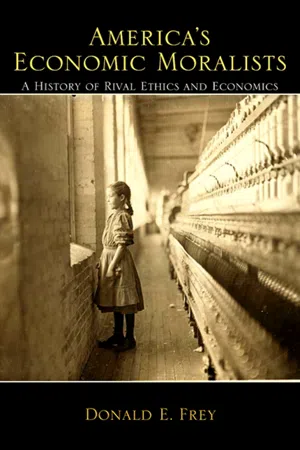 eBook - PDF
America's Economic Moralists
A History of Rival Ethics and Economics
- Donald E. Frey(Author)
- 2009(Publication Date)
- SUNY Press(Publisher)
Hoover worried that relief for the unemployed would undermine individual initiative. Compared to political leaders, the eco- nomics profession adapted quickly. Many economists by 1930 recommended active government intervention in the economy. The Depression stimulated 131 ELEVEN The 1920s and 1930s Depressed Old Values new economic theories to explain why an economy that could produce more would fall into a state of unemployment and poverty. Turning first to the 1920s, we observe efforts to mesh individualistic values with the new experi- ence of abundance and large-scale firms. THE 1920s World War I did much to set the moral climate of the 1920s. According to one commentator, “having at last paid their dues” Americans could with clear con- science turn to more self-oriented behavior (McElvaine 1984, 10). The war had provided precedent for economic activism by government in administering agricultural prices, encouraging unions, and guiding wide sectors of business with a War Industries Board. In the 1920s, the nation retreated from such gov- ernment activism. The decade witnessed the rise of consumerism, spurred by advertising, as rising productivity created an every-increasing flow of goods (see McElvaine 1984, 17). Consumption on such a scale undercut old individ- ual virtues such as thrift and self-discipline. Another remnant of the Puritan heritage, the duty of productive labor in a calling, lost appeal when compared to the fruits of speculation—largely in the stock market and real estate. 1 If these were trends among well-off people, what were the values of skilled workers? Labor leader Samuel Gompers perhaps reflected his con- stituency in accepting the legitimacy of capitalism and business management. Gompers’s values blended a small measure of worker solidarity with a larger measure of individualism.
Index pages curate the most relevant extracts from our library of academic textbooks. They’ve been created using an in-house natural language model (NLM), each adding context and meaning to key research topics.

