History

Great Depression Literature
Great Depression Literature refers to the literary works produced during the 1930s in the United States, which reflected the social and economic conditions of the time. These works often depicted the struggles of ordinary people, the impact of poverty and unemployment, and the search for hope and meaning in a time of crisis. Some notable examples include John Steinbeck's "The Grapes of Wrath" and Richard Wright's "Native Son."
Written by Perlego with AI-assistance
Related key terms
1 of 5

3 Key excerpts on "Great Depression Literature"
 eBook - PDF
Great Depression
People and Perspectives
- Hamilton Cravens(Author)
- 2009(Publication Date)
- ABC-CLIO(Publisher)
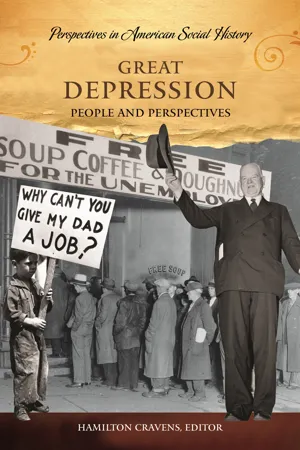
American Society and Culture in the Age of the Great Depression Part 1 The Great Depression in the Countryside Derek Scott Oden 1 Privation Down on the Farm The Great Depression represents a peculiar epoch in the history of twentieth- century America. The nation’s continuous march toward technological, politi- cal, and economic ascendancy stood still for a time. After the stock market crash of 1929, the country was sent into a painful tailspin as a mysterious ill- ness infected and spread to its every organ. Americans spent a decade attempt- ing to vanquish the malady; however, an effective medicine was delayed until the onset of World War II. Although it ushered in an era of unprecedented carnage, the conflict did finally end a depression that had gripped the nation for a decade. During the period, the crisis produced unemployment, poverty, and unrelenting want, which took a terrific toll upon Americans. The peoples’ suffering is graphically communicated by images depicting haggard unemployed waiting wearily for nourishment in long soup lines and abandoned farmsteads buried by a devastated region’s desiccated and windblown soil, pictures that have been seared into the nation’s collective memory. The era’s atmosphere of desperation is also symbolized by photo- graphs of individuals who by the thousands opted to ride the rails in search of work. Such circumstances bear witness to how hard times tested the forti- tude of even the most hardworking and determined individuals. Although many Americans would enjoy the benefits of a reinvigorated economy dur- ing the 1940s, large numbers forever possessed the Great Depression’s psy- chological scars, always fully aware of the transitory nature of prosperity. The era represented not only a time of great economic misfortune and need, but also a period of profound change.
- Elizabeth L. Wollman, Kevin J. Wetmore, Jr., Patrick Lonergan, Kevin J. Wetmore, Jr., Patrick Lonergan(Authors)
- 2017(Publication Date)
- Methuen Drama(Publisher)
But the Depression colored the 1930s, lifting only once the United States entered the Second World War in December 1941. Popular imagination looks back on the Great Depression as an era during which all Americans were abruptly plunged into a wretched, hardscrabble subsistence economy: one long, gray breadline peopled by desperate, gray citizens. The statistics were certainly dramatic, and millions suffered mightily through the 1930s in search of food, steady work, and shelter. This was especially the case for people who were already poor and disenfranchised, as well as for Americans who were adversely affected by the Dust Bowl, which 77 A Critical Companion to the American Stage Musical 78 hit the American prairie like some sort of cruel joke midway through the decade. There were, however, also millions of Americans who made it through the era without an overabundance of hardship. Many citizens held onto their jobs (if sometimes at reduced salaries), or benefited from the Works Progress Administration and other New Deal agencies. Even in the worst of times, many remained able to feed their families, meet rent or mortgage payments, and even afford the occasional travel or leisure outing (Jones 2003, 80). After all, if consumer spending had ground to a halt in the US during the Great Depression, mass entertainment would have died along with it. Instead, as often occurs in times of crisis, American popular entertainment flourished through the darkest days of the Great Depression. Hollywood grew stronger through the 1930s as Americans searched for affordable ways to forget their troubles. And while it took an enormous financial hit from which it had to struggle mightily to recover, the American commercial theater survived, too, growing less financially and artistically frivolous in the process. As its citizenry suffered through the era, America’s commercial entertainments not only reflected the times but helped the country through them. eBook - ePub
America and Its Sources
A Guided Journey through Key Documents, 1865-present
- Erin L. Conlin, Stephan Schaffrath, Erin L. Conlin, Stephan Schaffrath(Authors)
- 2019(Publication Date)
- Milestone Documents(Publisher)
Throughout history, the American economy has had periods of growth followed by periods of recession and depression. That is part of a normal economic cycle. What made the depression of the 1930s so “great,” however, was the scope and scale of the disaster. Roughly a quarter of the nation was unemployed during the 1930s. (In a healthy economy, unemployment rates are typically about 4 to 5 percent.) Millions of Americans became migrants—people with no permanent home—because they had lost their land or jobs working in agriculture. No one knew how to end the Depression, because to date, the nation had never suffered such a severe one. Franklin Delano Roosevelt, elected president in 1932, promised to lead the country in a new direction.Note: When you’re referring explicitly to the Great Depression, “Depression” is capitalized. When speaking generally about an economic depression, it is lowercase.Unit Questions 1. Why is the Great Depression seen as a watershed moment in American history? To answer this question, think about the many ways that it affected all sorts of people across the country.2. How did different groups of people experience the Depression differently? Create a matrix or diagram with a list of different types of people (on the left) and the ways in which these people experienced the Depression (on the right).3. How and why did the role of the U.S. government change in society from the 1920s through the 1930s? Here it would be helpful to make two lists of government policies: one for policies that contributed to the Depression and another one for policies that were designed to lift the country out of the Depression. Passage contains an image
6.2 Herbert Hoover: “Rugged Individualism” Campaign Speech (1928)Historical ContextFollowing World War I, the United States pulled back from international affairs and focused on domestic growth. The Republican Party led efforts to roll back Progressive-era legislation to stimulate business growth. Although Republicans did not call it laissez faire,
Passage contains an image
6.2 Herbert Hoover: “Rugged Individualism” Campaign Speech (1928)Historical ContextFollowing World War I, the United States pulled back from international affairs and focused on domestic growth. The Republican Party led efforts to roll back Progressive-era legislation to stimulate business growth. Although Republicans did not call it laissez faire,
Index pages curate the most relevant extracts from our library of academic textbooks. They’ve been created using an in-house natural language model (NLM), each adding context and meaning to key research topics.

