History

Discovery of Penicillin
The discovery of penicillin is credited to Scottish scientist Alexander Fleming in 1928. While studying bacteria, Fleming noticed that a mold called Penicillium notatum had antibacterial properties, leading to the development of the first antibiotic. This breakthrough revolutionized medicine by providing an effective treatment for bacterial infections and laid the foundation for the development of numerous other antibiotics.
Written by Perlego with AI-assistance
Related key terms
1 of 5

10 Key excerpts on "Discovery of Penicillin"
 eBook - ePub
- Helen Sheumaker(Author)
- 2017(Publication Date)
- Greenwood(Publisher)
staphylocci that had a mold growing on it with a distinctly white appearance. More important, the staph bacteria flourished on the parts of the dish where the mold was absent; where the mold was, the staph culture had receded and shrunk. He subcultured the mold (that is, removed a minuscule part of it, grew more of it in a clean petri dish, and saved it). It remains unclear where the original mold spore came from. Perhaps the spore clung to a lab worker’s jacket? Maybe it came from the cellar of Fleming’s residence or the laboratory. Serendipity lay in the mold spore managing to develop on the staph-covered petri dish; preparation lay in Fleming’s methods and his quickened response in realizing that the mold was the start of something extraordinary: the age of penicillin.By the mid-1930s, about the time this petri dish of cultured pencilli was saved, Fleming’s penicillin was still relatively unknown. As Adolf Hitler took power in the early 1930s scientists fled Germany for safety, and one, Ernst Boris Chain (1906–1979), a German Jew, fled to Britain. There he successfully purified penicillin, making it possible to treat bacterial infections. When World War II broke out the utility of penicillin was obvious, but the cost and production put the drug out of reach. This was a question about manufacturing the drug at the scale required to lower the cost and produce enough to meet the need.The British turned to the Americans, handing over the proprietary formulas. In Peoria, Illinois, a team of researchers struggled to secure a stable mold spore sample that was easily reproducible, allowing for quick, easy culturation (that is, to grow the necessary molds for penicillin; not all molds, or even all strains of penicillium, produce the penicillin needed). A local woman working in the laboratory, Mary Hunt (dates unknown), brought in a moldy cantaloupe from a local market. The mold produced the needed species. By 1943, 10,000 gallons of penicillin, enough for 100,000 doses, were manufactured in record time. Scientists openly shared the information with the Allies in the war. In World War I, 150 men died out of every 1,000 casualties due to infections caused by bacteria; this number was nearly brought to zero with the liberal use of penicillin.SIGNIFICANCEPenicillin was one of many ways that medical science has been able to control the damage wrought by contagious bacterial, viral, and other infections. Bacterial infections include tetanus, anthrax, diphtheria, gonorrhea, and other diseases. Viruses cannot be cultured like bacteria and cause diseases such as rubella, mumps, the common cold (for which there is no effective treatment), and acquired immunodeficiency syndrome (AIDS). Antibiotics are drugs derived from microorganisms that inhibit the growth of other microorganisms, as Fleming’s penicillium prevented the staphylocci eBook - PDF
The New Medicines
How Drugs are Created, Approved, Marketed, and Sold
- Bernice Z. Schacter(Author)
- 2005(Publication Date)
- Praeger(Publisher)
Soon after, quinine was isolated from the bark of a tropical tree (Landau et al. 1999). The development of the fields of physiology and pharmacology provided insights into how the various organs and systems of our body work and how drugs interact with those systems to bring about their effects, both desirable and unwanted. This led to the discovery of more and more active drugs, not only by identification of active principles from known natural sources but also by the synthesis of new compounds. Drugs to treat pain and fever were discovered. Vaccines and serums to protect against infectious diseases followed, based on a growing understanding of the basis of infectious diseases such as smallpox, diphtheria, typhoid, and anthrax. The discovery of the first antibiotic, penicillin, by Fleming is often seen as a lesson of the value of accidents to the prepared mind. The popular story of a contaminated culture plate found after a vacation break is true. What is often not described are the half-century-old in- sights that preceded the discovery of the penicillin-producing mold and the organized international industrial effort it took to bring the drug to reality as a treatment for infections, an effort made urgent by the ongoing World War II. In 1877, Louis Pasteur found that microorganisms themselves produce compounds that kill other types of microorganisms to rid 24 THE NEW MEDICINES themselves of competition for scarce nutrients. Pasteur's discovery was the reason Fleming was doing the work of looking for the antibiotic. Fleming's discovery in 1928 eventually yielded the first pure antibiotic, but only after an international team of scientists, driven by the need for treatment of infections from battlefield surgery, mounted a drive to de- velop a process to purify enough penicillin to treat a patient. The first patient was treated in 1942 (Goldsworthy and McFarlain 2002). eBook - ePub
Scientific Research In World War II
What scientists did in the war
- Ad Maas, Hans Hooijmaijers, Ad Maas, Hans Hooijmaijers(Authors)
- 2009(Publication Date)
- Routledge(Publisher)
3 Scientific research in the Second World WarThe case for Bacinol, Dutch penicillin
Marlene Burns
Yet, in relating the history of the development of penicillin, David Wilson begins by stating what he calls ‘the standard version of the penicillin story’ thus:In November 1945, the recovery of Maria Geene, a patient in Delft’s Bethel Hospital, signalled the success of the development of penicillin at NV Nederlandsche Gist- en Spiritusfabriek (NG&SF: Netherlands Yeast and Spirits Factory) in Delft, The Netherlands, during the Second World War, whilst under occupation by Nazi Germany.… penicillin, the first of the antibiotic drugs. First observed by Sir Alexander Fleming in 1928 when he noticed that a stray mould had killed germs on one of his culture plates. Developed by Lord Florey and Professor Sir Ernst Chain at Oxford in 1940. Mass produced by the U.S. pharmaceutical industry, it saved the lives of thousands of Allied servicemen and came into world use after the end of the Second World War.1However, Wilson submits that while no single item of this story is positively untrue, the whole adds up to a ‘myth’.2 Beginning with Fleming, Wilson claims he misinterpreted and misunderstood what he saw on his laboratory plate. He never found what was causing the effect he saw and never showed that ‘penicillin’ had any therapeutic or curative effect. Florey and Chain did indeed develop penicillin into a drug in their Oxford laboratory but this was not what they had set out to do in their original research programme. It had been a purely scientific investigation into the phenomenon of bacterial antagonism. Moreover, although mass production did take place in the United States, large-scale production also took place in Britain and Canada. However, for Wilson, the greatest distortion of the truth comes simply in the presentation of the penicillin story in a chronological order. While scientists, and most of the rest of us, have been brought up to believe that there is a steady build-up of knowledge and experimentation from the first observation of biological activity until the final product is marketed, this was certainly not the process in the case of penicillin. As Wilson points out, throughout its story penicillin is marked by the effects of luck, both good and bad, and sheer chance.3
- William T. Loging(Author)
- 2016(Publication Date)
- Cambridge University Press(Publisher)
1 The art and science of the drug discovery pipeline: History of drug discovery William T. Loging The disease condition is a standard in the lives of humans worldwide. As far back as the Roman era, early investigators pondered the reason for a wide array of disor- ders, such as typhoid and polio. In no place was this more evident than the bubonic plagues of the Middle Ages, which are reported as causing the deaths of more than 30% of the population in Europe (Alchon, 2003). As the observational science of biology grew, individual scientists increased their understanding of the underlying causes of human illness. In the nineteenth century, scientists like Louis Pasteur made significant contributions to the human understanding of microbiology and bacteriology. Pasteur’s determination to understand human illness was born of the fact that several of his children did not survive to adulthood (Feinstein, 2008), a standard occurrence preceding the advent of twentieth-century medicine. Less than 200 years ago, prior to Pasteur’s discoveries, it was coarsely thought that life spon- taneously generated from inert materials (Farley and Geison, 1974); this thinking gave little value to the washing of hands and other hygienic procedures. However, additional discoveries quickly followed, such as those made by innovative physician scientists like Joseph Lister, who deduced ground-breaking procedures on aseptic treatment of patients. The fundamentals of modern drug discovery can be found as an outline to the pioneering work of both Edward Jenner and Alexander Fleming. Although occur- ring more than 50 years ago, their contributions to combating human illnesses have collectively saved tens of millions of human lives; work that first started with an observation – one that caught their interest (Willis, 1997). eBook - PDF
Life Saving Drugs
The Elusive Magic Bullet
- John Mann(Author)
- 2007(Publication Date)
- Royal Society of Chemistry(Publisher)
An idea of the suc-cess of this innovation can be gained from the fact that by the end of the war, the US company Pfizer (the largest producer) was producing nearly 100,000 million units of penicillin every month, with enough overall to treat about a quarter of a million patients. The American public had been given a foretaste of this ‘magic bullet’ prior to its arrival on the battlefield. On November 28, 1942, a devastating fire at the Coconut Grove night club in Boston left around 500 people dead and many hundreds with serious injuries. Despite strict wartime secrecy, news leaked out that employees at Merck in Rahway, New Jersey, had worked around the clock to prepare enough of ‘an unnamed miracle drug’ in order to provide antibacterial treatment for these burn victims. In Britain, production lagged very much behind that of the US, and for most of the war, all the penicillin came from the Oxford Group. They treated a further 187 cases in 1942 with almost total success; but it was the belated Fighting Bacteria 47 involvement of Fleming that finally encouraged the government to take an interest in penicillin. In August 1942, a family friend of the Flemings became seriously ill with meningitis, and Fleming asked Florey for samples of peni-cillin and instruction on its use. These were freely given and the treatment was successful: Florey was good enough to give me his whole stock of penicillin to try on this, the first case of meningitis to be treated. After a few days’ treatment with intramuscular and intrathecal ( i.e. , directly into the blood vessels of the brain) injections the patient was out of danger and he made an uneventful recovery. The fortunate outcome of what had been a dangerous experiment obvi-ously made a huge impression on Fleming, because he immediately con-tacted friends in the government and a Penicillin Committee was soon established. The pharmaceutical industry was finally galavanised into action, and pencillin production began in earnest. No longer available |Learn more
Germ Theory
Medical Pioneers in Infectious Diseases
- Robert P. Gaynes(Author)
- 2020(Publication Date)
- ASM Press(Publisher)
With the help of chemists, Domagk and his team were testing some 30 chemicals a week for antibacterial activity. The Beginnings of the Penicillins Penicillin was discovered entirely by accident rather than by the me- thodical trial and error process leading to Prontosil. At nearly the same time that Prontosil was found, Alexander Fleming stumbled Alexander Fleming and the Discovery of Penicillin 267 over the antibacterial compound that was produced by another mi- croorganism, a mold. But his 1929 discovery would not find its way into clinical use for a decade. The reason for this delay had much to do with Fleming himself. Alexander Fleming: Early Influences Alexander Fleming was born on 6 August 1881 in southwest Scot- land (14). He was the second youngest of eight children. His father had two daughters and two sons by his first wife, who passed away. He remarried at the age of 60. His second marriage resulted in a son and a daughter before Alec (as he was known) was born. A younger brother was born 2 years later, in 1883. His father had a stroke and died when Alec was only 7 years old. Fleming’s extended family was largely responsible for raising the boy. He attended school on the moors until 1893, when he went to Kilmarnock Academy, the alma mater of Robert Louis Stevenson and Robert Burns. At the age of 13, Alec moved to London. He was enrolled in Regent Street Polytech- nic, where he did quite well in school. When Alec was 16, he took an apprenticeship with a shipping firm. Following the tradition of the males in his family, when Alec turned 18, he joined the London Scottish Rifle Volunteers. His short stature (he was 5 ft 6 in. tall) led to much teasing. Fleming did not have a prodigious career with the Volunteers, although he was an expert shot with a rifle. After 4 years out of school, Alec passed an examination that qualified him for en- trance into medical school.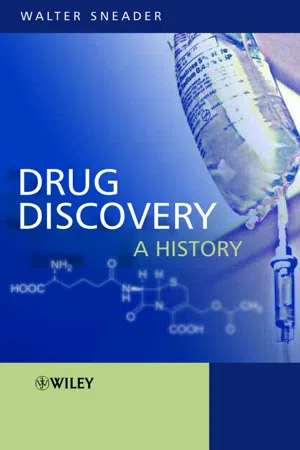 eBook - PDF
Drug Discovery
A History
- Walter Sneader(Author)
- 2005(Publication Date)
- Wiley-Interscience(Publisher)
His mission was greatly assisted by the presentation of a paper on penicillin a few months earlier by Martin Dawson, Karl Meyer and Gladys Hobby of Columbia University College of Physicians and Surgeons. This had been given at the annual conference of the American Society for Clinical Investigation, an abstract being published in their widely read journal. 35 The paper described how the authors had grown cultures of penicillin obtained from the Oxford team and briefly outlined clinical results on testing a crude preparation on patients. Several American companies had also conducted exploratory work on penicillin before the arrival of Florey and Heatley. 36 Merck agreed to proceed with penicillin production at once and also to exchange information with other interested parties, but the other companies reserved their position. After further meetings, Squibb and Pfizer joined in the collaborative effort. Another consortium calling itself the Midwest Group was formed when Abbott Laboratories, Eli Lilly Antibiotics __________________________________________________________________________________________________ 293 and Company, Parke, Davis and Company and the Upjohn Company also agreed to exchange information on penicillin. Wyeth Laboratories took up penicillin production near Philadelphia by growing the mould in cellars where mushrooms had previously been cultivated for the gourmet market. They became the largest producer of penicillin until deep fermentation processes were introduced. The first large-scale clinical use of penicillin in America was unrehearsed. On the night of 28 November 1942, over 500 people perished in a disastrous fire at the Coconut Grove night club in Boston. As soon as it was known that there were 220 badly burned casualties, the Committee on Medical Research authorised the release of supplies of penicillin in an attempt to reduce the anticipated mortality among the survivors. eBook - ePub
Accidental Medical Discoveries
How Tenacity and Pure Dumb Luck Changed the World
- Robert W. Winters(Author)
- 2016(Publication Date)
- Skyhorse(Publisher)
Many years earlier, Edward Jenner had accidentally overheard a conversation in which he learned that a cowpox infection on the hands of milkmaids conferred protection against the future development of smallpox. Subsequently, the folklore provided abundant confirmation in England and in Europe. But even though he did not know how that was accomplished, he concluded that the causative agent, which he called a virus, was transferable, since the only transmission to the milkmaids had to be the virus carried from the teats of the cow to the milkmaids’ hands. Once again, we see a prepared mind at work.REFERENCESBarquet, N. et al. “Smallpox: the triumph over the most terrible of the ministers of death.” Ann Intern Med. 127 (1997), 635–642.Friedman, M., and G. W. Friedland. “Edward Jenner and Vaccination.” Chap. 4 in Medicine’s 10 Greatest Discoveries. New Haven, CT: Yale University Press, 1998.Henderson, D. A. et al. “Working Group on Civilian Biodefense. Smallpox as a biological weapon: medical and public health management.” JAMA 22 (1999), 2127–2137.World Health Organization. Global Commission for Certification of Smallpox Eradication. The Global Eradication of Smallpox: Final Report of the Global Commission for the Certification of Smallpox Eradication. Geneva: World Health Organization, 1980. Passage contains an image
CHAPTER
10
Penicillin: The Crucial Role of Weather
The phrase that heralds a new discovery is not “Eureka!”
It’s “That’s funny.”
—Isaac Asimov, a uthorIntroductionT he story of penicillin has been told many times, often superficially and nearly always inaccurately. The following is a more complete account of this amazing discovery by Alexander Fleming. It deals with the critical role that the London weather played during September 1928. The unsung hero of this tale is Howard Florey, leader of the Oxford Group, whose great contribution was to bring penicillin from the laboratory to the bedside.The DiscoveryIn 1928, Dr. Alexander Fleming, nicknamed “Flem,” was happily working in a cramped lab in St. Mary’s Hospital in London. Fleming’s job was to isolate the bacteria that were causing diseases in patients. To do this, he would take a small, circular, covered glass plate called a Petri plate that was filled with nutrients on which bacteria would grow. Fleming would quickly lift the plate’s lid and smear a sample of some infectious fluid like pus or throat washings that had come from one of the patients. Speed was essential to minimize any contaminating bacteria or molds in the air from accidently dropping onto the plate when it was exposed. He would then put the plate into a warm (37°C) incubator to speed the growth of the bacteria. The next day the bacterial growth would have spread all over the plate. Fleming would then identify the bacteria under a microscope and determine to which bacterial family it belonged. He sent his reports back to the doctors in the hospital, who depended on them to guide the treatments of their patients.
Passage contains an image
CHAPTER
10
Penicillin: The Crucial Role of Weather
The phrase that heralds a new discovery is not “Eureka!”
It’s “That’s funny.”
—Isaac Asimov, a uthorIntroductionT he story of penicillin has been told many times, often superficially and nearly always inaccurately. The following is a more complete account of this amazing discovery by Alexander Fleming. It deals with the critical role that the London weather played during September 1928. The unsung hero of this tale is Howard Florey, leader of the Oxford Group, whose great contribution was to bring penicillin from the laboratory to the bedside.The DiscoveryIn 1928, Dr. Alexander Fleming, nicknamed “Flem,” was happily working in a cramped lab in St. Mary’s Hospital in London. Fleming’s job was to isolate the bacteria that were causing diseases in patients. To do this, he would take a small, circular, covered glass plate called a Petri plate that was filled with nutrients on which bacteria would grow. Fleming would quickly lift the plate’s lid and smear a sample of some infectious fluid like pus or throat washings that had come from one of the patients. Speed was essential to minimize any contaminating bacteria or molds in the air from accidently dropping onto the plate when it was exposed. He would then put the plate into a warm (37°C) incubator to speed the growth of the bacteria. The next day the bacterial growth would have spread all over the plate. Fleming would then identify the bacteria under a microscope and determine to which bacterial family it belonged. He sent his reports back to the doctors in the hospital, who depended on them to guide the treatments of their patients. eBook - ePub
Infectious
Pathogens and How We Fight Them
- John S. Tregoning(Author)
- 2021(Publication Date)
- S&S India(Publisher)
Working in the fraught early days of the Second World War, Florey and Chain rubbed spores of Penicillium into their clothes, so if forced to flee they could continue their research. Florey and Chain’s method was effective, but not effi cient enough to produce a drug in sufficient quantities to treat people, because the strain of Penicillium they used, P. notatum, didn’t produce much penicillin. Mary Hunt (or Mouldy Mary), working for the US Department of Agriculture in Peoria, Illinois, had the romantic job of searching local markets to find better strains. In 1943 she struck mould. She found a strain of P. chrysogenum on the skin of a going-off cantaloupe, which produced two hundred times as much penicillin. A bit like selecting cows for greater milk yield, the scientists selectively bred a more productive ye ast by bombarding it with X-rays. 4 Manufacturing scale-up followed and 2.3 million penicillin doses were prepared in time for the D-Day landings in 1944. Soldiers being soldiers, many of these doses were used to treat soldiers who had acquired STIs rather than battlefield injuries. In an unfortunate twist to Churchill benefiting from the German-developed sulfa drugs, Hitler was most likely treated with Allied penicillin following the von Stauffenberg bomb plot. Following the war, research on novel antibacterial drugs intensified and the twenty-year period from the end of the 1940s to the 1960s is often called the golden age of antibiotics. Half of the antibiotic drugs currently in use were discovered in this time period, including chloramphenicol, tetracycline, cephalosporin and vancomycin. Selman Waksman, a Ukrainian-born microbiologist, spearheaded this work while working at Rutgers in New Jersey. Rutgers is an institute dear to my heart, because it was where I began, and ended, my international rugby career – admittedly only 15 students from a cohort of 67,000 played rugby
- Heinz-Dietrich Fischer(Author)
- 2020(Publication Date)
- LIT Verlag(Publisher)
He proved it was nontoxic to rabbits and mice by injecting it into their ear veins and abdominal cavities. He used it as a surface dressing in several cases of infected wounds and reported that they seemed to clean up rapidly. He made, in 1929, the specific prediction that penicillin may prove to be an efficient antiseptic when injected into areas infected with penicillin-sensitive organisms. And at this point he stopped. He had demonstrated an apparently nontoxic substance which was effective against certain dangerous bacteria when grown in laboratory media. The problems which remained were the chemical one of producing penicillin in quantity and the clinical one of determining its effectiveness. These problems remained unsolved for ten years and even unattacked, save that, at the London School of Hygiene in I932, Raistrick grew the mold and attempted to extract penicillin from the culture media. He was dissuaded from continuing his experiments, as so many were very nearly dissuaded later, by the chemical difficulties involved in isolating such an unstable substance. 158 As Fleming had been the chief character in the first act of the penicillin drama so Sir Howard Florey, an Australian-born Professor of Pathology at Oxford, and his colleague, Ernest Chain, became chief characters in the second act - a sort of revival staged in I939. The philosophical implication of Fleming’s work was clear. The war between the species which we see going on all about us in the world, too closely about us, extended beyond our vision into the microscopic world. A mold dropped from the air onto a bacterial village, a colony, and its inhabitants were promptly liquidated. A very neat parallel. The demonstration was not entirely a new one. In Pasteur’s laboratory the destruc- tive effect of certain airborne bacteria upon the bacillus of anthrax had been observed.
Index pages curate the most relevant extracts from our library of academic textbooks. They’ve been created using an in-house natural language model (NLM), each adding context and meaning to key research topics.
