History

Louis Pasteur Germ Theory
Louis Pasteur's Germ Theory revolutionized the understanding of infectious diseases by proposing that microorganisms, or germs, are the cause of many diseases. This theory laid the foundation for modern microbiology and led to significant advancements in public health and medicine. Pasteur's work also contributed to the development of vaccines and sterilization techniques, ultimately saving countless lives.
Written by Perlego with AI-assistance
Related key terms
1 of 5

11 Key excerpts on "Louis Pasteur Germ Theory"
 eBook - ePub
- Theodore H. Tulchinsky(Author)
- 2018(Publication Date)
- Academic Press(Publisher)
Pasteur succeeded in producing vaccines through attenuation, or weakening an organism’s strength aging of the organism in the culture media, as for chicken cholera vaccine, or by passing it successively through animals, recovering it, and retransmitting it to other animals. He postulated that if a vaccine can prevent smallpox, then one can be created for all diseases. In collaboration with a physician, he inoculated chickens with chicken cholera germs taken from an old culture. The dispute continued, however, with “germ theorists,” “miasmists,” or “sanitationists” arguing with equal vehemence.When Pasteur published the concept that the very microorganisms that contaminated the liquids also floated in the air, it was met with ridicule and rejected by the medical establishment. Pasteur’s monumental proof of the Germ Theory, over time drastically influenced the way in which public health evolved. He proved the existence of germs and their role in disease causation, confirming previous discoveries and promoting new scientific development in microbiology and immunology.While the Germ versus Miasma issue was debated until the end of the 19th century, the practical application of sanitary reform was promoted by both theories. Increasing attention to sewage, water safety, and removal of waste products by organized municipal activities was adopted in European and North American cities. The Sanitary Revolution proceeded while the debates raged and solid scientific proof of the Germ Theory accumulated, primarily in the 1880s. Fear of cholera stimulated New York City to establish a Board of Health in 1866. In the city of Hamburg, Germany, a Board of Health was established in 1892 only after a cholera epidemic attacked the city, while the neighboring town remained cholera-free because it had established a water-filtration plant.The specific causation of disease (Germ Theory) has been a vital part of the development of public health. The bacteriologic revolution led by the work of Louis Pasteur and his rival Robert Koch provided enormous benefit to medicine and public health. But those who argued that disease is environmental in origin (the Miasma Theory) also contributed to public health because of their recognition of the importance of social or other environmental factors, such as poor sanitation and housing conditions or nutritional status, all of which increase susceptibility to specific agents of disease, or the severity of disease.
- Lois N. Magner(Author)
- 2009(Publication Date)
- Praeger(Publisher)
LOUIS PASTEUR Louis Pasteur was not the first to argue that germs caused infectious diseases, but his work was of paramount importance in demonstrating the relevance of germ theory to infectious disease, surgery, hospital management, agriculture, and industry. Generally involved in several major lines of research at the same time, Pasteur made major contributions to the study of fermentation; spontaneous generation; the diseases of wine, beer, silkworms, farm animals, and humans; the development of protective vaccines; and virology. In terms of human health and welfare, Pasteur’s work on vaccines as well as the development of techniques for sterilizing growth media and medical instruments and the process now known as pasteurization have saved more lives than any specific therapeutic intervention. In addition to his genius for selecting challenging, but feasible, research problems, Pasteur had a genius for self-promotion and was more than willing to publicly debate his critics. These debates helped bring scientific germ theory to the attention of a broad audience (see Figure 2.2). 32 A History of Infectious Diseases and the Microbial World Figure 2.2 Louis Pasteur. Credit: Library of Congress Prints and Photographs Division. Wash- ington, D.C. When he began his research career, Pasteur expected to devote himself to chemistry and physics, but his innate curiosity, and requests for his help in solving problems plaguing French agriculture and industries, led to his work on fermentation and med- ical microbiology. As Professor of Chemistry and Dean of Sciences at the University of Lille, Pasteur was expected to demonstrate that science could be applied to im- proving local industries. While investigating problems involved in the fermentation of beet juice, Pasteur became interested in the relationship between microorganisms and fermentation, especially when the process was unsuccessful. eBook - PDF
Germ Theory
Medical Pioneers in Infectious Diseases
- Robert P. Gaynes(Author)
- 2023(Publication Date)
- ASM Press(Publisher)
The Paris School of Medicine advocated that diseases were discrete entities that could be classified, first by their symptoms in life and then, by their pathologic anatomy at autopsy, in stark contrast to the holistic disease approach of Hippocratic/Galenic Louis Pasteur and the Germ Theory of Disease 9 127 128 • Germ Theory: Medical Pioneers in Infectious Diseases medicine. Disease specificity, a concept crucial to the development of the germ theory of disease, was extended by early 19th-century scientists. For example, Pierre-Fidèle Bretonneau proposed a “morbid seed” causing specific diseases such as diphtheria in the 1820s. William Gerhard in the United States provided evidence that typhus was a distinct disease from typhoid, following an 1833 epidemic in Philadelphia. William Budd in England published a book on typhoid fever, stressing the specific and unchanging nature of the disease. Claude Bernard proposed that disease had a clinical spectrum; only the end stage was seen in hospitals. He empha- sized experimental medicine where the laboratory, crucial for the germ theory, could be the seat for study of disease. While others had presented a concept that microscopic living organisms were the causative agents of diseases, especially those that occurred in epidemic form (1), it was Pasteur’s contributions to the germ theory of disease that ultimately led to its acceptance. A chapter on Louis Pasteur presents a considerable challenge. Louis Pasteur is probably the most notable nonphysician in the history of medicine (Fig. 9.1). Volumes have been written about Pasteur, including a biography from his son-in- law (2). Even with all that has been already written, his importance in the develop- ment of the germ theory of disease is crucial to include and still can present a few surprises to the reader. Pasteur researched the structure of chemical crystals and described the biological basis of fermentation of wine and beer. No longer available |Learn more
Germ Theory
Medical Pioneers in Infectious Diseases
- Robert P. Gaynes(Author)
- 2020(Publication Date)
- ASM Press(Publisher)
In 1868, the University of Bonn had awarded Pasteur an honorary doctorate to acknowledge his work in the role of microorganisms. During the Franco-Prussian war, Pasteur sent back the degree with an acerbic letter explaining his reasons. His dislike of Germany would play a role in a profes- sional dispute with Robert Koch some years later. The Germ Theory of Disease, Pasteur, and Medicine in the 19th Century Between 1857 and 1878, Pasteur contemplated and sought further evidence for the germ theory of disease, but the concept had not sprung from his mind alone. There were others in the 19th century who had come before Pasteur and deserve some consideration for 160 Germ Theory: Medical Pioneers in Infectious Diseases their efforts. Agostino Bassi, sometimes called de Lodi, was an ento- mologist who had discovered a disease of silkworms in Italy caused by a fungus that now bears his name, Beauveria bassiana. In 1844, he theorized that microorganisms caused human diseases. Perhaps the most prominent 19th-century individual whose work preceded Pas- teur was a pathologist named Jacob Henle. Henle wrote in his Pa- thologische Untersuchungen that: material of contagion is not only organic but living, endowed with in- dividual life and standing to the diseased body in relation of a parasite organism. (4) The difficulty that scientists had in proving this theory of disease to a skeptical physician audience was that there was little means to differentiate one microorganism from another despite the extraor- dinary differences in symptoms and signs of various infectious diseases. Henle even predicted that specific microscopic agents would be consistently found to cause certain diseases but did not have the methods at his disposal to prove his assertion. Curiously, Henle taught Robert Koch, who, along with Pasteur, would provide the scientific evidence for the germ theory. One other name worth considering for his pre-Pasteur work is John Snow.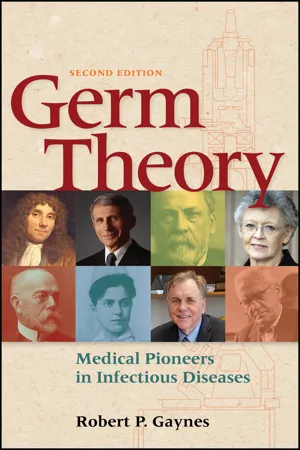 eBook - ePub
Germ Theory
Medical Pioneers in Infectious Diseases
- Robert P. Gaynes(Author)
- 2023(Publication Date)
- ASM Press(Publisher)
Disease specificity, a concept crucial to the development of the germ theory of disease, was extended by early 19th‐century scientists. For example, Pierre‐Fidèle Bretonneau proposed a “morbid seed” causing specific diseases such as diphtheria in the 1820s. William Gerhard in the United States provided evidence that typhus was a distinct disease from typhoid, following an 1833 epidemic in Philadelphia. William Budd in England published a book on typhoid fever, stressing the specific and unchanging nature of the disease. Claude Bernard proposed that disease had a clinical spectrum; only the end stage was seen in hospitals. He emphasized experimental medicine where the laboratory, crucial for the germ theory, could be the seat for study of disease. While others had presented a concept that microscopic living organisms were the causative agents of diseases, especially those that occurred in epidemic form (1), it was Pasteur’s contributions to the germ theory of disease that ultimately led to its acceptance. A chapter on Louis Pasteur presents a considerable challenge. Louis Pasteur is probably the most notable nonphysician in the history of medicine (Fig. 9.1). Volumes have been written about Pasteur, including a biography from his son‐in‐law (2). Even with all that has been already written, his importance in the development of the germ theory of disease is crucial to include and still can present a few surprises to the reader. Pasteur researched the structure of chemical crystals and described the biological basis of fermentation of wine and beer. He debunked the widely accepted concept of spontaneous generation. Pasteur solved the mysteries of silkworm diseases, chicken cholera, anthrax, and rabies, which contributed to the development of the first vaccines with attenuated microorganisms. These seemingly unrelated topics can be strung together in a surprisingly logical sequence through Pasteur’s life eBook - ePub
Great Feuds in Medicine
Ten of the Liveliest Disputes Ever
- Hal Hellman(Author)
- 2007(Publication Date)
- Trade Paper Press(Publisher)
Ever since 1857, when Pasteur had published his first paper on fermentation, he had been playing with the idea that there is a connection between germs and disease. His work with the diseases in silkworms pushed him even further in this direction. He worked continually to spread his germ theory of disease—but with little success.For example, one day in the late 1870s a famous physician was holding forth at the Academy of Medicine in Paris. Using lots of Greek and Latin terminology, he was explaining childbed fever as some sort of metabolic disorder.Suddenly a voice bellowed from the rear of the hall: “The thing that kills women with childbed fever—it isn’t anything like that! It is you doctors who carry deadly microbes from sick women to healthy ones . . . !”27 The voice was Pasteur’s, and he was again embroiled in one of his many celebrated battles.For despite the solid insights of Semmelweis, set forth a quarter of a century earlier (chapter 3), the medical establishment still refused to accept contagion as the disease’s cause. Pasteur, however, had something that Semmelweis did not, a mechanism to explain what was happening.The idea behind his germ theory seems simple enough today. Microorganisms such as bacteria, fungi, and protozoan parasites come from forebears of the same species; they are present in large numbers almost everywhere—in air, in water, in dust; finally, germs can therefore be understood as the causative factor in not only fermentation and putrescence but also in disease. Different diseases are caused by different microbes. It all fits together into such a neat package that it’s hard at first to understand why his germ theory was so controversial and took so long to be accepted.Recall, however, how difficult it had been earlier, and still was in Pasteur’s day, to combat vitalistic beliefs in the essential difference between living material and inanimate matter. There was still enough confusion that his ideas could be conflated with vitalism, and were sometimes used by its proponents to support their position. To Pasteur’s opponents, appealing to a living “germ” to explain a chemical reaction was a step backward.
- Lois N. Magner(Author)
- 2002(Publication Date)
- CRC Press(Publisher)
Using Schwann’s metabolic theory of the cell as a point of departure, Henle compared the action of contagion to fermentation. Well aware of the difficulties confronting the contagion theory of disease, Henle warned that finding some microorganism in the sick did not prove that it had a causal role. The agent must be isolated and cultured so that it was free from any toxins or tissues of the diseased individual. Indeed, Henle came close to outlining what are usually called “Koch’s postulates.” Acknowledging the lack of rigorous evidence for the germ theory of disease, Henle argued that science should not wait for unequivocal proofs because scientists could only conduct research “in the light of a reasonable theory.” A major problem in establishing the truth of germ theory was methodological. Obtaining pure cultures was a difficult and tedious procedure, almost impossible in the hands of any but the most meticulous experimentalists. Working out proper sterilization and culture procedures required a prior understanding of and commitment to the germ theory of disease. Given the state of the methods available until quite late in the nineteenth century, it was no wonder new animalcules seemed to appear spontaneously in the tempt-ing broths set out for them, as well as in the raw wounds of surgical patients. Confused by the claims of the heterogenesists, physicians tended to reject the germ theory or dismiss it as a laboratory curiosity unrelated to clinical medicine. But as Pasteur’s associate émile Duclaux declared: “The great merit of a new theory is not to be true, because there is no such thing as a true theory, but to be fruitful.”Research on crystals led Pasteur to investigate the nature of fermentation and the diseases of wine, beer, and vinegar. His next practical challenge was a mysterious disease threatening the silk industry of France, causing great despair and hardship in many households and villages. Although Pasteur knew very little about silkworms and their diseases, he expected to resolve the problem by finding a germ. The problem was more complex than expected, because it involved two different disease organisms, as well as nutritional and environmental effects. The epidemic was actually the result of complex interactions among host, germ, and environment. From silkworm diseases, Pasteur progressed to the riddle of disease in higher animals and, finally, to rabies in humans. During this phase of his career, Pasteur was devastated by the deaths of two of his daughters, his son’s war experiences, and a series of strokes that left him partially paralyzed.Medical microbiology owes much to Pasteur’s studies of chicken cholera, a disease unrelated to human cholera, except in the virulence of the infection. Chickens that picked at foods soiled with the excreta of the sick acquired the disease. Based on reports by veterinary surgeons that bacteria were present in the tissues of sick chickens, Pasteur isolated a microbe that could be cultured in a medium made of chicken gristle. A small drop of the fresh culture would quickly kill a chicken, but the microbe only caused a small abscess in guinea pigs. Eventually, Pasteur discovered that it was possible to produce weaker cultures of the microbe, which could be used as vaccines. Laboratory-created attenuated cultures did not cause disease when injected into chickens, but these inoculated animals resisted infection when they were later challenged by virulent cultures of the microbe. eBook - ePub
Vaccination and Its Critics
A Documentary and Reference Guide
- Lisa Rosner(Author)
- 2017(Publication Date)
- Greenwood(Publisher)
5
THE GERM THEORY AND VACCINATION (1870–1900)
THE GERM THEORY AND THE SCIENCE OF IMMUNOLOGY
- Document: Louis Pasteur, “Prevention of Rabies”
- Date: 1885, 1886
- Where: Paris, France
- Significance: Louis Pasteur, together with Robert Koch (see next section), was one of the founders of the germ theory, the theory that a specific microorganism causes a specific disease. He made bacteriology, the study of microorganisms, his life’s work. His research showed that an attenuated, or weakened, version of certain microorganisms could produce immunity to the disease in animals and inaugurated a worldwide effort to produce vaccines. In the section below, Pasteur explained the circumstances that led him to switch his efforts from producing immunity to rabies from dogs to people, specifically a nine-year-old boy, Joseph Meister (1876–1940).
DOCUMENT
Of twenty dogs treated, I could not render more than fifteen or sixteen refractory to rabies. Further, it was desirable, at the end of the treatment, to inoculate with a very virulent virus—a control virus—in order to confirm and reinforce the refractory condition. More than this, prudence demanded that the dogs should be kept under observation during a period longer than the period of incubation of the disease produced by the direct inoculation of this last virus. Therefore, in order to be quite sure that the refractory state had been produced, it was sometimes necessary to wait three or four months. The application of the method would have been very much limited by these troublesome conditions … eBook - PDF
Microbiology
Principles and Explorations
- Jacquelyn G. Black, Laura J. Black(Authors)
- 2018(Publication Date)
- Wiley(Publisher)
(Bettmann/Getty Images) 1. What similarities and differences do you see when comparing past epidemics of plague with today’s AIDS epidemic? 2. State the germ theory of disease. Try to think of an explanation of disease causation that would be contrary to the germ theory. 3. How did Pasteur’s experiment with “swan-necked” flasks disprove the theory of spontaneous generation? 4. Why was the French microbiologists’ method of broth dilution inadequate for obtaining pure cultures of organisms? STOP and CHECK Pocahontas died of smallpox in 1617, in England. Calves—shaved, inoculated, and covered with cowpox lesions— were led house to house by entrepreneurs who offered vaccination during American colonial times. 16 CHAPTER 1 Scope and History of Microbiology as bacteria had been developed. When Pasteur’s collabo- rator Charles Chamberland developed a porcelain filter to remove bacteria from water in 1884, he had no idea that any kind of infectious agent could pass through the filter. But researchers soon realized that some filtrates (materials that passed through the filters) remained infectious even after the bacteria were filtered out. The Dutch microbiologist Martinus Beijerinck determined why such filtrates were infectious and was thus the first to characterize viruses. The term virus had been used ear- lier to refer to poisons and to infectious agents in general. Beijerinck used the term to refer to specific pathogenic (disease-causing) molecules incorporated into cells. He also believed that these molecules could borrow for their own use existing metabolic and replicative mechanisms of the infected cells, known as host cells. Further progress in virology required development of techniques for isolating, propagating, and analyzing viruses. The American scientist Wendell Stanley crystal- lized tobacco mosaic virus in 1935, showing that an agent with properties of a living organism also behaved as a chemical substance (Figure 1.14). No longer available |Learn more
- Margaret Rodriguez(Author)
- 2016(Publication Date)
- Cengage Learning EMEA(Publisher)
The same heating process is used today to kill bacteria in milk and is referred to as pasteurization (see Figure 1-6). Pasteur’s proof of the relationship between food spoilage and microor- ganisms was a major contribution to the establishment of the relationship between disease and microbes. Before Pasteur, treatments for some diseases were estab- lished without knowledge of their etiology. Pasteur’s discov- ery of the link between yeasts and alcohol established an entirely new point of view within the scientific community. Scientists began pondering the possibility that microbes might actually cause illness, launching the idea known as the Germ Theory of Disease. For many, this radical theory that suggested that unseen microbes were responsible for disease was simply inconceiv- able. But during this Golden Age, scientists accumulated a wealth of information to support the theory. For example, in 1865 Pasteur discovered that a protozoan was responsible for a devastating silkworm disease. He then developed the Figure 1-6 1934 instructional flyer for maintenance of a safe milk supply, from the Minnesota Health Department. Courtesy of CDC/ Minnesota Department of Health, R.N. Barr Library; Librarians Melissa Rethlefsen and Marie Jones Copyright 2017 Cengage Learning. All Rights Reserved. May not be copied, scanned, or duplicated, in whole or in part. Due to electronic rights, some third party content may be suppressed from the eBook and/or eChapter(s). Editorial review has deemed that any suppressed content does not materially affect the overall learning experience. Cengage Learning reserves the right to remove additional content at any time if subsequent rights restrictions require it. 8 Microbiology for Surgical Technologists technique for recognizing the silkworm moths that were affected by the protozoan. In 1885, after several years study- ing rabies, a rhabdovirus carried in the saliva of infected host animals, Pasteur was faced with a professional dilemma.
- King-thom Chung, Jong-kang Liu(Authors)
- 2017(Publication Date)
- World Scientific(Publisher)
But he was beaten by Robert Koch (1843–1910), a Prussian country doctor, who turned the world upside down by his 1882 demonstration that tubercle bacillus was the cause of tuberculosis. Koch had earlier (1876) found the germ caused anthrax, a dreaded disease of humans and livestock and formulated Koch’s postulates (briefly that one organism transmits one disease). In 1850, the Hungarian physician Ignaz Semmelweis (1818– 1865) had stated the childbed fever (puerperal sepsis) was con-tagious and that the obstetric wards in Vienna were “pestholes”. Physicians sneered at this idea for many years, often in the face of Lister’s work on asepsis in hospitals. In the late 1870s, Pasteur disrupted a meeting of the Academy of Medicine in Paris and scandalized the Academy by shouting at a prominent physician lecturing (conventional) on the causes of childbed fever. Interrupting loudly, Pasteur told him bluntly that he was wrong about the cause and that the physicians themselves were carry-ing the infection. When the famous doctor told him that he Pioneers in Microbiology: The Human Side of Science 58 would never find the microbes, Pasteur limped to the rostrum, drew a chain of small circles on the board and announced, “I have found it already and here is how it looks!” Pasteur had not gotten into the medical field earlier because aside from his occupation with other projects, he knew nothing of anatomy and physiology, did not like the smell of hospitals and was squeamish about using animals for experi-ments. Fortunately, in the mid-1870s he took on three newly graduated physicians: Jules Joubert (1834–1910), Pierre Paul Emile Roux (1853–1933), and Charles Edouard Chamberland (1851–1908). The team began to study anthrax, collecting and growing various strains. With this, Pasteur examined the effi-cacy of “cures” pronounced by veterinarians and disproved them all. But some cows survived the disease, and Pasteur stud-ied these animals.
Index pages curate the most relevant extracts from our library of academic textbooks. They’ve been created using an in-house natural language model (NLM), each adding context and meaning to key research topics.
