History

German Catholic Church
The German Catholic Church refers to the collective body of Catholic institutions, clergy, and followers in Germany. It has played a significant role in the country's history, particularly during the Reformation and the subsequent religious conflicts. The German Catholic Church has also been influential in shaping social and political developments in Germany over the centuries.
Written by Perlego with AI-assistance
Related key terms
1 of 5
8 Key excerpts on "German Catholic Church"
 eBook - ePub
- Donald Dietrich(Author)
- 2017(Publication Date)
- Routledge(Publisher)
5 The Construction of the Modern Catholic Theological MilieuI
German Catholicism was galvanized during the Kulturkampf through a renewal of Catholic political influence and of theological reflection. The Kulturkampf consisted of a series of measures enacted between July 1871 and May 1873 and included the expulsion of the Jesuits from German territory, the dissolution of religious orders not dedicated to social care issues, and the “May Laws of 1873.” These measures effectively established state control of seminary training and the governmental approval of the appointment of the clergy. Bismarck’s political assault resulted in the emergence of the Catholic Center as an effective parliamentary party that could influence Reich policy in favor of the Papacy as well as serve as a rallying point for Polish, Hanoverian, and other anti-Prussian parliamentary forces. So crucial was the Catholic cultural dynamic stimulated by the Kulturkampf that Eduard Spranger has asserted that Catholicism as a cultural movement actually began to rival Protestantism as a vivifying cultural force.1 In the wake of Bismarck’s restrictions on the church, Catholicism experienced a constellation of dynamic theological, social, and political impulses that converged and promised a profound spiritual and cultural renewal along several developmental lines.2In 1908, Theodor Abele, for example, began an extensive study of French developments in philosophy, theology, and liturgy. Along with Herman Platz, he forged an academic link in 1911 with the liturgical innovations taking shape at the Benedictine Abbey at Beuron. In 1913 he contacted the Abbey of Maria Laach and its young and ardently nationalistic abbot, Ildefons Herwegen.3 A renewed Catholic literary impulse centering on Hochland and its editor, Karl Muth, also emerged during the period.4 Prior to World War I, Hochland focused on literary criticism, but subsequently began pursuing political and social challenges that Germans had to face after 1918. During World War II, the journal was banned by the Nazis because of its outspoken criticism of the regime and subsequently resumed publication in 1946. Turn-of-the-century German Catholicism was revitalized also by the new Youth Movement founded by Bernhard Strehler, Hermann Hoffmann, and Clemens Neuman. Perhaps even more important were the social-justice initiatives cultivated by the political scientist Franz Hitze, the textile industrialist Franz Brandts, and the extraordinary parliamentarian from the Center party, Ludwig Windthorst.5 No longer available |Learn more
Germany and the Confessional Divide
Religious Tensions and Political Culture, 1871-1989
- Mark Edward Ruff, Thomas Großbölting(Authors)
- 2021(Publication Date)
- Berghahn Books(Publisher)
But all are shaped by the reality noted by virtually every observer of the German religious landscape: Germany was historically a biconfessional land in which confessional identity, even for the less devout and nonprac-ticing, continued to play a significant role in shaping social interactions, the choice of a spouse, levels of education, and career prospects. But as much as the Peace of Westphalia had sought to maintain the confessional peace by keeping the confessions apart as much as possible, doing so was increasingly difficult because of social, economic, and political changes fol-lowing the defeat of Napoleon. These brought Germans of different faith backgrounds closer together, certainly at the highest level of politics but of-ten locally as well. The Prussian state expanded, annexing predominantly Catholic states in the west of Germany. As Germany unified, newly created political parties had to identify their voter base and craft identities and platforms out of them. This was not hard to do. The dislocations brought on by rapid economic growth and industrialization led to massive inter-nal migrations of both Catholics and Protestants into new regions during the course of the nineteenth century. The potential for conflict between a Protestant-dominated national state with a Protestant monarchy and Catholic and Jewish minorities was thus massive. Protestants, differences between Lutheran, Reformed, United, Kulturprotestanten notwithstanding, saw themselves as the Leitkultur and Catholics as a cultural threat. Jeffrey T. Zalar’s chapter accordingly explains how Catholics and Protes-tants clashed over the idea of culture. To Protestant charges that Catholics were dividing the nation, Catholics argued that Catholicism historically had provided the unity of Christendom: it was Protestantism that had de-stroyed this and continued to do so through its many fissures. eBook - ePub
Protestant-Catholic Conflict from the Reformation to the 21st Century
The Dynamics of Religious Difference
- John Wolffe(Author)
- 2013(Publication Date)
- Palgrave Macmillan(Publisher)
Reichsdeputationshauptschluss) of 1803, an assembly of princes in charge of compensating those who had lost their territory west of the Rhine rationalized what remained of the many splinters of territory east of the Rhine. The result was the demise of worldly territories in the patrimony of the Roman Catholic Church, the secularization of countless abbeys and cloisters, the dissolution of the domains of the Imperial Knights, and the end of the autonomy of numerous imperial cities. In the process, German middle-sized states enriched themselves: the previously largely Protestant state of Baden collected nine times more territory than it lost, and became a state made up of nearly two-thirds Catholics. Württemberg became nearly a third larger, and mainly added Catholic subjects. Bavaria, too, increased in size and population, swallowing a string of Protestant territories. Hanover, Oldenburg, and Prussia also expanded. Even prelates joined in the reorganization. In 1810, the former Archbishop of Mainz, Karl Theodor Anton Maria von Dalberg, combined the predominantly Catholic territories of Aschaffenburg and Fulda with the predominantly Protestant territories of Wetzlar, Hanau, and Frankfurt to create the short-lived Grand Duchy of Frankfurt. In all these cases, the religious identity of ruler and ruled, or the religious homogeneity of the subjects living within the territory, seemed of little concern.For the Catholic Church, the Imperial Deputation was, however, of central significance, with one historian, Karl Otmar Freiherr von Aretin, even calling it the ‘deepest caesura’ in the history of the ‘German Catholics’.38 In one blow, it eliminated the dual structure of spiritual principalities (in which the prince was also bishop, and the high clergy attained offices by dint of noble birth) and eliminated the Catholic Church as a functional member of the Imperial Estates. As a result, a fundamental reorientation began to occur. No longer a statelike church, Catholicism in Germany became a privileged religious association, with a clergy that, by the 1830s, was bureaucratically trained for, and concentrated on, the spiritual organization of the faithful. In this sense, Catholicism re-emerged as a religious confession among others, and religious differences were increasingly confined to social and public realms. Indeed, it was the secularization of the church and its property that forced reconstitution of the religious as an autonomous sphere.39 eBook - PDF
Catholicism and the Great War
Religion and Everyday Life in Germany and Austria-Hungary, 1914–1922
- Patrick J. Houlihan(Author)
- 2015(Publication Date)
- Cambridge University Press(Publisher)
For a pointed argument about clerics as “milieu managers,” see Blaschke, “Die Kolonial- isierung der Laienwelt.” 38 Thomas Mergel, “Milieu und Religion. ¨ Uberlegungen zur Ver-Ortung kollektiver Iden- tit¨ aten,” in Sachsen in Deutschland. Politik, Kultur und Gesellschaft 1830–1918, ed. James N. Retallack (Bielefeld: G¨ utersloh, 2000), 265–79. 39 Rudolf Morsey, “Die Deutsche Katholiken und der Nationalstaat zwischen Kul- turkampf und Erstem Weltkrieg,” Historisches Jahrbuch 90, no. 3 (1970): 31–64. More recently, see Barbara Stambolis, “Nationalisierung trotz Ultramontanisierung oder: ‘Alles f¨ ur Deutschland. Deutschland aber f¨ ur Christus’: mentalit¨ atsleitende Wertori- entierung deutscher Katholiken im 19. und 20. Jahrhundert,” Historische Zeitschrift 269 (1999): 57–97. 40 Alon Confino, The Nation as a Local Metaphor: W¨ urttemberg, Imperial Germany, and National Memory, 1871–1918 (Chapel Hill: University of North Carolina Press, 1997). 41 James E. Bjork, Neither German nor Pole: Catholicism and National Indifference in a Central European Borderland (Ann Arbor: University of Michigan Press, 2008). The Great War in Germany and Austria-Hungary 33 on petite-bourgeois and agrarian concerns. It was a world that was pre- capitalist, pre-industrial, and in many ways, pre-modern. Most Catholics lived in communities of under 10 000 inhabitants. According to the fig- ures of the 1907 census, Catholics formed 36.5% of all the citizens of the German Empire. Yet, Catholics were statistically overrepresented in the primary sector of the economy, where they made up 44.2% of all workers, and underrepresented in the tertiary sector, where they made up 29.9% of workers. 42 Catholics in Germany came from a wider spectrum of socio-economic development than did their counterparts in Austria-Hungary. Rapidly developing industrialization, especially in western areas of Prussia such as the Ruhr and Rhineland-Westphalia, caused major socio-economic shifts in heavily Catholic areas.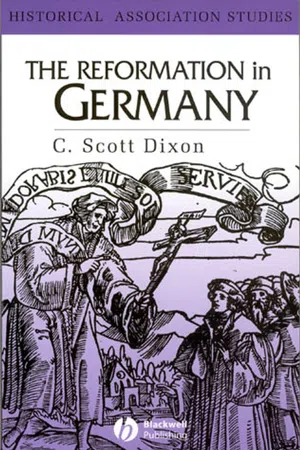 eBook - PDF
- C. Scott Dixon(Author)
- 2008(Publication Date)
- Wiley-Blackwell(Publisher)
In some cases, as in Austria, Saxony and Brandenburg, the territorial sovereigns had Religious Culture and the Reformation 35 been able to facilitate their hold over the Church by way of a special agreement with the papacy, but in most instances it was simply the result of force of rule. In both the electoral Palati-nate and Württemberg, for example, the gradual usurpation of ecclesiastical authority meant that the princes effectively dominated the territorial Church. Similarly, as early as the mid-fourteenth century the Duke of Bavaria could boast that the pope was powerless in his territories. This was testimony to a certain degree of cohesion at the territorial level, but this was also precisely the reason why the imperial Church remained so impo-tent and diffuse, as the author of the Reformatio Sigismundi recognized: ‘It is plain that the Holy Father, the pope, and all our princes have abandoned the task set them by God’ (Strauss, 1971, p. 6). There could be no general reform of an institution that lay in the hands of so many contending sovereign interests. But the problems gripped more than just the rule of the Church. In the German Nation, Catholicism of the medieval period was suffering from a lack of theological clarity. Schools of scholastic thought had multiplied throughout the Middle Ages, especially in the face of the crises of the fifteenth century, with the result that there was considerable complexity and con-fusion on the eve of the Reformation (McGrath, 1993, pp. 9–28). This doctrinal plurality weakened the integrity of the Church, and it would prove instrumental in the rise of the reform move-ments. When the Luther affair surfaced, no single Catholic voice could be raised in defence. eBook - ePub
- Peter Wende(Author)
- 2017(Publication Date)
- Bloomsbury Academic(Publisher)
Doctrinally they all shared Luther’s belief in the absolute authority of the Bible and in justification of the sinner by faith alone. But they differed on other matters, such as on the nature of the Holy Communion which, after the abolition of the Catholic Mass, became the focal point of Protestant worship; on forms of church organization; as well as on the political implications of their spiritual message. Three decades after the formulation of the Augsburg Confession the ‘Heidelberg Catechism’, issued in 1563, became the main confessional statement of the Calvinists.Thus after the middle of the sixteenth century, detailed and explicit confessions (that is, statements of faith) set out the essentials of the different Christian doctrines. These were at the centre of what German historians have recently characterized as ‘confessionalization’ – a process which ‘enabled the spirit of confessional Christianity to penetrate, transform and then reform the state, culture, the legal and intellectual realm, and indeed society’ as a whole.3 In spite of many and various forms of revolutionary change, religion had not become just a private matter; on the contrary, religious beliefs were even more than before a matter of public concern and formed a constituent part of national political identity within the framework of the evolving modern states.THE IMPACT OF THE REFORMATION ON THE COURSE OF GERMAN HISTORY
In considering the manifold far-reaching effects of the Reformation on the course of German history, the historian will come to paradoxical conclusions. In his own time Luther was regarded by many German humanist scholars as a national hero and later German national mythology saw him in the tradition of Arminius, venerating him as one of the founding fathers of the German nation. In actual fact, however, Luther’s Reformation produced profound and long-lasting religious, political and cultural divides within the nascent German nation.Whereas in Western Europe, as soon as confessional conformity had been established – though often as the result of prolonged and bloody inner wars as in France – powerful nation-states were on the advance, the merely partial success of the Reformation in Germany stood in the way of further political and cultural integration. And though at the turn of the century various projects had been discussed and even efforts made to reorganize the constitution of the Empire in order to strengthen its efficiency, the Reformation effected further consolidation of the self-sufficiency of the territorial states. As a minority in the councils of the estates of the Empire, the Protestant rulers had to be watchful guardians of their liberties against the efforts of the emperor and his Catholic allies to restore religious unity. Thus the Reformation intensified the centrifugal tendencies within the loose framework of the Empire. eBook - PDF
Were We Ever Protestants?
Essays in Honour of Tarald Rasmussen
- Sivert Angel, Hallgeir Elstad, Eivor Andersen Oftestad, Sivert Angel, Hallgeir Elstad, Eivor Andersen Oftestad(Authors)
- 2019(Publication Date)
- De Gruyter(Publisher)
Thomas Kaufmann Protestant Anti-Catholicism in Early Modern Germany 1 Introductory Remarks Viewed from the vantage point of twenty-first century Europe – in which much of mainstream society prides itself on its pluralism, the integration of minorities and the near-universal acceptance of a secular, tolerant and consensus-oriented Enlightenment order – many find it impossible to conceive of how not just reli-gious but even confessional differences provided the justification for systems of social and political exclusion within which both individuals and groups experi-enced defamation, discrimination and even systematic persecution. Contempo-rary ecumenically-minded Christians view the Reformation and its long after-math – during which Roman Catholics, Lutherans and Reformed Christians seemed to invest as much time and energy in defaming and ex-communicating each other as they did to the missionary fields – with bewilderment and embar-rassment, finding it not just immoral, but even “ un-Christian. ” In these more tol-erant and open times, it has therefore become de rigueur to engage in long and involved processes of contrition and reconciliation to achieve an ill-defined “ healing of memory ” , by which its practitioners hope to demonstrate the moral superiority of our present times and the level of civilization which we are all proud to have reached.¹ The German ‘ Protestant community ’ itself has a chequered history of divi-sion and hatred. The Lutheran and Reformed (Calvinist) parties required con-siderable time and effort to overcome doctrinal differences and reach a frosty unity based on perception of the common Catholic enemy. eBook - ePub
- Philip G. Dwyer(Author)
- 2014(Publication Date)
- Routledge(Publisher)
Even with the ascendancy of social history after 1970, confessional identity and religious culture were seldom taken as seriously as the influence of class and material interests when historians sought to explain the political orientations and behaviour of social groupings. A deeper appreciation of the centrality and force of confessionalism in Prussian social and political life came from new scholarship on the Kulturkampf, that placed this state-church struggle in the context of the unstable process of German nation state building and cultural coalescence, and from research on the social history of Catholicism in Germany, that focused on its distinctive subculture and massive associational life in the years after 1870. This historical scholarship has shed new light on two significant questions. How and why did confessional solidarities and conflicts come to play a central role in society and politics? What were the long-term historical consequences of the polarization and political mobilization of Catholics and Protestants for the national polity? The tendency of Catholics and Protestants to live in homogeneous areas marked the geographical terrain of Prussia with distinct confessional lines. Protestants constituted 95 per cent or more of the population in 13 governmental districts located in the eastern provinces of old Prussia and in the territory of Hanover annexed by Prussia in 1866. Although the Rhine Province, Silesia and Westphalia had more confessionally mixed populations, many counties here were confessionally homogeneous enclaves, with Catholics or Protestants forming a commanding majority of 80 per cent or more. The rural–urban migration that came in the wake of industrialization brought Catholics and Protestants closer together in Berlin, Breslau and other cities in the northern Rhineland and Westphalia
Index pages curate the most relevant extracts from our library of academic textbooks. They’ve been created using an in-house natural language model (NLM), each adding context and meaning to key research topics.

