History

Huguenots
The Huguenots were French Protestants who emerged in the 16th century as followers of John Calvin's teachings. They faced persecution and discrimination due to their religious beliefs, leading to conflicts with the Catholic majority. Many Huguenots fled France to seek religious freedom in other countries, contributing to the spread of Protestantism and influencing the cultures of their new homes.
Written by Perlego with AI-assistance
Related key terms
1 of 5
10 Key excerpts on "Huguenots"
 No longer available |Learn more
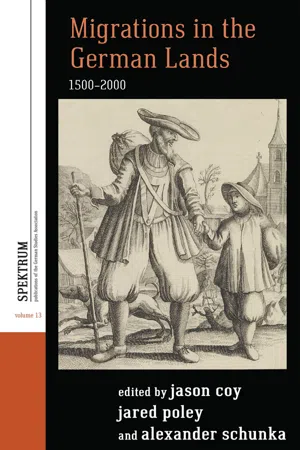
- Jason Coy, Jared Poley, Alexander Schunka, Jason Coy, Jared Poley, Alexander Schunka(Authors)
- 2016(Publication Date)
- Berghahn Books(Publisher)
73 Even during the Third Reich, the Huguenots were seen by some ideologists as descendants of the “Germanic” parts of the French people. 74 These are late phenomena, and as such they are part of another interesting story. However, they have their origin in the early his-tories of the Huguenot migration, for the most part written by the progeny of the immigrants themselves. It was the result of a process of defining and redefining identities within changing political situations and under differing circumstances. The case of the Huguenots is a good example of the varieties of images created during times of persecution and migration. These images served sev-eral different interests: the interest of the Protestant churches in Germany and their efforts to define their own identities against the Catholic threat, the political interest of a broad alliance against France in the late seventeenth and early eighteenth centuries, as well as the interest of the Huguenots and their supporters to market themselves as attractive immigrants for German principalities. These strategies, however, were the cornerstone of a tradition of Huguenot history that had impact well into the twentieth century. In this tradition Huguenots, as well as the Salzburgers, were depicted as exemplar-ily pious, industrious, and loyal to authority. The works of eighteenth- and nineteenth-century historians enforced this image and transferred it into popular knowledge. Even today, the Hugenottengesellschaft (Huguenot society) and local societies are keen to preserve at least parts of the Huguenot image and defend it against any attempt to undermine it. Ulrich Niggeman is director of the Institute of European Cultural History at the University of Augsburg. He received his doctorate at the University of Marburg in 2007. In 2015, he finished his habilitation at the University of Marburg.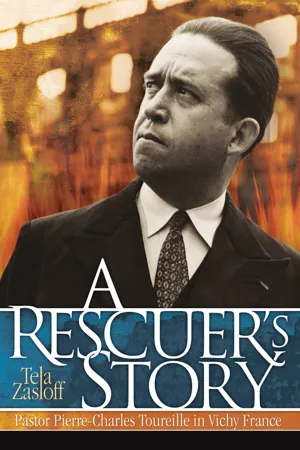 eBook - PDF
A Rescuer's Story
Pastor Pierre-Charles Toureille in Vichy France
- Tela Zasloff(Author)
- 2003(Publication Date)
- University of Wisconsin Press(Publisher)
His mother was an example of strength through remembering. Although proud of her native village in southern France, she reminded her children and grand- children all her life that she had been betrayed by the Protestant occu- pants of her village two hundred years earlier, because they had converted to Catholicism under threat of imprisonment and execution by the king’s dragoons. 2 Such stories must have shaped not only Pierre Toureille’s view of his life’s role but also his style of writing—narrative was consistently his fa- vorite technique of analysis. To continue that tradition, the following his- torical overview will include some of the narratives that demonstrate most vividly the periods of deepest crisis in Huguenot history. Early Years: The Edict of Nantes and the Exodus The spirit and mind of the Huguenots is Calvinist, maintaining the se- vere sense of duty and rigorously logical strictures set out by its founder. John Calvin barely escaped with his life, from France to Switzerland in 1534, after giving a lecture at the Sorbonne that purportedly smacked of heresy. After teaching and traveling, he became, in 1536, the spiritual and temporal leader of a Protestant, or Reformed, community/state in Ge- neva, which rivaled the Catholic church in its merging of religious and po- litical power. The Huguenot/Protestant community of France was active before Calvin had formally established his religious state in Geneva, but by doing so, he gave the Huguenots a political legitimacy and provided them a source of aid and refuge for the next four centuries. The name Huguenot has been attributed either to the sixteenth century Protestants of Tours, who assembled in a tower haunted by a spirit called King Huguet (or Hugon), or to the word aignos, a derivation of the German word Eid- genossen (those bound together by oath).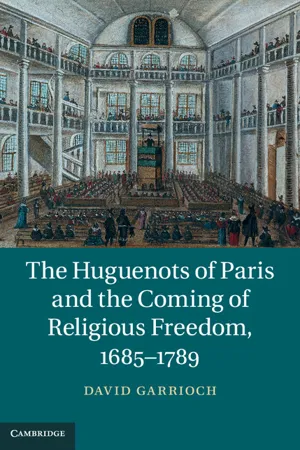
- David Garrioch(Author)
- 2014(Publication Date)
- Cambridge University Press(Publisher)
On the whole, only the most obstinate and the unlucky came to the attention of the police. The Protestants had every incentive to hide their beliefs, and this makes it difficult not only to identify them but even to define what a Huguenot was. Some historians have assumed that Huguenot identity was cultural and familial, though not all have gone as far as the Protestant historian André Siegfried, who in 1945 argued that calling a French man a Protestant ‘does not mean that he has faith, but that he was born a Protestant and remains one, just as people who are born white remain 3 Who were the Huguenots of Paris? 1 Douen, La Révocation, 2: 477–8; André Encrevé, Les Protestants en France de 1800 à nos jours. Histoire d’une réintégration (Paris: Stock, 1985), p. 30; Garrisson, ‘Genèse de l’Église réformée’, 33, n. 21. Who were the Huguenots of Paris? 76 white’. 2 The examples of genuine conversion are too numerous to sus- tain this kind of determinism, and – ironically, since that was not what Siegfried intended – it places too little emphasis on religious belief. So too did Herbert Lüthy, who in his wonderful study of Protestant banking sought no evidence that those he was studying were in fact Protestants. ‘What defines them’, he wrote, ‘is not their individual faith, but their belonging to a family, to a group, to a “network” of Protestant connec- tions, none of which, in this period, was except in very rare cases a matter of personal choice, but one of birth and family tradition.’ 3 Such a socio- logical definition ignores the many lasting conversions and the bitterly divided families that often resulted. In considering who the Huguenots were, then, what evidence should we seek? Should we consider only the tiny number who never compro- mised their faith, never went to a Catholic church, never had their chil- dren baptised there? This would be far too restrictive, since many who did these things continued to see themselves as Protestants.
- Henry Martyn Baird(Author)
- 2010(Publication Date)
- Gorgias Press(Publisher)
Of these a million, or a little over, were Huguenots. They were the only Protestants toler-ated in the kingdom, of whose population they constituted some-what over one-fifteenth, never more than one-tenth part. 1 The fact is that the statistics of Protestantism in France have always been exaggerated. Before the Revocation, the Huguenots were popularly reckoned at two or even three millions. In 1680, even an official document set down the Huguenots old enough to par-take of the Holy Communion at one million seven hundred thousand souls, and supposed their total strength to be fully two millions out of the eighteen millions that France contained at that date. If this could be relied upon, the Huguenots would have numbered fully one-ninth part of the entire popula-tion of France. Even in our own days the number of Protes-tants has been commonly represented as a million and a half, though the government census fails to show that the adherents of the Reformed church reach six hundred thousand souls. In the membership of the Huguenot churches all ranks of society were represented. Persecution, however, had sifted out many of those who, in the initial stages of the history of the Reformation, attached themselves to it from interested motives —both the ambitious nobles who sought support in political contentions, and that restless and unruly class whom contem-poraries styled atheists and Epicureans, leaders in insubordi-nation and iconoclastic exploits. 3 Yet if the lower populace was not now strongly Protestant, the Protestant nobles and ! Bentivoglio and The Huguenots and Henry of Navarre, ubi supra. 5 Letter of N. de la Mare, August 6, 1680, published from the MS. in the National Library, with comments, in the Bulletin de la Société de l'histoire du Prot. eBook - PDF
- Howard Robinson(Author)
- 2019(Publication Date)
- Columbia University Press(Publisher)
With time at his command he became a veritable intellectual machine, working late and long on the numerous questions that appealed to his ever-curious mind. Indeed, the years after 1682 were filled, nay packed, with assiduous reading and much writing. Occasion for appearing in print soon offered itself in the melan-choly misfortunes that were accumulating for the French Protes-tants. The Edict of Nantes (1598) had produced a difficult political dualism in France. The Huguenots, as we have said, lost many of their guarantees at the time of Richelieu. After 1629, though their armed political power was nearly gone, they were yet largely unhampered in the exercise of their religious practices. The years that followed, at least until 1660, when Louis XIV assumed direct control of the state, were years of great advancement for French Protestantism. Huguenot workmen were skilful, Huguenot mer-2 Quoted by Serrurier, p. 46. 38 CATHOLICS AND Huguenots chants so successful that the majority of the business of the kingdom was in their hands. After 1660 there was a change for the worse in Huguenot for-tunes. The young King was very sure of his own importance, and determined to follow his own lights whether or no his insuffi-cient education was a true guide. Time after time their guaranteed rights were disregarded, increasingly so as the reign progressed. The Huguenots were embarrassed by vexatious limitations which, it was pretended, infringed in no way the edict under which they enjoyed their privileges. The pretended Reformed religion suffered seriously when the Chambers of the Edict were suppressed in 1669. An eloquent advocate even went so far at the time as to say to the King that we are everywhere driven to extremities. Our condition is made not only calamitous, but positively unendurable. Our places of worship are taken from us. We are excluded from trades. eBook - PDF
Birthing Revival
Women and Mission in Nineteenth-Century France
- Michèle Miller Sigg(Author)
- 2022(Publication Date)
- Baylor University Press(Publisher)
The repressive circumstances inside the country effectively displaced the operational heart of French Protestantism and fostered the creation of multiple centers—in Geneva, London, Rotterdam, and Strasburg, among others—where Hugue- nots settled. There they contributed to the prosperity of their adopted home countries and, in many cases, to the Reformation legacy as pastors in exile. 38 In the 1922 History of the Wesleyan Methodist Missionary Soci- ety, the British authors wrote, “It is sometimes forgotten, too, that from a merely material point of view our country is greatly indebted to French Protestants. These came to England in the thousands during the troubled years of the seventeenth century, bringing with them arts and crafts which greatly enriched the industries of this country.” 39 Alice Wemyss notes that in 37 W. Gregory Monahan, Let God Arise: The War and Rebellion of the Camisards (Oxford: Oxford University Press, 2014), 7. 38 There is a rich bibliography of books on the Huguenot exiles in various countries. Among these are: Ole Peter Grell, Calvinist Exiles in Tudor and Stuart England (London: Routledge, 2017), and Robin D. Gwynn, Huguenot Heritage: The History and Contribution of the Huguenots in Britain, 2nd ed. (Brighton, U.K.: Sussex Academic, 2011). 39 G. G. Findlay and W. W. Holdsworth, The History of the Wesleyan Methodist Mission- ary Society, 5 vols. (London: Epworth Press, 1922), 4:444. Keeping the Faith 23 the second decade of the nineteenth century “the quasi-totality of Genevans were French descendants.” 40 Geneva exerted a privileged influence on the French Reformed Church because of the many theologians in exile who had made Switzerland their home—men such as Calvin, Guillaume Farel, and Théodore de Bèze—and the many pastors, trained in Swiss seminaries, who returned to support the French church. Leading French figures of the Reformation, such as Calvin, lived in exile, as if on a sort of “long term loan” to their countries of adop- tion. eBook - PDF
A Right to Flee
Refugees, States, and the Construction of International Cooperation
- Phil Orchard(Author)
- 2014(Publication Date)
- Cambridge University Press(Publisher)
The total number of refugees who received assistance may have been between 40,000 and 50,000 (Scoville 1952a: 298). 62 A Right to Flee economic interest very largely which led Holland to sympathize with the Huguenots” (Thompson 1908: 45). Others, however, suggest that Protestant fervor was successfully aligned with these economic interests (see Stoye 2000: 271). Other governments were impressed by the skills the Huguenots brought with them and as much by the economic consequen- ces of this loss to France as their own gain. This was reflected in the moves toward toleration in a number of states during the eighteenth century, including England, Prussia, and the Austrian Empire (Doyle 1992: 202). The second thread was that many European states saw in the flight of the Huguenots further evidence of Louis’s hegemonic ambitions. This led to him being cast as “a monarch of Machiavellian intentions and a man willing to break agreements with violence” (Black 1990: 30). As Harris (1964: 103) notes, “his suppression of the Huguenots in 1685 struck fear into the heart of Protestant Europe” and contributed to a coalition form- ing against him. Louis lost valuable Protestant allies, including Brandenburg (Stoye 2000: 272). Concerns were raised over what Louis’s actions might be following the end of the Truce of Ratisbon, which had ended the First Dutch War, and what the fate of the Spanish Empire might be upon the death of the sickly and heirless Charles II. This led in 1686 to the creation of the secret League of Augsburg, which included both Protestant and Catholic states and which received the adherence of the Pope (Harris 1964: 103–04). 15 Louis does appear to have been aware of the possible consequences of his actions. He chose not to interfere with the rights of the Protestant population of Alsace, which was conquered by France during the Thirty Years’ War.
- Joseph Bergin(Author)
- 2014(Publication Date)
- Yale University Press(Publisher)
Controversy and exchanges in print thus poured off the presses during the 1670s, increasingly pigeonholing the Huguenots as schismatics and rebels, whose religion and church were false and without warrant. Such accusations were heavily loaded politically, and enabled those employing them to perpetuate the myth of rebellious Protestants, their ultra-royalism notwithstanding. This 248 THE POLITICS OF RELIGION IN EARLY MODERN FRANCE shift itself reflects the relative trajectories of Catholicism and Protestantism in France since the age of Richelieu, when French Catholicism still had to put its house in order. This weakness was one important reason why its propagandists were unable to impress or seduce their opposite numbers for a long time. However, by the 1660s and 1670s, the situation was changing, especially after the intra-Catholic Jansenist feud had been suspended. The Catholic Reformation had begun to show results – pastoral, educational and intellectual – that increas-ingly licensed its apologists to claim that whatever reasons there might have been in the past for Protestants to leave the church of their ancestors, they were no longer valid. 84 The Protestants should thus return to that church now that it had been successfully restored to its splendour. If they refused to do so, it was owing to their rebellious, schismatic and insubordinate nature. The RPR did not consti-tute a church, and what they believed and practised was not a religion. Turenne’s conversion probably dented Protestant resistance much less than it stirred Catholic ambitions. He immediately tried to persuade Louis XIV to take the lead and produce a rapid solution, while the king himself was keen to revive Richelieu’s earlier four-step plan for reunion in late 1668 and early 1669. But with the papacy as hostile as ever to a gallican inter-confessional confer-ence that would pave the way for reunion, nothing came of this particular approach. eBook - ePub
- J. W. Allen(Author)
- 2013(Publication Date)
- Routledge(Publisher)
1 But it was at Leyden, in opposition to Coornhert and the city magistrates, that he maintained this doctrine. I know of no similar writings published in France. Even the most convinced French Calvinist could not imagine France organized like Scotland. To have set up such an ideal would have hopelessly split the Huguenot party and deprived the Calvinists of most of their allies. Could anyone in his senses suppose that the Prince of Condé would endeavour to set up the government of consistories ? It might have been possible, perhaps, after 1572, to establish a strictly Calvinistic system of government in Languedoc. But the Genevan ideal could be realized in France locally only, if at all: and to realize it even so, the French Calvinists must have become separatists in the completest sense. But though they allied themselves with, and shared in, separatist provincial feeling, they never completely committed themselves to definite separation. They were too French. At heart, as they showed finally, they believed in France and in its monarchy. They ended by accepting mere toleration from a Catholic monarchy claiming absolutism by divine right. From a point of view strictly Calvinistic, that was nothing less than defeat.1 See his Politices Christianae. He was absent from France 1572–1583. In 1582 he published, in Dutch, a violent attack on the heresies of Coornhert.The development of the whole controversy is one of the most striking examples of the way in which men adjust their theories at once to their desires and to circumstance. As circumstances changed so did Huguenot, and so did Catholic, opinion. One of the most acute and unbiased of contemporary observers noted and commented on the fact.‘Voyez,’ wrote Montaigne, ‘l'horrible impudence de quoy nous pelotons les raisons divines et combien irréligieusement nous les avons rejetées et reprises selon que la fortune nous à changés de place en ces orages publics. Ceste proposition si solennelle: s'il est permis au sujet de se rebeller et armer contre son prince pour defense de la religion, souvienne vous en quelles bouches cette année passée, l'affirmative d'icelle estoit l'arc-boutant d'un party, le negative de quel autre party c'estoit l'arc-boutant: et oyez à present de quel quartier vient la voix et instruction de l'une et de l'autre et si les armes bruyent moms pour ceste cause que pour celle-la.’Accurately as these words apply to France in the sixteenth century, they have a far wider application. But Montaigne hardly seems to see that the process by which men persuade themselves of the truth of some principle that justifies them in doing what they wish to do, involves no conscious insincerity. eBook - PDF
Money, Trade, and Power
The Evolution of Colonial South Carolina's Plantation Society
- Jack P. Greene, Rosemary Brana-Shute, Randy J. Sparks, Jack P. Greene, Rosemary Brana-Shute, Randy J. Sparks, Rosemary Brana- Shute(Authors)
- 2021(Publication Date)
- University of South Carolina Press(Publisher)
86. Butler, The Huguenots in America, 138. 87. Ibid., 140. 88. Will of Isaac Mazyck, 338–42. 89. Cooper and McCord, eds., Statutes at Large, 2:288. 90. Henry deSaussure, “Huguenots on the Santee River,” Transactions of the Huguenot Society of South Carolina 3 (1907): 24. 91. Friedlander, “Carolina Huguenots,” 199. 92. Cooper and McCord, Statutes at Large, 2:283. 93. In British and American Huguenot history, the conformists are the refugees who conformed to the Church of England by using a French version of the Book of Common Prayer, recognizing the authority of the bishops, and having their pastors ordained. The nonconformist Huguenots are those who refused to conform and remained French Calvinists. 94. Van Ruymbeke, “L’émigration huguenote,” 2:440–41. 95. Alexander Garden, A Brief Account of the Deluded Dutartres (New Haven: James Parker and Company, 1762), [1]. 96. For more detailed accounts of this case see Butler, The Huguenots in America, 117–120, and Van Ruymbeke, “L’émigration huguenote,” 2:436–50. 97. In a letter to the influential Huguenot conformist minister Claude Grotête de la Mothe, the St. Denis minister Jean LaPierre mentions “master Bochet” (Abel Bochet) as one of the ringleaders. “Letter to rev. Grotête de la Mothe” (14 Aug. 1714), The Aufrere Papers, Huguenot Society of Great Britain and Ireland Publications, quarto series, 40 (Frome, England, 1940), 211–12.
Index pages curate the most relevant extracts from our library of academic textbooks. They’ve been created using an in-house natural language model (NLM), each adding context and meaning to key research topics.

