History

John Calvin
John Calvin was a prominent figure in the Protestant Reformation, known for his influential theological writings and his role in the development of Calvinism. He emphasized the sovereignty of God, predestination, and the authority of Scripture. Calvin's teachings had a significant impact on the spread of Protestantism and the shaping of religious thought in Europe and beyond.
Written by Perlego with AI-assistance
Related key terms
1 of 5
11 Key excerpts on "John Calvin"
 eBook - ePub
Early Modern Philosophy of Religion
The History of Western Philosophy of Religion, volume 3
- Graham Oppy, N. N. Trakakis(Authors)
- 2014(Publication Date)
- Routledge(Publisher)
4 John Calvin Michael SudduthThe French Genevan reformer John Calvin (1509–64) holds an important place in the development of the theology of the Protestant Reformation. Building on insights articulated by other reformers such as Philipp Melanchthon, Martin Bucer and Huldrych Zwingli, Calvin is perhaps best known for his careful and penetrating biblical exegesis and the production of a compendium of Christian theology that strongly influenced the emergence of Reformed orthodoxy in the latter part of the sixteenth century. Calvin’s teachings on divine providence and predestination, the doctrine of sin and the Christian’s union with Christ were among his influential contributions to Reformed theology. But Calvin is also known for his doctrine of the natural knowledge of God, roughly, the idea that human beings have some knowledge of God from the light of nature and independent of scriptural revelation. The relationship between this doctrine and traditional natural theology (i.e. arguments for the existence and nature of God) has been a point of controversy among Calvin commentators and philosophical theologians in the Protestant tradition. In this entry I outline this controversy and show why Calvin should be regarded as having made an important, positive contribution to natural theology.INTRODUCTION Calvin’s educational background and theological workThe structure of Calvin’s thought and his influence as a Protestant reformer must be viewed in the light of his own intellectual development and background as a humanist thinker educated in classical literature and law.1 In 1523, at fourteen years of age, Calvin began his college education (ostensibly in preparation for the priesthood) in Paris at the Collège de la Marche. Here Calvin came under the instruction of the Latinist and rhetorician Mathurin Cordier, an important influence on the development of Calvin’s Latin writing style and an inspiration for the pedagogy Calvin sought to implement in the schools in Geneva many years later. Calvin’s stay at the Collège de la Marche was brief, though, and within several months he transferred to the Collège de Montaigu, where he completed his licentiate in arts in 1527. Beginning in 1528 Calvin took up the study of civil law, first at the University of Orléans and then at the University of Bourges, universities where Calvin was taught by influential legal scholars of the day such as Pierre de l’Estoile and Andrea Alciati. Calvin’s humanist educational background was evident in his first published book, a commentary on Seneca’s De Clementia eBook - PDF
- Robert D. Linder(Author)
- 2007(Publication Date)
- Greenwood(Publisher)
Historians are not all of one mind concerning the nature of the continuing impact of Calvin- ism on the Western world but the vast majority of them acknowl- edge that it is extensive. First, in the course of stressing the doctrinal component of his intellectual legacy, Calvin’s successors placed a new emphasis on 48 THE REFORMATION ERA predestination, which in turn sparked some of the most intense dis- putes over exactly what it meant and how much it should be empha- sized. It also served as a benchmark in controversies with Arminians, those who stressed free will in matters of God’s plan of salvation. In so doing, Calvin’s second- and third-generation followers placed an emphasis on this doctrine which is largely lacking in Calvin’s thought but which attracted many looking for the comfort and secu- rity of inclusion among the Elect. Therefore, Calvin’s theological system attracted large numbers of followers, especially among the clergy, who then popularized it for their flocks, because it seemed to explain so much. Given his prem- ises, Calvin’s theology was a vigorous and coherent explication of both how and why sins are forgiven. Moreover, successive genera- tions could consult his Institutes where these explanations, along with almost all aspects of theology, are systematically arranged. No other reformer left behind such a legacy. Moreover, the genius of Calvin’s theology was such that it could become the official doctrine of the Presbyterian, Reformed and Congregational churches while at the same time seeping into the theology of the Church of England and many Baptist churches in a modified form. 22 Second, Calvin deeply influenced the course of political thought in the Western world. He did this in several ways, especially in terms of trends toward democracy, the right of resistance and the develop- ment of civil religion. No longer available |Learn more
- (Author)
- 2014(Publication Date)
- College Publishing House(Publisher)
________________________ WORLD TECHNOLOGIES ________________________ Chapter 5 Introduction to Calvinism Calvinism (also called the Reformed tradition , the Reformed faith , or Reformed theology ) is a theological system and an approach to the Christian life. The Reformed tradition was advanced by several theologians such as Martin Bucer, Heinrich Bullinger, Peter Martyr Vermigli, and Huldrych Zwingli, but this branch of Christianity bears the name of the French reformer John Calvin ( Jean Cauvin in old French) because of his prominent influence on it and because of his role in the confessional and ecclesiastical debates throughout the 16th century. Today, this term also refers to the doctrines and practices of the Reformed churches of which Calvin was an early leader. Less commonly, it can refer to the individual teaching of Calvin himself. The system is often summarized in the Five Points of Calvinism and is best known for its doctrines of predestination and total depravity, stressing the absolute sovereignty of God. Historical background John Calvin ________________________ WORLD TECHNOLOGIES ________________________ John Calvin's international influence on the development of the doctrines of the Protestant Reformation began in 1534 when Calvin was 25. That marks his start on the first edition of Institutes of the Christian Religion (published 1536). He revised this work several times, and produced a French vernacular translation. The Institutes , together with Calvin's polemical and pastoral works, his contributions to confessional documents for use in churches, and his massive outpouring of commentary on the Bible, meant that Calvin had a direct personal influence on Protestantism. Along with Martin Bucer, Heinrich Bullinger, Peter Martyr Vermigli, and Ulrich Zwingli, Calvin influenced the doctrines of the Reformed churches. He eventually became the most prominent of those reformers. No longer available |Learn more
- (Author)
- 2014(Publication Date)
- University Publications(Publisher)
________________________ WORLD TECHNOLOGIES ________________________ Chapter- 1 Introduction to Calvinism Calvinism (also called the Reformed tradition , the Reformed faith , or Reformed theology ) is a theological system and an approach to the Christian life. The Reformed tradition was advanced by several theologians such as Martin Bucer, Heinrich Bullinger, Peter Martyr Vermigli, and Huldrych Zwingli, but this branch of Christianity bears the name of the French reformer John Calvin ( Jean Cauvin in old French) because of his prominent influence on it and because of his role in the confessional and ecclesiastical debates throughout the 16th century. Today, this term also refers to the doctrines and practices of the Reformed churches of which Calvin was an early leader. Less commonly, it can refer to the individual teaching of Calvin himself. The system is often summarized in the Five Points of Calvinism and is best known for its doctrines of predestination and total depravity, stressing the absolute sovereignty of God. Historical background John Calvin ________________________ WORLD TECHNOLOGIES ________________________ John Calvin's international influence on the development of the doctrines of the Protestant Reformation began in 1534 when Calvin was 25. That marks his start on the first edition of Institutes of the Christian Religion (published 1536). He revised this work several times, and produced a French vernacular translation. The Institutes , together with Calvin's polemical and pastoral works, his contributions to confessional documents for use in churches, and his massive outpouring of commentary on the Bible, meant that Calvin had a direct personal influence on Protestantism. Along with Martin Bucer, Heinrich Bullinger, Peter Martyr Vermigli, and Ulrich Zwingli, Calvin influenced the doctrines of the Reformed churches. He eventually became the most prominent of those reformers. eBook - ePub
- Glenn S. Sunshine(Author)
- 2005(Publication Date)
- Westminster John Knox Press(Publisher)
CHAPTER EIGHT John Calvin: BiographyWe turn now to John Calvin, by most measures the most important theologian of the Protestant Reformation. Calvin was born on July 10, 1509, in the city of Noyon in Picardy, France, close to the Belgian border. He came from a solidly middle-class family; his father was a notary (sort of a JV lawyer who drafted legal documents, witnessed contracts, etc., in an era of widespread illiteracy) who did a great deal of business with the bishop of Noyon. The bishop sponsored a school for his family, and the elder Calvin’s connections with the bishop meant that John was one of only a few students unrelated to the bishop who attended this school. When John completed grammar school, his father arranged for the bishop to give him a benefice to finance his higher education, and so John was named priest of a village in the diocese of Noyons. He wasn’t ordained, of course, and in any event was too young to become a priest legally. But he was nonetheless entitled to collect the revenues from the village, out of which he paid a priest to act as his vicar in the village—that is, to say Mass, baptize, marry, hold funerals, and so forth. The difference between the revenues and the vicar’s salary paid John’s college expenses. This was pretty much standard procedure for people attending college in late medieval and early modern Europe. Students were considered part of the clergy anyway, so you could think of the benefice as a kind of scholarship. His father intended for him to study theology; normally, canon (i.e., church) law would have been a better choice for advancing to high office in the church, but in 1521 with Luther and Protestantism getting rolling, theology looked like a growth industry and must have seemed a better bet.At age twelve, John left Noyons for the University of Paris. The university was made up of a number of residential colleges, much like they still have at Oxford, for example. Students lived and took classes in a single building or complex. All students studied the liberal arts until they received a bachelor’s degree, after which they could pursue advanced training in liberal arts or in one of the “higher” faculties of law, medicine, or theology. Calvin started off at the Collège de la Marche, but quickly transferred to the Collège Montaigu. This was an absolutely first-rate school: strict, hard nosed, and academically rigorous. To put it in perspective, consider that Erasmus had attended here for a time, and Calvin, Ignatius Loyola (the founder of the Jesuits), and Rabelais (the brilliant French burlesque novelist) all completed their degrees at Montaigu. All moved in radically different directions, but they were also all marked by their experiences at the school. eBook - ePub
- Glenn S. Sunshine(Author)
- 2017(Publication Date)
- Westminster John Knox Press(Publisher)
Chapter Eight John Calvin: BiographyW e turn now to John Calvin, by most measures the most important theologian of the Protestant Reformation. Calvin was born on July 10, 1509, in the city of Noyon in Picardy, France, close to the Belgian border. He came from a solidly middle-class family; his father was a notary (sort of a JV lawyer who drafted legal documents, witnessed contracts, etc., in an era of widespread illiteracy) who did a great deal of business with the bishop of Noyon. The bishop sponsored a school for his family, and the elder Calvin’s connections with the bishop meant that John was one of only a few students unrelated to the bishop who attended this school. When John completed grammar school, his father arranged for the bishop to give him a benefice to finance his higher education, and so John was named priest of a village in the diocese of Noyons. He wasn’t ordained, of course, and in any event was too young to become a priest legally. But he was nonetheless entitled to collect the revenues from the village, out of which he paid a priest to act as his vicar—that is, to say Mass, baptize, marry, hold funerals, and so forth. The difference between the revenues and the vicar’s salary paid John’s college expenses. This was pretty much standard procedure for people attending college in late medieval and early modern Europe. Students were considered part of the clergy anyway, so you could think of the benefice as a kind of scholarship. His father intended for him to study theology; normally, canon (i.e., church) law would have been a better choice for advancing to high office in the church, but in 1521 with Luther and Protestantism getting rolling, theology looked like a growth industry and must have seemed a better bet.At age twelve, John left Noyons for the University of Paris. The university was made up of a number of residential colleges, much like they still have at Oxford, for example. Students lived and took classes in a single building or complex. All students studied the liberal arts until they received a bachelor’s degree, after which they could pursue advanced training in liberal arts or in one of the “higher” faculties of law, medicine, or theology. Calvin started off at the Collège de la Marche but quickly transferred to the Collège Montaigu. This was an absolutely first-rate school: strict, hard nosed, and academically rigorous. To put it in perspective, consider that Erasmus had attended here for a time, and Calvin, Ignatius Loyola (the founder of the Jesuits), and Rabelais (the brilliant French burlesque novelist) all completed their degrees at Montaigu. All moved in radically different directions, but they were also all marked by their experiences at the school.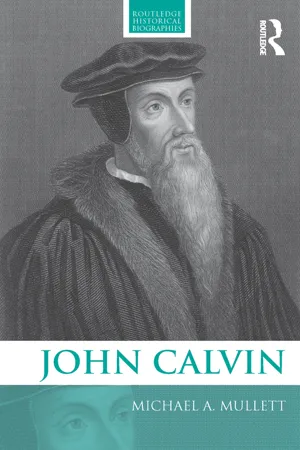 eBook - ePub
- Michael Mullett(Author)
- 2016(Publication Date)
- Routledge(Publisher)
He taught, the Catholic Dictionary explained, ‘peculiar’ [in the sense of singular or distinctive] doctrines’, unbalanced dogmas which formed a ‘gulf which separated him from the tradition of the Church…’. His was the ‘Calvinist heresy… in sharp antagonism to Catholic doctrine’. The product of his towering self, these theological teachings (which were in fact derived from a doctrinal tradition stretching back to St Augustine) were presented as an extreme and eccentric compendium devised ‘According to Calvin’. 28 A later, and American, variant of the Catholic Dictionary type of production, the Encyclopedia of Catholicism, in an otherwise coolly dispassionate brief account of Calvin, can be read as hinting that an extreme doctrine – ‘double predestination… that God in eternity has infallibly decreed who will be saved and who will be damned’ – was the outcome of an exaggerated and absolutist personality. This psyche was responsible for an ‘unyielding espousal’ of the formula in question, 29 – an over-rigorous view of God’s dispositions worked out by a rigid character. Indeed, there is little at fault in a projection of John Calvin as a mighty and formidable man, able to achieve the vast amount he did because of his unbending conviction of his rightness. In him the great masters of mid-20th-century English historical writing on the Reformation had a fitting and fascinating subject for character cameos. Here, for example, is the Cambridge professor of ecclesiastical history Owen Chadwick (b. 1916) in a passage of characteristic epigrammatic elegance and insight, writing still within the Victorian and Edwardian tradition of historical prose as belles lettres, and drawn magnetically by Calvin the man of steel: The true source of Calvin’s authority was in himself eBook - PDF
The Two Reformations
The Journey from the Last Days to the New World
- Heiko A. Oberman, Donald Weinstein(Authors)
- 2008(Publication Date)
- Yale University Press(Publisher)
Where Calvinistic politics and theology want to be more than a witness medi-ated by an individual’s own life and sacrificial spirit, there they have crossed the fatal boundary line between influence and coercive power, and we can smell again the first wisps of the smoke rising from the stake. The old saying that city air is the air of liberty does not apply to that kind of Calvinistic city-state. Election: Faith on Its Way to Tomorrow Turning from the public face of Calvinism to its heart and center, we encounter the doctrine of predestination—more accurately, of election, for predestination concerns the series of executive decrees which follows election. However, I will adapt myself to the looser word usage of modern theology: the doctrine of predestination is an internationally recognized limitation of Calvinism—which is reason to view it as an obsolete Chris-tian tradition, one with which it no longer pays to enter into dialogue. Nationally too, Remonstrantism has won out and the pithy Canons of Dordt barely resonate among the handful of people who still know the confessions. 52 The doctrine of predestination, once a precious heirloom, now shows up only here and there at theological discount markets. C A LV I N ’ S L E G A C Y 1 5 7 Earlier we pointed out that the teaching of predestination acquired special meaning in the third phase of the Reformation, the Reformation of the Refugees. This phase originated after 1548, when the Reformation of the Cities was halted and changed into the Reformation of the Refu-gees. For those who had no permanent place of residence, not even a fixed stone on which to lay their heads, neither a valid passport nor a residence permit, predestination became their identity card.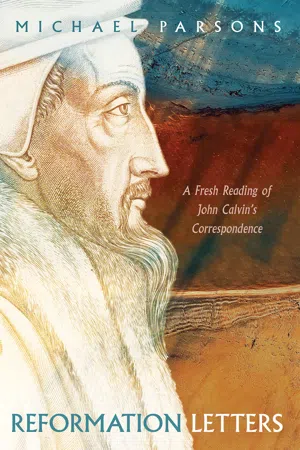 eBook - PDF
Reformation Letters
A Fresh Reading of John Calvin's Correspondence
- Michael Parsons(Author)
- 2018(Publication Date)
- Pickwick Publications(Publisher)
Reymond, John Calvin. His Life and Influence (Geanies House, Fearn: Christian Focus, 2000), 111-25; Bernard Cottret, Calvin. A Biography (Grand Rapids: Eerdmans / Edinburgh: T&T Clark, 2000), 213-17; Naphy, Calvin and the Consolidation , 182-84; Rudolph W. Heinze, Reform and Conflict. From the Medieval World to the Wars of Religion, AD 1350-1648 (Grand Rapids: Baker, 2005), 188-90; Selderhuis, John Calvin , 203-206; Mullett, John Calvin , 151-55. For extensive critical accounts of the history, see the following early full-length works: Roland Bainton, Hunted Heretic. The Life and Death of Michael Servetus, 1511-1553 (Boston: Beacon, 1953); Jerome Friedman, Michael Servetus: A Case Study in Total Heresy (Geneva: Librairie Droz, 1978). 7 T.H.L. Parker, John Calvin. A Biography (Philadelphia: Westminster , 1975), 118; Richard C. Gamble, ‗Calvin‘s Controversies‘ in Donald K. McKim (ed.), The Cam-bridge Companion to John Calvin (Cambridge: Cambridge University Press, 2004), 197. 8 Mullett, John Calvin , 153. 9 Hans J. Hillerbrand, The Reformation. A Narrative History Related by Contemporary Observers and Participants (Grand Rapids: Baker, 1979), 273, see 273-75; Mullett, John Calvin , 152. Reformation Letters: A Fresh Reading of John Calvin’s Correspondence 102 considerations into a concrete context, before deliberating upon Calvin‘s r e-sponse to the situation as he is drawn crucially into it by the protagonist, him-self. This is followed by an examination of relevant correspondence and a criti-cal consideration of the possible reasons for Calvin‘s reaction, before conclu d-ing with brief reflections. Michael Servetus (1511-1553) Michael Servetus (Miguel Serveto), ‗a Spanish Radical,‘ ‗an evangelical ratio n-alist,‘ 10 went to reside in Basel as early as 1530 but soon fell out with Johannes Oecolampadius (1482-1531), the city‘s very influential and greatly respected reformer, over the nature of the sonship of Jesus Christ.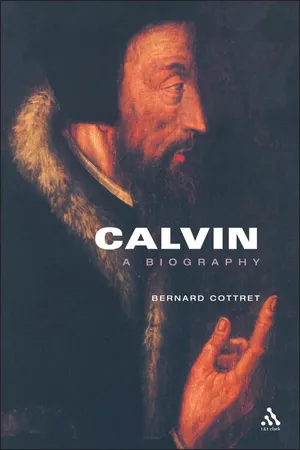 eBook - PDF
- Bernard Cottret(Author)
- 2003(Publication Date)
- T&T Clark(Publisher)
57 From this viewpoint predestination mysteriously exalted saving and inventiveness, seeing them as marks of election by God. To succeed was to be chosen. 58 The picture offered by Calvin's teaching is clearly bolder in tone. His Four Sermons of 1552 were presented as an open letter to all true Christians who de-sire the advancement of the reign of Our Lord Jesus Christ. The Reformer be-gins by recalling what baseness it is for those to whom God has given knowl-edge of the truth of his Gospel to pollute themselves with the abominations of the papists, which are entirely contrary to the Christian religion, since in doing this they disavow as far as they can the Son of God who redeemed them. 59 The first solution suggested by Calvin is testimony, carried to the point of martyrdom, which he calls the cross. This is one of the means of fulfilling the Christian life. The doctrine of purely adoring God would be useless unless men were disposed to despise this fragile and precarious life and search for the kingdom of God, following Jesus Christ to the cross to achieve the glory of his 56. OC28, cols. 220-22, 142nd sermon on Deuteronomy, February 12, 1556. 57. R. H. Tawney, Religion and the Rise of Capitalism (1926; Harmondsworth: Pen-guin, 1972), p. 113. 58. This thesis has been vigorously opposed on a theological level in E. Fuchs, La morale selon Calvin (Paris: Le Cerf, 1986), p. 35: One cannot impute to Calvin the famous 'practical syllogism' that according to M. Weber was the driving force of Puritan morality. This syllogism is as follows: election has as its consequence the leading of a holy life, hence one who leads a holy life is elect; consequently to be sure one is elect one must lead a holy life. No one says that such a life can earn salvation, which depends only on the grace of God; but one can confirm that one is saved by the practice of good works. This reasoning Calvin did not maintain. But here we need to distinguish between Calvin and Calvinism. eBook - PDF
Public Theology in Korea?
Rereading John Calvin
- Minseok Kim(Author)
- 2021(Publication Date)
- LIT Verlag(Publisher)
His most basic theological concepts, such as the Holy Spirit as a ‘witness’, the essence of ‘justification’, ‘the author of the law’, ‘the judge’ and the everlasting ‘advocate’ can be attributed to his study of the law. 94 Christoph Strohm points out how Calvin’s study of law influenced his theology: 94 See Gordon, Calvin, 18–22. Re-evaluating John Calvin’s Works and His Role 195 The lifelong attempt to arrive at a philological-contextual explanation of biblical texts; the weight that Calvin assigns to questions of ethics and canon law; and finally, the interest in a systemic representation of Christian teaching that took shape in the Institutio. Moreover, Calvin’s theological profile was influenced overall by his education in the dilieu of humanist jurisprudence. 95 This view is concrete in asserting the use of the law. Calvin insisted on three uses of the law: The first was theological use, which revealed God’s righteousness and condemned our injustice. The second was to convince people to obey the laws of the government because of fear of coercion and punishment. The third was to teach and advise the Christian to keep on doing good. Calvin saw a need for the stimulation and counsel of the law because of the laziness and self-centeredness of each Christian, though they were united with Christ through faith. 96 This concept of Calvin was well represented by the role of the Consistory of Geneva. Those who violated the Ten Commandments and related New Testament directives were to be warned by the Consistory, and its primary purpose was not to establish the authority of the church but to nurture the members of the church and to exhort them to imitate Christ and to live in fellowship in the freedom of true Christian sanctification under the Word of God. 97 Calvin’s legal knowledge was embodied even in his thinking about natural law. Calvin referred to the natural law that God had engraved in the human mind when God created it.
Index pages curate the most relevant extracts from our library of academic textbooks. They’ve been created using an in-house natural language model (NLM), each adding context and meaning to key research topics.

