History

Iraq War
The Iraq War, also known as the Second Gulf War, was a conflict that began in 2003 with the invasion of Iraq by a coalition led by the United States. The war aimed to disarm Iraq of weapons of mass destruction and remove Saddam Hussein from power. It resulted in significant loss of life, political instability, and ongoing repercussions in the region.
Written by Perlego with AI-assistance
Related key terms
1 of 5
12 Key excerpts on "Iraq War"
 eBook - PDF
Overconfidence and War
The Havoc and Glory of Positive Illusions
- Dominic D. P. Johnson(Author)
- 2009(Publication Date)
- Harvard University Press(Publisher)
Chapter 8 Iraq, 2003 Bush’s goals are extraordinarily ambitious, involving remak-ing not only international politics but recalcitrant societies as well, which is seen as an end in itself and a means to American security. For better or (and?) for worse, the United States has set itself tasks that prudent states would shun. —Robert Jervis Some important assumptions turned out to underestimate the problem. —Paul Wolfowitz, 23 July 2003 The age-old human proclivity to go to war shows no sign of abat-ing. Indeed, there has been a “disquieting constancy in warfare,” with more than two million battle deaths in nearly every decade since World War II, and the 1990s was “one of the worst decades in modern history,” with thirty-one new outbreaks of war. Re-cent wars include countries around the globe, from the Congo to Kashmir, from Chechnya to Afghanistan and Iraq. These con-flicts are too recent to have been as widely analyzed as the ones in my case studies, and feelings about them are still too strong for any consensus to have developed among historians or interna-tional relations scholars. But I believe it is not too soon to investi-gate whether positive illusions and overconfidence continue to affect international relations, or more specifically, whether they continue to promote war. To do this, I will take a look at the most recent: the war in Iraq that began in March 2003. 1 By the criteria of the case studies in earlier chapters, the Iraq War should feature few positive illusions. On the Iraqi side, there had been many years of interaction with the United States, op-191 tions other than war were available (such as cooperating with weapons inspectors), and assessments regarding the likely out-come of war should have been simple, given that Iraq had lost the 1991 Gulf War, and that it was widely known that in the subse-quent decade U.S. military strength had grown extensively while Iraq’s had declined. eBook - PDF
Fogs of War and Peace
A Midstream Analysis of World War III
- Robert L. Dilworth, Schlomo Maital(Authors)
- 2008(Publication Date)
- Praeger(Publisher)
2. Democracy must be brought to Iraq and to the region. It is doubtful that the Bush administration would have been able to sell the war to the U.S. Congress and the American people beforehand, on this revised basis. The rationale for the war has now been transformed yet again. Now Iraq is referred to by the Bush administration as the epicenter of the war on global terrorism. A secondary rationale is to protect the oil reserves, which may be closer to the truth than anything else that has been said. What has characterized the latest Iraq War almost from the outset is a very thick fog effect, with facts about the conflict shaped to fit political ends. The War in Iraq 115 “Facts” have been so abundant and diverse that the truth can be hard to be found. Political “spin” has been superabundant. In terms of Iraq’s visibility on the world stage, it has spent much more time in the spotlight over the past twenty years than Afghanistan, although the spotlight has not always burned brightly. Iraq has appeared in the head- lines only intermittently. When the war with Iran was taking place (1980– 1989), Iraq could garner attention, but it was not very intense. That conflict seemed very distant to the average American and of little import. As is true of that area of the world in general, there was little interest or focus on it in the United States beyond government circles. Even today, interest seems minimal. CNN reported on November 22, 2002, that a National Geographic survey showed that only 13 percent of young Americans, aged 18–24 (military age) could find Iraq on a map. 2 Matters changed dramatically with the invasion of Kuwait by Iraq in 1990, prompting a strong response by the United States and its coalition partners in 1991, in what came to be known as the 100-hour War (a mis- nomer, given the many days of aerial bombardment prior to the introduction of ground forces). No longer available |Learn more
- (Author)
- 2014(Publication Date)
- College Publishing House(Publisher)
________________________ WORLD TECHNOLOGIES ________________________ Chapter 8 Iraq War Clockwise, starting at top left: a joint patrol in Samarra; the toppling of the Saddam Hussein statue in Firdos Square; an Iraqi Army soldier readies his rifle during an assault; a roadside bomb detonates in South Baghdad. The Iraq War (also known as the Occupation of Iraq , the Second Gulf War , and Operation Iraqi Freedom ) is a military campaign that began on March 20, 2003, with the invasion of Iraq by a multinational force led by troops from the United States under the administration of President George W. Bush and the United Kingdom under the Prime Minister Tony Blair. The last U.S. combat brigade left Iraq on August 19, 2010. On August 31, U.S. president Barack Obama declared an end to combat operations. Approximately 50,000 U.S. troops still remain in the country in an advise and assist capacity. Prior to the invasion, the governments of the United States and the United Kingdom asserted that the possibility of Iraq employing weapons of mass destruction (WMD) threatened their security and that of their coalition/regional allies. In 2002, the United Nations Security Council passed Resolution 1441 which called for Iraq to completely cooperate with UN weapon inspectors to verify that it was not in possession of weapons of mass destruction and cruise missiles. The United Nations Monitoring, Verification and Inspection Commission (UNMOVIC) was given access by Iraq under provisions of the ________________________ WORLD TECHNOLOGIES ________________________ U.N. resolution but found no evidence of weapons of mass destruction. Additional months of inspection to conclusively verify Iraq's compliance with the U.N. eBook - PDF
Why War?
The Cultural Logic of Iraq, the Gulf War, and Suez
- Philip Smith(Author)
- 2010(Publication Date)
- University of Chicago Press(Publisher)
F I V E T H E W A R I N I R A Q O F 2 0 0 3 Our next conflict, the War in Iraq of 2003 emerged out of the Gulf War, al-though just how it did so remains a complex and contested issue. The shell of a narrative can be related as follows. At the end of the Gulf War, Saddam Hussein remained in power. Iraq was subject, however, to United Nations sanctions and also to inspections intended to prevent rearmament. These fo-cused, in particular, on weapons of mass destruction or WMD—an acronym used with increasing frequency during the buildup to war to refer in a generic way to chemical, biological, and nuclear technologies. In April 1991 , Iraq had been forced to accept a UN resolution that required it to abandon its WMD programs, destroy stockpiles, and allow regular inspections by international teams that would attempt to verify compliance. Over the following years a scenario repeatedly emerged in which Iraq would first allow and then deny access to inspectors, or try to impose restrictive conditions on when, where and who could inspect, or attempt to negotiate on inspections in order to have an oil-for-food trade policy lifted. After each standoff and its associated diplomatic activity Iraq would back down and the inspections would resume. At one point President Clinton considered the use of force to be necessary. December 1998 saw Operation Desert Fox in which British and American air strikes were made against what were thought to be weapons programs. Although the presence of practicable ongoing WMD programs and/or ca-pabilities was never conclusively demonstrated it was widely believed that Saddam Hussein was up to something. Certainly he was understood to be t h e w a r i n i r a q o f 2003 155 an irritation, thumbing his nose at the UN and making life difficult for the victorious powers of the Gulf War. This pattern might have continued for another decade but for the terrorist attacks on the United States of America on September 11 , 2001 . No longer available |Learn more
- (Author)
- 2014(Publication Date)
- College Publishing House(Publisher)
________________________ WORLD TECHNOLOGIES ________________________ Chapter 6 2003 Invasion of Iraq The 2003 invasion of Iraq (March 20 – May 1, 2003), was the start of the conflict known as the Iraq War or Operation Iraqi Freedom in which a combined force of troops from the United States, alongside the United Kingdom, and smaller contingents from Australia and Poland invaded Iraq and toppled the regime of Saddam Hussein in 21 days of major combat operations. This phase (March–April 2003) consisted of a con-ventionally fought war which concluded with the fall of Baghdad that marked the beginning of the second phase, the Iraq War which would last until August 31, 2010, and was followed by Operation New Dawn. This was considered a continuation of the Gulf War of 1991, prior to which Saddam Hussein had invaded Kuwait, and after defeat by Coalition Forces had agreed to surrender and/or destroy several types of weapons, including SCUD missiles and weapons of mass destruction (WMD). Since the Persian Gulf War 1991 the US and Britain had been keeping a tight rein on Saddam Hussein, waging an undeclared conflict against Iraq for twelve years. U.S. President Bill Clinton had maintained sanctions and ordered air strikes in the Iraqi no-fly zones Operation Desert Fox, in the hope that Saddam would be overthrown by political enemies inside Iraq and had signed into law H.R. 4655, the Iraq Liberation Act. which appropriated funds to Iraqi opposition groups.Four countries participated with troops during the initial invasion phase, which lasted from March 20 to May 1, 2003. These were the United States (148,000), United Kingdom (45,000), Australia (2,000), and Poland (194). 36 other countries were involved in its aftermath. In preparation for the invasion, 100,000 US troops were assembled in Kuwait by February 18. The United States supplied the vast majority of the invading forces, but also received support from Kurdish irregulars in Iraqi Kurdistan. No longer available |Learn more
- (Author)
- 2014(Publication Date)
- University Publications(Publisher)
________________________ WORLD TECHNOLOGIES ________________________ Chapter- 1 2003 Invasion of Iraq The 2003 invasion of Iraq (March 20 – May 1, 2003), was the start of the conflict known as the Iraq War or Operation Iraqi Freedom in which a combined force of troops from the United States, alongside the United Kingdom, and smaller contingents from Australia and Poland invaded Iraq and toppled the regime of Saddam Hussein in 21 days of major combat operations. This phase (March–April 2003) consisted of a conventionally fought war which concluded with the fall of Baghdad that marked the beginning of the second phase, the Iraq War which would last until August 31, 2010, and was followed by Operation New Dawn. This was considered a continuation of the Gulf War of 1991, prior to which Saddam Hussein had invaded Kuwait, and after defeat by Coalition Forces had agreed to surrender and/or destroy several types of weapons, including SCUD missiles and weapons of mass destruction (WMD). Since the Persian Gulf War 1991 the US and Britain had been keeping a tight rein on Saddam Hussein, waging an undeclared conflict against Iraq for twelve years. U.S. President Bill Clinton had maintained sanctions and ordered air strikes in the Iraqi no-fly zones Operation Desert Fox, in the hope that Saddam would be overthrown by political enemies inside Iraq and had signed into law H.R. 4655, the Iraq Liberation Act. which appropriated funds to Iraqi opposition groups.Four countries participated with troops during the initial invasion phase, which lasted from March 20 to May 1, 2003. These were the United States (148,000), United Kingdom (45,000), Australia (2,000), and Poland (194). 36 other countries were involved in its aftermath. In preparation for the invasion, 100,000 US troops were assembled in Kuwait by February 18. The United States supplied the vast majority of the invading forces, but also received support from Kurdish irregulars in Iraqi Kurdistan. eBook - PDF
U.S. Strategy Against Global Terrorism
How It Evolved, Why It Failed, and Where It is Headed
- A. Tan(Author)
- 2009(Publication Date)
- Palgrave Macmillan(Publisher)
C H A P T E R T H R E E The U.S. Invasion of Iraq The Case Against Iraq Apart from the wave of Al Qaeda-inspired terrorist attacks around the world since 9/11, Iraq has proven problematic for the Global War on Terror (GWOT). At issue here is how an Iraq, which was initially unre- lated to Al Qaeda, became part of the terrorist problem and part of the GWOT. Indeed, from nonrelevance to the GWOT, Iraq has become a focal point in the radical jihadist propaganda that is part of the informa- tion war being waged for the hearts and minds of the umma or world- wide Muslim community. As a result of its invasion of Iraq, as well as its own ineptitude in countering this information war, the United States has thus far lost this battle. The broader strategic implications of Iraq for the GWOT as well as the balance of power in the Middle East are highly negative. Under President Ronald Reagan, the United States had backed the Saddam regime against Iran during the long and vicious Iran–Iraq War from 1980–1988, a conflict that claimed more than a million lives. The Reagan administration did nothing to stop Iraq from developing weapons of mass destruction (WMDs), including chemical weapons such as nerve gas, which Iraq deployed on the battlefield. The CIA also shared battlefield intelligence with Iraq. 1 The Reagan administra- tion followed this course of action out of realist geopolitical calcula- tions, fearing that if Iran won the war, it would install a religious Shiite regime in power in Iraq, one that would not only give Iran control over the vast oil wealth of the country but would also enable Iran to become the dominant power in the Persian Gulf. Such a scenario would have dire consequences for the stability of the Middle East, as Iran could U.S. Strategy Against Global Terrorism 46 then destabilize the rest of the Persian Gulf, given the presence of sig- nificant numbers of Shiites living in Saudi Arabia and other Gulf states. eBook - PDF
Theatre and War
Theatrical Responses since 1991
- J. Colleran(Author)
- 2012(Publication Date)
- Palgrave Macmillan(Publisher)
The instantaneous reproduction of the event results in an image that is itself already coded and part of a signifying chain, even if that signification later gets reversed or debated. To indicate the entire range of this complexity, James Der Derian has devised the term the “military- T h e a t r e a n d W a r 36 industrial-media-entertainment-network” (2009) to describe the enmeshed network of actors who may be operating somewhat independently but are always cognizant of each other’s presence. As spectators encounter the flux, speed, and recombinant possibilities of these boundary-blurring networks, they paradoxically find themselves in a labyrinth of infinite choices and a desert of judgment. The 1991 Persian Gulf War: The New Model of Technowar We have no opinion on Arab-Arab conflicts. —April Glaspie, US ambassador to Iraq 4 The beginning of the Persian Gulf War is attached to two dates: August 2, 1990, when Iraq invaded Kuwait, and January 16, 1991, when the United States and its coalition allies bombed Baghdad at 6:38 p.m. EST, just 24 hours past the deadline that the United Nations had set for withdrawal. These two dates demarcate the pre-invasion, diplomatic phase, known as Desert Shield, and the war itself, Desert Storm. The United States had supported Iraq in the 1988 Iran-Iraq War, con- tinued to provide aid despite the abuses committed against the Kurds, and appears to have sent signals that it would not intervene should Saddam Hussein decide to invade Kuwait. But when Iraq invaded its oil-exporting rival, the United States led the deployment of a coalition of troops from some thirty countries (Kellner 1992, 12). In November 1990, the UN Security Council set January 16, 1991 as the deadline for an Iraqi withdrawal from Kuwait, and on January 17, the air bombardment began. President George H. W. Bush addressed the nation to justify the intervention. eBook - ePub
- Scott Silverstone(Author)
- 2012(Publication Date)
- Routledge(Publisher)
7ConclusionThe Iraq War of 2003On the night of March 19, 2003, President George W. Bush announced to the nation that American military forces were in the opening stage of a war to bring down the government of Saddam Hussein in Iraq. Drawing on familiar themes deployed repeatedly for over a year, the president declared that “the people of the United States and our friends and allies will not live at the mercy of an outlaw regime that threatens the peace with weapons of mass murder.”1 Two days earlier Bush had warned that Saddam Hussein and his sons had just forty-eight hours to leave Iraq, or military force would be used to remove him from power. According to the president, this demand was a response to Iraqi defiance of “patient and honorable efforts” by the United Nations to disarm Iraq peacefully of its outlawed weapons of mass destruction (WMDs), according to its obligations emerging from the 1991 Gulf War.2 When Hussein predictably refused to accept this ultimatum, Bush launched the first true preventive war in American history.Nearly a decade earlier American leaders confronted the preventive war temptation to stop North Korea from developing its own nuclear arsenal. But with the peaceful settlement of the North Korea crisis in 1994, America avoided a true test of its tolerance for preventive war. The Iraq War of 2003 provided that test. In fact, after President Bush first announced the so-called preemption doctrine during his West Point commencement speech in June 2002, the democratic anti-preventive war norm argument would suggest that at some point on the road to war the president should have faced strong domestic opposition to this particular option for dealing with the Iraqi threat. Despite a lively public discussion, in the run-up to the Iraq conflict domestic opposition rooted in the anti-preventive war norm was marginalized and inconsequential in the ultimate decision to go to war. In fact, the Iraq War began with the backing of a healthy majority of the public and a joint congressional resolution passed in October 2002 by 77 percent in the Senate and 69 percent in the House of Representatives. The contrast in attitudes on preventive war between 2003 and the 1940s and 1950s could not be starker. In the early Cold War the anti-preventive war norm was central to the security ethos of the United States, which produced a conscious and explicit rejection of preventive war on normative grounds alone. This is not to say that the anti-preventive war norm had disappeared completely by the start of the twenty-first century. As this final chapter makes clear, there is indeed a pocket of normative resistance to preventive war among Americans that see this problem exactly as Americans at mid-century saw it. But the normative anti-preventive war perspective, which was once shared across the political spectrum and in both major political parties, is now concentrated among political liberals.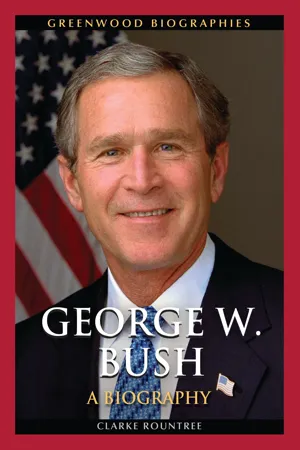 eBook - PDF
George W. Bush
A Biography
- Clarke Rountree(Author)
- 2010(Publication Date)
- Greenwood(Publisher)
Chapter 8 THE Iraq War The United States has had a convoluted relationship with Iraq. In 1979, a U.S. ally and leader of Iraq’s neighbor Iran, Shah Mohammad Reza Pahlavi, was overthrown in the Iranian Revolution. Fifty-two Americans working in the U.S. embassy were taken hostage by student revolutionar- ies for 444 days, causing a crisis that contributed to President Jimmy Car- ter’s reelection loss to Ronald Reagan. In response to Iran’s belligerence, the United States turned to Iraq, a competitor with Iran for dominance in the Middle East. When Iraq’s leader, Saddam Hussein, wanted to wage war on Iran, the United States supported the effort, which involved a bloody eight-year conflict that ended in a stalemate. During that conflict, Hussein used chemical weapons against his own people, who were rising up against him, killing thousands of men, women, and children. In 1990, Saddam Hussein took on a smaller challenge when Iraq in- vaded its tiny, oil-rich neighbor Kuwait. The first President Bush was in office and rallied a broad coalition of nations and quickly expelled Iraqi forces from Kuwait. The coalition stopped short of marching on Bagh- dad, but it created no-fly zones in the north and south, which kept full control of over half of Iraq out of Saddam’s hands. Following Saddam’s defeat, the Bush administration urged those living in these protected 114 GEORGE W. BUSH zones—the majority Shiites in the south and the persecuted Kurds in the north—to rise against the hobbled minority Sunni leader. Unfor- tunately, General Norman Schwartzkopf made a critical error when he agreed to let Saddam fly helicopters (but not fixed-wing aircraft) in the no-fly zones. The dictator employed helicopter gunships to crush the rebellion, killing thousands. 1 Now, as the younger President Bush began beating the drums of war against Iraq, these persecuted groups were wary.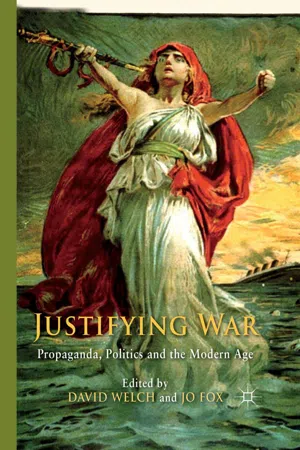 eBook - PDF
Justifying War
Propaganda, Politics and the Modern Age
- D. Welch, J. Fox, D. Welch, J. Fox(Authors)
- 2012(Publication Date)
- Palgrave Macmillan(Publisher)
Issues of the legality and legitimacy of the United States’ decision to invade and its conduct of operations in what was to become a protracted war in Iraq were to divide the international commu- nity far more than the Kosovo War, eclipsing debates over the humanitarian interventions and wars of the previous decade. Notes 1. F.G. Hoffman (2007) ‘Conflict in the 21st Century: The Rise of Hybrid Wars’, Potomac Institute for Policy Studies (Arlington, VA: Potomac Institute for Policy Studies), p. 11. 2. See E. Hobsbawm (1994) The Age of Extremes: The Short Twentieth Century 1914–1991 (London: Michael Joseph); P. Bobbitt (2002) The Shield of Achilles: War, Peace and the Course of History (London: Allen Lane); F. Fukuyama (1992) The End of History Stephen Badsey 325 and the Last Man (New York: Free Press); S.P. Huntington (1992) The Clash of Civilizations? (Washington, DC: American Enterprise Institute). 3. R.F. Grimmett (2 February 2009) Instances of Use of United States Armed Forces Abroad 1798–2008, Congressional Research Service, Washington, DC. 4. For a useful summary of differing positions on the legality of the Kosovo War, see the essays in J.L. Holzgrefe and R.O. Keohane (eds) (2003) Humanitarian Intervention: Ethical, Legal and Political Dilemmas (Cambridge: Cambridge University Press). 5. See M. Newman (2009) Humanitarian Intervention: Confronting the Contradictions (London: Hurst & Co.), pp. 181–200. 6. B. Kouchner (1987) ‘Préface: Le Devoir d’Ingérence’, in Mario Bettati and Bernard Kouchner (eds), Le Devoir d’Ingérence (Paris: Denoël ), p. 9. 7. M. Bettati (1996) Le Droit d’Ingérence: Mutations de l’Ordre International (Paris: Odile Jacob); see also Newman (2007) Humanitarian Intervention, pp. 51, 100; T.G. Weiss (2007) Humanitarian Intervention (Cambridge: Polity), pp. 41–2. 8. Compare the definitions offered by J.L. Holzgrefe in Holzgrefe and Keohane, Humanitarian Intervention, p. 18, and by J.M. Welsh (following Sir Adam Roberts) in Jennifer M.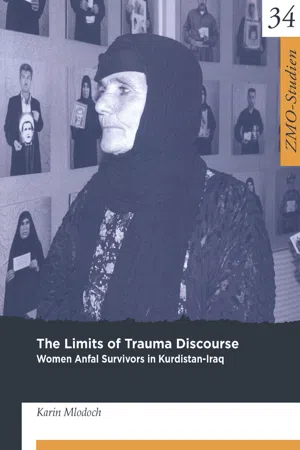 eBook - PDF
The Limits of Trauma Discourse
Women Anfal Survivors in Kurdistan-Iraq
- Karin Mlodoch(Author)
- 2021(Publication Date)
- Klaus Schwarz Verlag(Publisher)
On 6 February 2003, US foreign minister Colin Powell presented - as we now know - largely constructed proof of the existence of weapons of mass destruction in Iraq and the regime's association with the al-Qaeda network. The UN Security Council refused to mandate a military operation against Iraq. On 20 March, the US-led »coalition of the willing«, which included Great Brit-57 Violence and revenge also hit the inner power circle. In 1995, Saddam Hussein's son-in-law, Hussein Kamel, Minister for Military Industries, and his brother, who was married to one of Saddam Hussein's daughters, defec-ted to Jordan with their wives. They returned to Iraq in 1996 after Saddam Hussein had assured them of impunity and reintegration. On their return, however, both brothers were forced to divorce their wives and killed by Ali Hassan al-Majid. 58 United Nations Security Council Resolution No. 1441, 8 November 2002. Available at: http://www.un.org/depts/unmovic/new/documents/resolutions/s-res-1441.pdf (last accessed 1 April 2013). Historical, political and social context 1 1 5 ain, Spain, Italy, Japan, South Korea and some thirty smaller countries, launched »Operation Iraqi Freedom«. Strategic targets in Baghdad were bombed parallel to invasion by ground troops from Kuwait. Germany and France strongly objected to the invasion of Iraq. The war triggered a wave of protest throughout the world. Bearing the slogan »No blood for oil«, demonstrators expressed their indignation at the bypassing of UN decisions by the US government and its allies. At the same time, a large segment of the Iraqi people welcomed the US-led invasion as the ultimate opportunity to overthrow the hated regime.
Index pages curate the most relevant extracts from our library of academic textbooks. They’ve been created using an in-house natural language model (NLM), each adding context and meaning to key research topics.

