History

John Stuart Mill
John Stuart Mill was a 19th-century British philosopher and political economist known for his influential works on liberty, utilitarianism, and the role of government in society. He advocated for individual freedom and the importance of free speech, and his ideas continue to shape political and ethical discourse. Mill's work has had a lasting impact on the development of liberal thought and democratic principles.
Written by Perlego with AI-assistance
Related key terms
1 of 5


10 Key excerpts on "John Stuart Mill"
 eBook - PDF
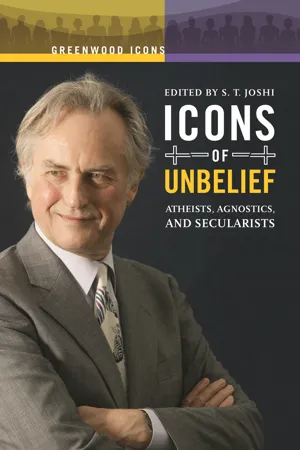
Icons of Unbelief
Atheists, Agnostics, and Secularists
- S. T. Joshi(Author)
- 2008(Publication Date)
- Greenwood(Publisher)
John Stuart Mill S. T. Joshi One of the towering intellects of the nineteenth century, John Stuart Mill (1806–1873) distinguished himself in a number of disciplines, including philo- sophical logic, political economy, ethics, and feminism. Although best known today by the slim but immensely influential treatise On Liberty (1859), Mill in his own time was known as a leading proponent of the philosophical school known as utilitarianism, with its central theory of “the greatest happiness of the greatest number”—a school that today continues to have widespread sup- port among philosophers. Mill’s early advocacy of equal rights for women, including woman suffrage, helped to lay the groundwork that ultimately led to the overthrow of legal, social, and political barriers for women in both England and the United States. Religion was, on the surface, only a side issue with Mill, as evidenced by the late and posthumously published Three Essays on Religion. But several recent studies have argued convincingly that his lifelong thoughts about the exis- tence and nature of God, the afterlife, and the place of religion in society lay just below the surface of much of his work on ethics and politics. In the course of his career, Mill dissected a number of central tenets of religion and helped to establish the intellectual cogency of such issues as the free discussion of religion, the separation of church and state, and the development of a secular ethic. THE LIFE OF A POLYMATH In 1873 Mill told his own life in his Autobiography, one of the most poignant documents of the nineteenth century. Although written with the impeccable precision, reserve, and fluency that mark his entire work, the 262 Icons of Unbelief Autobiography exhibits the remarkable early life of a man whose upbringing seemed destined to single him out from the mass of humanity. eBook - PDF
Classical Theorists in the Social Scienc
From Western Ideas to African Realities
- Dejo Abdulrahman(Author)
- 2023(Publication Date)
- Malthouse Press(Publisher)
9 John Stuart Mill’s Political Philosophy and the Shaping of Political and Economic Structures James Iorliam Apam Introduction John Stuart Mill (1806-1873) was born in London on May 20, 1806. He was a British philosopher, political economist and civil servant. He made major contributions to social theory, political theory and political economy through his writings, speeches and conduct. He is often referred to as the most influential English speaking philosopher of the nineteenth century. He lived and wrote in the era of 19 th century philosophy and classical economics and belonged to the schools of empiricism, utilitarianism and liberalism. His main interests were in political philosophy, ethics and economics and inductive logic and his major writings covered these areas. His most notable ideas were expressed on the public/private sphere, hierarchy of pleasures in utilitarianism, liberalism, early liberal feminism, harm principle and methods. What has captured the world greatest attention particularly in the area of politics was his views and writings on liberalism and early liberal feminism and political economy. These views and writings as well as those of the others who wrote before and after him have contributed greatly in shaping political and economic relations in all nations of the world today. He was himself influenced by the works of philosophers like Plato, Socrates, Thomas Hobbes, John Locke, Adam Smith, David Ricardo, Thomas Aquinas, his father James Mill, Bentham, his wife Harriet Taylor and utopian socialists like Saint Simon among others. He in turn influenced others like Bertrand Russell to whom he was a „godfather’, Karl Pooper, John Maynard Keynes, John Rawls and many others just he has influenced decisions of political and economic leaders in many nations of the world. eBook - ePub
- Albert B. Hakim(Author)
- 2016(Publication Date)
- Routledge(Publisher)
20 John Stuart Mill (1806–1873) DOI: 10.4324/9781315509853-21 In his timely, sensitive, and clearheaded analyses of moral and political life, John Stuart Mill bridges the contemporary and classical modern periods. He can be seen as a contemporary philosopher inasmuch as he championed personal value in his advocacy of individuality, sought for some way to ground humanity in view of a declining Christianity, and tried to improve the conditions of the working class of England. But perhaps he can be seen more clearly as working in the empirical tradition of Locke, Berkeley, and Hume: His view of man was sympathetic to that tradition; he elaborated its moral implications anew as utilitarianism; and his thoughts on government reach back to Locke. He was born in London in 1806, the oldest child of James and Harriet Mill. His father was a Scotsman who, in pursuing an intellectual career in London, became a respected author and a devoted follower of the utilitarian philosopher Jeremy Bentham. In the opening pages of his Autobiography, the younger Mill describes how his father became the principal shaper of his early life by putting him through one of the most exacting programs of home education ever recorded. As a child he learned Greek at age three and read Greek authors in their own language before he was seven (Plato at age eight); he did arithmetic as well and commenced the study of Latin. He read extensively, and each morning he had to give an account of his previous day’s reading to his father. Such an intense intellectual regime, coupled with his father’s inability to show any “signs of feeling,” took its toll on the child’s development, for the normal playfulness, feelings, and friendships of childhood were not his: “I never was a boy,” he wrote. His education was completely areligious, which was surprising only in that his father, who embraced a humanistic religion, had once studied for the ministry eBook - ePub
John Stuart Mill - Thought and Influence
The Saint of Rationalism
- Georgios Varouxakis, Paul Kelly(Authors)
- 2010(Publication Date)
- Routledge(Publisher)
1 John Stuart Mill’s thought and legacy A timely reappraisal Georgios Varouxakis and Paul KellyJohn Stuart Mill was born more than two centuries ago, in 1806. He distinguished himself in many overlapping roles as a philosopher, political thinker, political economist, journalist, intellectual and politician. It is difficult to exaggerate Mill’s significance and influence. He was not merely an astonishingly versatile thinker who made major contributions to many areas of philosophy. He was also a ‘public moralist’ par excellence , a committed thinker who, by the last two to three decades of his life, obtained a rare ascendancy over his contemporaries as well as over thinkers and students of subsequent generations. As befits this fundamentally cosmopolitan thinker, his reputation and influence reached far beyond his native country. His major works (as well as some less well known) found translators in several languages very soon after their publication in English. With a moral earnestness that is bound to surprise people in our more cynical times, Mill made strenuous efforts, on behalf of a variety of causes, ‘either as theorist or as practical man, to effect the greatest amount of good compatible with his opportunities’.1
- John Rawls, Samuel Freeman(Authors)
- 2008(Publication Date)
- Belknap Press(Publisher)
2. John Stuart Mill, Collected Works (CW) (Toronto: University of Toronto Press, 1963– 1991), Vol. XVIII, p. 163. 3. See Mill, Whewell on Moral Philosophy (1852). CW, X. (1840); but not surprisingly he was more critical still in his anonymous “Re-marks on Bentham’s Philosophy” (1833). 4 5. In his chosen vocation Mill surely succeeded to an extraordinary de-gree. He became one of the most influential political and social writers of the Victorian Age. For our purposes, understanding his vocation helps us to understand the defects of his works: their often loose and ambiguous ter-minology, and their almost incessant lofty style and sermonizing tone un-troubled by self-doubt, even when the most intricate questions are being discussed. Those who disliked him said he sought to convince, and when that failed, to convict. These defects are most disturbing in the later essays (after 1850, say), which are widely read, and three of which we will be discussing: Utilitarian-ism, On Liberty, and The Subjection of Women. By this time Mill had Eng-land’s ear. He knew it and meant to keep it. But the most creative period of Mill’s life is roughly 1827–1848. Anyone who doubts Mill’s extraordinary gifts has only to consider the works of this period, beginning with the Es-says on Some Unsettled Questions of Political Economy (late 1830–31, the 5th es-say partially rewritten in 1833, but not published until 1844), then the many brilliant essays of the 1830s and A System of Logic in 1843, and on to The Principles of Political Economy in 1848. Despite his defects, it is a great mistake to assume a superior manner in reading Mill. He is a great figure and deserves our attention and respect. J. S. Mill: Biographical Data 1806 Born May 20, in London. 1809–1820 Period of intensive education at home by his father. 1820–1821 Year in France in the household of Sir Samuel Bentham. 1822 Studied law. First publication in newspapers. 1823 Begins his career in East India Company.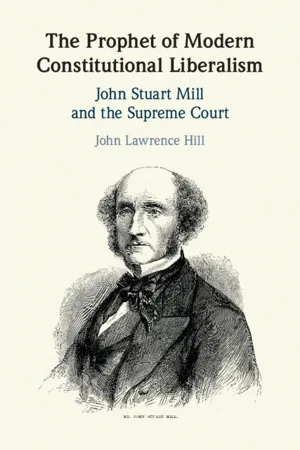 eBook - PDF
The Prophet of Modern Constitutional Liberalism
John Stuart Mill and the Supreme Court
- John Lawrence Hill(Author)
- 2020(Publication Date)
- Cambridge University Press(Publisher)
Yes, the case for liberty was based on utility – but utility only “in the largest sense, grounded in the permanent interests of man as a progressive being.” 4 1 Rawls argued that “comprehensive doctrines” – his term for an overarching worldview, whether it is religious or philosophical – cannot play a role in liberal political societies. All arguments in the liberal mainstream must be limited by “public reason.” John Rawls, Political Liberalism (New York: Columbia University Press, extended edition, 2005), 58–61. “Political liberalism does not engage those who want … the whole truth.” Ibid., 441. See also Richard Rorty, Contingency, Irony and Solidarity (Cambridge: Cambridge University Press, 1989) (for an “ironistic” account of liberalism). 2 In sum, Mill was a “foundationalist,” as was almost every important political thinker of his time. In contrast, many twentieth-century thinkers are anti-foundationalist. 3 I explore the conflict between Mill’s basic philosophical assumptions, particularly his determinism and skepticism about the idea of an enduring self or subject, with the tenor of On Liberty, which seems to require a belief in a self, and in some conception of free will, in John Lawrence Hill, Theism, Naturalism and Liberalism: John Stuart Mill and the “Final Inexplicability” of the Self, 39 Pepperdine Law Review 1401 (2013). 4 John Stuart Mill, “On Liberty,” in Essays on Politics and Society Part I, CW, 18:224. 39 Inventing Modern Liberalism But what might this mean? Mill’s well-considered views on religion, in general, and Christianity, in partic- ular, set the stage for his, and for modern, liberalism. He wrote his most impor- tant essay on the topic of God and religion, “Theism,” toward the end of his life. 5 Following Comte, who had written that the laws of history entail a progression from religious belief to metaphysics to science, Mill thought it likely that orthodox reli- gion was “destined to disappear” at the hands of progress and secularization.
- Nancy J. Hirschmann(Author)
- 2009(Publication Date)
- Princeton University Press(Publisher)
Accordingly, Mill must push them to make those choices to get the process started, until they become the kinds of people who can make those choices on their own. The myth of liberalism, which many associate with Mill, is that the self stands outside of context, and hence that it is possible to choose your own way as if divorced from context. Mill challenges that idea. He accepts the inevitability of context and its construction of individuals, but he wants a better context that will produce better people who make better choices. He may want more diversity among such people than does Rousseau, because diversity helps secure truth; but truth is still attainable in Mill’s view, and diversity serves as a means to that greater end. The desire for improvement will occur only to people who already have the capacity to appreciate gradations in human refinement and intelligence. There is thus a circularity to Mill’s reasoning that plagues the determinist posi- tion more generally. This circularity affects Mill’s utilitarianism as well. Utility is key to Mill’s theory of liberty: “I regard utility as the ultimate appeal on all ethical questions,” he says in the opening pages of On Liberty , “but it must be utility in the largest sense, grounded on the permanent interests of man” (15). Mill came to reject the individualist variant of utilitarian- ism put forth by Bentham to adopt a more social notion of utility, the version we find in Hume and that Urmson allies with “rule utilitarian- ism.” 35 Mill distinguishes between what people do want, that is, what they think will make them happy, and what they should want, that is, what actually will make them happy. Bentham’s famous axiom that “pushpin is as good as poetry” suggested that utility is a matter only of quantity; one person’s enjoyment of a mindless game has the same value John Stuart Mill • 233 as another’s enjoyment of the intellectually complicated task of interpret- ing literature.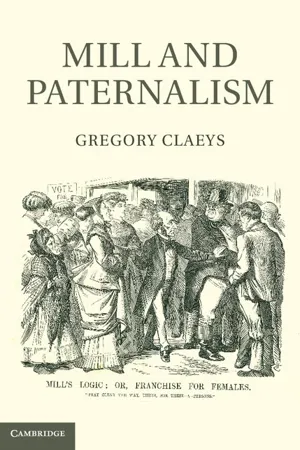 eBook - PDF
- Gregory Claeys(Author)
- 2013(Publication Date)
- Cambridge University Press(Publisher)
In sum, she argues, the ‘primary goods in Utilitarianism were morality and a sense of unity; the primary goods in On Liberty were liberty and individuality. In Utilitarianism Mill’s purpose was precisely to overcome the separateness of individuals, to make the “social state” as natural, habitual, and compelling as the individual, private state was in On Liberty’ (pp. 106–7). Harrison had earlier asserted that Mill never reconciled the ‘militant Individualism’ of On Liberty with the ‘enthusiastic Altruism’ of Utilitarianism (Tennyson, Ruskin, Mill, and Other Literary Estimates, pp. 305–6). Ryan has noted that while Mill in On Liberty seems to prefer non-paternalist means, and in the Considerations espouses paternalism, both texts aim at education and improvement, and different means are required according to the different domains addressed in both texts (J.S. Mill, p. 199). Arneson however responds that this does not remove the objection that paternalist means might well work equally in the circumstances addressed in On Liberty (‘Democracy and Liberty in Mill’s Theory of Government’, 49–51). See generally Dixon, The Invention of Altruism. 70 Donisthorpe, Individualism, p. 366. 71 Exceptions include Habibi, who takes up the examples of both children and imperialism as excep- tions to Mill’s hostility to paternalism (John Stuart Mill and the Ethic of Human Growth, pp. 158–216). Introduction: Mill, liberty and paternalism 13 and the interpretation of the key doctrines of On Liberty itself. The latter, first conceived as a short essay in 1854, was described by Mill as an attempt to confront the problem of social liberty, or the individual’s relation to society. 72 It is not about political liberty (a chief theme in the Considerations) or economic liberty (addressed in the Principles). eBook - PDF
- Dana Villa(Author)
- 2020(Publication Date)
- Princeton University Press(Publisher)
106 As I shall argue in the next section, Mill is not without his moments of self-betrayal, moments that under-mine the Socratic nature of his project and his commitment to a broadly philosophical form of citizenship. However, the line of ar-gument in chapter 3 of On Liberty and chapters 2 and 3 of Representa-tive Government cannot be counted among such moments. What links these texts is their shared emphasis on the importance of indi-vidual energy as the sine qua non of moral progress. Where individ-ual energy is quashed or given no outlet, the result is cultural stagna-tion and moral retrogression. Where citizens or subjects have no active role in the public realm, the result is a docility which promotes authoritarianism. Of Individuality begins with the less than startling claim that freedom of opinion should be matched by a corresponding (but nec-essarily more limited) freedom of action: Men should be free to act upon their opinions—to carry these out in their lives, without hindrance, either physical or moral, from their fellow-men, so long as it is at their own risk and peril, 107 and so long as it doesn't injure others. However, it soon shifts to a discussion of the value of sponta-neity in human life, and from there to an insistence that individuals have the right to use and interpret experience in their own way, to choose their own plan of life, and to cultivate or form themselves in an active, independent, and utterly individual way. Among the works of man, Mill writes, which human life is rightly employed in perfecting and beautifying, the first in importance is surely man himself. 108 Mill urges each one of us to approach his or her life as a work of art, and to think of ourselves as the artist primarily respon-sible for the beauty (or ugliness) of what results. 109 The terrain of Mill's argument has shifted from morality and truth to what might be called the aesthetics of character.
- I. Hall(Author)
- 2009(Publication Date)
- Palgrave Macmillan(Publisher)
CHAPTER SEVEN The International Political Thought of John Stuart Mill Georgios Varouxakis “ [ W ] henever we need to argue about whether it is right or wrong, just or unjust, to send an army across a border, it is useful to return to Mill’s ‘few words’ [on nonintervention],” wrote Michael Walzer in 2007. “He is our contemporary. Indeed, I argue that he speaks directly to current U.S. debates about for- eign policy and international society.” 1 Academics often begin their articles or books by stressing how neglected the topic they are about to discuss has been. Works are still written today that claim the topic of this essay, Mill’s thought on international politics, has been ignored or neglected, in general or by at least some related academic discipline. Such claims today are ill- timed by around a decade. A time was, before the recent explosion of inter- est in what is now called “international political theory,” when there was indeed very little commentary on Mill’s thought on international relations. 2 It speaks volumes that the late Martin Wight even confused Mill with his father. 3 The nineteenth century more generally had, it has correctly been said, “largely . . . dropped out of view.” 4 J. S. Mill was more or less absent from general studies of political thought on international relations until the late 1990s. 5 Precious few works noted some of his pronouncements briefly, and his views on international relations were the main focus of no more than one rather unsatisfactory article written in 1961. 6 This has changed in the last decade or so. There is an ever-growing liter- ature on one or more aspects of Mill’s thought on international politics. 7 He 118 ● Georgios Varouxakis now has a place in anthologies of political thought on international relations or international ethics.
Index pages curate the most relevant extracts from our library of academic textbooks. They’ve been created using an in-house natural language model (NLM), each adding context and meaning to key research topics.

