Politics & International Relations

Michael Oakeshott
Michael Oakeshott was a prominent political philosopher known for his contributions to conservative thought. He emphasized the importance of tradition, gradual change, and the limitations of rationalism in politics. Oakeshott's work focused on the idea of "the rule of law" and the role of government in preserving individual freedom and maintaining order.
Written by Perlego with AI-assistance
Related key terms
1 of 5
12 Key excerpts on "Michael Oakeshott"
 eBook - ePub
The Conservative Case for Education
Against the Current
- Nicholas Tate(Author)
- 2017(Publication Date)
- Routledge(Publisher)
Michael Oakeshott Passage contains an image
11Michael Oakeshott – philosopher and educatorMichael Oakeshott (1901–90), unlike T S Eliot, cannot be said, either now or at any point during his long life, to have been a ‘household name’. As a philosopher and political thinker he would probably have been better known had he been writing and teaching in France, where philosophy is taught in schools and intellectuals are still sometimes ‘household names’. Even there, as a critic of ‘ideologies’, ‘theories’ and what he called ‘rationalism’, one cannot imagine him settling comfortably into the role of a ‘public intellectual’.Interest in his thinking, however, has continued to grow, and in particular as it concerns the nature of the political life, different types of state and society and different forms of knowledge, and as it throws light on concepts such as ‘liberalism’, ‘conservatism’ and ‘modernity’. One commentator even describes Oakeshott’s later philosophy as ‘quite possibly the greatest philosophic system of the twentieth century’ (although one cannot help feeling that the word ‘system’ is not one that would have appealed to him) (Alexander 2012: 37).Although Oakeshott spent most of his life writing and teaching about politics and political history his interests were never narrowly political and embraced all aspects of ‘our life as human beings in society’ – beliefs, habits, morals and dispositions – and all the varied ways in which, as human beings, we try to make sense of the world (through science, philosophy, history, poetry and practical activity). His two major works – Experience and its Modes (1933) and On Human Conduct (1975) – range widely across many aspects of human understanding, in the case of the former, and human action, in the case of the latter (Oakeshott 1933; Oakeshott 1975; Podoksik 2003: 130). He had a particular interest in history as a distinctive type of enquiry, having studied history at Cambridge and spent the first part of his career as a history don at his old college. A collection of essays on the topic was published as On History and Other Essays
Passage contains an image
11Michael Oakeshott – philosopher and educatorMichael Oakeshott (1901–90), unlike T S Eliot, cannot be said, either now or at any point during his long life, to have been a ‘household name’. As a philosopher and political thinker he would probably have been better known had he been writing and teaching in France, where philosophy is taught in schools and intellectuals are still sometimes ‘household names’. Even there, as a critic of ‘ideologies’, ‘theories’ and what he called ‘rationalism’, one cannot imagine him settling comfortably into the role of a ‘public intellectual’.Interest in his thinking, however, has continued to grow, and in particular as it concerns the nature of the political life, different types of state and society and different forms of knowledge, and as it throws light on concepts such as ‘liberalism’, ‘conservatism’ and ‘modernity’. One commentator even describes Oakeshott’s later philosophy as ‘quite possibly the greatest philosophic system of the twentieth century’ (although one cannot help feeling that the word ‘system’ is not one that would have appealed to him) (Alexander 2012: 37).Although Oakeshott spent most of his life writing and teaching about politics and political history his interests were never narrowly political and embraced all aspects of ‘our life as human beings in society’ – beliefs, habits, morals and dispositions – and all the varied ways in which, as human beings, we try to make sense of the world (through science, philosophy, history, poetry and practical activity). His two major works – Experience and its Modes (1933) and On Human Conduct (1975) – range widely across many aspects of human understanding, in the case of the former, and human action, in the case of the latter (Oakeshott 1933; Oakeshott 1975; Podoksik 2003: 130). He had a particular interest in history as a distinctive type of enquiry, having studied history at Cambridge and spent the first part of his career as a history don at his old college. A collection of essays on the topic was published as On History and Other Essays eBook - PDF
On World Politics
R.G. Collingwood, Michael Oakeshott and Neotraditionalism in International Relations
- A. Astrov(Author)
- 2005(Publication Date)
- Palgrave Macmillan(Publisher)
This change of attitude had nothing to do with some sudden, inexpli- cable improvement in the quality of political action in the years that separated the two statements. Rather, Oakeshott took politics out of the context of the actually existing European states and their analogues elsewhere and placed it into a different one, that of civil association. In fact, ‘politics’ is one of the very few words from the vocabulary of the 36 modern European state for which Oakeshott did not substitute some term of his own so as to distinguish them from their current counter- parts too often ‘mistaken for the characteristics of historic and equivocal associations’ (109). This does not mean that civil association or politics is treated in sepa- ration from any locale. No human action can be understood this way: The overt actions of men take on a certain intelligibility when we rec- ognize them as the ingredients of a disposition to behave in a certain manner, the dispositions of conduct in turn become understandable when they are recognized as the idiosyncrasies of a certain human character, and the human character becomes less mysterious when we observe it, not as a general type or as a possibility, but in its place in a local context. And the process may be continued in the gradual expansion of this context in place and time. (HL 3–4) In the case of politics, the limits to such gradual expansion are set by the circumstances to which a certain view of the office of government is appropriate: And the chief feature of these circumstances is the appearance of sub- jects who desire to make choices for themselves, who find happiness in doing so and who are frustrated in having choices imposed upon them. eBook - ePub
- T. Nardin(Author)
- 2015(Publication Date)
- Palgrave Macmillan(Publisher)
Do these remarks on the character and significance of Oakeshott’s thought suggest an answer to the question I dismissed at the beginning of this paper, whether that thought is liberal or conservative? That Oakeshott is a genuine philosopher, not an ideologue, suggests that the dismissal is warranted. The philosophy of politics he arrived at after many years of reflection rests on a distinction between civil and enterprise association that cuts across the liberal-conservative distinction and assigns both liberalism and conservatism to the enterprise category. And this suggests, given a preference for civil association that is evident in moments when he slips from theorizing to moralizing, that Oakeshott’s thought is neither liberal nor conservative. He treats freedom as a postulate of civil association, defining just laws to be those that respect independence and forbid domination, which suggests a close but largely unexplored relationship between his theory of civil association and Kant’s theory of right. And his critique of Rationalism, together with his observation that a state that wishes to preserve its civil character cannot forego the enterprise of maintaining itself by policies that must at times violate civil laws, suggests an affinity with themes that are characteristic of political realism.Notes1. Michael Oakeshott, On Human Conduct (Oxford: Oxford University Press, 1975), 27–31.2. This is not to dispute the point that some of Oakeshott’s writing on politics is ideological, but it is to challenge making ideology central to his political thought. Andrew Gamble, “Oakeshott’s Ideological Politics: Conservative or Liberal?” in The Cambridge Companion to Oakeshott eBook - ePub
Faces of Moderation
The Art of Balance in an Age of Extremes
- Aurelian Craiutu(Author)
- 2016(Publication Date)
- University of Pennsylvania Press(Publisher)
Oakeshott was suspicious of those who used principles of all sorts as if they were universal and apodictic axioms that could be applied anywhere and at any time. In his view, Hayek’s political agenda was single-mindedly predicated upon rolling back the frontiers of the state, and as such it worked with what Oakeshott took to be a simplified and distorted view of the proper tasks of government. The role of government, he insisted (2008: 39), is not so much to promote a specific type of freedom (as freedom from interference) as “to maintain that peace and order without which civilization is impossible.” Once again, it is not primarily the size of the government but the manner of intervention that distinguishes civil association from enterprise association; the first conceives of government as an “activity of secondary order,” the second as an “activity of primary order.” 35 Any doctrine, Oakeshott concluded, whether liberal or conservative, that ignores this fundamental distinction between the two different orders of activity makes a grave error and must be criticized for that. This accounts for Oakeshott’s skepticism toward our conventional political vocabulary, a topic he explored in a long essay, “The Concept of Government in Modern Europe.” The ambiguities of our political vocabulary with regard to key concepts such as freedom, justice, rights, and security reflect the ambivalence of our views on the role of government. 36 As previously mentioned, the distinction between civil and enterprise associations was much more important for Oakeshott than concepts such as Left and Right, democracy, socialism, or capitalism eBook - PDF
- Paul Franco, Leslie Marsh, Paul Franco, Leslie Marsh(Authors)
- 2012(Publication Date)
- Penn State University Press(Publisher)
9 Michael Oakeshott on the history of political thought Martyn Thompson My concern is twofold. First, I outline what I take Oakeshott to have meant by the phrase “the history of political thought,” and then I consider some criticisms from Oakeshott’s perspective of the theory and practice of Quentin Skinner, the leading figure in the so-called Cambridge School of historians of political thought. 1 Oakeshott was impressed by his work. But there are signifi- cant points of disagreement. I focus on two: first, Oakeshott’s disagreement with Skinner about the historical interpretation of Hobbes’s Leviathan; and second, more generally, Oakeshott’s objections to Skinner’s reduction of the history of political thought to “the history of ideologies.” 2 The two points are closely connected. i I do not attempt to compare any of Oakeshott’s historical narratives with any of Skinner’s, because Oakeshott published nothing which, in his own account of the logic of historical inquiry, might properly be characterized as an exclusively historical narrative. 3 Even the posthumously published works that many have taken to be histories, such as The Politics of Faith and the Politics of Scepticism (1996), are not. 4 Included among these posthumously published writings are Oakeshott’s undergraduate lectures that appeared in print with the misleading title of Michael Oakeshott: Lectures in the History of Political Thought (2006). I must begin, then, by correcting the false impres- sion that these lectures are likely to give to anyone interested in Oakeshott’s understanding of the history of political thought. There is much in the lec- tures that is relevant to my concerns, but it has to be extracted from a work of a quite different character. 198 political philosophy The published title is an invention of the editors. 5 Anyone even partly familiar with Oakeshott’s published writings on the logic of history is bound to be surprised by some aspects of the lectures.
- Luke Philip Plotica(Author)
- 2015(Publication Date)
- SUNY Press(Publisher)
The emphasis upon tradition may appear to stand in tension with Oakeshott’s valorization of individual agency, yet I argue that his treatment of tradition is most fruitfully understood as intertwined with his analysis of contingency as a fundamental, inexorable condition of thought and action. Considering the interaction between these two concepts in Oakeshott’s thought brings him into conversation with theorists of tradition and community, such as Alasdair MacIntyre, Edward Shils, and Charles Taylor, each of whom seeks to illustrate how individual agents are deeply embedded in networks of tradition. Read alongside these thinkers, Oakeshott provides a view of individuality and tradition that recognizes the profound effects of intersubjective practices and sentiments without affording tradition an independent normative status. Building from the broad philosophical themes of chapters 1 and 2, in chapter 3 I take up an expressly political concern and consider Oakeshott’s characterization of the “modern European state.” In order to elaborate Oakeshott’s account of the emergence, conditions, and character of the state, I explore elements of his political thought that resonate with the work of three significant twentieth-century political thinkers who grappled with the concept of the modern state and its attendant philosophical and practical problems: Michel Foucault, Isaiah Berlin, and Hannah Arendt. I begin by examining the affinities between Oakeshott’s account of the emergence and character of the modern state and Foucault’s analyses of the logic and pragmatics of state power (via his accounts of “governmentality” and “bio-power”). I next consider points of convergence and divergence between Oakeshott and Berlin regarding the condition of plurality in modern political communities and its implications for political freedom eBook - ePub
- Terry Nardin(Author)
- 2017(Publication Date)
- Routledge(Publisher)
RESEARCH ARTICLE
Oakeshott on theory and practice
Terry Nardin Department of Political Science, Faculty of Arts and Social Sciences, National University of Singapore, SingaporeThe expression ‘theory and practice’ implies a separation between the two, even when that separation is denied. Political theorists are divided on the question of their relationship, some regretting the abstraction of theory and its consequent irrelevance to practical discourse and action, others insisting that no theory is without practical biases or implications. Oakeshott’s contribution has been to suggest that theory and practice – or, more exactly, the activities those words identify, theorizing, and doing – are conceptually distinct. Much can be learned about the vocation of political theorist, in contrast to that of the citizen or politician, by distinguishing theory and theorizing from practice and doing. Whether political theorizing emerges as an autonomous activity only when it is distinguished from political activity and whether this autonomy should be cultivated or rejected are questions that invite continued debate.Politics is a practical activity. The study of politics – political inquiry, which may take the form of political science, political history, or political philosophy – can also be practical in the sense of aiming to make a difference in the world of political affairs. But must that study be practical? Let us grant that the arguments of political scientists, historians, and philosophers are often practical either by intention or by contamination. The question I want to consider is whether, setting aside such contingencies, the study of politics can be purely theoretical – that is, theoretical in aiming to understand and explain the objects it studies without also being practical in the sense wanting to alter or preserve them. Michael Oakeshott is one of the few political theorists who defends the separation of political theory from its subject, politics. The activity of theorizing politics can be detached from the intentions or motives of political agents – those who are engaged in making political decisions and arguments (and political theorists, when they trade reflection for advocacy and action are political agents). It is, moreover, distinctively theoretical to the degree that it achieves such detachment. In particular, to theorize politics is to try to understand political decisions and arguments in terms of their presuppositions (Oakeshott 1975, 1–31). On this view, a space for theorizing that is distinct from doing is opened up because it is possible to say something about a political decision or argument that is not already eBook - ePub
Michael Oakeshott and Leo Strauss
The Politics of Renaissance and Enlightenment
- David McIlwain(Author)
- 2019(Publication Date)
- Palgrave Macmillan(Publisher)
2Michael Oakeshott, Rationalism in Politics and Other Essays , ed. Timothy Fuller (Indianapolis: Liberty Press, 1991), xi; Michael Oakeshott, Experience and Its Modes (Cambridge: Cambridge University Press, 1933), 296.3Michael Oakeshott, On Human Conduct (Oxford: Oxford University Press, 1975), 84.4Alexandre Kojève, “The Idea of Death in the Philosophy of Hegel,” trans. Joseph J. Carpino Interpretation 3, no. 2/3 (1973): 124.5Oakeshott, Experience and Its Modes , 10.6 Ibid., 196.7Michael Oakeshott, “Review of N. Berdyaev, The Meaning of History (1936),” in The Concept of a Philosophical Jurisprudence: Essays and Reviews 1926–51, Selected Writings, Volume III , ed. Luke O’Sullivan (Exeter: Imprint Academic, 2007), 137.8Stanley Rosen, G. W. F. Hegel: An Introduction to the Science of Wisdom (South Bend: St. Augustine’s Press, 2000), 221–222.9Michael Oakeshott, “Introduction to Leviathan ,” in Hobbes on Civil Association (Indianapolis: Liberty Fund, 2000), 61–62.10Wendell John Coats Jr., Oakeshott and His Contemporaries: Montaigne, St. Augustine, Hegel, Et al (Selinsgrove: Susquehanna University Press, 2000), 42.11Michael Oakeshott, “The Importance of the Historical Element in Christianity,” in Religion, Politics and the Moral Life , ed. Timothy Fuller (New Haven: Yale University Press, 1993), 69.12Michael Oakeshott, “Dr. Leo Strauss on Hobbes,” in Hobbes on Civil Association , 157.13Paul Franco, introduction to Oakeshott, Hobbes on Civil Association , ix.14Leo Strauss, The Political Philosophy of Hobbes: Its Basis and Its Genesis eBook - ePub
- Edmund Neill(Author)
- 2013(Publication Date)
- Bloomsbury Academic(Publisher)
26 Oakeshott’s position here is extremely radical – even compared to Ryle and Wittgenstein, who make similar arguments in favour of the primacy of practical reasoning – since he maintains that the rationality associated with each practical ability is entirely discrete and non-transferable. This is probably not ultimately very convincing, since it seems likely that our practical abilities are more closely linked than this – so that, for example, an ability to practice law might well help us to understand how to perform in political life better. But it is at least more internally coherent than the position Oakeshott puts forward in ‘Rationalism in Politics‘, giving a better explanation of how technical and practical knowledge are related.The second problem with the way in which Oakeshott conceptualizes tradition in ‘Rationalism in Politics‘, is that he seems to be making a descriptive ontological claim about it, rather than putting forward a normative argument. Instead of establishing that modern politics suffers from being insufficiently sensitive towards the importance of tradition, it would seem that the net effect of Oakeshott’s argument in this essay is simply to point out that political actors are necessarily always conditioned by the tradition within which they are performed – so that it is literally impossible to engage in political activity without recourse to some kind of traditional knowledge. But if this is the case, Oakeshott is left with no means of objecting, normatively, to the way that society has developed – if all is traditional, in other words, nothing can be reprehensible. So if a country develops a tradition that favours extensive government intervention, or a lack of respect for authority, or even discrimination against certain racial groups, there seems to be no way of objecting to such traditions, according to this position.To deal with this problem, Oakeshott puts forward a number of potential solutions, gradually adapting his position over the course of the 1950s and 1960s. First, he simply tries to maintain that, since tradition is not conceived of as monolithic, but rather as inevitably diverse, it always has sufficient resources to repair itself if it runs into trouble. Because a wide variety of courses of action will be sanctioned by tradition at any given point in time, in other words, it does not follow that we must automatically follow any one particular norm; this is to mistake the nature of the concept. Rather, through debate and discussion – through ‘conversation‘, to use one of Oakeshott’s favoured terms – political actors will decide which of the many courses of action on offer they will choose to take. So if a political system has taken a wrong turn, therefore, there is no reason to suppose that it cannot remedy itself, provided its tradition is sufficiently rich in conceptual resources to allow this to happen. eBook - PDF
- J. S. McClelland, Dr J S Mcclelland(Authors)
- 2005(Publication Date)
- Routledge(Publisher)
Oakeshottian conservatism means making the most of the given world. Conservatives are sometimes thought of as being attached to the past in some special sense which makes them downgrade the present, but Oakeshott would say that this is to misunderstand conservatism’s own nature. A true conservative would no more like to live ‘in the past’ than he would like to live in a future utopia. Both would be another country. Better fencemending in this world than pining for lost pasts and unattainable futures. Oakeshott’s modest claims for political thought make it hard to pin him down to any particular band in the political spectrum. Oakeshott’s political thought cannot be a political philosophy, and it is not obvious in what sense it constitutes a political doctrine when one of its purposes is to arouse in us a suspicion of most of the claims which political doctrines make. Perhaps the best way of looking at Oakeshott’s political thought is to see it as intended to encourage a particularly sceptical way of holding political doctrines. Oakeshott certainly does not think that his own political thought is capable of banishing political doctrines from the world. Political doctrines, we do well to remind ourselves, are part of the world of practice, and it is not thought’s job to alter the world of practice much, let alone to abolish parts of it. The world of practice, however, being a world of change, can always be improved, and Oakeshott is not addressing his mild admonitions only to those who would call themselves political conservatives. Oakeshottianism could just as easily be a way of being a socialist as being a conservative. There is, after all, something called a socialist ‘tradition’ which is very self-conscious of itself as a tradition and which means that some socialists at least recognise a past as well as a present and a future. Movements calling themselves ‘socialist’ often split into what Conservatism 757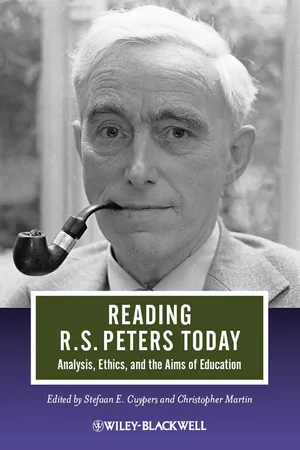 eBook - ePub
Reading R. S. Peters Today
Analysis, Ethics, and the Aims of Education
- Stefaan E. Cuypers, Christopher Martin, Stefaan E. Cuypers, Christopher Martin(Authors)
- 2011(Publication Date)
- Wiley-Blackwell(Publisher)
Chapter 14 Vision and Elusiveness in Philosophy of Education: R. S. Peters on the Legacy of Michael Oakeshott KEVIN WILLIAMSRichard Peters responded very positively to the re-statement of the tradition of liberal education in the second half of the 20th century elaborated by Michael Oakeshott (see Podoksik, 2003, pp. 222–3). Readers may well be surprised to learn that aspects of Oakeshott’s writing on education still retain quite an influence on work in the philosophy of education. In Education and the Voice of Michael Oakeshott I draw attention to the tendency of philosophers of education (for example, Rene Arcilla and Maxine Green) to continue to draw on his oeuvre (Williams, 2007, pp. 2, 10, 11, 102, 81). Since the publication of the book, at least two extensive pieces have appeared addressing Oakeshott’s philosophy of education, one on his conception of civic education (Engel, 2007) and the other dealing with the role of tradition in his theory of liberal learning (Alexander, 2008). Equally significant is Oakeshott’s more general impact on thinking about the educational project. For example, in a recent extensive and searching study of the role of religion in education in the USA, Marc O. DeGirolami (2008) draws substantially on Oakeshott’s work in the elaboration of his framework of educational theory.Despite his very positive response to Michael Oakeshott’s educational vision, Peters is also judiciously critical, demonstrating that it is possible to maintain scholarly distance from a philosopher whom one admires. His criticism is always nuanced, selective and discriminating and his appraisal of Oakeshott’s philosophy of learning on the grounds of its ‘systematic elusiveness’ (Peters, 1974a, p. 433) on crucial issues is particularly subtle, fine grained and illuminating. Peters is also critical of features of Oakeshott’s philosophical style. Oakeshott writes in the grand style of English prose, but unfortunately his rhetorical virtuosity can lead him to present the ideas of his opponents in the form of unjustifiable, tendentious parody. Peters takes him to task for a tendency to be provocative and to make statements that are designed to offend the culture of idées reçues eBook - PDF
International Political Theory after Hobbes
Analysis, Interpretation and Orientation
- R. Prokhovnik, G. Slomp, R. Prokhovnik, G. Slomp(Authors)
- 2011(Publication Date)
- Palgrave Macmillan(Publisher)
21 The forms of courage and pride required of these Hobbesian individuals are dif- ficult: they are (to adopt Richard Flathman’s apt phrase) ‘chastened’, Michael C. Williams 161 and they rely on an appreciation of the conclusions of reason and the limits of reason (Flathman 1993). But they are by no means impos- sible from within the logic of Hobbes’s philosophy, and they point a way towards a liberal tradition with dynamics and possibilities very different from the dire diagnoses of either Schmitt or Strauss. Oakeshott’s potential contribution to these debates is thus poten- tially very fertile. Yet it, too, is not without complex difficulties and challenges. In particular, an appeal to moralised pride as a response to the problem of war sits uncomfortably with Oakeshott’s simulta- neous conviction that modern war, with its socially unifying logic and demands, favours forms of ‘enterprise association’ concerned with directed, substantive social action (and power); one that stands as the alter-ego – and to some extent the opponent – of the ‘civil association’ that he identifies with the form of heroic individuality that he proposes. 22 If this is the case, then Oakeshott’s vision risks looking anachronistic, and even quaintly conservative; and as with each thinker touched upon in this survey, the issues at stake here defy easy summary. However, they illustrate yet again the analytic breadth and political significance of integrating a wider understand- ing of Hobbes’s legacy into thinking about war and the relationship between domestic and international politics. International political theory after Hobbes In the field of International Relations, Hobbes is routinely identified with the over-arching importance of international anarchy.
Index pages curate the most relevant extracts from our library of academic textbooks. They’ve been created using an in-house natural language model (NLM), each adding context and meaning to key research topics.

