Politics & International Relations

Robert Nozick
Robert Nozick was an influential American philosopher known for his work on political theory. He is most famous for his book "Anarchy, State, and Utopia," in which he argues for a minimal state that only exists to protect individuals' rights. Nozick's ideas have had a significant impact on libertarian political thought and continue to be widely discussed and debated.
Written by Perlego with AI-assistance
Related key terms
1 of 5

11 Key excerpts on "Robert Nozick"
 eBook - PDF
Robert Nozick
Property, Justice and the Minimal State
- Jonathan Wolff(Author)
- 2018(Publication Date)
- Polity(Publisher)
It is remarkable (and, indeed, often remarked) that, although the entire edifice of libertarianism rests on these ideas of absolute property rights over self and world, they themselves are given so little by way of defence. But, on the other hand, Nozick’s emphasis on historical considerations of ownership has come as a salutary reminder to utilitarians, egalitarians, and welfare econom- ists that political philosophy cannot restrict itself to ideas of need or efficiency. We must not overlook that people own things and believe that they have very strong moral title over what they own. Entitlement theory strikes an intuitive chord with many people, and is an important aspect of our moral and political life. Nozick’s main achievement is to bring the concept of rights firmly back into the middle of debate in political philosophy. But although entitlement is important, is it of sole importance? Considerations of need, desert, and efficiency also strike an intuitive chord. Bernard Williams suggests that Nozick’s concep- tion of justice looks like‘an enormous exaggeration of at best one aspect of our moral ideas’. 3 2 Political philosophy consists, in part, of taking all those values relevant to the political sphere, examining their relations and investigating how much of what we value we can have. Do we need to compromise some or all of our values, or, properly understood, do they cohere? One way of understanding libertarianism is that it finesses the trading and trimming of values, by focusing on one– ownership– and pushing it to the limit, at the expense, if necessary, of all else. We learn a great deal in seeing how far this can be taken. eBook - PDF
The Conquest of Politics
Liberal Philosophy in Democratic Times
- Benjamin R. Barber(Author)
- 2021(Publication Date)
- Princeton University Press(Publisher)
FOUR Deconstituting Politics: Robert Nozick and Philosophical Reductionism There is no body of knowledge such that from it can be derived infallible or even fallible decisions about ultimate political objectives. F. H. Bradley OF ALL THE postwar philosophical attempts to conquer politics, none is more self-evidently foundationalist, more explicitly reduc-tionist, more radically antipolitical, and more obsessively preoc-cupied with rights than Robert Nozick's influential book Anarchy, State and Utopia. Whereas John Rawls wishes to bridge right and utility by using a form of rationality arising out of the first to jus-tify certain propositions about justice tending toward the second, Nozick wishes only to establish, delimit, and underscore the ar-gument for rights, even at the price of deconstituting the political into apolitical bits. It is ironic, if not surprising in an era that prizes individualism and privatism, that Nozick's antipolitical version of rights-based individualism should have such political success. The book is reputed to have sat invitingly on the desks of Ford admin-istration staffers in the mid-1970s, and more recently it has become a kind of locus classicus of the Reagan era's aggressive free-mar-ket privatism. In a rights-obsessed society that views the appeal to the radically isolated individual as a legitimation of just about any-thing and the possible existence of a public weal or a community good as a threat to just about everything, a work devoted to the resuscitation of something very much akin to natural rights abso-lutism is obviously a boon. If such a work provides new evidence for my view that contem-porary Anglo-American philosophy is not an ideal vehicle for gen-91 FOUR: DECONSTITUTING POLITICS uine political thinking, it also demonstrates the power of philoso-phy to shape and distort popular thought about politics. eBook - PDF
- Ralf M. Bader(Author)
- 2010(Publication Date)
- Continuum(Publisher)
4 Relevance There is no doubt that Nozick’s work has had and will con-tinue to have a signicant impact on political philosophy. Anarchy, State, and Utopia is a fascinating book that is full of interesting ideas, compelling examples, thought-provoking suggestions, trenchant criticisms and powerful arguments. It is not a dogmatic statement of a doctrine, but the unfold-ing of a philosophical position by one of the greatest phi-losophers of the twentieth century. The central messages of the book remain highly relevant and important, even if in most cases there is still a great deal of work to be done in order to arrive at a satisfactory position. This chapter attempts to give an assessment of what is still viable within the Nozickian project. It tries to set out what lines of research are still open, which aspects of his work have been unjustly neglected and ignored and what parts of this project have survived the criticisms. In short, this chapter gives an account of the legacy of Robert Nozick. While many of Nozick’s critiques of other positions and arguments are insightful and worth keeping in mind, in this chapter we will mainly focus on some of the positive arguments, assumptions and approaches that Nozick makes use of in Anarchy, State, and Utopia . 112 Robert Nozick Rights-based libertarianism Nozick’s work reinvigorated rights-based libertarianism, showing that this can be a highly fruitful research agenda. Rights-based approaches were prominent in the early modern period, in particular within the context of theistic moral frameworks where moral laws were considered to be divinely ordained. However, they had become neglected in recent times and were instead replaced by consequential-ist accounts that primarily appeal to economic arguments. ‘With the exception of Robert Nozick, no major theorist in the Anglo-Saxon world for almost a century has based his work on the concept of a right’ (Tuck: 1979, p. 1).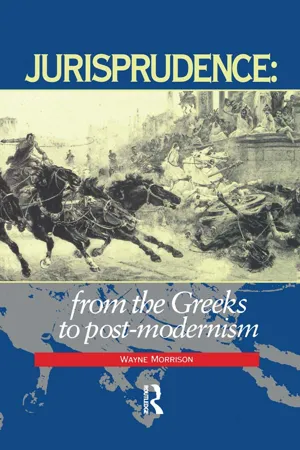 eBook - ePub
Jurisprudence
From The Greeks To Post-Modernity
- Wayne Morrison(Author)
- 2016(Publication Date)
- Routledge-Cavendish(Publisher)
Libertarians share a profound distaste for all theories which promote any idea of a social good which legitimates centralised social administration – even if this is the rather individualist conception of classical utilitarianism – and the aim is to abolish all governmental interference with the lives and ‘rights’ of the citizen. Libertarianism largely founds itself upon a reading of the classical social contract theorist John Locke, who is seen as holding a central thesis that in a state of nature mankind is possessed of inviolable individual rights and has supreme right to take possession of any goods which others do not own. Once seized of these goods, they become their property. The role of government is to protect those rights – particularly the rights to life and property – and social administration is only legitimated insofar as it reinforces and protects those rights and is never legitimated in overriding them. Society is conceived only as the space wherein individuals pursue their own projects, free from interference and respecting the rights of others. The political jurisprudence of Robert Nozick, characterised by his book Anarchy State and Utopia (1974), is the best known of the libertarian theories of justice. 20 Nozick begins from the dual premise that all persons are naturally individuals possessed of right, 21 and that all governments, and all social organisations, need justification: the fundamental question of political philosophy, one that precedes questions about how the state should be organised, is whether there should be any state at all. Why not have anarchy? (1974: 4) To begin with this basic premise sounds strange to the European reader, but in the American context it represents an understandable, if extreme, beginning eBook - ePub
Freedom
Contemporary Liberal Perspectives
- Katrin Flikschuh(Author)
- 2013(Publication Date)
- Polity(Publisher)
3 Robert Nozick: Freedom as a Property Right I. IntroductionRobert Nozick’s influential book Anarchy, State, and Utopia (hereafter ASU) is a modern statement and defence of libertarianism – a free-market-based approach to liberal society and state often associated with aspects of John Locke’s political thought. Libertarians defend the idea of what Nozick calls the ‘minimal state’ – better known historically as the ‘nightwatchman state’. Proponents of a night-watchman state favour minimal governmental interference with individuals’ activities, especially their economic activities. They generally regard legitimate government functions as restricted to upholding the rule of law internally and defending the state’s sovereignty externally. Most libertarians are suspicious of state-enforced social welfare policies that involve the redistribution of resources from the better-off to the worse-off: they prefer to let the mechanism of the market determine allocation of resources. Their ‘hands-off’ approach to government reflects libertarians’ generally sympathetic stance towards negative freedom as non-interference with a person’s actions.Nozick himself is best known for his provocative claim that ‘taxation of earnings from labor is on a par with forced labor’.1 Modern liberal governments typically finance distributive schemes through taxation – primarily by means of income taxation. Income tax is deducted from salaries and wages at source, without asking individual wage earners’ consent. According to Nozick, such non-voluntary taxation amounts to partial enslavement. To ‘enslave’ wage-earners in this way is to treat them as mere things, not as persons. Treating persons as mere things is equivalent to violating their liberty rights – and violating persons’ liberty rights is never
- Suman Gupta(Author)
- 2001(Publication Date)
- Pluto Press(Publisher)
Anarchy, State, and Utopia . Nozick’s anti-political philosophy presents exactly the same kind of contained overdeterminism as Hayek’s. With this account of Nozick’s use of philosophical conventions and understanding of first principles it becomes possible to run through the main contentions of the anti-political philosophy which is laid out in Anarchy, State, and Utopia . This develops in the following manner: Nozick believes that if he is able to chart out an original condition onwards argument, starting from a state of nature and ending with a conceptualisation of the minimal state, which is fully consistent with his first principles (that is, that maintains the invi-olability of the individual and coheres with invisible-hand explanations), and if at the same time he can show that any other conceptualisation of the state and any other original condition onwards argument is unsustainable through the conventional method of testing by plausible hypothetical situations, then a sufficient case would be made for accepting the minimal state and the commitments which arise out of that. Nozick’s understanding of the minimal state is basically the same as Hayek’s – it consists in allocating to the political state no more than a policing and protective function, and disallows all other means of collective action and planning and redistribution to the state on the grounds that this would encourage violation of the position of absolute indi-vidualism – and in asserting this, like Hayek, Nozick strips the main organon of a political will and of any effective ability to exercise a political will. The first principle of privileging invisible-hand expla-nations doesn’t leave any space for other agencies to exercise a political will either. Nozick, in short, joins Hayek in becoming one of the foremost anti-political philosophers of our time, who provide validation for the disabling of political will involved in contempo-rary corporate capitalism. eBook - ePub
Central Works of Philosophy v5
Twentieth Century: Quine and After
- John Shand(Author)
- 2014(Publication Date)
- Routledge(Publisher)
4 Robert Nozick Anarchy, State, and Utopia Peter Vallentyne Robert Nozick’s Anarchy, State, and Utopia (1974), along with John Rawls’s A Theory of Justice (1971), radically changed the landscape in analytic political philosophy. For much of the preceding half-century, under the influence of logical positivism’s heavy emphasis on empirical verifiability, much of moral philosophy was taken up with metaethics (e.g. the semantics of moral discourse), with little attention given to normative moral theories. Moreover, to the extent that normative theories were considered, utilitarianism was the centre of attention. This all changed with the publication of Rawls’s articulation and defence of liberal egalitarianism and Nozick’s libertarian challenge to the legitimacy of anything more than the night-watchman state. At the core of Nozick’s book are two arguments. One is that a night-watchman state (which protects only against violence, theft, fraud and breach of contract) could be legitimate, even without the consent of all those to be governed. The other is that nothing more extensive than the night-watchman state is legitimate, except with the consent of all. The argument is complex, and Nozick often inserts long – and very interesting – digressions. Below I shall focus only on his core argument. I shall thus not address his discussions of Rawls’s theory of justice (ch. 7, § 2) and other arguments attempting to justify more than the night-watchman state (ch. 8), nor his discussion of utopias (ch. 10). The anarchist challenge Nozick attempts to rebut anarchism, which comes in several shapes and forms. The strongest version says that it is impossible for any state to be legitimate. Almost everyone finds this view implausible because a state seems perfectly legitimate when, for example, it efficiently and fairly promotes individual wellbeing and all those governed by it have given, under fair conditions, their free and informed consent to it eBook - PDF
- C. Farrelly(Author)
- 2007(Publication Date)
- Palgrave Macmillan(Publisher)
(A lifetime?) That task is so crucial, the gap left without its accomplishment so yawing, that it is only a minor comfort to note that we here are following the respectable tradition of Locke, who does not provide anything remotely resembling a satisfactory explanation of the status and basis of the law of nature in his Second Treatise. (Nozick, 1974, p. 9) Nozick’s failure to provide a basis for the absolute properties rights entailed by his commitment to self-ownership has led some to describe his position as ‘libertarianism without foundations’ (Nagel, 1982). If there is no foundation for Nozick’s theory then one can justifiably ask why they should accept it. Why favour a theory that accords so much weight to private property, especially when such a right will result in extensive socio-economic inequalities? Unlike Rawls’s purposeful approach to property rights, Nozick’s approach seems to simply beg the question. Without providing some justification for respecting this right there is no reason for us to endorse Nozick’s commitment to the minimal state. The Cost-Blind Approach to Rights 75 4.2 Nozick against taxation In Anarchy, State and Utopia Nozick famously remarked that ‘taxation is on a moral par with forced labour’. For Nozick, the only justified state is the minimal state whose functions are ‘restricted to the narrow functions of protection against force, theft, fraud, enforcement of contracts and so on’ (Nozick, 1974, p. xi). Individuals have rights, argues Nozick, and these rights are inviolable. Like Rawls, Nozick fails to recognize that rights have costs and thus his objection to taxation is a non-starter. To legally enforce just the so-called ‘negative rights’ (e.g. security of the person, freedom of expression) requires a huge investment of public funds and resources. This point is effectively illustrated by Stephen Holmes and Cass Sunstein in their book The Costs of Rights.
- Ralf M. Bader, John Meadowcroft(Authors)
- 2011(Publication Date)
- Cambridge University Press(Publisher)
Part III Justice 145 6 Nozick’s libertarian theory of justice Peter Vallentyne In Anarchy, State, and Utopia (ASU), Robert Nozick sketches and motivates a libertarian theory of justice and then uses it to argue that a minimal state, but nothing stronger, can be just. In this chap- ter, I focus on explaining and assessing his libertarian theory. My focus will be on laying out the basics and identifying how they can be challenged. I shall not address his argument for the minimal state. 1 6.1 Justice Although Nozick frequently (and confusedly) writes of (moral) jus- tifiability, permissibility, and legitimacy, it is clear that his main focus in the book is on justice. 2 He never, however, explains the con- cept of justice. We shall therefore start by clarifying the concept of justice relevant to Nozick’s theory. What is his theory about? The term “justice” is used in many different ways by philoso- phers: as fairness (comparative desert), as moral permissibility (or justifiability) either of distributions of benefits and burdens or of social structures (e.g., legal systems), as enforceable duties (duties that others are permitted to enforce), as the duties that are owed to individuals (as opposed to impersonal duties, owed to no one), and as the enforceable duties owed to individuals. It is clear that Nozick restricts justice to the fulfillment of the duties owed to individuals, but it is unclear whether he restricts it only to enforceable duties. For you to owe someone a duty is for that person to have a claim- right against you that you perform, or not perform, some action. This means that you wrong that individual if you fail to fulfill that duty. As long as rights are understood inclusively, justice in the sense of Peter Vallentyne 146 duties owed to individuals is a broad topic. 3 The Libertarian Theory of Justice: Robert NozickIt is very clear, that God, as King David says, Psalm. 115:16, “has given the earth to the children of men,” given it to mankind in common…. Though the earth, and all inferior creatures, be common to all men, yet every man has a property in his own person: this no body has any right to but himself. The labor of his body, and the work of his hands, we may say, are properly his. Whatsoever then he removes out of the state that nature hath provided, and left it in, he hath mixed his labor with, and joined to it something that is his own, and thereby makes it his property. It being by him removed from the common state nature hath placed it in, it hath by this labor something annexed to it, that excludes the common right of other men. For this labor being the unquestionable property of the laborer, no man but he can have a right to what that is once joined to, at least where there is enough, and as good, left in common for others.(John Locke, Second Treatise of Government, 1789, Section 27)Classical Liberalism and Justice: Rights and the Justification of PropertyJustice, according to John Rawls, is the dominant concept of economically advanced societies like ours where contract and private property are key characteristics. Justice is not a dominant concept in primitive societies, where duties of generosity and reciprocity reign. In many cultures, taking your neighbor’s boat or weapon when you need it is not considered stealing, since the idea of property is not well defined. Societies concerned with social justice are generally relatively stable, economically advanced communities, where private property is a dominant institution. In primitive societies, the concept of justice is related more closely to partiality and relationships than it is in our more impersonal society. For example, in a primitive society it would be wrong not to give an important job to a close relative, if one were a candidate, whereas in ours one would be charged with the crime of nepotism.
 eBook - PDF
Law, Liberty and State
Oakeshott, Hayek and Schmitt on the Rule of Law
- David Dyzenhaus, Thomas Poole(Authors)
- 2015(Publication Date)
- Cambridge University Press(Publisher)
hayek and the state 291 already committed to a particular and very narrow range of values. His was a liberalism for liberals who accepted the ideals of individuality and autonomy commonly associated with the thought of John Stuart Mill and Immanuel Kant. Rawls responded to this critique by conceding that the theory he had crafted was indeed more limited in its reach than he had initially hoped. His re-working of his view in Political Liberalism sug- gested that the most he hoped to do was to offer a statement of the liberal ideal as one that could appeal only to those within a particular modern Western political tradition – and possibly only within the American tradition at that. Rawls aimed in his later writings to craft a theory of justice that might serve as a statement of principle that could be embraced by a diversity of people within a political tradition by express- ing the terms under which they could live as a single people within a closed society. Rawls constructed a theory that was in effect an account of the foundations of the modern American Rechtsstaat. Confronting the same problem, Hayek took a different path. While Rawls backed away from his original aspirations to develop a widely applicable theory, Hayek moved in a more international direction. What he sensed was that it was not possible to defend the Rechtsstaat without retreating to the kind of nationalist position he saw as the main threat to the idea of a liberal political order.
Index pages curate the most relevant extracts from our library of academic textbooks. They’ve been created using an in-house natural language model (NLM), each adding context and meaning to key research topics.

