Politics & International Relations

Edmund Burke
Edmund Burke was an influential 18th-century Irish statesman, political theorist, and philosopher. He is often regarded as the father of modern conservatism due to his emphasis on tradition, gradual reform, and the importance of preserving established institutions. Burke's writings, particularly his reflections on the French Revolution, continue to shape political thought and have had a lasting impact on conservative ideology.
Written by Perlego with AI-assistance
Related key terms
1 of 5
12 Key excerpts on "Edmund Burke"
- I. Hall(Author)
- 2009(Publication Date)
- Palgrave Macmillan(Publisher)
CHAPTER SIX Edmund Burke and International Conflict Richard Bourke A significant body of scholarly literature habitually presents the writings of Edmund Burke as constituting a contribution to inter - national relations theory . This perspective derives in large part from an examination of Burke’s later writings, especially those concerned with the outbreak of the French Revolution and the pattern of its subsequent development. 1 Some of this literature claims Burke as the inaugural repre- sentative of a specific “English school ” of international thought. 2 This idea is not completely without foundation because Burke did indeed champion the cause of the British constitution as an exemplary model of political engi- neering, favorably contrasting it with the organization of France. But this fact is hardly sufficient to qualify him as a British theorist of international relations—or as the creator of any kind of “school ” for that matter. Burke was above all else a publicist and a politician, although it is clear that he was preoccupied with international affairs, particularly as these unfolded af ter 1 789. But although it is distorting to appropriate Burke to either nineteenth- or twentieth-century academic categories and norms, mistaking him for a theorist or an international lawyer , it is clear that his arguments do draw on assorted traditions of legal theory , including common law and natural law traditions. 3 Of course, the key question is what Burke did with these tradi- tions: what insights did they contribute to his thinking about politics, and what programs of action did they help to justify? 4 My main concern in this 92 ● Richard Bourke chapter is to isolate Burke’s views on international conflict as they developed over the course of his career. eBook - PDF
The Burke-Wollstonecraft Debate
Savagery, Civilization, and Democracy
- Daniel I. O’Neill, Daniel I. O'Neill(Authors)
- 2007(Publication Date)
- Penn State University Press(Publisher)
5. See especially Alfred Cobban, Edmund Burke and the Revolt Against the Eighteenth Century (1929; London: Allen & Unwin, 1960). 6. For an influential reading of Burke as a thinker torn between defending the Old Regime aristocracy and embracing the rising bourgeoisie, see Isaac Kramnick, The Rage of Edmund Burke: Portrait of an Ambivalent Conservative (New York: Basic Books, 1977). For the 52 I The Burke-Wollstonecraft Debate Some scholars have been interested in extracting from Burke’s work a general theory of political representation, 7 political parties and statesman- ship, 8 or radicalism and revolution, 9 while others have focused more on Burke’s particular relation to standard eighteenth-century Whig politics. 10 A still more general approach takes Burke as a repository of timeless wis- dom capable of saving us from our own “present discontents.” 11 And, finally, there is the dominant school of postwar Burkean interpretation that argues, with a greater or lesser degree of stridency, that Burke should be seen as the father of modern conservatism, a statesman whose political theory is deeply rooted in Thomism and the Scholastic tradition of natu- ral law. 12 erasure of all ambivalence, see C. B. Macpherson’s unreconstructed Burke (Oxford: Oxford University Press, 1980). Macpherson follows the lead of Marx himself, who categorized Burke as “a vulgar bourgeois through and through”; see Marx, Capital: A Critique of Political Economy, vol. 1, trans. Ben Fowkes (New York: Vintage Books, 1977), 926n13. 7. See James Conniff, The Useful Cobbler: Edmund Burke and the Politics of Progress (Albany: State University of New York Press, 1994). 8. See Harvey C. Mansfield Jr., Statesmanship and Party Government: A Study of Burke and Bolingbroke (Chicago: University of Chicago Press, 1965). 9. See Michael Freeman, Edmund Burke and the Critique of Political Radicalism (Oxford: Basil Blackwell, 1980). eBook - PDF
Interpreting Modern Political Philosophy
From Machiavelli to Marx
- Alistair Edwards, Jules Townshend, Alistair Edwards, Jules Townshend(Authors)
- 2017(Publication Date)
- Red Globe Press(Publisher)
Then came his reaction to the revolution in France and the break with his party and from his reputation as a reformer. As a thinker who actively engaged in, and was at times highly influential in, public life he resembles many other major figures in the history of west-ern political thought. Yet unlike them, with the possible exceptions of Machiavelli and Marx (with both of whom he is diametrically opposed on a wide range of matters), Burke was dismissive of the role that philosophy might play in contributing to a better understanding of politics. In addition, as a partisan, impassioned critic and activist he adopted a speechmaking and writing style which much of the time was less that of the philosopher or theorist and more that of someone who seems part newspaper columnist, part political rhetorician, part dramatist, and part preacher. As a result, there are those who caution against reading too much of any philosophy into Burke and instead focus on his skills as a rhetorician and political actor. His self-consciously philosophical writings were largely confined to his earliest endeavours. One of those early titles began with the words ‘ A Philosophical Enquiry ’. Yet throughout the rest of his life he responded to concrete polit-ical issues as they arose and resisted any inclination to set out a treatise on the nature of politics. He argued or asserted repeatedly that the attempt to apply philosophical inquiry to politics was dangerously inappropriate. It meant digging up what should be left to flourish. Combined with his eclectic use of metaphors, examples and rationales, Burke’s counsel to resist resort-ing to philosophy when addressing practical issues makes the place and meaning of theory in his own approach to politics difficult to characterise and appreciate. Over the past thirty years or so several new, important reassessments of Burke have appeared which try to account for different Burkes or different interpretations of him. eBook - ePub
Edmund Burke and the Revolt Against the Eighteenth Century
A Study of the Political and Social Thinking of Burke, Wordsworth, Coleridge and Southey
- Alfred Cobban(Author)
- 2019(Publication Date)
- Routledge(Publisher)
But there is, if not an interregnum between Locke and Bentham, at least an incipient revolt, represented by Edmund Burke, whose vivid imagination was not to be confined in the rigid categories of Locke, or satisfied by the calculated benevolence of Helvêtius’s school. Our object in this chapter is to attempt to discover in what respects he breaks away from the prevailing attitude towards politics; and this may help us to approach the further question of his conception of the State. Disciple of Locke and Whig politician though Burke was, the real man stands quite apart from the eighteenth century and the philosophes. A believer in antiquity in an age when the Moderns had definitely conquered in their struggle with the Ancients, an adherent of the past in an age that was beginning to look to the future, he was also a philosopher of unreason in the great age of Reason. It was an age that found a mysterious virtue and balm for doubting minds in abstractions and universals—above all in those grand abstractions called Laws of Nature, on which political thinking was still almost entirely based. Burke, on the other hand, denied altogether the validity of abstract, deductive thinking in politics. “Circumstances give every political principle its distinguishing colour”, and he required to have a principle thus embodied, to be able to see the conduct that would flow from it, before he would judge of it. Procrustes, he said, should never provide his ideal of legislation. Universal dicta were never valid in morals or in politics, which were not matters for metaphysical argument but for practical working out eBook - PDF
Small World
Ireland, 1798–2018
- Seamus Deane(Author)
- 2021(Publication Date)
- Cambridge University Press(Publisher)
2 The Burke who had so successfully opposed 1789 to 1688, the Irishman who was more British than the English could ever be, the crypto-Catholic who had a deeper vision of Anglicanism than any Anglican since Hooker, the 19 former supporter of rebellion who became the scourge and analyst of revolution, presented so great a paradox that for two hundred years its resolution or dissolution became a structuring feature of the commen- tary upon him. The fright of the French Revolution had brought out his deepest convictions in a suddenly articulated but long-implicit political theology. Even when this faded, Burke’s polemic against ‘theory’ retained its force as the most enduring and identifiable feature of his work, adopted and adapted in the service of many causes. ‘Burke’s remarks on the problem of theory and practice are the most important part of his work’, says Strauss. 3 Yet he appeared to yield at a critical moment to the idea that since the French Revolution was itself part of the Providential order, it should be accepted; he showed himself to be ‘oblivious of the nobility of last-ditch resistance’. 4 This sudden shift in the tenor of Strauss’s argument presents a Burke who promoted both a fatal resignation to what is, and who denied a presiding law of what ought to be, thereby giving to relativism an unwitting but decisively important impetus. FOUNDING FATHER Strauss’s intervention was especially controversial in the United States where Burke had always retained a special position as the defender of a specifically Christian society against a desolating modernity. Rousseau, so identified by Burke himself, was his scandalous and dan- gerous rival; from Irving Babbitt’s Democracy and Leadership (1924) to J. L. Talmon’s The Origins of Totalitarian Democracy (1952), the battle between these avatars of the contemporary world was regularly and histrionically restaged in academic publications and in journalism as the primal scene in American political philosophy.
- Kyriakos N. Demetriou, Antis Loizides(Authors)
- 2015(Publication Date)
- Routledge(Publisher)
It is this understanding of civilization and its antitheses, I wish to argue, that constituted Burke’s “science of man.” As such, it also provided the basis for his unique view of “scientific statesmanship,” a view that he applied in a theoretically consistent fashion as a means of analyzing both domestic politics as well as the monumental political events that confronted him in America, India, France, and Ireland over the course of his career. In what follows, I will consider Burke’s particular approach to “scientific statesmanship” briefly across each of these areas of concern.i. Domestic British Politics 15
For Burke, Britain was appropriately understood as a civilized society. What marked it as such for him was the existence of an established church and a titled landed nobility, which enabled rule by those he called the “natural aristocracy.” Conversely, Burke argued that democracy stands “in defiance of every political principle.”16 This is because, at a fundamental level, Burke regarded egalitarianism as antithetical to human nature. As he would write in the Reflections on the Revolution in France , “The levelers therefore only change and pervert the natural order of things.” Thus, whereas members of the more “servile” professions “ought not to suffer oppression from the state,” Burke tells his readers, “the state suffers oppression, if such as they, either individually or collectively, are permitted to rule. In this you think you are combating prejudice, but you are at war with nature” (W&S , VIII.100–101). Indeed, Burke defines “a people,” proper, as existing only when “the multitude” are in a state of “habitual social discipline” governed by the “the wiser, the more expert, and the more opulent” (Works, III.85). It is this “natural aristocracy’s” role in such a system to keep in place the intergenerational social contract, to specify the appropriate boundaries of necessarily conventional individual rights, and to knit together in harmony “those who are living, those who are dead, and those who are to be born” (W&S , VIII.147). Because this is so, Burke writes, “when you separate the common sort of men from their proper chieftains,” then the “venerable object called the People” collapses into a “disbanded race of deserters and vagabonds” (Works eBook - PDF
Revolutionary Histories
Cultural Crossings 1775-1875
- W. Verhoeven(Author)
- 2016(Publication Date)
- Palgrave Macmillan(Publisher)
Thus, for all his veneration of the English constitution and of 1688, any hint of ``Whiggism'' a Á la Macaulay remains strangely absent from Burke's writings. There is no general principle, historical, metaphysical, epistemological, or other, guiding the development of the English constitution, however gradual, natural, and beneficial this development may have been. In sum, Burke's view of history could best be seen as an Aristotel- ianism from which the universalist dimension of philosophical wisdom (corresponding to that striking absence of universalist (Platonist) principles in Burke's political thought) has been completely eliminated. And all that remained was the practical wisdom, the ``prudence'' of the responsible statesman. And certainly much is to be said in favor of Burke's construction; it may well be that in politicis the dimension of philosophical wisdom should be recognized as the arcanum imperii whose existence we could not possibly deny but about which we should never speculate. For this arcanum imperii has the strange property of disappearing into thin air, as soon as we start to theorize about it. 208 Revolutionary Histories German Aristotelianism and historism When looking at historism and its antecedents in eighteenth-century natural-law philosophy we will get a different picture. The Aristotelian tradition was in Germany a far more stubborn and successful adversary of the modernist tradition than in England or, for that matter, in France. Its success was, at least partly, due to the fact that, in contrast to what happened in England and in France, it managed to evade the conflict by timely concession or even by grafting itself onto the modernist trad- ition. It is illustrative that all through the eighteenth century, German political treatises tended to be entitled treatises on ``practical philoso- phy,'' and that Aristotelian terminology, definitions, and schematiza- tions predominantly remained in use.
- F. Furet, M. Ozouf(Authors)
- 2015(Publication Date)
- Pergamon(Publisher)
40. Colin Lucas, Edmund Burke and the Émigrés, p. 101. 41. Burke et les Français. 42. Harvey Mitchell, Tocqueville's Mirage or Reality? Political Freedom from Old Regime to Revolu-tion, Journal of Modern History 60 (1988), pp. 2 8 -5 4 . CHAPTER 1 Edmund Burke and the Redefinition of Enthusiasm: the Context as Counter-Revolution j . G. A. POCOCK THIS colloquium is devoted to an assessment of the transformation of European political culture in response to the French Revolution in the period up to 1850, and is mainly concerned with the Revolution's role in the historical memory of the first half of the nineteenth century. Burke is in some ways a strange choice to introduce such an enquiry; he died in 1797, a surviving witness to a somewhat imaginary Whig regime which had been upset by George III in 1783-84, and the restatement of his anti-Revolutionary writings, so that they became part of the liberal conservatism of late Georgian and early Victorian Britain, is a complex subject which has been strangely little studied. The decades from 1790 to 1830 from the true Sattelzeit in the history of English-British political discourse, and though Burke's texts form part of what was going on in that period, he did not himself belong to it. Many changes in the vocabulary, content and style of anglo-phone discourse occurred in the course of that Sattelzeit, and the response to the French Revolution was only one major factor in occasioning them; and that response moreover, was often hostile and still more often uncomprehending. Of even the warmest English sympathizers with what was going forward in France it could be said, as the Parisian authorities said of Thomas Paine when they had him in gaol in 1794, that their genius had never truly comprehended the principles of the Revolution. eBook - PDF
Parliamentarism
From Burke to Weber
- William Selinger(Author)
- 2019(Publication Date)
- Cambridge University Press(Publisher)
He carried the glory, the power, the commerce of England, to a height unknown.” Burke was not only a theorist of Parliament but also was among the great parliamentary statesmen of the eighteenth century. Born in , he entered the House of Commons in , after an uneven career in law and letters, and he served in Parliament for nearly three decades, retiring in . For much of that period, he was convinced that British politics had entered an era of profound upheaval because of the actions of George III. During the previous reigns of George I and George II, the Whig party had maintained a steady hold on ministerial office. From to , Robert Walpole had been prime minister. He was succeeded by his protégé Henry Pelham, who was prime minister between and . Following Pelham’s death, the dominant figure in Parliament was his brother the Duke of Newcastle. Even William Pitt, the most popular and eloquent statesman of the period, could not hold onto power without Newcastle’s support. However, with George III’s ascension to the throne in , the monopoly of the Whigs came to an end. In , the king dismissed Newcastle’s ministry, leading to sustained cabinet instability for the rest of the s. As Burke declared in horror at the end of the decade, “no less than seven prime ministers of state” had recently held office. In , Lord North became prime minister and the cabinet instability came to an end. However, for Burke, this constituted little improvement. Burke, Thoughts on the Present Discontents, . Ibid., –. J. C. D. Clark persuasively traces the “disintegration of the Old Corps” as Parliament’s ruling power further back to the s and to the weakening of the conventional Whig and Tory parties during that period. See J. C. D. Clark, The Dynamics of Change: The Crisis of the s and English Party Systems (Cambridge: ). In contrast with Clark, Burke saw the crucial event as George III’s ascent to the throne. eBook - ePub
The Saga of Edmund Burke
From His Age to Ours
- Mark Hulliung(Author)
- 2023(Publication Date)
- Routledge(Publisher)
Front and center in their reflections was Bolingbroke, the figure Burke had dismissed with stinging sarcasm in Reflections on the Revolution in France. The many commentators of recent times who have characterized Burke as the hero of an unbroken conservative tradition are therefore mistaken. The nineteenth century is not Burke’s conservative moment. If anything, that period was one in which it was the liberals who repeatedly called out his name and claimed him as their illustrious predecessor. Among the liberals, nothing was more common than to express admiration for the Burke who had been the outstanding Whig spokesperson during the period preceding the French Revolution. And liberals felt forced to remember the Burke of the Reflections when they confronted events in nineteenth-century France, especially in 1830 and 1848. Often, they took pleasure in projecting images of the England of 1688 upon the promising France of 1830, only to express their shock and dismay not many years later when it appeared that the France of 1848 might be a repeat of that country’s 1790s. Burke, who could express both their hopes and their fears, was frequently called upon by liberals in search of a formidable spokesperson. Burke as an Outsider to the Conservative Tradition Burke’s writings in 1796, the year before his death, convinced the Tories of the early nineteenth century to keep their distance from the man who would eventually be known as the hero of conservatism. Mainly, it was the Letters on a Regicide Peace that led Tories to shun and sometimes criticize Burke. A lesser but by no means insignificant problem was his Letter to a Noble Lord, which inadvertently raised questions as to whether he continued to uphold his lifetime commitment to the English aristocracy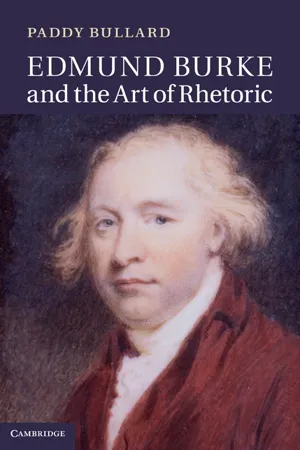 eBook - PDF
- Paddy Bullard(Author)
- 2011(Publication Date)
- Cambridge University Press(Publisher)
In Burke’s hands, rhetoric is both something less and something more than a technology for interfering with the convictions of others. It is his theory of government that indicates the most appropriate way of under- standing the sorts of comprehensive strategies we find in Burke’s writings and speeches. From the very start of his political career Burke argues that it is the first duty of all legislators to attune themselves to the character and disposition of the political nation for whom they legislate. His experience of American colonial politics – his early realization that it would always be impossible to compel or impose upon the Americans – is the defining one here. ‘People must be governed in a manner agreeable to their temper and disposition’, he writes in Observations on a Late State of the Nation (1769), his first major pamphlet, ‘and men of free character and spirit must be ruled with, at least, some condescension to this spirit and this character.’ 35 ‘The temper and character which prevail in our Col- onies’, he reiterates in his Speech on Conciliation with America (1775), ‘are, I am afraid, unalterable by any human art. We cannot . . . persuade them that they are not sprung from a nation, in whose veins the blood of freedom circulates. The language in which they would hear you tell them this tale, would detect the imposition; your speech would betray you.’ 36 10 Edmund Burke and the Art of Rhetoric The retort of rhetorical language back upon the ethos of the persuader defines the limit of its instrumentality. It also points the way towards a more positive purpose for civil deliber- ation, based on knowledge of those tempers and dispositions. eBook - PDF
The Fullness of Knowing
Modernity and Postmodernity from Defoe to Gadamer
- Daniel E. Ritchie(Author)
- 2011(Publication Date)
- Baylor University Press(Publisher)
They also agree that Burke defends taste as an alternative to the Enlightenment mode of political judgment. Like most of the other figures in this book, Burke’s approach to knowl-edge was at odds with the dominant trends in Enlightenment culture, and his detractors were excellent at ridiculing him. Paine’s criticism of Burke, for expressing concern for the aristocracy while allegedly ignoring the suffering of the French nation, still reso-nates: “He pities the plumage, but forgets the dying bird.” 50 What is missing from these interpretations, however, is an explanation of how Burke’s approach to history differs epistemo-logically from that of his opponents. Burke’s aesthetics cannot be reduced to a method. Unlike the “necessary” outcomes of Paine’s methodical analyses, the outcomes of Burke’s approach always require judgment. Where the revolutionaries offer certainty, Burke requires prudence. Where their approach offers a pre-scribed method, Burke demands flexibility. Q Tradition as a Way of Knowing 173 In focusing on the “flexibility” of Burke’s standard of taste, I do not mean to deny the moral and philosophical principles at the core of his thought. Burke believed in an underlying natural law, capable of recognition by all nations, which provided a moral cen-ter to the social world. 51 He did not believe, however, that human laws followed straightforwardly from natural law in the way that Paine derived civil rights from natural rights. 52 The flexibility in Burke’s thought runs through his political, moral, and aesthetic judgment: Nothing universal can be rationally affirmed on any moral, or any political subject. Pure metaphysical abstraction does not belong to these matters. The lines of morality are not like the ideal lines of mathematics. They are broad and deep as well as long. They admit of exceptions; they demand modifications. These exceptions and modifications are not made by the process of logic, but by the rules of prudence.
Index pages curate the most relevant extracts from our library of academic textbooks. They’ve been created using an in-house natural language model (NLM), each adding context and meaning to key research topics.

