Politics & International Relations

Isaiah Berlin
Isaiah Berlin was a prominent political philosopher known for his work on liberalism, pluralism, and the concept of negative freedom. He emphasized the importance of recognizing and respecting the diversity of human values and beliefs, and his ideas have had a significant impact on political thought and international relations theory. Berlin's writings continue to be influential in discussions about individual liberty and the nature of political power.
Written by Perlego with AI-assistance
Related key terms
1 of 5

11 Key excerpts on "Isaiah Berlin"
 eBook - ePub
- Hans Blokland(Author)
- 2019(Publication Date)
- Routledge(Publisher)
2 Isaiah Berlin on positive and negative freedomINTRODUCTION
Isaiah Berlin was born on 6 June 1909, the son of a Jewish timber merchant in Riga, capital of Latvia. In 1915, he left with his parents for St Petersburg, where he was to witness both Russian revolutions. From there, the family, characterized by Berlin as ‘bourgeois liberal’ emigrated to England in 1919. His father was an anglophile, which explains his choice of destination. In England, he attended St Paul’s School in London and Corpus Christi College in Oxford. He was to spend the greater part of his academic career attached to the University of Oxford, as professor of social and political theory (1957–67), chairman of Wolfson College (1966–75) and Fellow of All Souls College (1932–8 and 1960 to the present). Berlin, who was knighted in 1957, was also chairman of the British Academy (1974–8). He is mainly known for his work in the history of ideas and political theory, but has also been active in the fields of theory of knowledge and science, literature (especially Russian) and musicology.1A thread running through Berlin’s work is his crusade against the widespread monistic conviction that there is only one correct answer to every question and that all correct answers can be arranged in a harmonious manner into a single knowable rational system. Opposed to this belief, which according to Berlin has led to inertia, intolerance and cruelty, he suggests that there are many values, each of which is worth emulating in itself yet which are conflicting, so that inevitably they must be weighed up against each other. In his history of ideas, which can be characterized as a sort of phenomenology of Western consciousness, he studies in particular how this idea of pluralism has developed since the end of the eighteenth century. The philosophers Giambattista Vico (1668–1744) and Johann Gottfried Herder (1744–1803), and above all the Russian writer Alexander Herzen (1812–70) are his heroes in this history. In the world of modern Anglo-American political theory, the discovery of the problem of pluralism is generally attributed to the work of Isaiah Berlin. In particular, the publication of his Inaugural Lecture, ‘Two Concepts of Liberty’, delivered on occupying the Chichele Chair of Political and Social Theory at the University of Oxford in 1958, is taken as the textual origin of the ‘pluralist movement’ in political theory. This essay was, at first, noticed primarily for the famous distinction between ‘positive’ and ‘negative’ liberty that Berlin did so much to popularize. It subsequently became clear that this conceptual distinction itself rested upon the more interesting and controversial thesis of value pluralism.It is now generally agreed that the idea of the existence of plural and conflicting values is, or has become in the eyes of many contemporary political theorists, the central theme in the political thought of Isaiah Berlin. This is a relatively recent development insofar as Berlin, prior to the emergence of the problem of pluralism as a central topic in political thought, was generally thought of as primarily a historian of political ideas rather than a political philosopher. It might be that Berlin’s own self-description, as someone who had abandoned philosophy for the history of ideas, contributed to the general disregard of his account of pluralism by philosophers and political theorists. Charles Taylor has pointed out that Berlin’s thesis of pluralism was ‘deeply unsettling to the moral theories dominant in his own milieu. It is one of the paradoxes of our intellectual world, which will be increasingly discussed in the future, why this latter point was not realized. The bomb was planted in the academy but somehow failed to go off.’26 It is also worth noting that these claims made for the significance and originality of Berlin’s contribution to political thought have also been challenged, and have encountered considerable scepticism. For example, Ernest Gellner argued forcefully that Berlin’s idea of pluralism is both unoriginal and obscure. In particular, Gellner pointed out that Berlin himself refers to some intellectual precursors for this idea of pluralism. Machiavelli, Vico, Herder and Tolstoy are all mentioned in Berlin’s essays. However, the problem here is that, in so doing, Berlin seems to undermine his own claims, or, at least, those made on his behalf, for the originality of his idea of pluralism. We can point both to the centrality of tragic conflicts of value in ancient Greek drama and, in more recent times, to such figures (of whom Berlin was clearly more than just aware) as Max Weber and Raymond Aron, for whom the idea of the pluralism of values was a central concern. Clearly, it is of particular interest here to reflect upon Berlin’s avoidance of a discussion of Weber’s ideas on the problem of plural and conflicting values. As Gellner exclaims, Weber ‘didn’t merely talk about warring gods, he explored them with unequalled depth. All this is highly relevant, in as far as one of the crucial criticisms which can be made of Berlin’s formulation of the rival-gods problem is precisely its sociological thinness, its abstract philosophical formulation.’27
 eBook - ePub
- Jeffrey Friedman(Author)
- 2022(Publication Date)
- Routledge(Publisher)
Ignatieff, Michael. 1998 .Isaiah Berlin: A Life. New York: Henry Holt.- Jahanbegloo, Ramin. 1991 .
Conversations with Isaiah Berlin. New York: Macmillan.- Laslett, Peter. 1956 . “Introduction.”
Philosophy, Politics and Society, First Series. New York: Macmillan.- Merelman, Richard. 2003 .
Pluralism at Yale: The Culture of Political Science in America. Madison: University of Wisconsin Press.- Ricci, David. 1984 .
The Tragedy of Political Science: Politics, Scholarship, and Democracy. New Haven: Yale University Press.- Ryle, Gilbert. [1949 ] 2000.
The Concept of Mind. Chicago: University of Chicago Press.- Schoeck, Helmut, and James W. Wiggins, eds. 1961.
Relativism and the Study of Man. Princeton: Van Nostrand.- Smith, Steven B. 2006 . “Leo Strauss’s Platonic Liberalism.” In
Reading Leo Strauss: Politics, Philosophy, Judaism. Chicago: University of Chicago Press.- Smith, Steven B. 2018 . “Isaiah Berlin on the Enlightenment and Counter-Enlightenment.” In
The Cambridge Companion to Isaiah Berlin, ed. Joshua L. Cherniss and Steven B. Smith. Cambridge: Cambridge University Press.- Storing, Herbert, ed. 1962.
Essays on the Scientific Study of Politics. New York: Holt, Rinehart, and Winston.- Strauss, Leo. [1936 ] 1966.
The Political Philosophy of Hobbes: Its Basis and Its Genesis, trans. Elsa M. Sinclair. Chicago: University of Chicago Press.- Strauss, Leo. [1946 ] 2008. “Letter to Karl Löwith, August 20, 1946.” In
Leo Strauss Gesammelte Schriften Band 3: Hobbes’ politische Wissenschaft und zugehörige Schriften – Briefe, ed. Heinrich and Wiebke Meier. Stuttgart: Metzler.- Strauss, Leo. [1948 ] 2013.
On Tyranny. Including the Strauss-Kojève Correspondence, ed. Victor Gourevitch and Michal S. Roth. Chicago: University of Chicago Press.- Strauss, Leo. [1953 ] 1971.
Natural Right and History. Chicago: University of Chicago Press.- Strauss, Leo. [1956] 1989. “An Introduction to Heideggerian Existentialism.” In idem,
The Rebirth of Classical Political Rationalism eBook - PDF
Exile, Statelessness, and Migration
Playing Chess with History from Hannah Arendt to Isaiah Berlin
- Seyla Benhabib(Author)
- 2018(Publication Date)
- Princeton University Press(Publisher)
164 9 Isaiah Berlin A J u da ism bet w e e n De cision ism a n d Plu r a l ism Upon Sir Isaiah Berlin’s death on November 5, 1997, Leon Wie-seltier, one of the most influential editors of The New Republic , wrote an encomium titled with the Talmudic saying, “When a Sage Dies, All Are His Kin.”1 Wieseltier wrote elegiacally: “The pluralists are his kin, and they must mourn”; “The rationalists are his kin, and they must mourn”; “The democrats are his kin, and they must mourn”; The nationalists are his kin, and they must mourn”; finally, “The Jews were his kin, and they must mourn.”2 Commentators on Berlin’s work—even those most sympathetic to his best-known theses such as the inescapable plurality of human val-ues, two kinds of liberty, and the hedgehog and the fox as styles of thought—have not been quite so sanguine: Whether Berlin can recon-cile all his kin despite his Talmudic skills remains a vexing question.3 The relationship of liberalism to Berlin’s value pluralism remains fraught, as does the question whether value pluralism can avoid relativism. Although his family migrated from Latvia to Russia in 1915, when he was six years old and then to the United Kingdom in 1921, unlike “the eternally half-others” ( der ewig halb-anderen ) discussed in this collec-tion (see chapter 2 above) Isaiah Berlin was a migrant, but was neither stateless nor an exile. If anything, he represents a superb example of i s a i a h b e r l i n 165 successful migration and integration. As Wieseltier observes, “Berlin was a creature of loyalties, and he expounded a critical philosophy of loyalty. He lived a dutiful, polycentric, generous, and unidolatrous life. ‘I remain totally loyal to Britain, to Oxford, to liberalism, to Israel,’ he remarked. eBook - ePub
Freedom
Contemporary Liberal Perspectives
- Katrin Flikschuh(Author)
- 2013(Publication Date)
- Polity(Publisher)
1Isaiah Berlin: Two Concepts of Liberty?I. IntroductionIsaiah Berlin’s ‘Two Concepts of Liberty’ was first delivered in the form of a public lecture in 1958, when the Cold War was well under way.1 The essay has since been published in many different editions of Berlin’s considerable volume of work on (the history of) liberal thought. What is the abiding significance of ‘Two Concepts’ nearly fifty years on? Responses to this question will vary depending on whom one asks. Those who take umbrage at the unmistakably ideological undertones of Berlin’s essay will be inclined to say that the essay’s influence on the philosophical study of freedom has been inflated.2 Others – often those who knew him as colleague or teacher – will insist that without Berlin our understanding of liberal freedom would not be what it is today.3 From the perspective of contemporary analytic political philosophy, the significance of Berlin’s essay is often thought to lie in the fact that the contestation over ‘Two Concepts’ gave rise, eventually, to the now perhaps equally widely accepted understanding of freedom as a ‘triadic’ concept within those circles. This is Gerald MacCallum’s contention, to be examined in the next chapter, that there is only one concept of liberty – albeit one that contains both ‘negative’ and ‘positive’ elements within it.4From this last-mentioned perspective, the significance of Berlin’s essay is that it provided the opportunity for much-needed philosophical analysis and clarification of the concept of liberty, or freedom.5 This may be one way of saying that Berlin’s essay lacks the clarity and rigour demanded by current analytic philosophy. Others – often those working in the history of ideas – complain that the essay lacks a scholar’s differentiated understanding of particular philosophical thinkers in the history of ideas, that it ignores necessary attention to interpretative detail. Both charges have some warrant: not only does Berlin speak, without any sense of incoherence, of there being two distinct concepts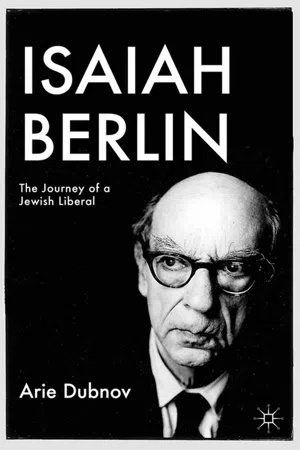 eBook - PDF
Isaiah Berlin
The Journey of a Jewish Liberal
- A. Dubnov(Author)
- 2012(Publication Date)
- Palgrave Macmillan(Publisher)
Two central Berlinian concepts illustrate particularly well one of the fundamental ten- sions in Berlin’s philosophy, namely, “negative liberty” and “counter-Enlightenment.” Berlin’s defense of what he called negative liberty was conventionally understood 6 Isaiah Berlin as an attempt to formulate a universalist liberal norm coupled with an individu- alistic view of society. It was a negative conception of liberty in the literal sense, for it stemmed from Berlin’s utter suspicion of any form of paternalism or govern- mental authority that attempted to impose external obstructions violating or nar- rowing that intimate area within which a person “is or should be left to do or be what he is able to do or be, without interference by other persons.” It is a concep- tion of freedom frequently described using spatial metaphors that assume a clear distinction between private and public spheres. It situates freedom in that “invio- lable sphere” of privacy, indeed suggesting that freedom could be defined “simply [as] the area within which a man can act unobstructed by others.” 19 In Berlin’s writings on counter-Enlightenment, however, we find a very different voice. Here Berlin the historian of ideas comes out as sympathetic of the exact opposite notions that the liberal defended: criticizing excessive individualism, mocking the attempt to formulate universal ethical norms, highlighting the importance of collectivity, and using language and metaphors that allude to organicist volk- ism and Romantic critique of Enlightenment’s cosmopolitanism. As a historical construct, “counter-Enlightenment” was an enormously problematic category, wrapping together all too easily divergent thinkers such as Giambattista Vico, an anti-Cartesian seventeenth-century Neapolitan Catholic, and Johann Gottfried von Herder, a much later anti-Kantian pessimist Lutheran who abhorred the very notion of universal reason and universalist conceptions of human nature. eBook - ePub
- Maria Dimova-Cookson(Author)
- 2019(Publication Date)
- Routledge(Publisher)
4 Isaiah Berlin, positive freedom and the impact of moral authorities on human agencyIntroduction
Berlin’s essay ‘Two Concepts of Liberty’ (hereafter TCL) is a masterpiece in moral and political philosophy.1 Readers find in it different inspirational themes,2 and they do not necessarily agree with the specific conclusions of the essay. I believe that the essay should be celebrated for its contribution not just to the analysis but also to the conceptualisation of liberty, even if this conceptualisation can be revised and improved. Berlin has demonstrated, better than any other scholar, the need for two concepts of liberty. He has suggested how the internal freedom boundary – the boundary between the two real meanings of freedom3 – should be drawn, and he has alluded to the flexibility of this boundary. Because of the scale of his philosophical aspiration, some critics have categorised his intellectual conduct as ‘ahistoric’ (Collini, 1999: 203). His ambition was to capture in clear theoretical terms the history of liberty in ‘the Western tradition in ethics and politics’ of the past ‘two millennia’ (TCL: 200). Berlin, however, is explicit about both his universalistic analytical intention and his more narrowly historical positioning on the anti-communist side of the Cold War. TCL moves in and out of its specific historical and ideological context, and this is one of the things that makes it so unique: its elaborate theoretical design is frail and, if anything, easy to challenge, but it continues to inspire philosophical fascination: ‘generations of students have cut their teeth in analytical political theory on the distinction between positive and negative liberty’ (Coole, 2013: 199). The continuous attention TCL eBook - PDF
Political and Civic Leadership
A Reference Handbook
- Richard A. Couto(Author)
- 2010(Publication Date)
- SAGE Publications, Inc(Publisher)
This view is associated with exis-tentialist philosophers and with many contemporary ana-lytic moral theorists (such as Charles Larmore, Susan Wolf, and Harry Frankfurt). Another popular view of positive liberty comes from the civic republican tradition in political theory. Benjamin Constant identified the liberty of the ancients—as in the ancient Athenians or Romans—as consisting in collective deliberation and power over the affairs of government. In this view, to be free is to participate as an equal in the affairs of government. Constant notes that this view of lib-erty is consistent with individuals having little control over their own lives. He contrasted the liberty of the ancients with the liberty of the moderns, liberty that emphasized having control over one’s own life rather than joint control over politics. Berlin’s conception of positive liberty seemed to be a mix of Plato’s and the liberty of the ancients. Berlin con-ceived of positive liberty as self-mastery, which included not only autonomy over one’s own choices but also involvement in collective self-government. These are just a few of the conceptions of liberty polit-ical theorists and philosophers have offered. Some dispute whether the distinction between positive and negative lib-erty is tenable. Some say that only negative liberty counts as real liberty. Others say the opposite. Still others accept both negative and positive views of liberty. And others claim to have conceptions of liberty that transcend the negative–positive distinction. 23. Liberty and Freedom – • – 191 Choosing a Conception of Liberty Berlin’s distinction between positive and negative liberty did not exhaust all of the ways of thinking about liberty. In fact, it seems that both philosophers and laypeople use the term liberty to refer to a variety of different, if perhaps related, things. eBook - PDF
Modern Pluralism
Anglo-American Debates since 1880
- Mark Bevir(Author)
- 2012(Publication Date)
- Cambridge University Press(Publisher)
None of this would satisfy critics who sought to hold on to a set of sub- stantive values and who kept indicting Berlin in particular for relativ- ism. Leo Strauss was the leading voice in this critical chorus, although many much less conservative thinkers chimed in, especially in rejecting the supposed link between value pluralism and liberalism. 63 Value pluralism after Rawls: too thick, too thin? As is well known, a number of thinkers after Berlin accepted the ‘con- ceptual truth’ of value pluralism – but completely denied that it entailed liberalism. John Gray argued that taking value pluralism seriously meant that liberal values could not possibly be assigned a privileged position in politics. He claimed: If value pluralism is true all the way down, then it follows inexorably that the identity of practitioners of a liberal form of life is a contingent matter, not a privileged expression of universal human nature. If there is value-conflict all the way down, then there is contingency all the way down, too. 64 62 Hampshire, Justice is Conflict, ix. 63 Leo Strauss, ‘Relativism’, in Thomas L. Pangle, ed., The Rebirth of Classical Political Rationalism (University of Chicago Press, 1989), 13–26. See also Michael Sandel, ‘Introduction’, in Michael Sandel, ed., Liberalism and its Critics (New York University Press, 1984), and George Crowder, ‘Pluralism and Liberalism’, Political Studies, vol. 42 (1994), 293–303. 64 John Gray, Isaiah Berlin (Princeton University Press, 1996), 168. Jan-Werner Müller 100 Like Berlin, Gray denied that value pluralism was a form of scepticism or relativism; rather it amounted to ‘objective pluralism’. At the same time, Gray’s position resembled Hampshire’s in that he also sought to indict Rawls’ political liberalism as implausible, while proposing an institutional solution to the inevitable conflicts among ‘ways of life’. eBook - ePub
Value, Conflict, and Order
Berlin, Hampshire, Williams, and the Realist Revival in Political Theory
- Edward Hall(Author)
- 2020(Publication Date)
- University of Chicago Press(Publisher)
It is also somewhat ironic that Berlin’s discussion of the first kind of statesman reveals that monistic commitment can be a begetter of political success because this implies that a philosophical appreciation of the plural nature of value may often be in tension with admirable statesmanship. However, Berlin’s discussion of these figures, alongside his remarks on political judgment, sketchy as they are, give color to his view that no set of theoretical claims can capture what it means to act well, and responsibly, in politics. To be sure, as I will argue in the next section, Berlin’s account of political judgment contains some damaging omissions, such as his disinclination to think about political conduct in terms of winning and exercising authority or ensuring the compliance of subjects. Yet this aspect of his thought expresses the view that although we can only decide how we can balance the competing claims of different values in concrete circumstances, an attractive integration of distinct values can sometimes take place, but that this is something that is necessarily revealed in practice, not delivered by theory. 31 Politics in a Pluralist Key So far in this chapter, I have argued that Berlin’s work is at odds with some aspects of moralist political philosophy, given the impure approach he favors and his skepticism about overly theoretical approaches. In this section, I argue that his value pluralism slants more directly in the direction of various considerations at the heart of recent realist thinking. 32 Berlin is clear that if we take value conflict seriously, this proscribes some ways of thinking about the tasks of politics. In particular, he claims that monists typically see politics in instrumental terms: as an activity concerned with putting the antecedently discovered answer to the question of how we should live into practice eBook - PDF
Freedom After the Critique of Foundations
Marx, Liberalism, Castoriadis and Agonistic Autonomy
- A. Kioupkiolis(Author)
- 2012(Publication Date)
- Palgrave Macmillan(Publisher)
4 Liberal Detours and Their Mishaps: Negative Liberty, Isaiah Berlin and John Stuart Mill John Stuart Mill's calls for original self-development and the ethics of negative liberty drift away from a fixation on uniform humanity and the ensuing conflation of freedom with recursive patterns of being. These gestures strike at the root cause of authoritarian threats and the repression inflicted on freedom when it is held hostage to an enduring substance. Negative liberty and Millian freedom are fraught, however, with their own defects. Negative liberty does not attend to the constitution of the free subject, thus leaving in play a wide range of restraints which operate more directly on the micro-politics of the self. Mill's plea for new life-experiments and self-enhancement eschews these limitations. But he summons the spectre of an individual nature that people are urged to uncover and bring to fruition. This signals a certain regression to essential freedom and its vicissitudes. Traditional liberal rejoinders to essentially stifled freedom are not liberat- ing enough and do not stage a compelling alternative; hence the need for a conceptual reworking of freedom and the shift towards a distinct current of thought that has taken shape in contemporary theory. The argument gets to grips here with Mill's vision of freedom and takes issue with negative liberty, which is thought through in the work of Isaiah Berlin. Berlin laid out the staple meaning of this concept and held it up against views with essentialist leanings, which he impugned under the heading of positive lib- erty. Moreover, he canvassed an enhanced version of negative liberty, which seems immune to oft-repeated criticisms against this road to freedom. What is negative in negative liberty? Negative liberty does not care seriously for the self The conceptual heart of negative liberty is attached to the 'absence of ...
Index pages curate the most relevant extracts from our library of academic textbooks. They’ve been created using an in-house natural language model (NLM), each adding context and meaning to key research topics.

