History

Junker
Junker was a term used in Prussia and Germany to refer to members of the landed aristocracy who held significant political and economic power. They were typically wealthy landowners who were exempt from taxes and military service, and often held positions of influence in government and the military. The term fell out of use after World War II.
Written by Perlego with AI-assistance

7 Key excerpts on "Junker"
 eBook - ePub
Peasants and Lords in Modern Germany
Recent Studies in Agricultural History
- Robert G. Moeller(Author)
- 2017(Publication Date)
- Routledge(Publisher)
Geschichte und Gesellschaft (Göttingen, 1980), 89–122. Some of the references have been shortened for this version. It appears here with permission of the publisher. The translation was provided by Lynn Mally.2 G. Schultz, ‘Deutschland und der preussische Osten. Heterologie und Hegemonie’, in H.-U. Wehler (ed.), Sozialgeschichte heute. Festschrift für H.. Rosenberg (Göttingen, 1974), 87. A polemical or pejorative tone is frequently implicit in the word Junker or Junkertum, as for example in the expressions KrautJunker (country bumpkins) or Junkerparlament (country backbenchers). The word was freely associated with the collective qualities of stubbornness, self-interest, egotism, ignorance, boorishness, provinciality, lack of education and narrow-mindedness. However, the word Junker was as commonly used as a term of self-definition and, as in the case of Bismarck, was a proud form of identification. In the following, both the negative and positive connotations of the words Junker and Junkertum will be avoided. The terms landed nobility, landed elite, knight’s estate-owner (Rittergutsbesitzer) and Junker will be used more or less interchangeably. One will be given preference to another only to highlight certain characteristics. For the semantics of the term ‘Junker’, see H. Rosenberg, ‘Die Ausprägung der Junkerherrschaft in Brandenburg-Preussen 1410–1648’, in his Machteliten und Wirtschaftskonjunkturen (Göttingen, 1978), 24–6.3 The decision to treat such a global question as the role and function of the Junkers in Prussian history in this way stems largely from personal interests which can, of course, be explained objectively. Two limitations of this essay should be made clear from the outset. The first part concentrates on the global characteristics of the development of the Junkers’ collective history. Relationships with other social groups and classes will be excluded or treated only in a tangential way. In the second half, I will concentrate on the West German historiography, occasionally referring to American authors. I will thus avoid a confrontation with East German authors (for example, H. Harnisch, R. Berthold, H. H. Müller and others) whose contributions to the field of Prussian social, economic and agrarian history have been very productive. This limitation is made largely for practical reasons. On this issue see J. Kocka, ‘Preussischer Staat und Modernisierung im Vormärz. Marxistisch-leninistische Interpretationen und ihre Probleme’, in Sozialgeschichte heute,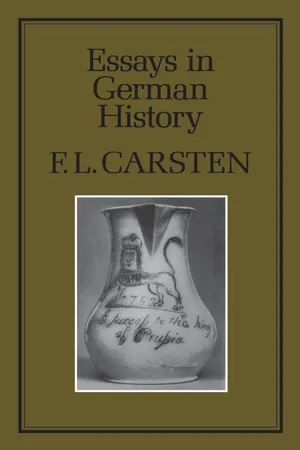 eBook - PDF
- F. L. Carsten(Author)
- 1985(Publication Date)
- Hambledon Continuum(Publisher)
2 THE ORIGINS OF THE JunkerS ALTHOUGH the Junkers of Brandenburg and Prussia only £. gained prominence in European history in the course of the nineteenth century, the foundations of their political and economic power were laid at a much earlier period. These foundations were : their large estates which were continuously encroaching upon the land of the peasants ; the strict serfdom of the peasants and their children which persisted up to the nineteenth century ; the rigid division of society into three main classes, Dobility, burghers, and peasants, among which the nobility was dominant ; the strong influence exercised by the Junkers upon the territorial princes who depended on their political support ; their right of filling the higher posts in state and army ; the identification of their own interests with those of the state. It is well known that practically all these characteristics de-veloped in the course of the sixteenth century, and that they were intimately connected with the transformation of the medieval agrarian system, the c Grundherrschaft ', into a system of large estates producing corn for export, normally called the ' Gutsherr-schaft '. This system came into being only in eastern Germany and Poland during the fifteenth and sixteenth centuries ; it not only entailed a complete revolution of the agrarian system, but it caused sweeping social and political changes from which the Junkers emerged as the all-powerful ruling class, the once free peasants having been reduced to serfdom and the towns to a mere shadow of their former wealth and power. Yet this manorial and political reaction has quite rightly been called ' capitalistic farming ', or at least * agrarian pre-capitalism ' ; 1 for the farming of large estates was more rational from the purely economic point of view than that of small peasant holdings and produced a larger surplus for the market. eBook - PDF
Elites Against Democracy
Leadership Ideals in Bourgeois Political Thought in Germany, 1890-1933
- Walter Struve(Author)
- 2015(Publication Date)
- Princeton University Press(Publisher)
Indeed, they suggested that an elite might expand the basis of its re- cruitment in order to avoid popular control. By the end of the eighteenth century, the Prussian state had drawn into service the bulk of an entire social estate. Under Frederick the Great the government committed itself to a policy aimed at preserving the Junkers by discouraging their intermarriage with commoners and by aiding the large estates which provided the economic basis for the Junkers' privileged position. 5 Entrusted to the Junkers, rural adminis- tration was to a large extent autonomous. The superordinate social and economic position of the Junkers received official sanction. In ex- change, so to speak, for their privileges the Junkers served as officers in the army. The Junkers were formally accorded preference for all governmental posts. The Prussian General Legal Code of 1794 explicit- ly recognized their special privileges.® What type of person was the typical Junker? Until the latter part of the nineteenth century no other group held him in much esteem. The common image of the Junker did not play a role in Prussian society similar to that of the "gentleman" in the Anglo-Saxon countries or the 5 See esp. Elsbeth Schwenke, Friedrich der Grosse und der Adel (Berlin diss., 1911). 6 See Uwe-Jens Heurer, Allgemeines Landrecht und Klassenkampf: Die Aus- einandersetzung urn die Prinzipien des AUgemeinen Landrechts am Ende des 18. Jahrhunderts als Ausdruck der Krise des Feudalsystems in Preussen (Berlin, 1960). The Challenge of the 1890's—57 "man of letters" in the Latin countries. Since presumably the Junker inherited his most characteristic attributes, how could anyone else really become a Junker? He and the bourgeois failed to find a social type which both could strive to approximate. The Junker lacked the polish supplied by a cosmopolitan court in Vienna or Versailles and the proverbial grace, charm, and savoir-faire of a French or Austrian aristocrat.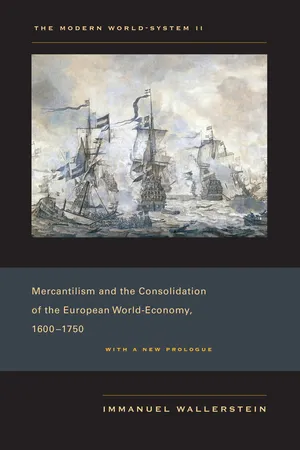 eBook - PDF
The Modern World-System II
Mercantilism and the Consolidation of the European World-Economy, 1600–1750
- Immanuel Wallerstein(Author)
- 2011(Publication Date)
- University of California Press(Publisher)
322 See Craig (1955, 16) and Braun (1975, 273). 323 i'he w intry economic climate of the later seventeenth century provided another incentive for the landowning class to rally to the political edifice of princely power that was now going up in the Hohenzollern lands (P. Anderson, 1974a, 243). 324 Above all, Prussia was terribly devastated [in the Northern War] by the marches of ill-disciplined troops, by booty, burning, and foreign invasion (Carsten, 1954, 208). Of course, Brandenburg and Cleves had already been devastated in the Thirty Years' War. 325 Mehring speaks of the sandy patrimonies in the Mark and Pomerania and points out that for the Junkers, every new company was as good as a new estate, earning them, even without swin-dling, an annual income of a few thousand thalers (1975, 54). 32fi Rosenberg (1958, 102). Mehring notes how the army established by the Great Elector solved the problem of a wandering lumpeiiproletariat created by the Thirty Years' War as well as the problem of the poor nobility known as the Krippenreiter, knights on wooden horses. They became soldiers and officers respectively (1975, 48—49). See also Craig (1955, 11). Rosenberg points out that the role of the army in the promotion of the poor nobility was interrupted in the reign of Frederick I (1688-1733), by the incorporation of Huguenots and German commoners into officer rank, but was re-sumed under the soldier-king, Frederick William I, w r ho methodically neutralized the political restless-ness, allayed the fears, and reconciled most of the Junker class to the growth of autocratic central power by inviting the noble 'reserve army' to regain a secure and highly honored position in society by joining the ranks of the professional service aristoc-racy (1958, 59-60). 327 A. J. P. Taylor asserts that the virtues of effi-ciency and hard work were the very virtues pos-sessed by the Junkers and not possessed to the same degree by the German burghers of the eighteenth century (1946, 29). eBook - ePub
- Maxwell Garnett, H. F. Koeppler(Authors)
- 2019(Publication Date)
- Routledge(Publisher)
* He finally undermined his own position by attempting to restrict the political influence of the army. His fall was therefore brought about by all that was powerful at the imperial court: the big landowners, the Junker party and the army. Parliament had no voice.* See first footnote on p. 271 belowThe new course pursued in economic policy resulted in a close alliance between the original, or agrarian, Junkers and those industrialists who came to share the political outlook of the Prussian squirearchy and whom, as was explained in Chapter 23 ,* we find it appropriate to describe as industrial Junkers.In all countries the period from 1890 to 1914 was on the whole one of unparalleled prosperity. Yet, in Germany, most people became convinced that this prosperity was solely due to Bismarck’s great achievement of German unity. People had desired unity for idealistic reasons. Now it seemed also to have brought great economic advantages. It was not surprising that a good number of the middle class whose ancestors had been passionately opposed to Bismarck’s methods now came to regard them with respect and even with affection.The political consequences of such an attitude were disastrous. The great majority of the German people felt helpless to oppose the machinery which governed them. It was an all-powerful machinery controlled by the Junkers in army, bureaucracy, agriculture and industry. The most important agent of the Junker influence became the army.The personality of the Emperor William II contributed to this influence. ‘When the diplomatists failed to bring about a political agreement with England, the Kaiser felt confirmed in the (to him) congenial belief that the military had better judgment even in political matters, and that the civilians were really no use whatever.’† This belief was so absurdly self-confident that he could say in 1908 to Sir Charles Hardinge, British Under-Secretary for Foreign Affairs: ‘Your material is all wrong! I am an Admiral of the English Fleet which I know very well and understand better than you who are a civilian.’** eBook - ePub
Articulating Hidden Histories
Exploring the Influence of Eric R. Wolf
- Jane Schneider, Rayna Rapp, Jane Schneider, Rayna Rapp(Authors)
- 1995(Publication Date)
- University of California Press(Publisher)
tocracy follows a general trend toward a positive revaluation of the services rendered by ancien régime elites toward so-called modernization. Although there has been some dissent against this trend in the case of the French aristocracy (McPhee 1989), the historical performance of the Junker is once again perceived as it was over a century ago by both conservative and nationalist-liberal traditions (Carsten 1947, 145; Hintze 1975) as an unequivocally positive contribution to Germany’s development.Writing as witness to the fall of the Prussian-based German empire, the great liberal institutional historian Otto Hintze accused the socialist historians of being the only opponents of a positive valuation of the Junker. However, there was also a strong scholarly critique of the Prussian aristocracy from another liberal source in the historical sociology of Max Weber and, more recently, in the work of historians Hans Rosenberg, Otto Büsch, and others. This view also represents an early and negative cost-benefit perspective on the Junker’s “modernizing” contributions. Weber’s fundamental observation was that the Prussian aristocracy’s drive as a class for economic supremacy destroyed the possibility for East Elbian peasants and townsmen to exercise any seriously competitive market rationality (Weber 1958, 365— eBook - PDF
For King and Kaiser!
The Making of the Prussian Army Officer, 1860-1914
- Steven E. Clemente(Author)
- 1992(Publication Date)
- Praeger(Publisher)
Initial involvement, however, had not come voluntarily. The process bringing about the domination of the officer corps by the crown began during the reign of the Great Elector, Frederick William of Brandenburg (1640-1688), but was not com- pleted until well into the eighteenth century. The most effective leverage in initiating what was at first a forced partnership between ruler and aristoc- racy came with the ruling by the Elector's courts that the Junkers' estates constituted a portion of the royal domain(4). Subsequent rulers (kings after 1701) realized the potential of the court rulings and used the resul- tant confusion and growing impoverishment of many Junker families to force noble sons into the officer ranks. The aristocracy protested at first. But in recognition of this loss of independence, the crown granted them status as the first estate of the land and material as well as social privileges. The most important concession, however, came during the reign of Frederick the Great (1740-1786) when the claim of royal prerogative over the Junker estates was abrogated and full right of ownership restored. In return for these concessions the King expected, and received, "feudal loyalty" (Vasallentreue) and a perennial supply of nobles for his officer corps. As the other nations of western Europe gradually abandoned feudalism, Prussia continued to base its officer corps on the traditional concept of a vassal's bond to his lord. This allegiance to the king above all else remained the distinguishing characteristic of the Prussian corps until the fall of the monarchy in 1918(5). At first the Junkers preferred to send their sons to the cavalry regiments, and these units remained noble enclaves. But many aristocrats could not afford the increased personal expense entailed in the offi- cer's purchase and maintenance of horse and equipment. An acceptable alternative was found in the infantry and light artillery, especially the elite Guards regiments.
Index pages curate the most relevant extracts from our library of academic textbooks. They’ve been created using an in-house natural language model (NLM), each adding context and meaning to key research topics.

